



 本文深入讲解链表的各种操作,包括正向打印、反向打印、删除节点、查找倒数第K个节点、寻找中间节点、判断是否有环及环入口、链表反转、合并排序链表等,提供多种实现思路如递归、栈、双指针等。
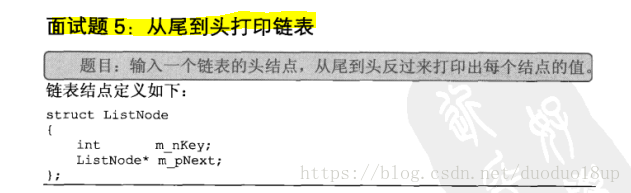
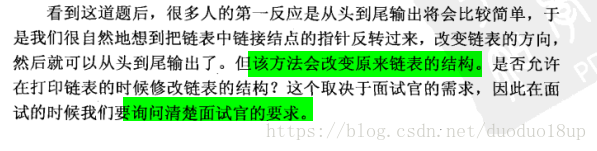
从头到尾打印链表
/**
*    public class ListNode {
*        int val;
*        ListNode next = null;
*
*        ListNode(int val) {
*            this.val = val;
*        }
*    }
*
*/
/*用栈的思路去解决*/
import java.util.Stack;
import java.util.ArrayList;
public class Solution {
    public ArrayList<Integer> printListFromTailToHead(ListNode listNode) {    //返回一个list
        if(listNode == null){                                                 //头节点为空的情况
            ArrayList<Integer> list = new ArrayList<Integer>();
            return list;
        }
        Stack<Integer> stk = new Stack<Integer>();
        while(listNode != null){                                             //入栈
            stk.push(listNode.val);
            listNode = listNode.next;
        }
        ArrayList<Integer> arr = new ArrayList<Integer>();
        while(!stk.isEmpty()){
            arr.add(stk.pop());                                             //出栈并记录
        }
        return arr;
    }
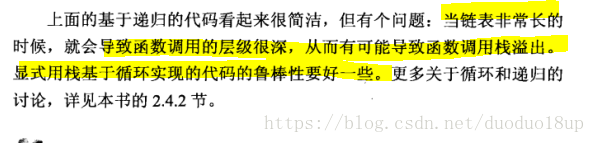
}/*用递归的思路解决*/import java.util.ArrayList;
public class Solution {
public ArrayList<Integer> printListFromTailToHead(ListNode listNode) {
if(listNode == null){
ArrayList<Integer> list = new ArrayList<Integer>();
return list;
}
ArrayList<Integer> list = new ArrayList<Integer>();
if(listNode.next!=null){
list=this.printListFromTailToHead(listNode.next); //每次递归记录
}
list.add(listNode.val);
return list;
}
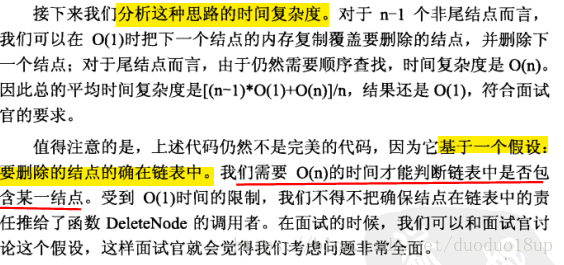
在O(1)时间删除链表节点

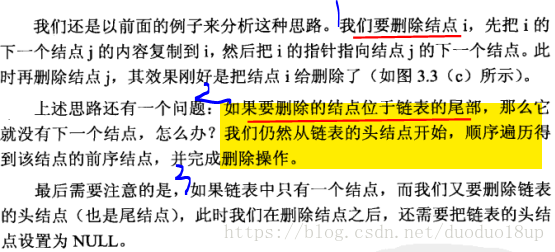
public static void deleteNode(Node head,Node delNode) {
		if(head==null || delNode==null) {
			return;
		}

		if(delNode.next!=null) {     			//删除节点下一节点不为空(正常情况)
			delNode.data=delNode.next.data;  	 //把有用信息拷贝过去
			delNode.next=delNode.next.next;  	 //删除含有delNode信息的节点
		}else if(head==delNode) {               //要删除的是只有一个元素的头节点
			head=null;
		}else {                                 //删除节点是尾节点(顺序遍历)
			Node cur=head;
			while(cur.next!=delNode) {          //找到删除节点的上一个节点
				cur=cur.next;
			}
			cur.next=null;                       //删除尾节点
		}
	}
相关题目:
如何在不知道头节点的情况下删除节点
1.若节点是尾节点,则无法删除 ,无法使其上一节点next置为空
2 .若节点不是尾节点 则如上 换值删除即可
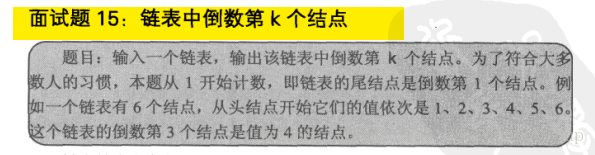
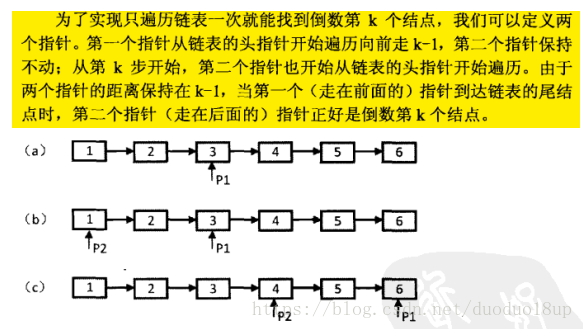
链表中倒数第K个节点
可能存在的问题和鲁棒性考虑:
public ListNode FindKthToTail(ListNode head,int k) {
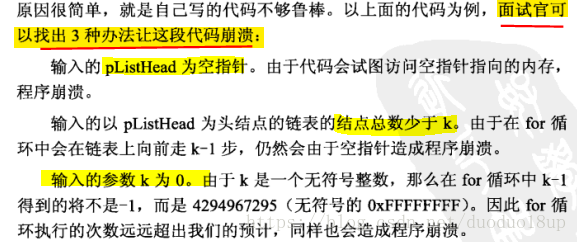
        if(head==null || k==0)                   //对于输入进行鲁棒性检测
            return null;
        ListNode p1=head;
        ListNode p2=head;
        for(int i=1;i<k;i++){
            if(p1.next!=null)
                p1=p1.next;
            else
                return null;                   //总长度<k
        }
        while(p1.next!=null){
            p1=p1.next;
            p2=p2.next;
        }
        return p2;
    }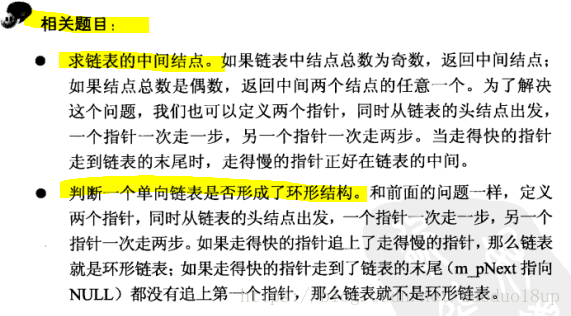
题目1:求中间节点(记住要考虑下一节点-->下下节点是否为空) 考虑奇数和偶数的情况
public Node searchMid(Node head) {
		//定义两个指针 一个一步 一个两步
		if(head==null)
			return null;
		Node p1=head;
		Node p2=head;
		//注意判断条件
		while(p1.next!=null && p1.next.next!=null) {
			p1=p1.next.next;
			p2=p2.next;
		}
		return p2;
}public boolean searchMid(Node head) {
//定义两个指针 一个一步 一个两步
if(head==null)
return false;
Node p1=head;
Node p2=head;
//注意判断条件
while(p1!=null && p1.next!=null ) {
p1=p1.next.next;
p2=p2.next;
if(p1==p2)
return true;
}
return !(p1==null ||p1.next==null );
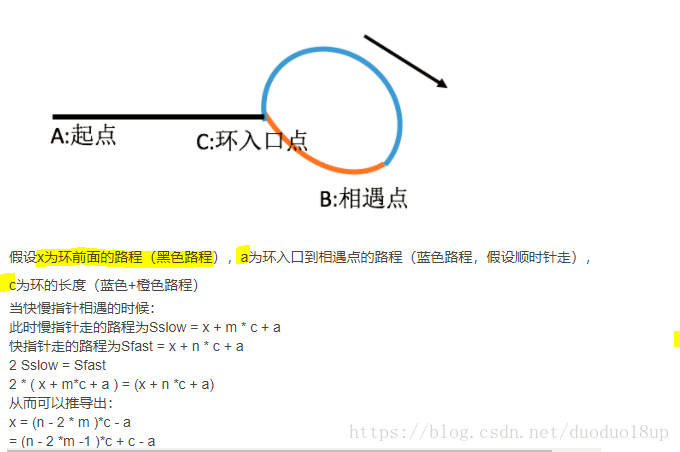
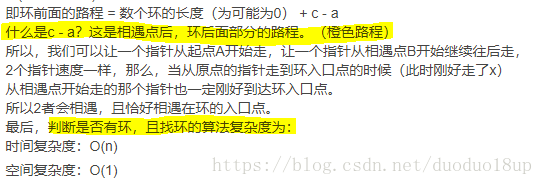
}环的入口:相遇时p2没有遍历完链表----p1已经循环了>1圈 相遇之后p1回到头节点,p2依然在相遇点-----两个均同步走一步----相遇第一点即为环入口点
public Node searchMid(Node head) {
		//定义两个指针 一个一步 一个两步
		if(head==null || head.next==null)
			return null;
		Node p1=head;
		Node p2=head;
		//注意判断条件
		while(p1!=null && p1.next!=null ) {
			p1=p1.next.next;
			p2=p2.next;
			if(p1==p2)
				break;
		}

		if(p1==null ||p1.next==null)
			return null;       //无环

		p1=head;              //回到头节点
		while(p1!=p2) {       //找相遇点
			p1=p1.next;
			p2=p2.next;
		}
		return p2;
	}
推导环的入口:
反转链表

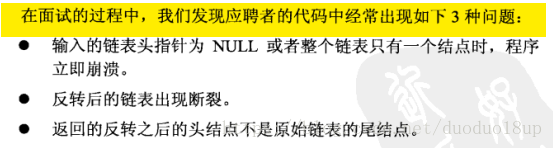
1. 递归的方法其实是非常巧的,它利用递归走到链表的末端,然后再更新每一个node的next 值 ,实现链表的反转。而newhead 的值没有发生改变,为该链表的最后一个结点,所以,反转后,我们可以得到新链表的head。
public ListNode ReverseList(ListNode head) {
        if(head==null || head.next==null)
            return head;

        ListNode Phead=ReverseList(head.next);   //递归的思想去解决该问题
        head.next.next=head;
        head.next=null;

        return Phead;
    }
2. 常规 定义3个指针节点
        if(head==null)
            return null;
        if(head.next==null){
            return head;
        }

        //定义三个指针节点
        ListNode Phead=null;
        ListNode Ppre=null;
        ListNode Pcur=head;

        while(Pcur!=null){
            ListNode Pnext=Pcur.next;
            if(Pnext==null)
                Phead=Pcur;
            Pcur.next=Ppre;
            Ppre=Pcur;
            Pcur=Pnext;
        }
        return Phead;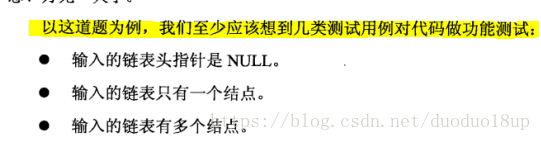
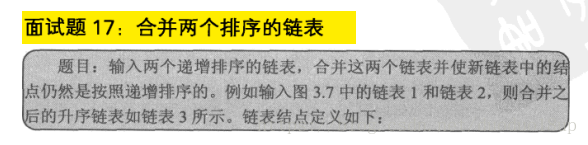
合并两个排序的链表
1. 简单递归思路:
public ListNode Merge(ListNode list1,ListNode list2) {
        //用递归的思路  每次选择两个链表中最小的节点 跟在新链表节点后面
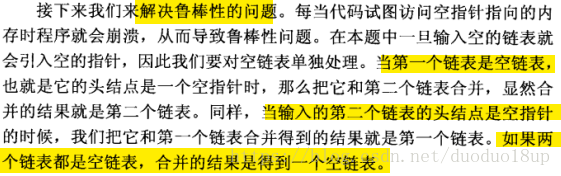
        if(list1==null)
            return list2;
        if(list2==null)
            return list1;
        if(list1==null && list2==null)
            return null;
        ListNode mergeHead=null;
        if(list1.val < list2.val){
            mergeHead=list1;
            mergeHead.next=Merge(list1.next,list2);
        }else{
            mergeHead=list2;
            mergeHead.next=Merge(list1,list2.next);
        }
        return mergeHead;
    }
2 正常思路:
public ListNode Merge(ListNode list1,ListNode list2) {
        if(list1 == null){
            return list2;
        }
        if(list2 == null){
            return list1;
        }
        ListNode mergeHead = null;   //合并链表头节点
        ListNode current = null;

        while(list1!=null && list2!=null){
            if(list1.val <= list2.val){
                if(mergeHead == null){   //若头节点为空
                   mergeHead = current = list1; //则此为第一个节点
                }else{
                   current.next = list1;         //正常节点则依次连接
                   current = current.next;
                }
                list1 = list1.next;              //右移节点
            }else{
                if(mergeHead == null){
                   mergeHead = current = list2;
                }else{
                   current.next = list2;
                   current = current.next;
                }
                list2 = list2.next;
            }
        }
        if(list1 == null){      //若list1节点合并完毕 则将list2剩余节点依次合并
            current.next = list2;
        }else{
            current.next = list1;
        }
        return mergeHead;
    }
复杂链表的复制
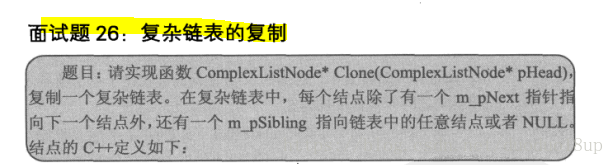
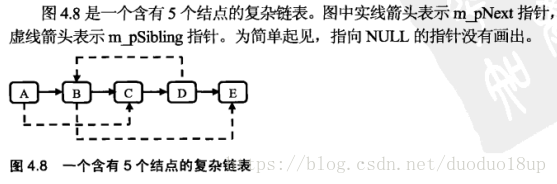
方法1 :先将正常的next进行链接,之后再找对应位置进行sibling的链接操作

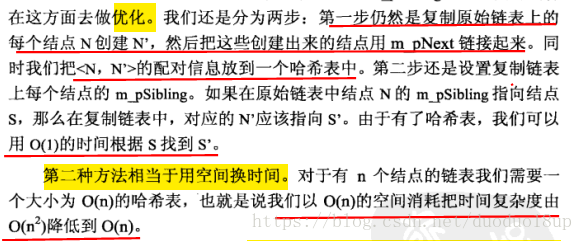
方法2 :优化查找sibling操作
import java.util.HashMap;
public class Solution {
    public RandomListNode Clone(RandomListNode pHead){
        if(pHead == null)
            return null;
        HashMap<RandomListNode, RandomListNode> map = new HashMap<RandomListNode, RandomListNode>();   //建立哈希表
        RandomListNode newHead = new RandomListNode(pHead.label);   //新链表头节点
        RandomListNode pre = pHead, newPre = newHead;
        map.put(pre, newPre);
        while(pre.next != null){
            newPre.next = new RandomListNode(pre.next.label);
            pre = pre.next;
            newPre = newPre.next;
            map.put(pre, newPre);
        }
        pre = pHead;
        newPre = newHead;
        while(newPre != null){
            newPre.random = map.get(pre.random);
            pre = pre.next;
            newPre = newPre.next;
        }
        return newHead;
    }
}
方法3 : 分治法
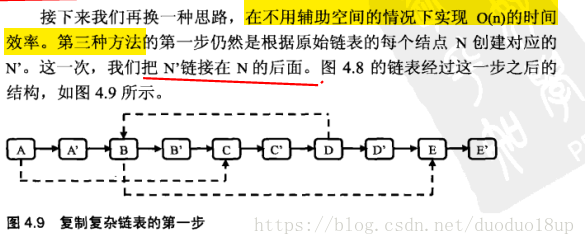
第一步
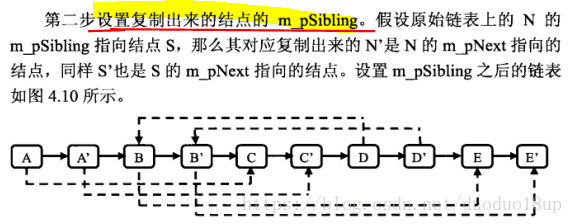
第二步
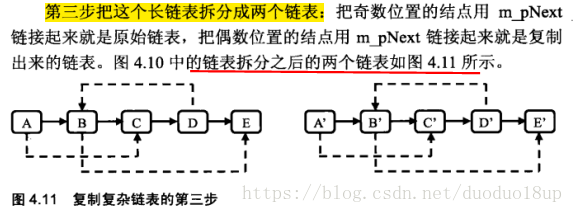
第三步
public class Solution {
    public RandomListNode Clone(RandomListNode pHead){
        if(pHead==null)
            return null;

        RandomListNode pCur = pHead;
        //复制next 如原来是A->B->C 变成A->A'->B->B'->C->C'
        while(pCur!=null){
            RandomListNode node = new RandomListNode(pCur.label);
            node.next = pCur.next;
            pCur.next = node;
            pCur = node.next;
        }

        pCur = pHead;   //重新恢复指向
        //复制random pCur是原来链表的结点 pCur.next是复制pCur的结点
        while(pCur!=null){
            if(pCur.random!=null)
                pCur.next.random = pCur.random.next;
            pCur = pCur.next.next;
        }

        //拆分链表
        RandomListNode head = pHead.next;      //复制链表头部 后期返回值
        RandomListNode cur = head;             //复制链表当前指向节点
        pCur = pHead;                          //原链表当前指向节点
        while(pCur!=null){                     /注意此时的判断条件
            pCur.next=pCur.next.next;
            if(cur.next!=null){                //判断是否到达null 没有节点  容易出错!!!
                cur.next=cur.next.next;
            }
            pCur=pCur.next;
            cur=cur.next;
        }
        return head;
    }
}
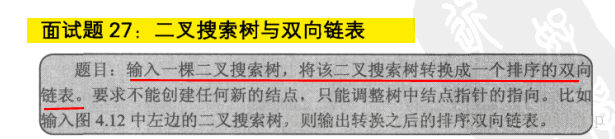
二叉搜索树与双向链表
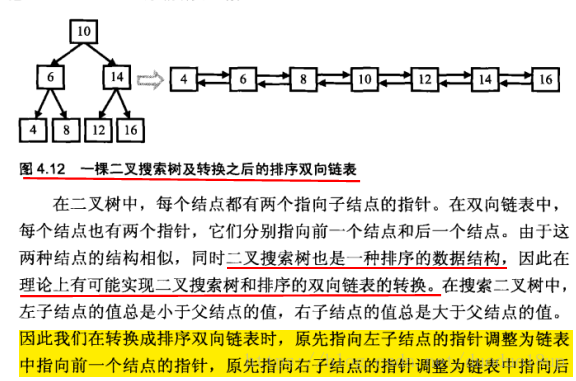
解法思路:
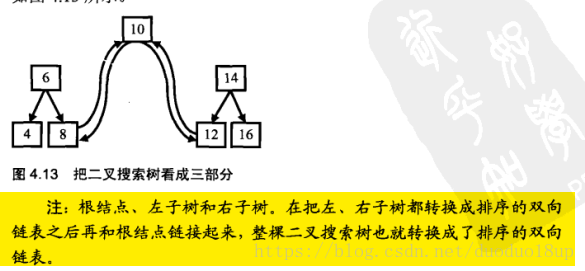
有3 种方法:
1 .非递归法(利用Stack实现)
中序遍历回顾:
import java.util.Stack;
public Node inOrderNotCur(Node root){
    if(root==null)
        return null;
    Stack<Node> s=new Stack<Node>();
    while(root!=null  || !s.isEmpty()){  //当前节点不为空或者栈不为空时
        if(root!=null){      //当前节点不为空时
            s.push(root);   //压入节点 并找寻左子节点  一直到达最左端节点 再开始出栈
            root=root.left;
        }else{              //当前节点没有左子节点  则开始出栈
            root=s.pop();
            System.out.println(root.data);   //打印弹出节点数据
            root=root.right;                 //压入当前节点的右子节点
        }
    }
}
使用“中序遍历”原理:
import java.util.Stack;
public class Solution {
    public TreeNode Convert(TreeNode root) {
        if(root==null)
            return null;
        Stack<TreeNode> stack = new Stack<TreeNode>();
        TreeNode p = root;
        TreeNode pre = null;                    // 用于保存中序遍历序列的上一节点
        boolean isFirst = true;               //标识链表的头节点
        while(p!=null || !stack.isEmpty()){
            while(p!=null){
                stack.push(p);
                p = p.left;
            }
            p = stack.pop();
            if(isFirst){                    //看是否是第一个节点  即链表的头节点
                root = p;                   // 将中序遍历序列中的第一个节点记为root
                pre = root;
                isFirst = false;
            }else{                         //不是链表的头节点
                pre.right = p;             //为每个弹出节点进行链表连接
                p.left = pre;
                pre = p;
            }
            p = p.right;
        }
        return root;
    }
}
2 .递归法
//方法二:递归版
//    解题思路:
//1.    将左子树构造成双链表,并返回链表头节点。
//2.    定位至左子树双链表最后一个节点。
//3.    如果左子树链表不为空的话,将当前root追加到左子树链表。
//4.    将右子树构造成双链表,并返回链表头节点。
//5.    如果右子树链表不为空的话,将该链表追加到root节点之后。
//6.    根据左子树链表是否为空确定返回的节点。
    public TreeNode Convert(TreeNode root) {
        if(root==null)
            return null;
        if(root.left==null&&root.right==null)
            return root;
        // 1.将左子树构造成双链表,并返回链表头节点
        TreeNode left = Convert(root.left);
        TreeNode p = left;
        // 2.定位至左子树双链表最后一个节点
        while(p!=null&&p.right!=null){
            p = p.right;
        }
        // 3.如果左子树链表不为空的话,将当前root追加到左子树链表
        if(left!=null){
            p.right = root;
            root.left = p;
        }
        // 4.将右子树构造成双链表,并返回链表头节点
        TreeNode right = Convert(root.right);
        // 5.如果右子树链表不为空的话,将该链表追加到root节点之后
        if(right!=null){
            right.left = root;
            root.right = right;
        }
        return left!=null?left:root;
}// 最喜欢的思路: 用全局变量去一直记录最后一个节点(按照中序遍历也就是最右节点)
// 方法三:改进递归版
// 解题思路:
// 思路与方法二中的递归版一致,仅对第2点中的定位作了修改,新增一个全局变量记录左子树的最后一个节点。 // 记录子树链表的最后一个节点,终结点只可能为只含左子树的非叶节点与叶节点
protected TreeNode leftLast = null;
public TreeNode Convert(TreeNode root) {
if(root==null)
return null;
if(root.left==null&&root.right==null){
leftLast = root; // 最后的一个节点可能为最右侧的叶节点
return root;
}
// 1.将左子树构造成双链表,并返回链表头节点
TreeNode left = Convert(root.left);
// 3.如果左子树链表不为空的话,将当前root追加到左子树链表
if(left!=null){
leftLast.right = root;
root.left = leftLast;
}
leftLast = root; // 当根节点只含左子树时,则该根节点为最后一个节点
// 4.将右子树构造成双链表,并返回链表头节点
TreeNode right = Convert(root.right);
// 5.如果右子树链表不为空的话,将该链表追加到root节点之后
if(right!=null){
right.left = root;
root.right = right;
}
return left!=null?left:root;
}两个链表的第一个公共节点
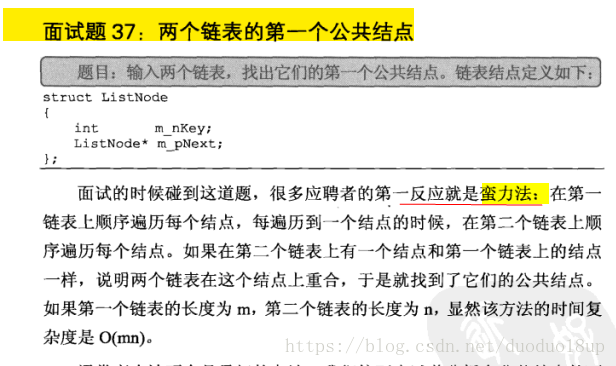
解法1 :蛮力法 时间复杂度O(mn)
解法2: 用栈来处理 倒序 时间复杂度O(m+n) 空间复杂度O(m+n)
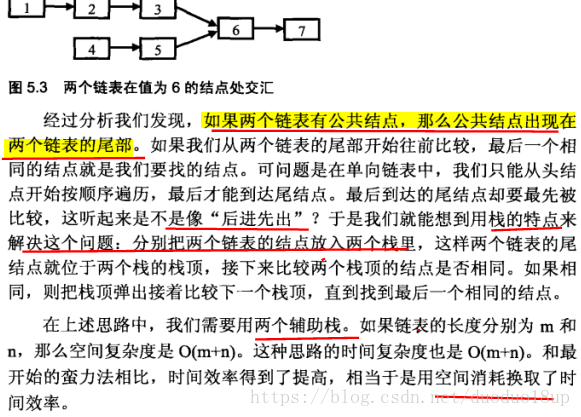
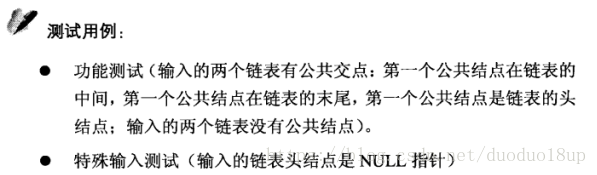
解法3: 遍历长度---长的先走--共同走--第一个相同点即为交点 时间复杂度O(m+n) 无额外空间

/*
public class ListNode {
    int val;
    ListNode next = null;

    ListNode(int val) {
        this.val = val;
    }
}*/
public class Solution {
    public ListNode FindFirstCommonNode(ListNode pHead1, ListNode pHead2) {
        if(pHead1==null || pHead2==null)
            return null;
        int len1=getListLength(pHead1);
        int len2=getListLength(pHead2);
        int dif=0;
        ListNode longNode=null;
        ListNode shortNode=null;
        if(len1>len2){
            dif=len1-len2;
            longNode=pHead1;
            shortNode=pHead2;
        }else{
            dif=len2-len1;
            longNode=pHead2;
            shortNode=pHead1;
        }

        for(int i=0;i<dif;i++){
           longNode=longNode.next;   //较长端先走
        }

        //开始一起走
        while(longNode!=null && shortNode!=null && longNode!=shortNode){
            longNode=longNode.next;
            shortNode=shortNode.next;
        }

        //走到相同点
        return longNode;
    }
    //长度统计
    public int getListLength(ListNode node){
        int count=1;
        while(node.next!=null){
            count++;
            node=node.next;
        }
        return count;
    }
}
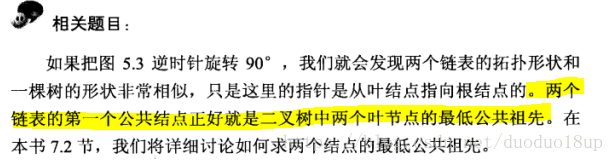
输入两个树节点 求他们的最低公共祖先

几个逐渐思考的过程:
1 这个树是否是二叉树? 二叉排序树?
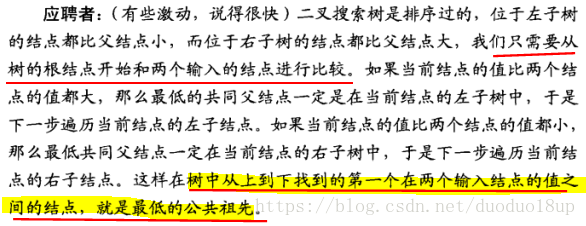
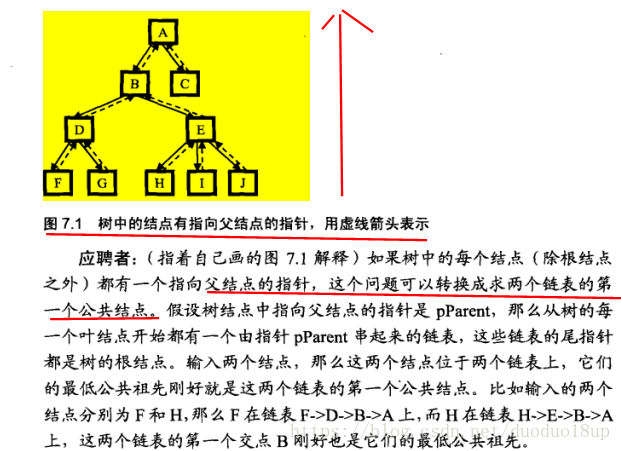
2 此树只是普通的树,连二叉树可能都不是 ,则问? 是否每个节点有指向父节点的指针?
这样 则可以转化为两个链表的第一个公共节点问题----
3 此树只是普通的树,连二叉树可能都不是 且每个节点没有指向父节点的指针
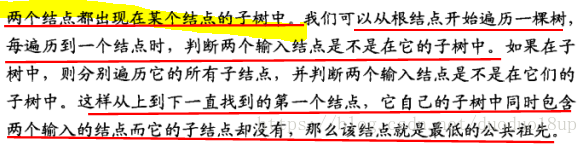
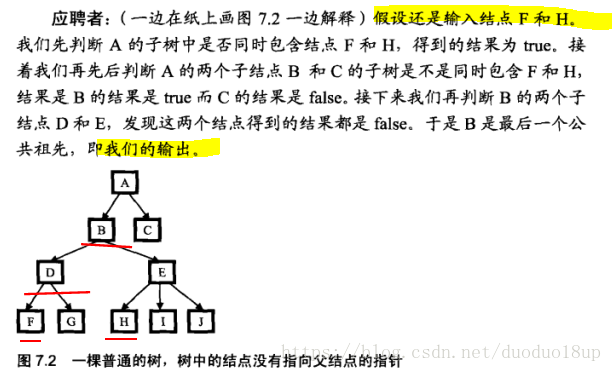
4 可能会有重复的计算 判断A的子节点---判断B的子节点

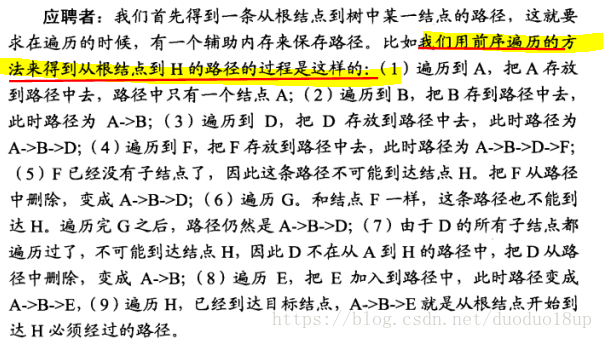
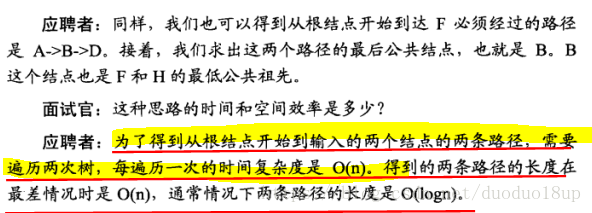
最终我简化问题:
在二叉树中找到两个节点的最近公共祖先
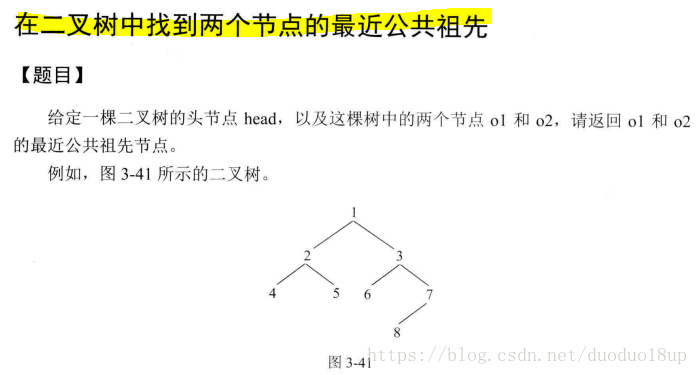
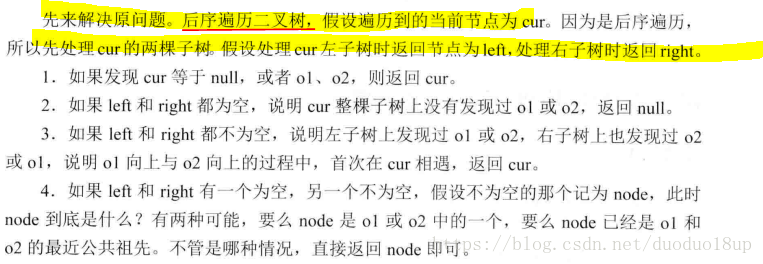
//在二叉树中找到两个节点的最近公共祖先
public class firstAncestor {
	public Node firstAncestor (Node head, Node h1,Node h2) {
		if(head==null || head==h1 ||head==h2 )
			return head;
		Node left=firstAncestor(head.left, h1,h2);
		Node right=firstAncestor(head.right,h1,h2);
		if(left!=null && right!=null) {
			return head;
		}
		return left!=null ? left:right;
	}
}
删除链表中重复的节点:
在一个排序的链表中,存在重复的结点,请删除该链表中重复的结点,重复的结点不保留,返回链表头指针。 例如,链表1->2->3->3->4->4->5 处理后为 1->2->5
方法1 :采用递归的方法(最简便) 时间0(n)
public class Solution {
    public ListNode deleteDuplication(ListNode pHead) {
        if (pHead == null || pHead.next == null) {       // 只有0个或1个结点,则返回
            return pHead;
        }
        if (pHead.val == pHead.next.val) {                 // 当前结点是重复结点
            ListNode pNode = pHead.next;
            while (pNode != null && pNode.val == pHead.val) {
                                                          // 跳过值与当前结点相同的全部结点,找到第一个与当前结点不同的结点
                pNode = pNode.next;
            }
            return deleteDuplication(pNode);             // 从第一个与当前结点不同的结点开始递归
        } else { // 当前结点不是重复结点
            pHead.next = deleteDuplication(pHead.next);     // 保留当前结点,从下一个结点开始递归
            return pHead;
        }
    }
}
方法2 : 采用常规循环方法 对应3个指针进行移动
public class Solution {
    public ListNode deleteDuplication(ListNode pHead){
        ListNode first=new ListNode(Integer.MIN_VALUE);  //创建一个新的头节点,主要是怕原头节点重复,需要删除
        ListNode last=first;                             //定义一个当前节点的上一节点  以后期删除节点之后连接之后的节点
        first.next=pHead;
        while(pHead!=null && pHead.next!=null){          //考虑当前节点和下一节点均不为空   否则返回的是pHead
            if(pHead.val==pHead.next.val){         //如果当前节点和下一节点的值相同
                int temp=pHead.val;
                while(pHead!=null && pHead.val==temp){   //则不断向后移动找到与当前节点值不同的节点
                    pHead=pHead.next;
                }
                last.next=pHead;                      //删除重复节点,与之前节点进行连接
            }else{
                last=pHead;                     //如果当前节点和下一节点并不相同
                pHead=pHead.next;               //则前一节点和当前节点均向后移动一位
            }
        }
        return first.next;           //最终返回新建头节点之后的节点即可
    }
}





 扫一扫
扫一扫


 321
321

 被折叠的 条评论
为什么被折叠?
被折叠的 条评论
为什么被折叠?
 到【灌水乐园】发言





