





 本文探讨了一种特定的游戏守卫问题,即如何在给定的树形结构中放置最少数量的士兵以便能够观察到所有的边。通过动态规划的方法,我们提供了一个高效的解决方案,并给出了具体的代码实现。
Bob enjoys playing computer games, especially strategic games, but sometimes he cannot find the solution fast enough and then he is very sad. Now he has the following problem. He must defend a medieval city, the roads of which form a tree. He has to put the minimum number of soldiers on the nodes so that they can observe all the edges. Can you help him?
Your program should find the minimum number of soldiers that Bob has to put for a given tree.
For example for the tree:
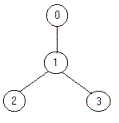
the solution is one soldier (at the node 1).
Input
The input file contains several data sets in text format. Each data set represents a tree with the following description:The node identifiers are integer numbers between 0 and n-1, for n nodes (0 < n ≤ 1500). Every edge appears only once in the input data.
- the number of nodes
- the description of each node in the following format:
node_identifier:(number_of_roads) node_identifier1 node_identifier2 � node_identifiernumber_of_roads
or
node_identifier:(0)
Output
The output should be printed on the standard output. For each given input data set, print one integer number in a single line that gives the result (the minimum number of soldiers).Sample Input
4
0:(1) 1
1:(2) 2 3
2:(0)
3:(0)
5
3:(3) 1 4 2
1:(1) 0
2:(0)
0:(0)
4:(0)
Sample Output
1
2
-------------
f[i][0]表示点i属于点覆盖,并且以点i为根的子树中所连接的边都被覆盖的情况下点覆盖集中所包含的最少点数。
f[i][1]表示点i不属于点覆盖,且以i为根的子树中所连接的边都被覆盖的情况下点覆盖集中所包含最少点的个数。
① f[i][0]=1+sum{ min(f[v][0], f[v][1]) };
② f[i][1]=sum{ f[v][0] };
-------------
#include <iostream>
#include <cstdio>
#include <cstring>
#include <algorithm>
#include <cmath>
using namespace std;

const int maxn=3111;
const int INF=1e9;

struct EDGENODE
{
    int to,next;
} edges[maxn];
int head[maxn],edge;
void addedge(int u,int v)
{
    edges[edge].to=v,edges[edge].next=head[u],head[u]=edge++;
    edges[edge].to=u,edges[edge].next=head[v],head[v]=edge++;
}
void init_edges()
{
    memset(head,-1,sizeof(head));
    edge=0;
}
int n;
int f[maxn][2];
void dp(int u,int pa)
{
    f[u][0]=1;
    f[u][1]=0;
    for (int k=head[u]; k!=-1; k=edges[k].next)
    {
        int v=edges[k].to;
        if (v==pa) continue;
        dp(v,u);
        f[u][0]+=min(f[v][0],f[v][1]);
        f[u][1]+=f[v][0];
    }
}

int main()
{
    while (~scanf("%d",&n))
    {
        int u,v,t;
        init_edges();
        for (int i=0; i<n; i++)
        {
            scanf("%d:(%d)",&u,&t);
            while (t--)
            {
                scanf("%d",&v);
                addedge(u,v);
            }
        }
        dp(0,-1);
        printf("%d\n",min(f[0][0],f[0][1]));
    }
    return 0;
}





 扫一扫
扫一扫


 327
327

 被折叠的 条评论
为什么被折叠?
被折叠的 条评论
为什么被折叠?
 到【灌水乐园】发言





