


Squares and rectangles fascinated the famous Dutch painter Piet Mondriaan. One night, after producing the drawings in his 'toilet series' (where he had to use his toilet paper to draw on, for all of his paper was filled with squares and rectangles), he dreamt
of filling a large rectangle with small rectangles of width 2 and height 1 in varying ways.

Expert as he was in this material, he saw at a glance that he'll need a computer to calculate the number of ways to fill the large rectangle whose dimensions were integer values, as well. Help him, so that his dream won't turn into a nightmare!
Expert as he was in this material, he saw at a glance that he'll need a computer to calculate the number of ways to fill the large rectangle whose dimensions were integer values, as well. Help him, so that his dream won't turn into a nightmare!
Input
The input contains several test cases. Each test case is made up of two integer numbers: the height h and the width w of the large rectangle. Input is terminated by h=w=0. Otherwise, 1<=h,w<=11.
Output
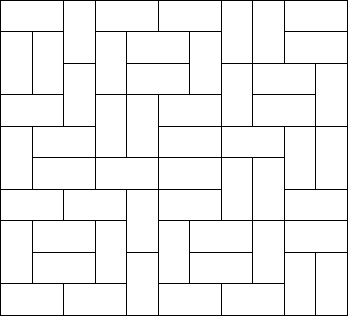 For each test case, output the number of different ways the given rectangle can be filled with small rectangles of size 2 times 1. Assume the given large rectangle
is oriented, i.e. count symmetrical tilings multiple times.
Sample Input
1 2
1 3
1 4
2 2
2 3
2 4
2 11
4 11
0 0
Sample Output
1
0
1
2
3
5
144
51205
用2进制的01表示不放还是放
<p>第i行只和i-1行有关</p><p><pre name="code" class="cpp">#include<iostream>
#include<algorithm>
#include<string>
#include<map>
#include<vector>
#include<cmath>
#include<string.h>
#include<stdlib.h>
#include<cstdio>
#define ll long long
using namespace std;
ll dp[15][1<<11]; //表示第i行为某种状态的时候(为止)已经有多少种方法数
ll n,m,tem; //n行m列,tem表示方法数
void dfs(int i,int p,int k){ //i:第几行,p:用二进制表示的当前这一行各个位置状态,k:第几列
	if(k>=m){
		dp[i][p]+=tem;
		return;}
	dfs(i,p,k+1);
	if(k<=m-2&&!(p&1<<k)&&!(p&1<<k+1)) //如果该行连续两列都为0,则可以选择添加一个横砖
		dfs(i,p|1<<k|1<<k+1,k+2);} //p|1<<k|1<<k+1表示把该行这两个位置置1
int main(){
	while(cin>>n>>m&&n!=0&&m!=0){
		memset(dp,0,sizeof(dp));
		tem=1;
		dfs(1,0,0);
		for(int i=2;i<=n;++i){
			for(int j=0;j<(1<<m);++j){
				if(dp[i-1][j]>0){
					tem=dp[i-1][j];
					dfs(i,~j&((1<<m)-1),0);}}} //~j&((1<<m)-1)所有位置取反
		cout<<dp[n][(1<<m)-1]<<endl;} //输出最后一行所有位置的数都是1的情况
	return 0;
}


 1120


 扫一扫


 被折叠的 条评论
为什么被折叠?
 到【灌水乐园】发言


