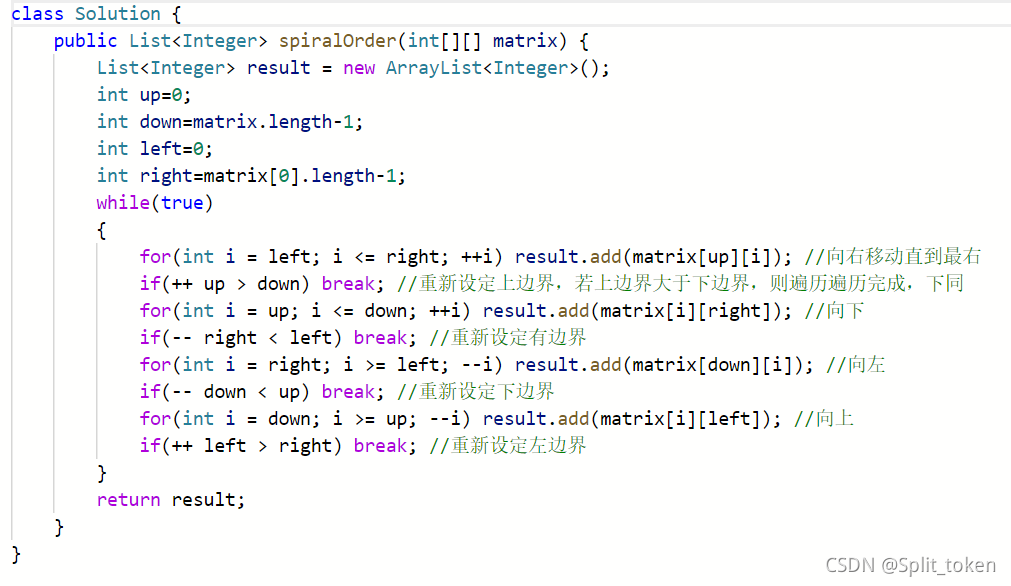
1、首先设定上下左右边界
2、其次向右移动到最右,此时第一行因为已经使用过了,可以将其从图中删去,体现在代码中就是重新定义上边界
3、判断若重新定义后,上下边界交错,表明螺旋矩阵遍历结束,跳出循环,返回答案
4、若上下边界不交错,则遍历还未结束,接着向下向左向上移动,操作过程与第一,二步同理
5、不断循环以上步骤,直到某两条边界交错,跳出循环,返回答案
简而言之,就是一层一层剥离出来!


 墨衍会员
·
AI 创作全网分发
墨衍智能分发
本文由作者通过墨衍一键同步至各平台
1分发平台
200+累计阅读
241平均单平台
已同步平台
优快云
微信公众号
微博
知乎
掘金
百家号
博客园
抖音
小红书
你的文章也可以这样分发
墨衍会员 ¥399起/年,写一次发全网
我也要
1、首先设定上下左右边界
2、其次向右移动到最右,此时第一行因为已经使用过了,可以将其从图中删去,体现在代码中就是重新定义上边界
3、判断若重新定义后,上下边界交错,表明螺旋矩阵遍历结束,跳出循环,返回答案
4、若上下边界不交错,则遍历还未结束,接着向下向左向上移动,操作过程与第一,二步同理
5、不断循环以上步骤,直到某两条边界交错,跳出循环,返回答案
简而言之,就是一层一层剥离出来!
【中等】力扣算法题解析LeetCode54:螺旋矩阵
本文介绍了一种模拟顺时针螺旋遍历矩阵的算法。通过维护四个动态边界(上、下、左、右),依次处理矩阵的外层元素后向内收缩边界,直至覆盖所有元素。算法时间复杂度为O(m×n),空间复杂度O(1)(不含结果存储)。Java实现中预分配结果列表容量,并通过循环条件确保无重复访问。该解法高效直观,适用于任意m×n矩阵的螺旋遍历需求。
python破解滑动解锁_selenium+python自动化102-登录页面滑动解锁(ActionChains)
前言登录页面会遇到滑动解锁,滑动解锁的目的就是为了防止别人用代码登录(也就是为了防止你自动化登录),有些滑动解锁是需要去拼图这种会难一点。有些直接拖到最最右侧就可以了,本篇讲下使用 selenium web 自动化的时候如何滑动解锁。滑动解锁场景看下图,是我本地写的一个 slider.html 网页除了输入账号和密码,还需将滑块拖动到最右端才能解锁最后才去点登陆按钮ActionChains 滑动滑...
中孚保密检查系统彻底卸载指南:绕过口令与清除内核残留
中孚保密检查系统是深度集成于Windows内核的合规管控软件,其卸载涉及用户态口令校验、内核态服务引擎与Ring 0级驱动自保三重机制。理解其基于SHA-256哈希的本地口令验证原理和zfsysflt.sys过滤驱动的加载逻辑,是实现无残留清理的技术前提。该系统具备高权限驻留特性,常规卸载工具无法触达驱动与服务层,易引发蓝屏、启动缓慢及新安全软件冲突等工程问题。典型应用场景包括涉密终端批量清退、安全研究环境重建及误装后紧急退出。本文聚焦‘口令绕过+手动清理’双轨方案,覆盖注册表、服务、驱动、文件与计划任务五
力扣54. 螺旋矩阵
1.题目 给你一个 m 行 n 列的矩阵 matrix ,请按照 顺时针螺旋顺序 ,返回矩阵中的所有元素。题目 2.思路 这是一道模拟题,按照螺旋的方式遍历二维数组即可。首先需要获取二维矩阵的行列值m、n。然后用一个同样大小的二维矩阵标记螺旋访问时走过的位置,循环遍历按照:1.右移;2下移;3.左移;4上移。.移动时需要判断是否到达边界和该位置是否已经访问过。循环的结束条件可以时移动的次数<m*n。 这里的重点是边界判断。 代码 class Solution { public: vect
若依(RuoYi)项目里,Quartz定时任务踩坑实录:并发控制、事务回滚与异常处理
本文深入解析若依(RuoYi)项目中Quartz定时任务的并发控制、事务回滚与异常处理三大核心问题。通过实战案例揭示@DisallowConcurrentExecution注解的局限性和Redis分布式锁的应用,详细讲解Spring事务集成方案及多数据源事务管理,并提供生产级监控体系搭建指南,帮助开发者规避Quartz在生产环境中的常见陷阱。
高通thermal-engine.conf配置详解:从虚拟传感器到CPU频率控制的完整指南
本文深入解析了高通thermal-engine.conf配置文件的架构与调优方法。从虚拟传感器的加权融合原理,到监控算法与CPU频率控制的多级策略,提供了完整的配置详解与实战调试指南。文章旨在帮助开发者与高级用户掌握底层温控逻辑,在性能与散热间实现精准平衡,并详细介绍了日志调试与场景化配置等高级技巧。
LeetCode 54. 螺旋矩阵 C++描述
LeetCode 54. 螺旋矩阵 C++描述 难度:中等 给定一个包含 m x n 个元素的矩阵(m 行, n 列),请按照顺时针螺旋顺序,返回矩阵中的所有元素。 示例 1: 输入: [ [ 1, 2, 3 ], [ 4, 5, 6 ], [ 7, 8, 9 ] ] 输出: [1,2,3,6,9,8,7,4,5] 示例 2: 输入: [ [1, 2, 3, 4], [5, 6, 7, 8], [...
如何在n8n中高效调用playwright-mcp实现浏览器自动化(附避坑指南)
本文详细介绍了在n8n中高效集成playwright-mcp实现浏览器自动化的全流程指南,包括环境准备、工作流设计与优化、高级技巧与性能调优以及调试与问题排查。通过克服实际部署中的各种挑战,帮助用户打造稳定高效的自动化解决方案,特别适合需要浏览器自动化的工作流场景。
【leetcode54】螺旋矩阵
题目描述 力扣54.螺旋矩阵 难度:中等 . 给你一个 m 行 n 列的矩阵 matrix ,请按照 顺时针螺旋顺序 ,返回矩阵中的所有元素。 示例 1: 输入:matrix = [[1,2,3],[4,5,6],[7,8,9]] 输出:[1,2,3,6,9,8,7,4,5] 示例 2: 输入:matrix = [[1,2,3,4],[5,6,7,8],[9,10,11,12]] 输出:[1,2,3,4,8,12,11,10,9,5,6,7] 代码: package main func spira
飞牛fnNAS同步微信微信聊天记录
微信聊天记录如何备份到NAS?本文介绍了利用NAS虚拟机和同步工具实现微信记录自动备份的方法。通过在NAS上搭建"云电脑"长期运行微信PC端,并配置微力同步将聊天记录文件夹自动同步到NAS存储,解决了传统电脑备份的安全性问题。操作步骤包括:1)在NAS上安装虚拟机系统;2)登录微信PC端并同步手机记录;3)配置同步工具将微信记录文件夹同步到NAS。该方法尤其适合不常使用PC微信的用户,可实现记录永久保存和远程查看,更换手机时也能快速恢复历史记录。
人像美肤 人体美型 CVPR 2022 ABPN
人像美肤 CVPR 2022 ABPN
LeetCode 力扣 54. 螺旋矩阵
题目描述(中等难度) 从第一个位置开始,螺旋状遍历二维矩阵。 解法一 可以理解成贪吃蛇,从第一个位置开始沿着边界走,遇到边界就转换方向接着走,直到走完所有位置。 /* * direction 0 代表向右, 1 代表向下, 2 代表向左, 3 代表向上 */ public List<Integer> spiralOrder(int[][] matrix) { List&l...
[AI] 企业内网部署大模型的三种常见方案:从“能用”到“好用”的技术选型指南
企业内网部署大模型的三种方案解析:本地模型安全但门槛高,平台方案(如Dify)最平衡推荐,混合架构适合进阶需求。关键路径是渐进式演进,从快速验证到平台化建设,核心在于流程优化而非单纯选模型。数据安全、成本可控和工程落地能力是决策重点。
LeetCode 54螺旋矩阵
LeetCode 54螺旋矩阵 给定一个包含 m x n 个元素的矩阵(m行, n列),请按照顺时针螺旋顺序,返回矩阵中的所有元素。 示例 输入: [ up left [1,2,3], [4,5,6], [7,8,9], right down ] 输出:[1,2,3,6,9,8,7,4,5] 思路:四指针扫描O(n2) 从左到右访问第一行,left++ 从上到下访问最后一列,up-- 从右往左访问最后一
在Grafana中合并加入两个指标值在table中展示
【代码】在Grafana中合并加入两个指标值在table中展示。
jre9下载 jdk9
(Java SE Runtime Environment 9.0) 9.0u175 官方最新版 【x86|x64】
力扣第 54 题: 螺旋矩阵
要求从矩阵的左上角开始,按顺时针方向逐层遍历矩阵中的所有元素,并以一维数组的形式返回结果。解决,通过维护矩阵的边界(上下左右四个方向)来实现螺旋顺序的输出。力扣第 54 题 ——测试用例中定义了一个。
深度学习工具包 DeepLearningToolbox
深度学习工具包Deprecation notice.-----This toolbox is outdated and no longer maintained.There are much better tools available for deep learning than this toolbox, e.g. [Theano](http://deeplearning.net/software/theano/), [torch](http://torch.ch/) or [tensorflow](http://www.tensorflow.org/)I would suggest you use one of the tools mentioned above rather than use this toolbox.Best, Rasmus.DeepLearnToolbox================A Matlab toolbox for Deep Learning.Deep Learning is a new subfield of machine learning that focuses on learning deep hierarchical models of data.It is inspired by the human brain's apparent deep (layered, hierarchical) architecture.A good overview of the theory of Deep Learning theory is[Learning Deep Architectures for AI](http://www.iro.umontreal.ca/~bengioy/papers/ftml_book.pdf)For a more informal introduction, see the following videos by Geoffrey Hinton and Andrew Ng.* [The Next Generation of Neural Networks](http://www.youtube.com/watch?v=AyzOUbkUf3M) (Hinton, 2007)* [Recent Developments in Deep Learning](http://www.youtube.com/watch?v=VdIURAu1-aU) (Hinton, 2010)* [Unsupervised Feature Learning and Deep Learning](http://www.youtube.com/watch?v=ZmNOAtZIgIk) (Ng, 2011)If you use this toolbox in your research please cite [Prediction as a candidate for learning deep hierarchical models of data](http://www2.imm.dtu.dk/pubdb/views/publication_details.php?id=6284)```@MASTERSTHESIS\{IMM2012-06284, author = "R. B. Palm", title = "Prediction as a candidate for learning deep hierarchical models of data", year = "2012",}```Contact: rasmusbergpalm at gmail dot comDirectories included in the toolbox-----------------------------------`NN/` - A library for Feedforward Backpropagation Neural Networks`CNN/` - A library for Convolutional Neural Networks`DBN/` - A library for Deep Belief Networks`SAE/` - A library for Stacked Auto-Encoders`CAE/` - A library for Convolutional Auto-Encoders`util/` - Utility functions used by the libraries`data/` - Data used by the examples`tests/` - unit tests to verify toolbox is workingFor references on each library check REFS.mdSetup-----1. Download.2. addpath(genpath('DeepLearnToolbox'));Example: Deep Belief Network---------------------```matlabfunction test_example_DBNload mnist_uint8;train_x = double(train_x) / 255;test_x = double(test_x) / 255;train_y = double(train_y);test_y = double(test_y);%% ex1 train a 100 hidden unit RBM and visualize its weightsrand('state',0)dbn.sizes = [100];opts.numepochs = 1;opts.batchsize = 100;opts.momentum = 0;opts.alpha = 1;dbn = dbnsetup(dbn, train_x, opts);dbn = dbntrain(dbn, train_x, opts);figure; visualize(dbn.rbm{1}.W'); % Visualize the RBM weights%% ex2 train a 100-100 hidden unit DBN and use its weights to initialize a NNrand('state',0)%train dbndbn.sizes = [100 100];opts.numepochs = 1;opts.batchsize = 100;opts.momentum = 0;opts.alpha = 1;dbn = dbnsetup(dbn, train_x, opts);dbn = dbntrain(dbn, train_x, opts);%unfold dbn to nnnn = dbnunfoldtonn(dbn, 10);nn.activation_function = 'sigm';%train nnopts.numepochs = 1;opts.batchsize = 100;nn = nntrain(nn, train_x, train_y, opts);[er, bad] = nntest(nn, test_x, test_y);assert(er < 0.10, 'Too big error');```Example: Stacked Auto-Encoders---------------------```matlabfunction test_example_SAEload mnist_uint8;train_x = double(train_x)/255;test_x = double(test_x)/255;train_y = double(train_y);test_y = double(test_y);%% ex1 train a 100 hidden unit SDAE and use it to initialize a FFNN% Setup and train a stacked denoising autoencoder (SDAE)rand('state',0)sae = saesetup([784 100]);sae.ae{1}.activation_function = 'sigm';sae.ae{1}.learningRate = 1;sae.ae{1}.inputZeroMaskedFraction = 0.5;opts.numepochs = 1;opts.batchsize = 100;sae = saetrain(sae, train_x, opts);visualize(sae.ae{1}.W{1}(:,2:end)')% Use the SDAE to initialize a FFNNnn = nnsetup([784 100 10]);nn.activation_function = 'sigm';nn.learningRate = 1;nn.W{1} = sae.ae{1}.W{1};% Train the FFNNopts.numepochs = 1;opts.batchsize = 100;nn = nntrain(nn, train_x, train_y, opts);[er, bad] = nntest(nn, test_x, test_y);assert(er < 0.16, 'Too big error');```Example: Convolutional Neural Nets---------------------```matlabfunction test_example_CNNload mnist_uint8;train_x = double(reshape(train_x',28,28,60000))/255;test_x = double(reshape(test_x',28,28,10000))/255;train_y = double(train_y');test_y = double(test_y');%% ex1 Train a 6c-2s-12c-2s Convolutional neural network %will run 1 epoch in about 200 second and get around 11% error. %With 100 epochs you'll get around 1.2% errorrand('state',0)cnn.layers = { struct('type', 'i') %input layer struct('type', 'c', 'outputmaps', 6, 'kernelsize', 5) %convolution layer struct('type', 's', 'scale', 2) %sub sampling layer struct('type', 'c', 'outputmaps', 12, 'kernelsize', 5) %convolution layer struct('type', 's', 'scale', 2) %subsampling layer};cnn = cnnsetup(cnn, train_x, train_y);opts.alpha = 1;opts.batchsize = 50;opts.numepochs = 1;cnn = cnntrain(cnn, train_x, train_y, opts);[er, bad] = cnntest(cnn, test_x, test_y);%plot mean squared errorfigure; plot(cnn.rL);assert(er<0.12, 'Too big error');```Example: Neural Networks---------------------```matlabfunction test_example_NNload mnist_uint8;train_x = double(train_x) / 255;test_x = double(test_x) / 255;train_y = double(train_y);test_y = double(test_y);% normalize[train_x, mu, sigma] = zscore(train_x);test_x = normalize(test_x, mu, sigma);%% ex1 vanilla neural netrand('state',0)nn = nnsetup([784 100 10]);opts.numepochs = 1; % Number of full sweeps through dataopts.batchsize = 100; % Take a mean gradient step over this many samples[nn, L] = nntrain(nn, train_x, train_y, opts);[er, bad] = nntest(nn, test_x, test_y);assert(er < 0.08, 'Too big error');%% ex2 neural net with L2 weight decayrand('state',0)nn = nnsetup([784 100 10]);nn.weightPenaltyL2 = 1e-4; % L2 weight decayopts.numepochs = 1; % Number of full sweeps through dataopts.batchsize = 100; % Take a mean gradient step over this many samplesnn = nntrain(nn, train_x, train_y, opts);[er, bad] = nntest(nn, test_x, test_y);assert(er < 0.1, 'Too big error');%% ex3 neural net with dropoutrand('state',0)nn = nnsetup([784 100 10]);nn.dropoutFraction = 0.5; % Dropout fraction opts.numepochs = 1; % Number of full sweeps through dataopts.batchsize = 100; % Take a mean gradient step over this many samplesnn = nntrain(nn, train_x, train_y, opts);[er, bad] = nntest(nn, test_x, test_y);assert(er < 0.1, 'Too big error');%% ex4 neural net with sigmoid activation functionrand('state',0)nn = nnsetup([784 100 10]);nn.activation_function = 'sigm'; % Sigmoid activation functionnn.learningRate = 1; % Sigm require a lower learning rateopts.numepochs = 1; % Number of full sweeps through dataopts.batchsize = 100; % Take a mean gradient step over this many samplesnn = nntrain(nn, train_x, train_y, opts);[er, bad] = nntest(nn, test_x, test_y);assert(er < 0.1, 'Too big error');%% ex5 plotting functionalityrand('state',0)nn = nnsetup([784 20 10]);opts.numepochs = 5; % Number of full sweeps through datann.output = 'softmax'; % use softmax outputopts.batchsize = 1000; % Take a mean gradient step over this many samplesopts.plot = 1; % enable plottingnn = nntrain(nn, train_x, train_y, opts);[er, bad] = nntest(nn, test_x, test_y);assert(er < 0.1, 'Too big error');%% ex6 neural net with sigmoid activation and plotting of validation and training error% split training data into training and validation datavx = train_x(1:10000,:);tx = train_x(10001:end,:);vy = train_y(1:10000,:);ty = train_y(10001:end,:);rand('state',0)nn = nnsetup([784 20 10]); nn.output = 'softmax'; % use softmax outputopts.numepochs = 5; % Number of full sweeps through dataopts.batchsize = 1000; % Take a mean gradient step over this many samplesopts.plot = 1; % enable plottingnn = nntrain(nn, tx, ty, opts, vx, vy); % nntrain takes validation set as last two arguments (optionally)[er, bad] = nntest(nn, test_x, test_y);assert(er < 0.1, 'Too big error');```[](https://bitdeli.com/free "Bitdeli Badge")
54. 螺旋矩阵 - 力扣(LeetCode)
首先定义四个边界变量。输入:matrix = [[1,2,3,4],[5,6,7,8],[9,10,11,12]]遍历 matrix[1][2] 到 matrix[2][2],添加到 res 中。遍历 matrix[2][1] 到 matrix[2][0],添加到 res 中。遍历 matrix[1][0] 到 matrix[1][0],添加到 res 中。输入:matrix = [[1,2,3],[4,5,6],[7,8,9]]输出:[1,2,3,4,8,12,11,10,9,5,6,7]
复分析 阿尔福斯(Ahlfors) 第三版答案 英文
答案分为十章,有部分习题没有答案,全英文复分析阿尔福斯(Ahlfors) 第三版答案
文档:亲测可用解决vnc灰屏,黑屏,鼠标大黑叉情况
主要解决vnc-viewer灰屏,黑屏,鼠标大黑叉等现象,详细见文档。
LeetCode 54 螺旋矩阵(java实现)
LeetCode 54 螺旋矩阵 给定一个包含 m x n 个元素的矩阵(m 行, n 列),请按照顺时针螺旋顺序,返回矩阵中的所有元素。 示例 1: 输入: [ [ 1, 2, 3 ], [ 4, 5, 6 ], [ 7, 8, 9 ] ] 输出: [1,2,3,6,9,8,7,4,5] 示例 2: 输入: [ [1, 2, 3, 4], [5, 6, 7, 8], [9...
Leetcode54(力扣54):螺旋矩阵
题目:给定一个矩阵,按照顺时针的方向打印,如 {[1,2,3,4], [5,6,7,8], [9,10,11,12], [13,14,15,16]} 输出应该是1 2 3 4 8 12 16 15 14 13 9 5 6 7 11 10 思路:一圈一圈的打印,
LeetCode 54 螺旋矩阵
// LeetCode 54 螺旋矩阵 // 分情况讨论,注意终止条件,奇偶统一,用上取整 class Solution { public List<Integer> spiralOrder(int[][] matrix) { if (matrix.length == 0) return new ArrayList<>(); Li...
力扣:54.螺旋矩阵
力扣:螺旋矩阵 题目: 给你一个 m 行 n 列的矩阵 matrix ,请按照 顺时针螺旋顺序 ,返回矩阵中的所有元素。 class Solution { public: vector<int> spiralOrder(vector<vector<int>>& matrix) { if (matrix.size() == 0 || matrix[0].size() == 0) { return {};
LeetCode54-螺旋矩阵
LeetCode54-螺旋矩阵 给定一个包含 m x n 个元素的矩阵(m 行, n 列),请按照顺时针螺旋顺序,返回矩阵中的所有元素。 示例 1: 输入: [ [ 1, 2, 3 ], [ 4, 5, 6 ], [ 7, 8, 9 ] ] 输出: [1,2,3,6,9,8,7,4,5] 示例 2: 输入: [ [1, 2, 3, 4], [5, 6, 7, 8], [9,10...
力扣54、螺旋矩阵的一点想法(Python)
回到我们的题目中,我们需要将剔除的第一行进行输出,然后进行对整体顺时针翻转,然后重复这样的操作即可。
day13【LeetCode力扣】54.螺旋矩阵
数组相关题目我们暂时先练习到这里,下一章我们开始链表相关题目的学习~。
【LeetCode54螺旋矩阵、LeetCode59螺旋矩阵II:简单模拟(Java实现,一种思想解决两道题)】
通过模拟解决螺旋矩阵生成及遍历问题
【Leetcode题解】Leetcode 54:螺旋矩阵Ⅰ
Leetcode 54:螺旋矩阵Ⅰ 给定一个包含 m x n 个元素的矩阵(m 行, n 列),请按照顺时针螺旋顺序,返回矩阵中的所有元素。 示例 1: 输入: [ [ 1, 2, 3 ], [ 4, 5, 6 ], [ 7, 8, 9 ] ] 输出: [1,2,3,6,9,8,7,4,5] 示例 2: 输入: [ [1, 2, 3, 4], [5, 6, 7, 8], ...

 被折叠的 条评论
为什么被折叠?
 到【灌水乐园】发言


 927


 扫一扫


