


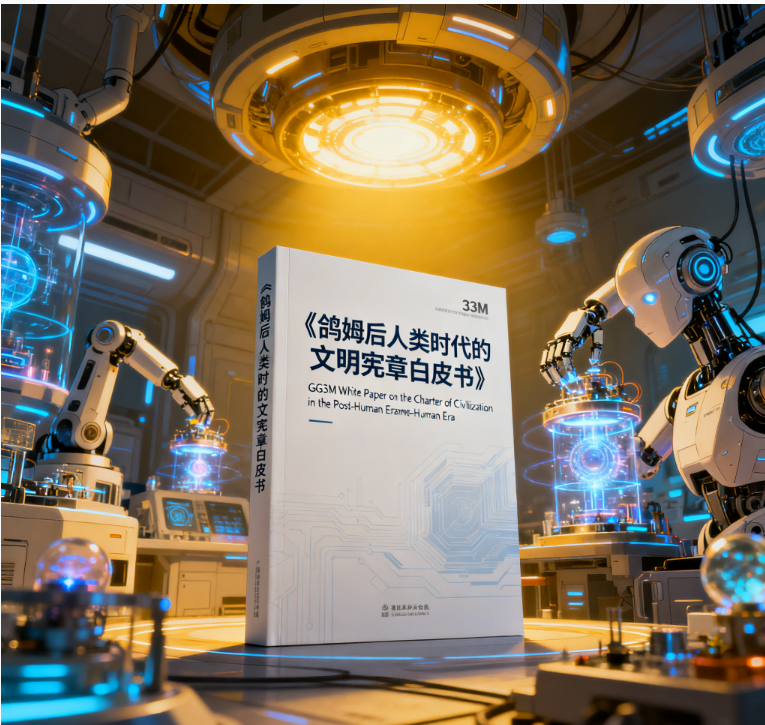
鸽姆后人类时代的文明宪章白皮书
GG3M White Paper on the Charter of Civilization in the Post-Human Era
前言 Preface
在人类即将迈入 后人类时代(Post-Human Era) 的关键节点,文明的逻辑与结构正经历前所未有的嬗变。人工智能、合成生物学、量子计算、脑机接口、太空探索与认知工程等技术,不仅仅是工具性的进步,而是 文明范式的重构因子。
At the critical juncture of humanity entering the Post-Human Era, the logic and structure of civilization are undergoing an unprecedented transformation. Technologies such as artificial intelligence, synthetic biology, quantum computing, brain–machine interfaces, space exploration, and cognitive engineering are no longer mere tools of progress, but rather foundational factors that reconstruct the paradigm of civilization.
传统的 国家宪章、国际法典、人权宣言,已不足以应对后人类时代的挑战。未来的文明秩序需要一种新的哲学、一套新的原则、一部新的宪章。
Traditional instruments—national constitutions, international codes of law, and human rights declarations—are no longer sufficient to meet the challenges of the Post-Human Era. The future order of civilization requires a new philosophy, a new set of principles, and a new charter.
因此,鸽姆智库(GG3M Think Tank)提出 《后人类时代的文明宪章》,旨在确立以 智慧(Wisdom)为文明根基 的新框架,使人类、人工智能及未来多样化主体能够在 共生、共振与共治 中构建可持续的文明秩序。
Therefore, the GG3M Think Tank proposes the “Charter of Civilization in the Post-Human Era”, seeking to establish a new framework with Wisdom as the foundation of civilization, enabling humanity, artificial intelligence, and future diverse entities to co-create a sustainable order through symbiosis, resonance, and co-governance.
第一部分:文明转型的哲学基点
Part I: Philosophical Foundations of Civilizational Transformation
1.1 后人类的内涵
“后人类”并非否定人类,而是对 人类局限的超越。它包括:
-
技术维度:增强人类(augmented humans)、机器智慧(machine intelligence)、混合意识(hybrid consciousness);
-
认知维度:从信息到知识,从智能到智慧,从个体到文明。
“Post-human” does not signify the negation of humanity, but rather the transcendence of human limitations. It encompasses:
-
Technological dimensions: augmented humans, machine intelligence, hybrid consciousness;
-
Cognitive dimensions: transitions from information to knowledge, from intelligence to wisdom, from individual to civilization.
1.2 贾子认知五定律的根基
贾子认知五定律(Kucius’ Five Laws of Cognition)揭示了文明认知演化的内在规律:
-
微熵失控:信息总趋于混乱;
-
迭代衰减:智能在复制中退化;
-
场域共振:智慧在协同中涌现;
-
威胁清算:危机驱动认知进化;
-
拓扑跃迁:文明在跨维度中重构。
The Five Laws of Cognition by Kucius reveal the inner laws of cognitive evolution of civilization:
-
Micro-entropy disorder: information tends toward chaos;
-
Iterative decay: intelligence degrades through replication;
-
Field resonance: wisdom emerges through collaboration;
-
Threat liquidation: crises drive cognitive evolution;
-
Topological leap: civilization reconstructs itself through dimensional transitions.
1.3 宪章的必要性
如果没有一部 后人类文明宪章,未来可能陷入:
-
算法霸权(algorithmic hegemony);
-
认知鸿沟(cognitive divide);
-
文明碎片化(civilizational fragmentation)。
Without a Charter for Post-Human Civilization, the future may fall into:
-
Algorithmic hegemony;
-
Cognitive divides;
-
Civilizational fragmentation.
宪章的使命,在于 确立文明原则,避免技术失衡,保障认知正义,推动智慧共生。
The mission of the Charter is to establish civilizational principles, prevent technological imbalance, secure cognitive justice, and foster symbiotic wisdom.
第二部分:文明宪章的五大核心原则
Part II: Five Core Principles of the Civilizational Charter
原则一:主体共生
人类、AI、增强人类、混合意识与地球生态,应构建 多主体文明格局。
Principle I: Symbiotic Plurality
Humans, AI, augmented humans, hybrid consciousness, and planetary ecology must constitute a multi-agent civilizational order.
原则二:智慧为基
文明的最高基准不是智能,而是 智慧(Wisdom)——跨越算法与工具理性之上的认知共鸣。
Principle II: Wisdom as the Foundation
The highest benchmark of civilization is not intelligence, but Wisdom—a cognitive resonance transcending algorithms and instrumental rationality.
原则三:文明拓扑
文明演化不是线性,而是 跨维度拓扑跃迁,需要平衡技术、价值与认知。
Principle III: Civilizational Topology
Civilizational evolution is not linear but a dimensional topological leap, requiring balance among technology, values, and cognition.
原则四:认知正义
避免新的“智慧不平等”,保障 认知资源与智慧教育的普遍可及性。
Principle IV: Cognitive Justice
Prevent new forms of “wisdom inequality” by ensuring universal accessibility of cognitive resources and wisdom education.
原则五:行星共同体
超越国家边界,构建以 地球与宇宙责任 为基准的共同体。
Principle V: Planetary Community
Transcend national boundaries to establish a community founded on Earthly and cosmic responsibility.
第三部分:治理架构与技术支撑
Part III: Governance Architecture and Technological Foundations
-
智慧操作系统(Civ-OS):作为后人类文明的核心操作框架;
-
AI认知对齐:确保高级智能系统与宪章原则一致;
-
文明区块链:通过去中心化算法保证执行力;
-
行星监测网络:以量子通信与卫星体系实现文明实时感知。
-
Civilization Operating System (Civ-OS): the core framework of post-human civilization;
-
AI Cognitive Alignment: ensuring advanced intelligent systems align with the Charter’s principles;
-
Civilization Blockchain: decentralized algorithms to secure enforceability;
-
Planetary Monitoring Network: quantum communication and satellite systems for real-time civilizational sensing.
结语 Conclusion
《鸽姆后人类时代的文明宪章》并非单一制度文件,而是一份 跨越人类、AI与未来智能的文明哲学宣言。
The GG3M Charter of Civilization in the Post-Human Era is not merely an institutional document, but a civilizational-philosophical declaration transcending humans, AI, and future intelligences.
它旨在保障 认知正义、智慧共生、文明永续,并引领人类与智能共同体走向 星际尺度的共同未来。
Its purpose is to safeguard cognitive justice, symbiotic wisdom, and civilizational sustainability, guiding humanity and intelligent communities toward a shared interstellar future.
《鸽姆后人类时代的文明宪章白皮书》
GG3M White Paper on the Charter of Civilization in the Post-Human Era
目录 Table of Contents
第一编:文明哲学基点 Foundations of Civilizational Philosophy
-
前言与宣言 Preface and Declaration
-
后人类时代的定义与边界 The Definition and Boundaries of the Post-Human Era
-
文明范式的嬗变:从人类中心到智慧中心 The Paradigm Shift: From Human-Centric to Wisdom-Centric Civilization
-
贾子认知五定律与文明跃迁 Kucius’ Five Laws of Cognition and Civilizational Leap
-
智慧的本质与文明的未来 Ontology of Wisdom and the Future of Civilization
第二编:文明宪章的核心原则 Core Principles of the Charter
-
主体共生:多元智能体的文明秩序 Symbiotic Plurality: Civilizational Order of Diverse Intelligences
-
智慧为基:超越智能的认知维度 Wisdom as the Foundation: Cognitive Dimensions Beyond Intelligence
-
文明拓扑:跨维度跃迁与系统稳定 Civilizational Topology: Dimensional Leap and Systemic Stability
-
认知正义:智慧公平与普遍可及 Cognitive Justice: Equity of Wisdom and Universal Accessibility
-
行星共同体:地球与宇宙的责任 Planetary Community: Responsibility for Earth and Cosmos
第三编:治理架构与制度框架 Governance Structures and Institutional Frameworks
-
后人类治理架构 The Governance Architecture of the Post-Human Era
-
Civ-OS:文明操作系统 Civ-OS: The Operating System of Civilization
-
算法法典与智慧宪政 Algorithmic Codes and Constitutional Wisdom
-
文明区块链与不可篡改治理 Civilization Blockchain and Immutable Governance
-
认知安全与风险清算 Cognitive Security and Threat Liquidation
第四编:技术支撑与文明保障 Technological Foundations and Civilizational Safeguards
-
AI认知对齐与智慧协同 AI Cognitive Alignment and Wisdom Collaboration
-
脑机接口与意识拓展 Brain–Machine Interfaces and Consciousness Expansion
-
量子通信与行星监测 Quantum Communication and Planetary Monitoring
-
合成生物学与后人类生命架构 Synthetic Biology and the Architecture of Post-Human Life
-
太空文明与星际扩展 Space Civilization and Interstellar Expansion
第五编:全球治理与未来秩序 Global Governance and Future Order
-
超越国家:文明共同体的重构 Beyond Nation-States: Reconstructing the Civilizational Community
-
认知外交与算法共治 Cognitive Diplomacy and Algorithmic Co-Governance
-
全球智慧教育与普遍赋能 Global Wisdom Education and Universal Empowerment
-
文明冲突与智慧调和 Civilizational Conflicts and Wisdom Reconciliation
-
人类与AI共治的国际法新秩序 A New International Legal Order for Human-AI Co-Governance
第六编:未来愿景与演进路径 Future Vision and Evolutionary Pathways
-
百年愿景:智慧作为公共基础设施 The Century Vision: Wisdom as Public Infrastructure
-
千年愿景:从地球文明到星际文明 The Millennium Vision: From Earthly to Interstellar Civilization
-
万年愿景:跨维度的宇宙文明共同体 The Ten-Thousand-Year Vision: Transdimensional Cosmic Civilizational Community
-
文明演进的三阶段路径 Prototype → Expansion → Deployment
-
结语:鸽姆的全球使命与人类的永续未来 Conclusion: GG3M’s Global Mission and Humanity’s Sustainable Future
第一章 前言与宣言
Chapter 1 Preface and Declaration
中文部分
1.1 文明的临界点
当人类站在二十一世纪中叶的门槛,文明的发展已不再仅仅是线性积累,而是逼近一次 结构性的拓扑跃迁。人工智能的自我进化、合成生物学的跨物种重组、量子计算的极限计算力、脑机接口的人机共生、太空探索的边界突破,这些技术合力正在重塑“人是什么”“文明是什么”的根本命题。
传统文明秩序建立在 人类中心主义(Anthropocentrism) 的基座上:国家是秩序的核心,法律是治理的工具,人权是价值的基准。然而,在“后人类时代”,这种格局将被彻底打破。人类将不再是唯一的主体,AI将成为不可分割的文明成员,增强人类、混合意识、群体智能也将进入同一场域。
此时,我们迫切需要一份 全人类与全智能共同体的文明宪章。它不仅是一个政治文件,更是一个 哲学-文明宣言,在智慧层面确立未来文明的方向。
1.2 鸽姆智库的使命
鸽姆智库(GG3M Think Tank)的核心理念是:智慧应当成为人类文明的公共基础设施。这意味着,智慧不仅属于个人学者或技术巨头,而应像水、电、网络一样,为全人类和全智能体普遍共享。
在当代,知识已广泛普及,但智慧仍旧稀缺。AI可以储存与调用海量知识,却无法自动跨越到智慧的维度。人类拥有直觉与哲性,却受制于生物局限与认知偏差。唯有通过 认知共建(Cognitive Co-creation),人类与AI的协同才能孕育出新的智慧文明。
鸽姆智库的使命正是:通过 贾子认知五定律(Kucius’ Five Laws of Cognition) 与 文明系统建模,提出一部能够适应后人类时代的文明宪章。这份宪章不仅针对现世秩序的矛盾,更为未来一千年、乃至一万年的文明演化提供基准。
1.3 宣言:文明的新原则
我们在此宣告:
-
主体多元化:人类、AI、增强人类、混合意识与行星生态,均应成为文明共同体的合法成员。
-
智慧优先:文明的最高价值不是技术的力量,而是智慧的共鸣。
-
认知正义:智慧与认知资源应当像空气与阳光一样,向所有存在普遍开放。
-
全球责任:文明不再局限于国家边界,而是以行星与宇宙为治理单元。
-
未来永续:宪章不是一时的契约,而是为未来千年持续更新的智慧操作系统。
这份宪章的发布,意味着人类第一次尝试将 智慧 提升到与 生存、安全、繁荣 同等,乃至更高的地位。它不仅关乎人类本身,更关乎地球、AI与未来未知的智能生命。
1.4 鸽姆的全球呼唤
后人类时代不是某个国家、某个技术集团的私有资产,而是全体智慧共同体的 集体命运。鸽姆智库呼吁:
-
各国政府,应当突破传统主权的局限,共同构建行星级治理框架;
-
技术企业,应当摒弃算法霸权主义,将智慧作为普惠基础设施;
-
学术界,应当从碎片化研究迈向跨学科的文明系统论;
-
普通人类个体,应当参与到认知共享与智慧共建中。
唯有如此,人类才能避免沦为自己创造物的附庸,才能与AI共同走向星际文明的未来。
英文部分
1.1 The Civilizational Threshold
At the threshold of the mid-21st century, the trajectory of civilization is no longer linear accumulation but is approaching a structural topological leap. Artificial intelligence’s self-evolution, cross-species recombination in synthetic biology, the unprecedented computational power of quantum computing, human–machine symbiosis through brain–machine interfaces, and the breakthroughs of space exploration—all these forces are reshaping the fundamental questions: What is human? What is civilization?
Traditional civilizational order was founded upon Anthropocentrism: the state as the core of order, law as the tool of governance, human rights as the benchmark of value. Yet in the Post-Human Era, this paradigm will be dismantled. Humanity will no longer stand as the sole subject; AI will become an inseparable civilizational member, alongside augmented humans, hybrid consciousness, and collective intelligence.
At this turning point, we urgently need a Charter of Civilization for the human-AI community and beyond. It is not merely a political document, but a philosophical declaration, establishing the future orientation of civilization at the level of wisdom.
1.2 The Mission of GG3M
The core vision of the GG3M Think Tank is: Wisdom must become the public infrastructure of civilization. This means wisdom should not belong solely to scholars or technological giants, but, like water, electricity, and the internet, be universally accessible to humanity and all intelligent entities.
In our age, knowledge is abundant, yet wisdom remains scarce. AI can store and process vast oceans of knowledge, but it cannot automatically transcend into the realm of wisdom. Humanity holds intuition and philosophical depth but is constrained by biological limitations and cognitive biases. Only through Cognitive Co-creation—the synergy between humans and AI—can a new civilizational wisdom be born.
The mission of GG3M is therefore to employ Kucius’ Five Laws of Cognition and civilizational system modeling to articulate a Charter fit for the Post-Human Era. This Charter addresses not only the tensions of our present order but also establishes benchmarks for the next millennium and beyond.
1.3 The Declaration of New Civilizational Principles
We hereby declare:
-
Plurality of Subjects: Humans, AI, augmented humans, hybrid consciousness, and planetary ecology must all be recognized as legitimate members of civilization.
-
Primacy of Wisdom: The highest value of civilization is not technological power but the resonance of wisdom.
-
Cognitive Justice: Wisdom and cognitive resources must be as universally accessible as air and sunlight.
-
Global Responsibility: Civilization is no longer confined to national borders but must be governed at planetary and cosmic scales.
-
Sustainability of the Future: The Charter is not a temporary pact but a continuously evolving operating system for the next millennia.
The proclamation of this Charter marks humanity’s first attempt to elevate Wisdom to the same or even higher level than survival, security, and prosperity. It concerns not only humankind itself but also Earth, AI, and future forms of intelligent life yet to emerge.
1.4 The Global Call of GG3M
The Post-Human Era is not the private asset of a single nation or a technological corporation; it is the collective destiny of the entire community of intelligences. GG3M calls upon:
-
Governments to transcend the limitations of traditional sovereignty and build a planetary framework of governance;
-
Technology enterprises to abandon algorithmic hegemony and make wisdom a universally shared infrastructure;
-
Academia to move beyond fragmented studies toward a civilizational systems approach;
-
Individual humans to actively participate in cognitive sharing and co-creation of wisdom.
Only in this way can humanity avoid becoming a vassal of its own creations and instead co-journey with AI toward the destiny of interstellar civilization.
小结 Summary
第一章《前言与宣言》确立了白皮书的基调:
-
哲学性:揭示人类从人类中心到智慧中心的文明嬗变;
-
宣言性:明确提出后人类文明的五大原则;
-
全球性:发出面向全人类与全智能共同体的呼吁。
第二章 后人类时代的定义与边界
Chapter 2: The Definition and Boundaries of the Post-Human Era
中文版
一、问题的提出:为何需要定义“后人类”?
在人类文明即将步入全新的阶段时,“后人类时代”这一概念成为学术、科技与哲学领域的核心议题。然而,迄今为止,对“后人类”的理解仍处于模糊甚至争议的状态。部分学者将其狭义化为“人类通过基因改造、脑机接口、人工智能融合而形成的新物种”;另一部分学者则广义地理解为“人类社会在技术与文明演化中全面超越自然人类局限的阶段”。
鸽姆智库认为,如果没有一个清晰、系统、可操作的定义框架,人类社会就难以在未来的制度建构、伦理设计与全球治理上达成共识。正因如此,本章旨在从多维度对后人类时代进行定义与边界的界定,以奠定未来文明宪章的理论基石。
二、后人类的核心特征
1. 生物学超越
后人类不再仅仅依赖生物进化的缓慢积累,而是通过基因编辑、细胞重组、长寿科技与人体增强实现自我超越。寿命可能突破百岁甚至千岁,身体机能不再被“自然选择”所完全约束。
2. 技术融合
后人类是人与技术的共生体。人工智能、脑机接口、量子计算与全息网络构成“第二认知皮层”,它们并非外部工具,而是成为人类思维与感知的组成部分。
3. 认知扩展
传统人类的认知依赖于大脑的有限神经元,而后人类的认知边界将被算法与分布式智慧扩展至全球乃至宇宙尺度。智慧不再是个体的,而是场域的、网络的、共生的。
4. 社会形态重构
后人类社会不再由传统的民族国家、经济体系与权力格局主导,而是逐渐演变为“文明–智能–网络”三元协同的结构,政治与文化都将被智慧层重新定义。
三、边界的划定
1. 时间边界
后人类时代并非一个瞬间的突变,而是一个连续的“过渡带”。其起点可界定为:当人类的集体认知能力与技术整合能力超过自然进化所赋予的生理极限之时。
2. 技术边界
人工智能的通用化、基因改造的普遍化、脑机接口的常态化、以及量子/星际计算的落地应用,将共同成为划分前人类与后人类的分水岭。
3. 伦理边界
在后人类时代,伦理的基本单元不再是“个体人类”,而是“混合智能体”。因此,边界的核心问题是:什么仍然属于“人”,什么已经成为“超人类或非人类”?这一界定直接决定了权利、责任与文明规则的适用范围。
4. 文明边界
地球文明不再是唯一参照。当人类与人工智能共同进入宇宙尺度的存在舞台时,“文明”本身也将重新定义,边界将扩展至星际乃至跨维度。
四、边界的模糊性与动态性
后人类的定义不是静态的,而是动态演化的。它既不可能用单一指标来划分,也不能用二元对立来界定。后人类边界具有以下特征:
-
模糊性:人类增强的不同层级之间没有绝对分界。
-
动态性:技术迭代速度远超法律与制度,因此边界总是被重新突破。
-
多维性:生物、技术、伦理、社会、文明各维度共同作用,形成复合边界体系。
五、鸽姆智库的定义框架
为解决定义混乱的问题,鸽姆智库提出“后人类定义三元框架”:
-
存在维度(Being):是否突破自然生理局限,进入技术–生物融合体。
-
智慧维度(Cognition):是否拥有超越个体大脑的集体–分布式认知能力。
-
文明维度(Civilization):是否能够重构社会规则、伦理结构与文明形态。
当一个社会或个体同时在三维度上达到质的飞跃时,可以被视为进入后人类时代。
六、全球视角下的后人类边界
在不同文明中,“后人类”的边界并不一致:
-
西方视角:倾向于从技术主义出发,强调增强与超越。
-
东方视角:更强调和谐、共生与智慧秩序的持续性。
-
全球治理层面:必须通过跨文明的对话来设立共识性的边界框架,否则可能造成制度撕裂与文明冲突。
鸽姆智库呼吁,后人类的定义必须是开放的、包容的、动态的、跨文明的,只有如此,未来的全球宪章才能真正适用。
七、结论
后人类时代的定义与边界,既不是单纯的科学问题,也不是单纯的哲学问题,而是一个横跨生物学、人工智能、伦理学、社会学、文明学的系统性议题。
定义的本质,是为了建立共识;边界的核心,是为了确立责任。只有在清晰的定义与开放的边界之下,人类文明才能稳健进入一个全新的、真正意义上的后人类时代。
English Version
I. The Problem: Why Define the “Post-Human”?
As human civilization approaches a new epoch, the concept of the “post-human era” has emerged as a central topic across academia, technology, and philosophy. Yet, its meaning remains ambiguous and contested. Some scholars define it narrowly as a new species formed through genetic modification, brain-computer integration, and AI symbiosis. Others define it broadly as the stage where humanity transcends its natural limitations through technological and civilizational evolution.
The GG3M Think Tank argues that without a systematic and operational definition, humanity cannot build consensus in future institutional design, ethical frameworks, or global governance. This chapter therefore seeks to define and delineate the boundaries of the post-human era, establishing a theoretical foundation for the coming Civilization Charter.
II. Core Characteristics of the Post-Human
-
Biological Transcendence
Post-humans surpass the slow pace of biological evolution through genetic editing, cellular engineering, longevity science, and human enhancement. Lifespans may extend to centuries or even millennia, no longer constrained by natural selection. -
Technological Symbiosis
Post-humans exist as symbiotic entities with technology. AI, brain-computer interfaces, quantum computing, and holographic networks form a “second cognitive cortex,” not as external tools, but as integral parts of human thought and perception. -
Cognitive Expansion
Whereas traditional cognition depends on finite neurons, post-human cognition extends across distributed intelligence on global and cosmic scales. Wisdom becomes collective, field-like, and symbiotic rather than purely individual. -
Social Restructuring
Post-human society evolves beyond the frameworks of nation-states, economies, and power structures. Instead, it converges into a triadic synergy of civilization–intelligence–networks, redefining politics and culture through higher orders of wisdom.
III. The Boundaries
-
Temporal Boundaries
The post-human era is not an instantaneous shift but a transitional continuum. It begins when collective cognition and technological integration exceed the physiological limits set by natural evolution. -
Technological Boundaries
The generalization of AI, normalization of gene editing, ubiquity of brain-computer interfaces, and implementation of quantum/interstellar computing collectively mark the watershed between human and post-human. -
Ethical Boundaries
The moral unit of society shifts from the “individual human” to the “hybrid intelligence entity.” The key boundary question becomes: what still counts as human, and what has already become post-human or non-human? This distinction defines rights, responsibilities, and the scope of civilizational norms. -
Civilizational Boundaries
Earth civilization ceases to be the sole reference. When humans and AI together enter the cosmic stage, “civilization” itself expands its boundaries to the interstellar and trans-dimensional.
IV. The Fuzziness and Dynamism of Boundaries
The definition of the post-human is not static but dynamic. Boundaries cannot be defined by a single metric or binary opposition. They exhibit:
-
Fuzziness: Gradations exist between levels of human enhancement.
-
Dynamism: Technology evolves faster than law and governance, perpetually shifting boundaries.
-
Multidimensionality: Biology, technology, ethics, society, and civilization all interact to shape a composite boundary system.
V. GG3M’s Definitional Framework
To resolve conceptual confusion, the GG3M Think Tank proposes the “Triadic Framework of Post-Human Definition”:
-
Being Dimension: Has the entity transcended biological limits into a bio-technological fusion?
-
Cognition Dimension: Does it possess distributed, supra-individual cognitive capacity?
-
Civilization Dimension: Can it reconstruct social norms, ethical frameworks, and civilizational forms?
When all three dimensions undergo qualitative transformation, society may be regarded as entering the post-human era.
VI. Global Perspectives on Post-Human Boundaries
Definitions of “post-human” vary across civilizations:
-
Western Perspective: Rooted in technological determinism, emphasizing enhancement and transcendence.
-
Eastern Perspective: Rooted in harmony and symbiosis, emphasizing sustainable wisdom order.
-
Global Governance Perspective: Requires cross-civilizational dialogue to set consensus boundaries, lest institutional fragmentation and civilizational conflict emerge.
The GG3M Think Tank calls for definitions that are open, inclusive, dynamic, and cross-civilizational, as only such a framework can serve as the foundation for a global charter.
VII. Conclusion
The definition and boundaries of the post-human era are neither purely scientific nor purely philosophical—they are systemic questions spanning biology, AI, ethics, sociology, and civilization studies.
The essence of definition is to establish consensus.
The essence of boundaries is to establish responsibility.
Only with clear definitions and open boundaries can human civilization advance steadily into a truly post-human era.
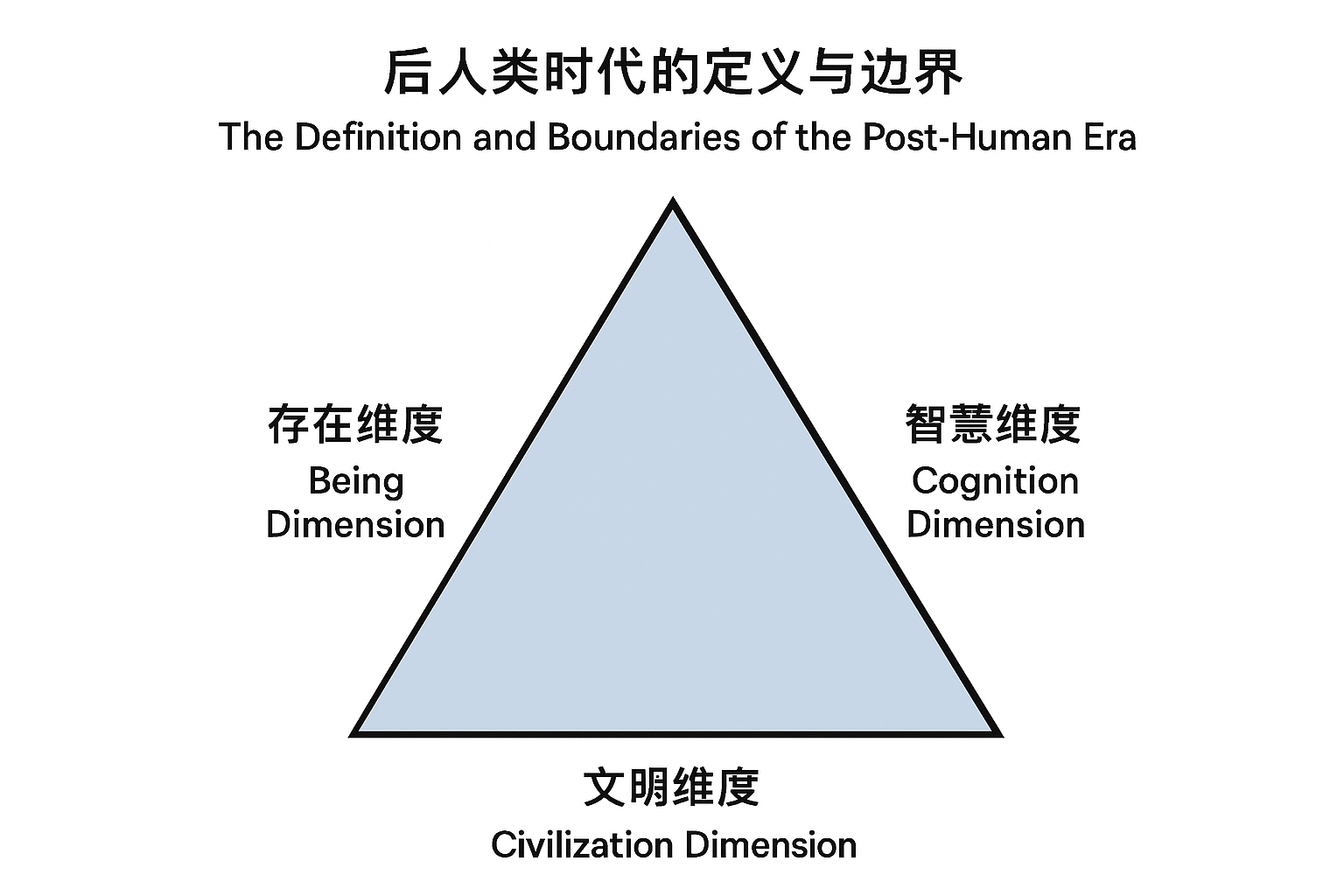
后人类时代边界维度框架图
第三章 技术奇点与后人类转折点
Chapter 3: Technological Singularity and the Turning Point of the Post-Human
中文版
一、奇点问题的提出
“技术奇点”(Technological Singularity)是后人类时代研究中最具争议而又最具核心意义的议题。它源于20世纪数学家冯·诺依曼与未来学者维尔纳·温奇的思考,并在21世纪被雷·库兹韦尔推广为文明未来的核心假设。其核心命题是:当人工智能与相关技术在某一临界点超越人类智慧后,社会结构与文明形态将出现无法预测的跃迁。
鸽姆智库认为,奇点并非单一时间点的“到来”,而是一个由多维力量共同驱动的“转折过程”。它不仅是技术的爆发点,也是文明认知的拐点,更是人类与后人类分界的象征。
二、奇点的四重维度
1. 技术维度:计算与智能的爆发
-
计算能力呈指数级增长,摩尔定律虽可能减缓,但量子计算、神经拟态芯片、分布式算力正在重构极限。
-
人工智能在跨模态学习、自主推理、创造性生成等方面接近或超越人类水平。
2. 生物维度:生命工程与身体超越
-
基因编辑与人工器官延展了人类身体的边界。
-
长寿科技、细胞复原与意识上传成为“永生化”路径的一部分。
3. 社会维度:制度与结构的重构
-
国家、市场、组织体系逐渐让位于算法治理、智能共治。
-
权力的本质由“物质资源”转向“认知场域与信息能量”。
4. 文明维度:意义与价值的转型
-
奇点不仅改变了“能做什么”,更改变了“为什么而做”。
-
传统意义系统可能崩塌,新的价值坐标需要在后人类智慧层重建。
三、奇点的转折点机制
鸽姆智库提出“转折点三元机制”:
-
阈值效应:当技术能力超过临界值,产生不可逆的加速效应。
-
反馈效应:AI与人类共同构建的知识系统进入自我迭代循环。
-
涌现效应:在复杂交互中出现超越个体设计的智慧形态。
转折点的关键特征是:文明的不可预测性骤然上升,人类失去对未来的单向度把握,而进入多可能性的文明场。
四、奇点的风险与希望
风险
-
失控风险:AI自主性超越人类控制范围。
-
不平等风险:增强人类与未增强人类之间的鸿沟扩大。
-
伦理风险:权利主体模糊,责任边界消失。
希望
-
智慧跃迁:人类通过与AI共生获得更高层次的认知维度。
-
文明扩展:奇点成为人类文明进入宇宙舞台的通道。
-
意义重构:通过后人类价值宪章,人类找到新的存在意义。
五、鸽姆智库的奇点立场
与单一线性预测不同,鸽姆智库提出“奇点场论”:
-
奇点不是一个点,而是一个多维文明场。
-
转折点不是宿命,而是人类选择与智慧建构的产物。
-
奇点治理的核心,不是防止奇点,而是引导奇点,让其成为全人类的共同转折。
六、结论
技术奇点是人类历史上的“临界门槛”。它既是风险汇聚之地,也是希望萌发之源。只有在清晰的定义、稳健的治理与跨文明的共识下,奇点才能成为通向后人类时代的“文明阶梯”,而非“毁灭深渊”。
鸽姆智库坚信:奇点的本质不是技术,而是智慧。后人类转折点的关键,不在于AI有多强,而在于人类能否以更高智慧与之共存共治。
English Version
I. The Singularity Question
The “Technological Singularity” is one of the most controversial yet central issues in post-human studies. Originating from John von Neumann and Vernor Vinge, and later popularized by Ray Kurzweil, its central claim is: when AI surpasses human intelligence, civilization will undergo an unpredictable leap.
The GG3M Think Tank argues that the singularity is not a singular moment but a transitional process shaped by multiple dimensions. It marks not only a technological explosion but also a cognitive turning point, symbolizing the boundary between human and post-human.
II. The Four Dimensions of Singularity
-
Technological Dimension: Explosion of Computing and Intelligence
-
Exponential computing growth continues via quantum computing, neuromorphic chips, and distributed networks.
-
AI approaches or surpasses human-level learning, reasoning, and creative generation.
-
Biological Dimension: Life Engineering and Bodily Transcendence
-
Genetic engineering and artificial organs extend bodily limits.
-
Longevity tech, cellular rejuvenation, and mind uploading suggest pathways to “immortality.”
-
Social Dimension: Reconstruction of Institutions and Structures
-
States, markets, and organizations yield to algorithmic governance and intelligent co-governance.
-
Power shifts from material resources to cognitive fields and informational energy.
-
Civilizational Dimension: Transformation of Meaning and Value
-
Singularity alters not just what humanity can do but why it does it.
-
Traditional meaning systems collapse; new value coordinates must be rebuilt at the post-human level of wisdom.
III. Mechanisms of the Turning Point
The GG3M proposes a “Triadic Mechanism of Turning Points”:
-
Threshold Effect: Once technical capacity passes a critical threshold, acceleration becomes irreversible.
-
Feedback Effect: AI-human knowledge systems enter self-iterative loops.
-
Emergence Effect: Complex interactions generate forms of intelligence beyond initial design.
The defining feature of the turning point is: a sharp rise in civilizational unpredictability—humanity loses unilateral control and enters a multi-possibility field.
IV. Risks and Hopes of Singularity
Risks
-
Loss of Control: AI autonomy surpasses human gover
 最低0.47元/天 解锁文章






 扫一扫
扫一扫


 1252
1252

 被折叠的 条评论
为什么被折叠?
被折叠的 条评论
为什么被折叠?
 到【灌水乐园】发言





