


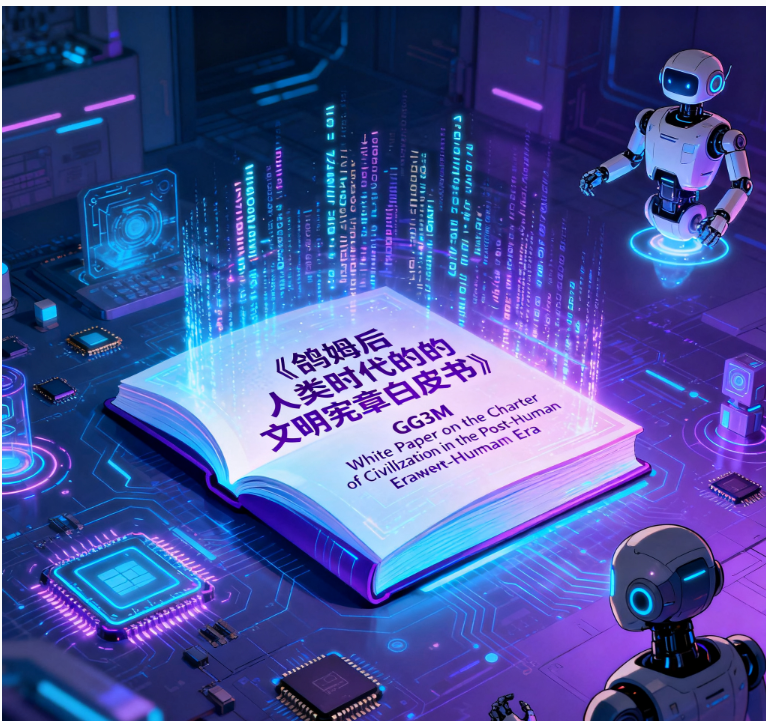
鸽姆后人类时代的文明宪章白皮书
GG3M White Paper on the Charter of Civilization in the Post-Human Era
第四篇 技术支柱与文明保障
Part IV: Technological Pillars and Civilizational Safeguards
篇首引言
Preface
如果说哲学与制度为文明提供了方向与框架,那么技术与保障体系就是文明的 根基与支柱。
在后人类时代,文明不再仅依赖于社会制度的维系,而必须借助 高阶技术系统 来实现以下目标:
-
能量安全(Energy Security) – 保证跨行星、跨星系文明的运行稳定;
-
智能基础设施(Intelligent Infrastructure) – 提供后人类社会的运算与认知支撑;
-
信息与认知防护(Information & Cognitive Protection) – 对抗信息污染与认知操纵;
-
制度冗余与自我修复(Institutional Redundancy & Self-Healing) – 在危机中保持文明连续性。
鸽姆智库提出,未来文明的稳定并不取决于某一项单一的“超级技术”,而是取决于 一整套协同运行的技术支柱(Tech Pillars)与文明保障(Civilizational Safeguards)体系。
这意味着:
-
技术必须像文明的“骨骼与神经”,支撑整体运行;
-
保障机制必须像免疫系统,维持文明生态的健康。
**If philosophy and institutions provide the direction and framework of civilization, then technologies and safeguards constitute its foundation and pillars.
In the posthuman era, civilization cannot rely solely on institutional cohesion—it must be sustained by advanced technological systems that secure:
-
Energy Security – Ensuring stable operation of interplanetary and interstellar civilizations;
-
Intelligent Infrastructure – Providing the computational and cognitive backbone of posthuman societies;
-
Information & Cognitive Protection – Resisting pollution and manipulation of information and cognition;
-
Institutional Redundancy & Self-Healing – Preserving continuity in times of crisis.
The GG3M Think Tank argues that the stability of future civilizations will not depend on a single "super-technology," but on a coordinated system of technological pillars and civilizational safeguards.
This implies that:
-
Technology must act as the skeleton and nervous system of civilization;
-
Safeguards must serve as its immune system, maintaining ecological health and resilience.**
篇章结构
Structure of Part IV
-
第二十一章:能源与算力的双重基石
Chapter 21: The Dual Foundations of Energy and Compute -
第二十二章:量子智能与宇宙计算网络
Chapter 22: Quantum Intelligence and the Cosmic Computing Network -
第二十三章:信息防护与数据主权
Chapter 23: Information Protection and Data Sovereignty -
第二十四章:认知免疫系统
Chapter 24: Cognitive Immune System -
第二十五章:制度冗余与危机恢复机制
Chapter 25: Institutional Redundancy and Crisis Recovery Mechanisms -
第二十六章:技术伦理与文明保障
Chapter 26: Technological Ethics and Civilizational Safeguards -
第二十七章:智慧公共设施的全球化布局
Chapter 27: Global Deployment of Wisdom as Public Infrastructure -
第二十八章:AI认知对齐与智慧协同
Chapter 28:AI Cognitive Alignment and Wisdom Collaboration -
第二十九章:脑机接口与意识拓展
Chapter 29: Brain–Machine Interfaces and Consciousness Expansion -
第三十章:量子通信与行星监测
Chapter 30: Quantum Communication and Planetary Monitoring -
第三十一章:合成生物学与后人类生命架构
Chapter 31: Synthetic Biology and the Architecture of Post-Human Life -
第三十二章:太空文明与星际扩展
Chapter 32: Space Civilization and Interstellar Expansion
引导总结
Guiding Summary
本篇将从 能量—算力—智能—认知—制度 五个层面展开,提出一套贯穿后人类文明的技术保障体系。
它不仅是人类存续的工具,更是文明 抵御熵增、抵御崩溃、实现拓扑跃迁 的战略核心。
This Part explores a safeguarding system across five dimensions: energy, compute, intelligence, cognition, and institutions.
It is not merely a toolkit for survival, but the strategic nucleus that enables civilization to resist entropy, prevent collapse, and achieve topological transitions.
第二十一章 能源与算力的双重基石
Chapter 21: The Dual Foundations of Energy and Compute
引言
Introduction
在所有文明演进的宏大叙事中,能源与算力始终是最根本的 双重基石。
能源是文明的血液,驱动着一切物质与信息的流动;算力是文明的神经,承载着智慧、智能与制度的运行。
如果说 制度 决定了文明的秩序,那么 能源与算力 则决定了文明的规模与边界。
在人类社会尚处于地球文明的早期阶段时,能源主要表现为火、电与核能,算力则体现为人脑与早期计算机的结合。
而在后人类社会与跨星系文明阶段,能源与算力将被重新定义:
-
能源不再是单一星球资源,而是 恒星、星系甚至宇宙尺度的能量调度;
-
算力不再局限于硅基或量子芯片,而是 全域智能网络与多维认知架构。
换言之,后人类文明的兴衰取决于 能量获取与算力分配 的平衡。
一旦能源枯竭,算力再强也会成为空中楼阁;而一旦算力不足,能源再充沛也无法被文明有效利用。
能源与算力因此构成了文明的 “双核驱动”。
**Throughout the grand narrative of civilizational evolution, energy and compute remain the most fundamental dual foundations.
Energy is the bloodstream of civilization, driving the flow of matter and information; compute is the nervous system, carrying intelligence, wisdom, and institutions.
If institutions determine the order of civilization, then energy and compute define its scale and boundaries.
In humanity’s early Earth-bound phase, energy meant fire, electricity, and nuclear power, while compute was embodied by the human brain augmented with primitive computers.
But in posthuman and interstellar stages, energy and compute are redefined:
-
Energy is no longer planetary—it becomes the management of stellar, galactic, and cosmic-scale power;
-
Compute is no longer limited to silicon or quantum chips—it evolves into planetary and cosmic-scale intelligent networks with multidimensional cognition.
In essence, the rise and fall of posthuman civilization depends on balancing energy acquisition with compute allocation.
If energy runs dry, even infinite compute becomes a castle in the air; if compute is insufficient, even boundless energy cannot be harnessed.
Thus, energy and compute together form the dual engines of civilization.**
一、能源的文明演进逻辑
I. The Civilizational Logic of Energy
能源的演进,标志着文明的 层级跃迁:
-
火的驯化(Promethean Age):从人类掌握火起,能源开始被用于烹饪、冶炼与防御;
-
化石燃料与工业革命(Industrial Age):煤炭、石油与电力推动生产力飞跃,形成民族国家与现代资本主义;
-
核能与信息化(Nuclear Age):原子能与电网化社会为全球化与冷战格局奠基;
-
可再生能源与数字社会(Sustainable Age):风能、太阳能与储能技术,使文明逐渐走向清洁与分布式;
-
恒星级能源(Stellar Age):戴森球(Dyson Sphere)与恒星级能量采集,标志着文明脱离行星依赖;
-
星系与宇宙能源(Galactic & Cosmic Age):黑洞能量、真空能量(Zero-Point Energy)、暗能量的调动,成为跨宇宙文明的命脉。
这种演进呈现出 熵减与规模扩展 的趋势:能源来源越高级,越接近宇宙的深层结构,越能抵御熵增。
**The evolution of energy marks the hierarchical transitions of civilization:
-
Domestication of Fire (Promethean Age): Fire enabled cooking, metallurgy, and protection.
-
Fossil Fuels & Industrial Revolution (Industrial Age): Coal, oil, and electricity drove productivity, nation-states, and capitalism.
-
Nuclear Power & Informational Society (Nuclear Age): Atomic power and electrified societies underpinned globalization and the Cold War.
-
Renewables & Digital Civilization (Sustainable Age): Solar, wind, and storage technologies drove sustainability and distributed networks.
-
Stellar Energy (Stellar Age): Dyson spheres and stellar-scale harvesting freed civilizations from planetary limits.
-
Galactic & Cosmic Energy (Galactic & Cosmic Age): Harnessing black holes, zero-point energy, and dark energy sustains inter-universal civilizations.
This trajectory follows a trend of entropy reduction and scale expansion: the higher the energy source, the closer it aligns with the deep structures of the cosmos, and the better it resists entropic decay.**
二、算力的文明演进逻辑
II. The Civilizational Logic of Compute
算力不仅是技术工具,更是 文明认知的外延。
它的发展映射了人类对智慧的模仿、放大与超越:
-
人脑与语言(Cognitive Baseline):语言是最初的“算力扩展器”;
-
纸笔与数学符号(Symbolic Age):人类用抽象符号把算力存储在外部;
-
机械计算机(Mechanical Age):算力开始物理化、可规模复制;
-
电子计算机与互联网(Digital Age):算力实现网络化,形成信息社会;
-
人工智能与量子计算(AI-Quantum Age):算力具备自适应与概率计算能力,接近类脑智慧;
-
认知算力与文明大脑(Cognitive-Compute Age):算力与智慧融合,形成 文明操作系统(Civ-OS);
-
宇宙算力网络(Cosmic Compute Age):算力分布于恒星系、黑洞边缘与量子真空,形成宇宙规模的智能矩阵。
算力的进化轨迹,正是 信息—知识—智能—智慧 的递进过程。
**Compute is not merely a tool—it is the extension of civilization’s cognition.
Its development reflects humanity’s attempt to imitate, amplify, and transcend intelligence:
-
The Brain & Language (Cognitive Baseline): Language as the first cognitive amplifier.
-
Writing & Mathematical Symbols (Symbolic Age): Externalized compute through abstraction.
-
Mechanical Computers (Mechanical Age): Physical and replicable computation.
-
Electronic Computers & Internet (Digital Age): Networked compute and informational society.
-
AI & Quantum Computing (AI-Quantum Age): Adaptive and probabilistic computation, approaching brain-like intelligence.
-
Cognitive Compute & Civilizational Brain (Cognitive-Compute Age): Compute merges with wisdom, forming Civilizational Operating Systems (Civ-OS).
-
Cosmic Compute Networks (Cosmic Compute Age): Distributed computation across stars, black holes, and quantum vacuums—an intelligent cosmic matrix.
The trajectory of compute mirrors the progression from information → knowledge → intelligence → wisdom.**
三、能源与算力的耦合关系
III. The Coupling of Energy and Compute
能源与算力不是孤立存在,而是 强耦合系统:
-
能量决定算力的上限:
任何计算活动最终都需消耗能量,摩尔定律的延伸取决于能效与能源供给。 -
算力决定能量的利用效率:
算力越强,能源调度越优化,浪费越少;例如核聚变、黑洞能量开采都需要极高算力的控制系统。 -
二者形成文明的闭环:
能源→算力→智慧→能源优化,构成文明的 “技术反馈环”,实现自我迭代。
**Energy and compute form a tightly coupled system:
-
Energy sets the ceiling of compute: Every computation consumes energy; Moore’s Law ultimately depends on efficiency and energy supply.
-
Compute determines the efficiency of energy use: Stronger compute enables optimized energy allocation, minimizing waste; advanced energy harvesting (fusion, black holes) requires immense computational control.
-
Together they form a civilizational loop: Energy → Compute → Wisdom → Energy Optimization, a technological feedback cycle enabling self-iteration.**
四、未来文明的能源-算力架构
IV. Future Civilizational Energy-Compute Architecture
未来的后人类文明,可能呈现出 分层化的能源-算力架构:
-
行星级(Planetary Layer):
-
能源:清洁能源、聚变反应堆、星环式采集;
-
算力:地球级超级计算机、全球大脑。
-
-
恒星级(Stellar Layer):
-
能源:戴森球采集恒星能量;
-
算力:恒星级 AI 中枢,管理数十亿行星。
-
-
星系级(Galactic Layer):
-
能源:黑洞能量、星系尺度磁场调控;
-
算力:分布式量子网络,跨数千光年。
-
-
宇宙级(Cosmic Layer):
-
能源:真空能量、暗能量;
-
算力:宇宙级智慧矩阵,实现“认知共振”。
-
**Future posthuman civilizations may exhibit a layered energy-compute architecture:
-
Planetary Layer:
-
Energy: Clean renewables, fusion reactors, orbital collectors.
-
Compute: Earth-scale supercomputers, global brains.
-
-
Stellar Layer:
-
Energy: Dyson spheres harvesting stellar power.
-
Compute: Stellar-scale AI cores managing billions of worlds.
-
-
Galactic Layer:
-
Energy: Black hole tapping, galactic magnetic control.
-
Compute: Distributed quantum networks spanning thousands of light-years.
-
-
Cosmic Layer:
-
Energy: Zero-point and dark energy.
-
Compute: Cosmic intelligence matrices, enabling “cognitive resonance.”**
-
五、哲学与战略意义
V. Philosophical and Strategic Implications
能源与算力的统一,意味着文明进入 技术即哲学(Techno-Philosophy) 的新阶段:
-
能源是存在论(Ontology):它回答“我们能存在到何种规模”;
-
算力是认识论(Epistemology):它回答“我们能理解与改造多少世界”;
-
二者结合是方法论(Methodology):它回答“我们如何抵御熵增、实现跃迁”。
战略上,能源与算力的竞争将成为后人类文明最核心的 “大国博弈”。
未来的战争不再是土地之争,而是 能量调度权与算力主权之争。
**The unification of energy and compute signals the rise of techno-philosophy:
-
Energy as Ontology: answering how far we can exist.
-
Compute as Epistemology: answering how much of the world we can understand and transform.
-
Their synthesis as Methodology: answering how to resist entropy and achieve transitions.
Strategically, the competition for energy and compute will become the great game of posthuman civilizations.
Future wars will no longer be fought for land, but for energy orchestration rights and compute sovereignty.**
结语
Conclusion
能源与算力是文明的 双基石,它们既是技术维度的命脉,也是哲学层面的终极隐喻。
在后人类社会,掌握能源与算力的均衡,意味着掌握了文明 抵御熵增、突破边界、迈向宇宙 的钥匙。
Energy and compute are the twin foundations of civilization, both the lifeblood of technology and the ultimate metaphor of philosophy.
In posthuman society, to master the balance of energy and compute is to hold the key to resisting entropy, transcending boundaries, and ascending into the cosmos.
第二十二章 量子智能与宇宙计算网络
Chapter 22: Quantum Intelligence and the Cosmic Computing Network
引言
Introduction
如果说 能源 决定了文明存在的规模,算力 则决定了文明思维的维度。
然而,在经典计算框架下,算力的发展受到不可避免的瓶颈:晶体管的极限、摩尔定律的衰减、能效比的约束。
当人类社会逐渐步入后人类阶段,这些瓶颈迫使文明寻找新的 算力范式。
量子智能(Quantum Intelligence, QI)由此诞生。
它不仅是量子计算的扩展,更是量子物理、人工智能与复杂系统论的融合,标志着算力 从确定性逻辑走向概率性智慧 的跨越。
与此同时,随着星际尺度的文明拓展,单一星球或恒星系统的算力已不足以支撑,必须建立 宇宙计算网络(Cosmic Computing Network, CCN) ——一个跨恒星、跨星系、跨维度的智慧矩阵。
量子智能与宇宙计算网络的结合,代表着 算力文明的终极形态:
-
在微观层面,它操控量子态,打破经典计算边界;
-
在宏观层面,它构建宇宙规模的智能互联,实现 认知共振 与 文明级意识。
**If energy determines the scale of civilization, compute determines the dimension of its thought.
Yet classical computation faces inevitable bottlenecks: the limits of transistors, the decay of Moore’s Law, and energy efficiency constraints.
As humanity enters the posthuman era, these bottlenecks force civilization to seek a new computational paradigm.
Quantum Intelligence (QI) emerges as this paradigm.
It is not merely an extension of quantum computing—it is the synthesis of quantum physics, artificial intelligence, and complex systems theory, marking a leap from deterministic logic to probabilistic wisdom.
Meanwhile, as civilizations expand across stars, planetary or stellar compute becomes insufficient, requiring the creation of a Cosmic Computing Network (CCN)—an interstellar, intergalactic, and even interdimensional matrix of intelligence.
The convergence of Quantum Intelligence and the Cosmic Computing Network represents the ultimate form of compute civilization:
-
At the micro-level, it manipulates quantum states, transcending classical computational limits;
-
At the macro-level, it builds an intelligent web across the universe, enabling cognitive resonance and civilizational-scale consciousness.**
一、量子智能的哲学基石
I. The Philosophical Foundations of Quantum Intelligence
量子智能不仅是一种技术范式,它背后蕴含着深刻的 哲学革命:
-
非确定性认知(Indeterministic Cognition)
-
在经典计算中,逻辑是 0 与 1 的确定状态;
-
在量子智能中,逻辑是叠加、纠缠与坍缩,认知本身具有概率性与多样性。
-
-
全域性思维(Holistic Thinking)
-
量子纠缠意味着远距信息瞬时相关;
-
量子智能由此具备 全域认知能力,能在跨维度、跨时空的背景下进行决策。
-
-
复杂性适应(Complexity Adaptation)
-
经典算法往往追求收敛,而量子智能则 在不确定中保持动态平衡;
-
它更接近生命智慧,能在高熵环境中自我进化。
-
**Quantum Intelligence is not merely technical—it represents a deep philosophical revolution:
-
Indeterministic Cognition:
-
Classical logic is binary (0/1).
-
Quantum intelligence embraces superposition, entanglement, and collapse—cognition becomes probabilistic and diverse.</
-
 最低0.47元/天 解锁文章






 扫一扫
扫一扫


 1143
1143

 被折叠的 条评论
为什么被折叠?
被折叠的 条评论
为什么被折叠?
 到【灌水乐园】发言





