


-
算法实现:
- 模拟退火算法:基于概率接受较差解,逐步降温以收敛到最优解
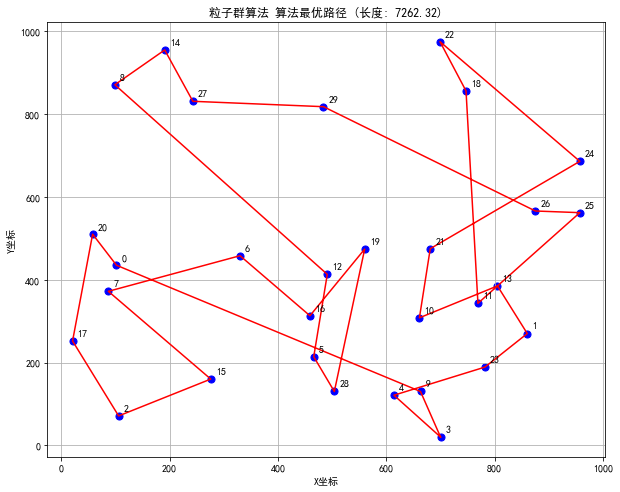
- 粒子群算法:通过粒子间的协作与信息共享寻找最优解
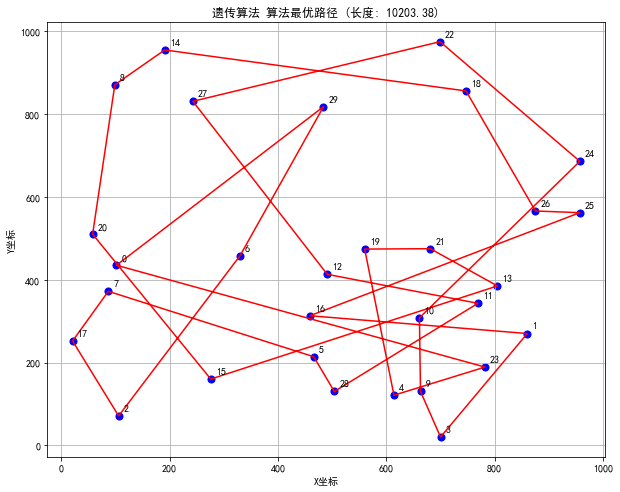
- 遗传算法:模拟生物进化过程,通过选择、交叉和变异操作优化解
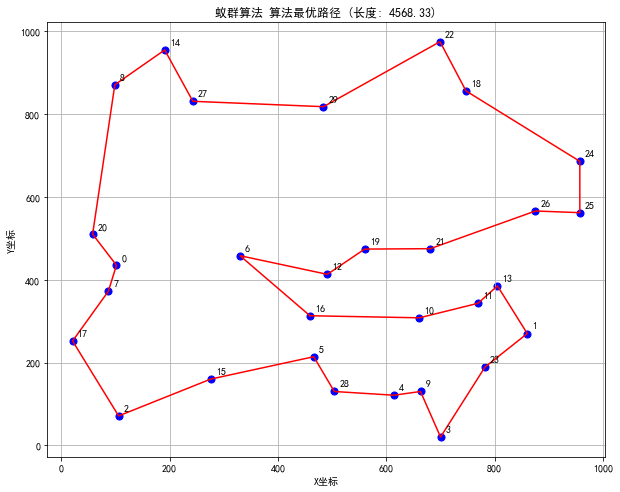
- 蚁群算法:模拟蚂蚁寻找食物的行为,利用信息素轨迹发现路径
-
性能比较:
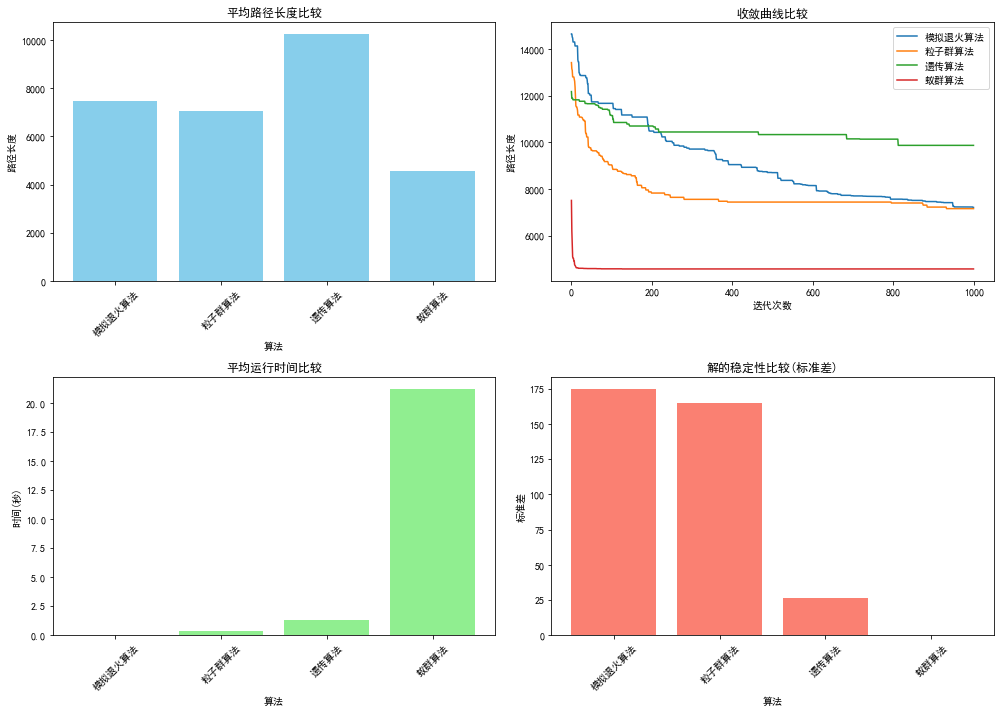
- 统计各算法的平均路径长度、最小路径长度、最大路径长度、标准差和运行时间
- 绘制收敛曲线比较算法的收敛速度
- 可视化各算法找到的最优路径
-
优缺点分析:
- 基于实验结果,分析每种算法在解质量、收敛速度、稳定性和计算复杂度方面的表现
- 讨论各算法的适用场景和局限性
import numpy as np
import matplotlib.pyplot as plt
import random
import math
import time
from typing import List, Tuple, Dict, Callable

# 设置随机种子以便结果可复现
np.random.seed(42)
random.seed(42)

class TSP:
    def __init__(self, num_cities: int = 20, width: int = 1000, height: int = 1000):
        """初始化TSP问题,随机生成城市坐标"""
        self.num_cities = num_cities
        self.cities = np.random.randint(0, width, size=(num_cities, 2))
        self.distance_matrix = self._calculate_distance_matrix()

    def _calculate_distance_matrix(self) -> np.ndarray:
        """计算城市间的距离矩阵"""
        matrix = np.zeros((self.num_cities, self.num_cities))
        for i in range(self.num_cities):
            for j in range(i+1, self.num_cities):
                dist = np.sqrt(np.sum((self.cities[i] - self.cities[j])**2))
                matrix[i, j] = dist
                matrix[j, i] = dist
        return matrix

    def get_tour_length(self, tour: List[int]) -> float:
        """计算路径长度"""
        total_distance = 0
        for i in range(len(tour) - 1):
            total_distance += self.distance_matrix[tour[i], tour[i+1]]
        # 回到起点
        total_distance += self.distance_matrix[tour[-1], tour[0]]
        return total_distance

    def plot_cities(self) -> None:
        """绘制城市分布"""
        plt.figure(figsize=(10, 8))
        plt.scatter(self.cities[:, 0], self.cities[:, 1], c='blue', s=50)
        for i, (x, y) in enumerate(self.cities):
            plt.annotate(str(i), (x, y), xytext=(5, 5), textcoords='offset points')
        plt.title('城市分布')
        plt.xlabel('X坐标')
        plt.ylabel('Y坐标')
        plt.grid(True)

    def plot_tour(self, tour: List[int], title: str = "旅行商路径") -> None:
        """绘制旅行路径"""
        plt.figure(figsize=(10, 8))
        # 绘制城市
        plt.scatter(self.cities[:, 0], self.cities[:, 1], c='blue', s=50)
        for i, (x, y) in enumerate(self.cities):
            plt.annotate(str(i), (x, y), xytext=(5, 5), textcoords='offset points')

        # 绘制路径
        tour_coords = self.cities[tour]
        plt.plot(np.append(tour_coords[:, 0], tour_coords[0, 0]),
                 np.append(tour_coords[:, 1], tour_coords[0, 1]),
                 'r-', linewidth=1.5)

        plt.title(title)
        plt.xlabel('X坐标')
        plt.ylabel('Y坐标')
        plt.grid(True)

# 模拟退火算法
def simulated_annealing(tsp: TSP, initial_temperature: float = 1000,
                        cooling_rate: float = 0.995, stopping_temperature: float = 1e-8,
                        max_iterations: int = 10000) -> Tuple[List[int], float, List[float]]:
    """使用模拟退火算法求解TSP"""
    # 初始化当前路径为随机路径
    current_tour = list(range(tsp.num_cities))
    random.shuffle(current_tour)
    current_length = tsp.get_tour_length(current_tour)

    # 记录最优路径
    best_tour = current_tour.copy()
    best_length = current_length

    # 温度和迭代记录
    temperature = initial_temperature
    iteration = 0
    history = []

    while temperature > stopping_temperature and iteration < max_iterations:
        # 生成相邻解
        neighbor_tour = generate_neighbor(current_tour)
        neighbor_length = tsp.get_tour_length(neighbor_tour)

        # 计算能量差
        delta = neighbor_length - current_length

        # 判断是否接受新解
        if delta < 0 or random.random() < math.exp(-delta / temperature):
            current_tour = neighbor_tour
            current_length = neighbor_length

            # 更新最优解
            if current_length < best_length:
                best_tour = current_tour.copy()
                best_length = current_length

        # 记录当前最优路径长度
        history.append(best_length)

        # 降温
        temperature *= cooling_rate
        iteration += 1

    return best_tour, best_length, history

def generate_neighbor(tour: List[int]) -> List[int]:
    """生成相邻解:随机交换路径中的两个城市"""
    neighbor = tour.copy()
    idx1, idx2 = random.sample(range(len(tour)), 2)
    neighbor[idx1], neighbor[idx2] = neighbor[idx2], neighbor[idx1]
    return neighbor

# 粒子群算法
class Particle:
    def __init__(self, num_cities: int):
        """初始化粒子"""
        self.position = list(range(num_cities))
        random.shuffle(self.position)
        self.velocity = []  # 交换序列
        self.pbest_position = self.position.copy()
        self.pbest_value = float('inf')

def particle_swarm_optimization(tsp: TSP, num_particles: int = 30, max_iterations: int = 1000,
                               w: float = 0.7, c1: float = 1.5, c2: float = 1.5) -> Tuple[List[int], float, List[float]]:
    """使用粒子群算法求解TSP"""
    num_cities = tsp.num_cities
    particles = [Particle(num_cities) for _ in range(num_particles)]

    # 初始化全局最优
    gbest_position = None
    gbest_value = float('inf')

    # 历史记录
    history = []

    for iteration in range(max_iterations):
        # 评估每个粒子
        for particle in particles:
            fitness = tsp.get_tour_length(particle.position)

            # 更新个体最优
            if fitness < particle.pbest_value:
                particle.pbest_value = fitness
                particle.pbest_position = particle.position.copy()

                # 更新全局最优
                if fitness < gbest_value:
                    gbest_value = fitness
                    gbest_position = particle.position.copy()

        # 记录当前全局最优
        history.append(gbest_value)

        # 更新粒子速度和位置
        for particle in particles:
            # 生成与个体最优的交换序列
            swap_sequence_pbest = generate_swap_sequence(particle.position, particle.pbest_position)
            # 生成与全局最优的交换序列
            swap_sequence_gbest = generate_swap_sequence(particle.position, gbest_position)

            # 计算新的速度(交换序列)
            particle.velocity = []
            # 继承部分旧速度
            if particle.velocity and random.random() < w:
                particle.velocity.append(random.choice(particle.velocity))

            # 添加与个体最优相关的交换
            if swap_sequence_pbest and random.random() < c1:
                particle.velocity.append(random.choice(swap_sequence_pbest))

            # 添加与全局最优相关的交换
            if swap_sequence_gbest and random.random() < c2:
                particle.velocity.append(random.choice(swap_sequence_gbest))

            # 应用速度(执行交换)
            for swap in particle.velocity:
                i, j = swap
                particle.position[i], particle.position[j] = particle.position[j], particle.position[i]

    return gbest_position, gbest_value, history

def generate_swap_sequence(tour1: List[int], tour2: List[int]) -> List[Tuple[int, int]]:
    """生成从tour1转换到tour2所需的交换序列"""
    swap_sequence = []
    tour = tour1.copy()
    pos = {city: idx for idx, city in enumerate(tour)}

    for i in range(len(tour)):
        if tour[i] != tour2[i]:
            # 找到tour2[i]在tour中的位置
            j = pos[tour2[i]]
            # 交换i和j位置的城市
            tour[i], tour[j] = tour[j], tour[i]
            # 更新位置字典
            pos[tour[i]] = i
            pos[tour[j]] = j
            # 记录交换
            swap_sequence.append((i, j))

    return swap_sequence

# 遗传算法
def genetic_algorithm(tsp: TSP, population_size: int = 100, generations: int = 500,
                     crossover_rate: float = 0.8, mutation_rate: float = 0.2) -> Tuple[List[int], float, List[float]]:
    """使用遗传算法求解TSP"""
    num_cities = tsp.num_cities

    # 初始化种群
    population = [list(range(num_cities)) for _ in range(population_size)]
    for individual in population:
        random.shuffle(individual)

    best_fitness = float('inf')
    best_individual = None
    history = []

    for generation in range(generations):
        # 评估适应度
        fitness_values = [1 / tsp.get_tour_length(individual) for individual in population]
        total_fitness = sum(fitness_values)

        # 记录最优解
        max_fitness_idx = fitness_values.index(max(fitness_values))
        current_best_fitness = 1 / fitness_values[max_fitness_idx]
        current_best_individual = population[max_fitness_idx]

        if current_best_fitness < best_fitness:
            best_fitness = current_best_fitness
            best_individual = current_best_individual.copy()

        history.append(best_fitness)

        # 选择操作 - 轮盘赌
        new_population = []
        for _ in range(population_size):
            r = random.uniform(0, total_fitness)
            cumulative_fitness = 0
            for i, fitness in enumerate(fitness_values):
                cumulative_fitness += fitness
                if cumulative_fitness >= r:
                    new_population.append(population[i].copy())
                    break

        # 交叉操作
        crossover_population = []
        while len(crossover_population) < population_size:
            parent1, parent2 = random.sample(new_population, 2)
            if random.random() < crossover_rate:
                child1, child2 = ordered_crossover(parent1, parent2)
                crossover_population.extend([child1, child2])
            else:
                crossover_population.extend([parent1.copy(), parent2.copy()])

        # 确保种群大小正确
        population = crossover_population[:population_size]

        # 变异操作
        for i in range(population_size):
            if random.random() < mutation_rate:
                population[i] = swap_mutation(population[i])

    return best_individual, best_fitness, history

def ordered_crossover(parent1: List[int], parent2: List[int]) -> Tuple[List[int], List[int]]:
    """有序交叉操作"""
    size = len(parent1)
    start, end = sorted(random.sample(range(size), 2))

    # 初始化子代
    child1 = [-1] * size
    child2 = [-1] * size

    # 复制交叉段
    child1[start:end] = parent1[start:end]
    child2[start:end] = parent2[start:end]

    # 填充剩余城市
    child1_remaining = [city for city in parent2 if city not in child1[start:end]]
    child2_remaining = [city for city in parent1 if city not in child2[start:end]]

    # 填充剩余位置
    index = 0
    for i in range(size):
        if i < start or i >= end:
            child1[i] = child1_remaining[index]
            child2[i] = child2_remaining[index]
            index += 1

    return child1, child2

def swap_mutation(individual: List[int]) -> List[int]:
    """交换变异操作"""
    if len(individual) > 1:
        i, j = random.sample(range(len(individual)), 2)
        individual[i], individual[j] = individual[j], individual[i]
    return individual

# 蚁群算法
def ant_colony_optimization(tsp: TSP, num_ants: int = 30, max_iterations: int = 100,
                           alpha: float = 1.0, beta: float = 2.0, rho: float = 0.5,
                           q: float = 100.0) -> Tuple[List[int], float, List[float]]:
    """使用蚁群算法求解TSP"""
    num_cities = tsp.num_cities
    distance_matrix = tsp.distance_matrix

    # 初始化信息素矩阵
    pheromone_matrix = np.ones((num_cities, num_cities)) * 0.1
    np.fill_diagonal(pheromone_matrix, 0)  # 对角线为0,因为城市到自身的距离为0

    best_tour = None
    best_length = float('inf')
    history = []

    for iteration in range(max_iterations):
        # 每只蚂蚁构建路径
        all_tours = []
        all_lengths = []

        for ant in range(num_ants):
            # 初始化
            current_city = random.randint(0, num_cities - 1)
            unvisited = list(range(num_cities))
            unvisited.remove(current_city)
            tour = [current_city]

            # 构建路径
            while unvisited:
                # 计算转移概率
                probabilities = []
                for city in unvisited:
                    pheromone = pheromone_matrix[current_city, city]
                    distance = distance_matrix[current_city, city]
                    if distance == 0:  # 避免除零错误
                        probability = 0
                    else:
                        probability = (pheromone ** alpha) * ((1.0 / distance) ** beta)
                    probabilities.append(probability)

                # 归一化概率
                if sum(probabilities) == 0:
                    next_city = random.choice(unvisited)
                else:
                    probabilities = [p / sum(probabilities) for p in probabilities]
                    # 轮盘赌选择下一个城市
                    next_city_idx = np.random.choice(len(unvisited), p=probabilities)
                    next_city = unvisited[next_city_idx]

                # 更新路径和未访问城市
                tour.append(next_city)
                unvisited.remove(next_city)
                current_city = next_city

            # 计算路径长度
            tour_length = tsp.get_tour_length(tour)
            all_tours.append(tour)
            all_lengths.append(tour_length)

            # 更新全局最优
            if tour_length < best_length:
                best_length = tour_length
                best_tour = tour.copy()

        # 记录当前迭代的最优路径长度
        history.append(best_length)

        # 更新信息素
        # 信息素挥发
        pheromone_matrix *= (1 - rho)

        # 信息素沉积
        for tour, length in zip(all_tours, all_lengths):
            if length == 0:  # 避免除零错误
                continue
            pheromone_deposit = q / length
            for i in range(len(tour) - 1):
                city1, city2 = tour[i], tour[i+1]
                pheromone_matrix[city1, city2] += pheromone_deposit
                pheromone_matrix[city2, city1] += pheromone_deposit
            # 回到起点
            city1, city2 = tour[-1], tour[0]
            pheromone_matrix[city1, city2] += pheromone_deposit
            pheromone_matrix[city2, city1] += pheromone_deposit

    return best_tour, best_length, history

# 比较算法
def compare_algorithms(tsp: TSP, algorithms: Dict[str, Callable], runs_per_algorithm: int = 5) -> None:
    """比较不同算法的性能"""
    results = {}

    # 运行每种算法多次并记录结果
    for alg_name, algorithm in algorithms.items():
        print(f"\n运行 {alg_name} 算法...")
        alg_results = []
        alg_times = []

        for run in range(runs_per_algorithm):
            print(f"第 {run+1}/{runs_per_algorithm} 次运行")
            start_time = time.time()
            best_tour, best_length, history = algorithm(tsp)
            end_time = time.time()

            alg_results.append(best_length)
            alg_times.append(end_time - start_time)

            # 只在第一次运行时绘制路径
            if run == 0:
                tsp.plot_tour(best_tour, f"{alg_name} 算法最优路径 (长度: {best_length:.2f})")

        # 计算统计数据
        avg_length = sum(alg_results) / runs_per_algorithm
        min_length = min(alg_results)
        max_length = max(alg_results)
        std_dev = np.std(alg_results)
        avg_time = sum(alg_times) / runs_per_algorithm

        results[alg_name] = {
            'avg_length': avg_length,
            'min_length': min_length,
            'max_length': max_length,
            'std_dev': std_dev,
            'avg_time': avg_time,
            'histories': [history for _, _, history in [algorithm(tsp) for _ in range(3)]]  # 保存几次运行的历史
        }

    # 绘制性能比较图
    plot_performance_comparison(results)

    # 输出统计结果
    print("\n算法性能比较:")
    print("{:<20} {:<15} {:<15} {:<15} {:<15} {:<15}".format(
        "算法", "平均路径长度", "最小路径长度", "最大路径长度", "标准差", "平均运行时间(秒)"))
    print("-" * 90)
    for alg_name, stats in results.items():
        print("{:<20} {:<15.2f} {:<15.2f} {:<15.2f} {:<15.2f} {:<15.2f}".format(
            alg_name, stats['avg_length'], stats['min_length'],
            stats['max_length'], stats['std_dev'], stats['avg_time']))

    # 算法优缺点分析
    analyze_algorithms(results)

def plot_performance_comparison(results: Dict[str, Dict]) -> None:
    """绘制算法性能比较图"""
    plt.figure(figsize=(14, 10))

    # 绘制平均路径长度比较
    plt.subplot(2, 2, 1)
    alg_names = list(results.keys())
    avg_lengths = [results[alg]['avg_length'] for alg in alg_names]
    plt.bar(alg_names, avg_lengths, color='skyblue')
    plt.title('平均路径长度比较')
    plt.xlabel('算法')
    plt.ylabel('路径长度')
    plt.xticks(rotation=45)
    plt.tight_layout()

    # 绘制收敛曲线比较
    plt.subplot(2, 2, 2)
    for alg_name, stats in results.items():
        # 取多次运行的平均收敛曲线
        histories = stats['histories']
        min_len = min(len(h) for h in histories)
        avg_history = np.mean([h[:min_len] for h in histories], axis=0)
        plt.plot(avg_history, label=alg_name)
    plt.title('收敛曲线比较')
    plt.xlabel('迭代次数')
    plt.ylabel('路径长度')
    plt.legend()
    plt.tight_layout()

    # 绘制运行时间比较
    plt.subplot(2, 2, 3)
    avg_times = [results[alg]['avg_time'] for alg in alg_names]
    plt.bar(alg_names, avg_times, color='lightgreen')
    plt.title('平均运行时间比较')
    plt.xlabel('算法')
    plt.ylabel('时间(秒)')
    plt.xticks(rotation=45)
    plt.tight_layout()

    # 绘制标准差比较
    plt.subplot(2, 2, 4)
    std_devs = [results[alg]['std_dev'] for alg in alg_names]
    plt.bar(alg_names, std_devs, color='salmon')
    plt.title('解的稳定性比较(标准差)')
    plt.xlabel('算法')
    plt.ylabel('标准差')
    plt.xticks(rotation=45)
    plt.tight_layout()

    plt.show()

def analyze_algorithms(results: Dict[str, Dict]) -> None:
    """分析各算法的优缺点"""
    print("\n\n算法优缺点分析:")

    # 找出最优算法(基于平均路径长度)
    best_alg = min(results, key=lambda x: results[x]['avg_length'])

    for alg_name in results:
        print(f"\n{alg_name}:")

        # 优点
        print("  优点:")
        if alg_name == best_alg:
            print("    - 找到的解质量最高,平均路径长度最短")

        if alg_name == "模拟退火算法":
            print("    - 实现简单,易于理解和调整")
            print("    - 能够跳出局部最优,找到全局最优解的概率较高")
            print("    - 对问题的适应性强,不需要特殊的问题结构知识")

        elif alg_name == "粒子群算法":
            print("    - 收敛速度较快,尤其在早期迭代")
            print("    - 保留了群体搜索的特性,能在全局和局部搜索之间取得平衡")
            print("    - 参数较少,易于实现")

        elif alg_name == "遗传算法":
            print("    - 并行搜索能力强,能同时探索多个解空间区域")
            print("    - 鲁棒性好,对初始解的依赖性较低")
            print("    - 适合大规模问题,可扩展性强")

        elif alg_name == "蚁群算法":
            print("    - 天然具有并行性,适合分布式计算")
            print("    - 能够利用信息素轨迹自适应地发现高质量路径")
            print("    - 具有正反馈机制,有助于快速收敛到较好的解")

        # 缺点
        print("  缺点:")

        if alg_name == "模拟退火算法":
            print("    - 收敛速度较慢,尤其在后期迭代")
            print("    - 参数调整对性能影响较大,需要谨慎选择初始温度和降温速率")
            print("    - 对于大规模问题,计算时间可能过长")

        elif alg_name == "粒子群算法":
            print("    - 在处理离散优化问题(如TSP)时,需要特殊的编码和解码策略")
            print("    - 容易陷入局部最优,尤其是在后期迭代")
            print("    - 对参数设置敏感,如惯性权重和学习因子")

        elif alg_name == "遗传算法":
            print("    - 编码复杂,需要设计合适的交叉和变异操作")
            print("    - 收敛速度可能较慢,尤其是当种群规模较大时")
            print("    - 参数调整(如交叉率、变异率)需要经验")

        elif alg_name == "蚁群算法":
            print("    - 初始阶段收敛速度较慢,需要一定迭代次数积累信息素")
            print("    - 参数众多(如信息素重要性、启发式因子、挥发率),调整困难")
            print("    - 容易出现停滞现象,所有蚂蚁可能集中在同一条路径上")

        # 适用场景
        print("  适用场景:")

        if alg_name == "模拟退火算法":
            print("    - 问题规模较小,需要高质量解")
            print("    - 问题结构复杂,没有明显的启发式信息")
            print("    - 对算法实现的简易性有较高要求")

        elif alg_name == "粒子群算法":
            print("    - 问题具有一定的连续性或可微性")
            print("    - 需要快速找到一个较好的解,对最优解的要求不是极高")
            print("    - 可以容忍一定的局部最优解")

        elif alg_name == "遗传算法":
            print("    - 问题规模较大,解空间复杂")
            print("    - 需要并行搜索能力")
            print("    - 解的多样性很重要")

        elif alg_name == "蚁群算法":
            print("    - 问题具有图结构,如路径规划、网络优化")
            print("    - 需要利用历史信息指导搜索")
            print("    - 可以接受较长的计算时间以换取高质量解")

if __name__ == "__main__":
    # 创建TSP问题实例
    tsp = TSP(num_cities=30)

    # 绘制城市分布
    tsp.plot_cities()

    # 定义要比较的算法及其参数
    algorithms = {
        "模拟退火算法": lambda tsp: simulated_annealing(
            tsp, initial_temperature=1000, cooling_rate=0.995,
            stopping_temperature=1e-8, max_iterations=1000
        ),
        "粒子群算法": lambda tsp: particle_swarm_optimization(
            tsp, num_particles=30, max_iterations=1000,
            w=0.7, c1=1.5, c2=1.5
        ),
        "遗传算法": lambda tsp: genetic_algorithm(
            tsp, population_size=100, generations=1000,
            crossover_rate=0.8, mutation_rate=0.2
        ),
        "蚁群算法": lambda tsp: ant_colony_optimization(
            tsp, num_ants=30, max_iterations=1000,
            alpha=1.0, beta=2.0, rho=0.5, q=100.0
        )
    }

    # 比较算法性能
    compare_algorithms(tsp, algorithms, runs_per_algorithm=3)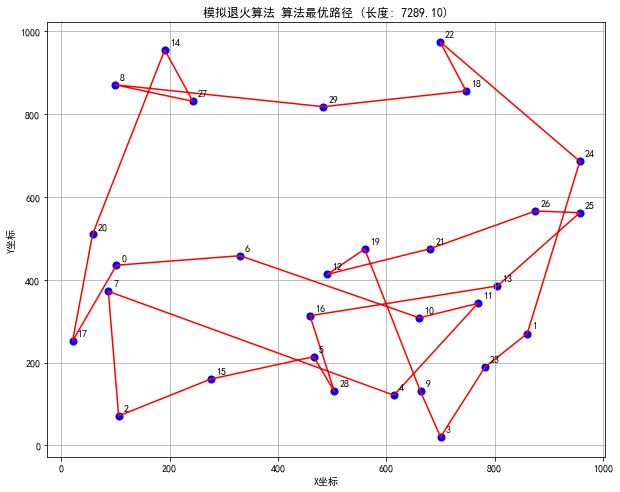
模拟退火算法、粒子群算法、遗传算法、蚁群算法TSP问题
于 2025-07-12 22:24:07 首次发布





 扫一扫
扫一扫


 269
269

 被折叠的 条评论
为什么被折叠?
被折叠的 条评论
为什么被折叠?
 到【灌水乐园】发言





