poj1753 高斯消元

poj--1753 Flip Game(二维反转)(高斯消元) 给定4乘4的01矩阵,反转成全零或者全1 阅读详情

Flip Game
Time Limit: 1000MS Memory Limit: 65536K
Total Submissions: 37055 Accepted: 16125

Description

Flip game is played on a rectangular 4x4 field with two-sided pieces placed on each of its 16 squares. One side of each piece is white and the other one is black and each piece is lying either it's black or white side up. Each round you flip 3 to 5 pieces, thus changing the color of their upper side from black to white and vice versa. The pieces to be flipped are chosen every round according to the following rules: 
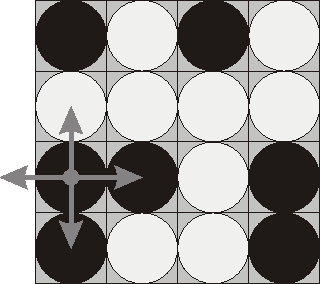
  1. Choose any one of the 16 pieces. 
  2. Flip the chosen piece and also all adjacent pieces to the left, to the right, to the top, and to the bottom of the chosen piece (if there are any).

Consider the following position as an example: 

bwbw 
wwww 
bbwb 
bwwb 
Here "b" denotes pieces lying their black side up and "w" denotes pieces lying their white side up. If we choose to flip the 1st piece from the 3rd row (this choice is shown at the picture), then the field will become: 

bwbw 
bwww 
wwwb 
wwwb 
The goal of the game is to flip either all pieces white side up or all pieces black side up. You are to write a program that will search for the minimum number of rounds needed to achieve this goal. 

Input

The input consists of 4 lines with 4 characters "w" or "b" each that denote game field position.

Output

Write to the output file a single integer number - the minimum number of rounds needed to achieve the goal of the game from the given position. If the goal is initially achieved, then write 0. If it's impossible to achieve the goal, then write the word "Impossible" (without quotes).

Sample Input

bwwb
bbwb
bwwb
bwww

Sample Output

4

思路:

和前面那些问题差不多吧,只是它最后结果要求全黑或者全白,所以算了两次


poj1753
/*
同样的基于二维矩阵的开关问题,只是题目要求最终结果要
全亮或者全黑,于是算两次即可
*/
#include <iostream>
#include <cstdio>
#include <cstdlib>
#include <cstring>
#include <algorithm>
#include <cmath>
using namespace std;
typedef long long ll;
typedef long double ld;

using namespace std;
const int maxn = 40;

int equ,var;
int a[maxn][maxn];
int b[maxn][maxn];
int x[maxn];
int free_x[maxn];
int free_num;

int Gauss()
{
    int max_r,col,k;
    free_num = 0;
    for(k = 0,col = 0; k < equ && col < var; k++,col++)
    {
        max_r = k;
        for(int i = k+1; i < equ; i++)
        {
            if(abs(a[i][col]) > abs(a[max_r][col]))
                max_r = i;
        }
        if(a[max_r][col] == 0)
        {
            k --;
            free_x[free_num++] = col;
            continue;
        }
        if(max_r != k)
        {
            for(int j = col; j < var+1; j++)
                swap(a[k][j],a[max_r][j]);

        }
        for(int i = k + 1; i < equ; i++)
        {
            if(a[i][col] != 0)
            {
                for(int j = col; j < var+1; j++)
                    a[i][j] ^= a[k][j];
            }
        }

    }
    for(int i = k; i < equ; i++)
        if(a[i][col] != 0)
            return -1;
    if(k < var) return var-k;

    for(int i = var-1; i >= 0; i--)
    {
        x[i] = a[i][var];
        for(int j = i +1; j < var; j++)
            x[i] ^= (a[i][j] && x[j]);

    }
    return 0;

}

int n;
void ini()
{
    memset(a,0,sizeof(a));
    memset(x,0,sizeof(x));
    equ = n*n;
    var = n*n;
    for(int i = 0; i < n; i++)
    {
        for(int j = 0; j < n; j++)
        {
            int tt = i*n+ j;
            a[tt][tt] =1;
            b[tt][tt] = 1;
            if(i > 0) a[(i-1)*n+j][tt] = 1;
            if(i < n-1) a[(i+1)*n+j][tt] =  1;
            if(j > 0) a[tt-1][tt] = 1;
            if(j < n-1) a[tt+1][tt] =1;
        }
    }
}

int solve()
{
    int t = Gauss();
    if(t == -1)
    {
        return t;
    }
    else if(t == 0)
    {
        int ans = 0;
        for(int i = 0; i < n*n; i++)
            ans += x[i];
        return ans;
    }
    else
    {
        int ans = 0x3f3f3f3f;
        int tot = (1 << t);
        for(int i = 0; i < tot; i++)
        {
            int cnt = 0;
            for(int j = 0; j < t; j++)
            {
                if(i & (1 << j))
                {
                    cnt ++;
                    x[free_x[j]]= 1;
                }
                else x[free_x[j]]= 0;
            }

            for(int j = var-t-1; j >= 0; j--)
            {
                int dex;
                for(dex = j; dex < var; dex++)
                    if(a[j][dex])
                        break;
                x[dex] = a[j][var];
                for(int l = dex +1; l <var ; l++)
                {
                    if(a[j][l])
                        x[dex] ^= x[l];
                }
                cnt += x[dex];
            }
            ans = min(ans,cnt);
        }
        return ans;
    }
}

char str[30][30];

int main()
{
    int T;
    char color;
    scanf("%d",&T);
    while(scanf("%s",str[0]) !=EOF)
    {
        n = 4;
        ini();
        for(int j = 0; j < n; j++)
        {
            if(str[0][j] == 'b')
            {
                a[j][n*n] = 0;
            }
            else
            {
                a[j][n*n] =  1;
            }
        }


        for(int i = 1; i < n; i++)
        {
            scanf("%s",str[i]);
            for(int j = 0; j < n; j++)
            {
                if(str[i][j] == 'b')
                {
                    a[i*n+j][n*n] = 0;
                }
                else
                {
                    a[i*n+j][n*n] =  1;
                }
            }
        }
        int ans1 = solve();
        //cout <<ans1 <<endl;
        ini();
        for(int i = 0;i < n;i++)
        {
            for(int j = 0;j < n;j++)
            {
                if(str[i][j] == 'b')
                {
                    a[i*n+j][n*n] = 1;
                }
                else
                {
                    a[i*n+j][n*n] =  0;
                }
            }
        }
        int ans2 = solve();
        //cout << ans2<<endl;
        if(ans1 == -1 && ans2 == -1)
            printf("Impossible\n");
        else if(ans1 == -1)
            printf("%d\n",ans2);
        else if(ans2 == -1)
            printf("%d\n",ans1);
        else
            printf("%d\n",min(ans1,ans2));
    }
    return 0;
}



自动驾驶仿真 (四)—— 基于PreScan与Simulink的AEB系统多场景验证 本文详细介绍了基于PreScan与Simulink的AEB系统多场景验证方法,涵盖标准场景搭建、复杂工况扩展及控制策略优化。通过仿真技术,显著降低测试成本并提升场景覆盖率,有效解决实车测试中的痛点问题。特别适用于自动驾驶领域的AEB系统开发与验证。 阅读详情

相关推荐

三、分区配置

rk3566/rk3568 修改分区

暮云星影的博客 514

POJ1753 Flip Game 高斯消元

题目链接:http://poj.org/problem?id=1753 题目大意:有一个4×4的棋盘,棋盘上每一点都有黑白两面,每次可以翻转任意一点,在翻转某一点时,该点上下左右的4个临近点同时也会被翻转,现在问你要使棋盘上所有点的颜色统一所需要的最小翻转次数。 分析:典型的高斯消元,不过也可以用DFS来做,具体参考:点击打开链接。用高消做的话,由系数矩阵可以得知该方程组的秩为

AC_Gibson的专栏 1288

IEC61850客户端连接实战:CMS vs MMS协议抓包对比与性能初探(基于YX-PIS协议栈)

本文深入探讨了IEC61850客户端连接中CMS与MMS协议的抓包对比与性能优化。通过Wireshark抓包分析、协议栈配置实战和性能基准测试,揭示了两种协议在连接建立、数据交互和性能调优方面的关键差异,为智能电网自动化系统的协议选择提供了实用指南。

weixin_29209805的博客 215

POJ1753 Flip Game【高斯消元法】

题目大意: 有一个 4*4 的棋盘,棋盘上有黑色和白色的格子,每一次你可以翻其中的一个格子,这 个格子(x,y)如果被翻,那么对应位置为(x-1,y)、(x+1,y)、(x,y-1)、(x,y+1) 格子的颜色会变成相对的颜色,现在求将棋盘全部翻为白色格子或者是黑色格子用的最 少的步数是多少?如果无法把所有格子都翻为白色或者是黑色,那么输出 "Impossible"。 解题思路: 和 POJ1222 一样,一个格子变化最多改变 5 个格子,其中格子改变为 1,格子不改变 为 0,则每个位

程序员充电站(itcharge) 1031

【技术解析】Point-NeRF:如何通过点云优化加速神经辐射场渲染

本文深入解析了Point-NeRF技术,它通过引入3D点云作为几何先验,有效解决了传统神经辐射场渲染速度慢的痛点。该方法利用神经点云构建局部辐射场,结合点剪枝与生长策略进行动态优化,在保证高渲染质量的同时,实现了高达30倍的训练加速,为高效3D场景重建提供了新范式。

weixin_29159127的博客 266

【UE5】VoskPlugin实战:离线语音识别与实时文本转换全流程解析

本文详细解析了如何在UE5中利用VoskPlugin实现离线实时语音转文字功能。从环境搭建、插件配置、核心代码编写到蓝图测试,提供了完整的实战教程。重点阐述了离线方案零延迟、数据私密的优势,并分享了模型选择、性能优化及常见问题的解决方案,帮助开发者快速构建稳定可靠的语音交互系统。

weixin_29001655的博客 619

POJ 1681 (高斯消元)

板子题,01方程求解,自由元取0不一定是最优的. #include #include #include #include #include using namespace std; #define maxn 333 #define free Free int a[maxn][maxn]; char mp[maxn][maxn]; int free[maxn*maxn]; //标记自由

morejarphone~ 493

ACS驱动器直线电机回零程序与误差补偿Buffer实战解析

本文深入解析了ACS驱动器控制直线电机时,实现高精度回零与误差补偿的完整实战流程。核心在于利用驱动器的D-Buffer功能,将激光干涉仪测量的误差数据导入补偿数组,通过ERRORMAP1D指令进行映射,从而实时修正定位误差,显著提升设备重复定位精度。文章详细拆解了回零程序逻辑、补偿参数设置及关键调试避坑指南。

646

POJ1753高斯消元+枚举

Flip Game Time Limit: 1000MS   Memory Limit: 65536K Total Submissions: 20337   Accepted: 8821 Description Flip game is played on a rectangular 4x4 field with two-sided piec

韩小侠的专栏 已迁移至lssea.com 1720

AI技术在电商中的实际应用

人工智能、电商、推荐系统、个性化、机器学习、深度学习 1. 背景介绍 电子商务行业近年来发展迅速,用户数量不断增长,商品种类日益丰富。然而,随着市场竞争的加剧,电商平台面临着如何提升用户体验、提高转化率、挖掘潜在商机等一系列挑战。人工智能(AI)技术作为一种新兴技术,凭借其强大的数

AGI×大数据,开启智能时代的认知跃迁;解码AGI,赋能数据驱动的智能革命。 1740

第十六章:载板制造工艺大全

本文详细介绍了IC载板制造的完整工艺流程,主要包括开料、钻孔、孔金属化、图形形成、层压、表面处理、成型和电测8大工序。每个工序都列出了关键参数和质量控制要点,如开料尺寸精度±0.1mm、激光钻孔孔径50-150μm、孔金属化铜厚20-30μm、图形形成线宽15μm±2μm等。文中还特别说明了MSAP工艺和沉金等特殊工艺的详细流程,以及成型精度和电测标准等关键指标。全文通过流程图和参数表格直观展示了IC载板制造的核心工艺和质量要求。

Open 184

poj 1753 Flip Game 高斯消元+枚举

poj 1753 Flip Game 高斯消元+枚举 题目链接:http://poj.org/problem?id=1753 题目描述: Flip Game Time Limit: 1000MS   Memory Limit: 65536K Total Submissions: 40652   Accepted: 17652 D

而濡木染 883

车载以太网网络测试-27【SOME/IP-SD简述】

SOME/IP-SD协议是基于IP的可扩展面向服务中间件中的服务发现协议,是汽车电子和嵌入式系统中实现动态服务发现与通信的核心组件。该协议规范详细说明了协议SOME/IP服务发现(SOME/IP-SD)的格式、消息序列和语义。本文将对SOME/IP-SD协议进行详细介绍。

车载网络测试工程师的博客 1953

POJ.1753 Flip Game(高斯消元+枚举自由元 两次)

题意:给你一个4*4的矩阵,每个位置对应着一个状态(开或者关),然后如果你按动某一个位置,那么上下左右位置都会被影响二改变状态,问最少经过几次达到全开或者全馆的状态。 分析:其实对于每一个位置都可以列一个线性方程,构成一个方程组,a[i][j]就是表示按动j位置时对i位置有影响,然后对于方程组用高斯消元求解,然后对于存在自由元的情况需要枚举判断符合的个数,最后取最小值。 #include <...

八百标兵奔北坡的博客 299

计算机控制技术及应用

《计算机控制技术及应用》通过总结作者的科研成果和吸收国内外的先进理论、方法和技术,以计算机控制系统的网络化、开放化、智能化和集成化发展趋势为主线索,主要介绍计算机控制系统的基本概念和计算机控制系统的典型形式,计算机控制系统的数学描述与基本分析方法,以及数字PID控制器、最少拍控制系统、达林算法、状态变量设计法等设计方法及其各种改进算法。重点突出计算机控制系统输入输出通道接口的设计方法和典型控制系统的设计案例与实现方法等。

深度学习工具包 DeepLearningToolbox

深度学习工具包Deprecation notice.-----This toolbox is outdated and no longer maintained.There are much better tools available for deep learning than this toolbox, e.g. [Theano](http://deeplearning.net/software/theano/), [torch](http://torch.ch/) or [tensorflow](http://www.tensorflow.org/)I would suggest you use one of the tools mentioned above rather than use this toolbox.Best, Rasmus.DeepLearnToolbox================A Matlab toolbox for Deep Learning.Deep Learning is a new subfield of machine learning that focuses on learning deep hierarchical models of data.It is inspired by the human brain's apparent deep (layered, hierarchical) architecture.A good overview of the theory of Deep Learning theory is[Learning Deep Architectures for AI](http://www.iro.umontreal.ca/~bengioy/papers/ftml_book.pdf)For a more informal introduction, see the following videos by Geoffrey Hinton and Andrew Ng.* [The Next Generation of Neural Networks](http://www.youtube.com/watch?v=AyzOUbkUf3M) (Hinton, 2007)* [Recent Developments in Deep Learning](http://www.youtube.com/watch?v=VdIURAu1-aU) (Hinton, 2010)* [Unsupervised Feature Learning and Deep Learning](http://www.youtube.com/watch?v=ZmNOAtZIgIk) (Ng, 2011)If you use this toolbox in your research please cite [Prediction as a candidate for learning deep hierarchical models of data](http://www2.imm.dtu.dk/pubdb/views/publication_details.php?id=6284)```@MASTERSTHESIS\{IMM2012-06284, author = "R. B. Palm", title = "Prediction as a candidate for learning deep hierarchical models of data", year = "2012",}```Contact: rasmusbergpalm at gmail dot comDirectories included in the toolbox-----------------------------------`NN/` - A library for Feedforward Backpropagation Neural Networks`CNN/` - A library for Convolutional Neural Networks`DBN/` - A library for Deep Belief Networks`SAE/` - A library for Stacked Auto-Encoders`CAE/` - A library for Convolutional Auto-Encoders`util/` - Utility functions used by the libraries`data/` - Data used by the examples`tests/` - unit tests to verify toolbox is workingFor references on each library check REFS.mdSetup-----1. Download.2. addpath(genpath('DeepLearnToolbox'));Example: Deep Belief Network---------------------```matlabfunction test_example_DBNload mnist_uint8;train_x = double(train_x) / 255;test_x = double(test_x) / 255;train_y = double(train_y);test_y = double(test_y);%% ex1 train a 100 hidden unit RBM and visualize its weightsrand('state',0)dbn.sizes = [100];opts.numepochs = 1;opts.batchsize = 100;opts.momentum = 0;opts.alpha = 1;dbn = dbnsetup(dbn, train_x, opts);dbn = dbntrain(dbn, train_x, opts);figure; visualize(dbn.rbm{1}.W'); % Visualize the RBM weights%% ex2 train a 100-100 hidden unit DBN and use its weights to initialize a NNrand('state',0)%train dbndbn.sizes = [100 100];opts.numepochs = 1;opts.batchsize = 100;opts.momentum = 0;opts.alpha = 1;dbn = dbnsetup(dbn, train_x, opts);dbn = dbntrain(dbn, train_x, opts);%unfold dbn to nnnn = dbnunfoldtonn(dbn, 10);nn.activation_function = 'sigm';%train nnopts.numepochs = 1;opts.batchsize = 100;nn = nntrain(nn, train_x, train_y, opts);[er, bad] = nntest(nn, test_x, test_y);assert(er < 0.10, 'Too big error');```Example: Stacked Auto-Encoders---------------------```matlabfunction test_example_SAEload mnist_uint8;train_x = double(train_x)/255;test_x = double(test_x)/255;train_y = double(train_y);test_y = double(test_y);%% ex1 train a 100 hidden unit SDAE and use it to initialize a FFNN% Setup and train a stacked denoising autoencoder (SDAE)rand('state',0)sae = saesetup([784 100]);sae.ae{1}.activation_function = 'sigm';sae.ae{1}.learningRate = 1;sae.ae{1}.inputZeroMaskedFraction = 0.5;opts.numepochs = 1;opts.batchsize = 100;sae = saetrain(sae, train_x, opts);visualize(sae.ae{1}.W{1}(:,2:end)')% Use the SDAE to initialize a FFNNnn = nnsetup([784 100 10]);nn.activation_function = 'sigm';nn.learningRate = 1;nn.W{1} = sae.ae{1}.W{1};% Train the FFNNopts.numepochs = 1;opts.batchsize = 100;nn = nntrain(nn, train_x, train_y, opts);[er, bad] = nntest(nn, test_x, test_y);assert(er < 0.16, 'Too big error');```Example: Convolutional Neural Nets---------------------```matlabfunction test_example_CNNload mnist_uint8;train_x = double(reshape(train_x',28,28,60000))/255;test_x = double(reshape(test_x',28,28,10000))/255;train_y = double(train_y');test_y = double(test_y');%% ex1 Train a 6c-2s-12c-2s Convolutional neural network %will run 1 epoch in about 200 second and get around 11% error. %With 100 epochs you'll get around 1.2% errorrand('state',0)cnn.layers = { struct('type', 'i') %input layer struct('type', 'c', 'outputmaps', 6, 'kernelsize', 5) %convolution layer struct('type', 's', 'scale', 2) %sub sampling layer struct('type', 'c', 'outputmaps', 12, 'kernelsize', 5) %convolution layer struct('type', 's', 'scale', 2) %subsampling layer};cnn = cnnsetup(cnn, train_x, train_y);opts.alpha = 1;opts.batchsize = 50;opts.numepochs = 1;cnn = cnntrain(cnn, train_x, train_y, opts);[er, bad] = cnntest(cnn, test_x, test_y);%plot mean squared errorfigure; plot(cnn.rL);assert(er<0.12, 'Too big error');```Example: Neural Networks---------------------```matlabfunction test_example_NNload mnist_uint8;train_x = double(train_x) / 255;test_x = double(test_x) / 255;train_y = double(train_y);test_y = double(test_y);% normalize[train_x, mu, sigma] = zscore(train_x);test_x = normalize(test_x, mu, sigma);%% ex1 vanilla neural netrand('state',0)nn = nnsetup([784 100 10]);opts.numepochs = 1; % Number of full sweeps through dataopts.batchsize = 100; % Take a mean gradient step over this many samples[nn, L] = nntrain(nn, train_x, train_y, opts);[er, bad] = nntest(nn, test_x, test_y);assert(er < 0.08, 'Too big error');%% ex2 neural net with L2 weight decayrand('state',0)nn = nnsetup([784 100 10]);nn.weightPenaltyL2 = 1e-4; % L2 weight decayopts.numepochs = 1; % Number of full sweeps through dataopts.batchsize = 100; % Take a mean gradient step over this many samplesnn = nntrain(nn, train_x, train_y, opts);[er, bad] = nntest(nn, test_x, test_y);assert(er < 0.1, 'Too big error');%% ex3 neural net with dropoutrand('state',0)nn = nnsetup([784 100 10]);nn.dropoutFraction = 0.5; % Dropout fraction opts.numepochs = 1; % Number of full sweeps through dataopts.batchsize = 100; % Take a mean gradient step over this many samplesnn = nntrain(nn, train_x, train_y, opts);[er, bad] = nntest(nn, test_x, test_y);assert(er < 0.1, 'Too big error');%% ex4 neural net with sigmoid activation functionrand('state',0)nn = nnsetup([784 100 10]);nn.activation_function = 'sigm'; % Sigmoid activation functionnn.learningRate = 1; % Sigm require a lower learning rateopts.numepochs = 1; % Number of full sweeps through dataopts.batchsize = 100; % Take a mean gradient step over this many samplesnn = nntrain(nn, train_x, train_y, opts);[er, bad] = nntest(nn, test_x, test_y);assert(er < 0.1, 'Too big error');%% ex5 plotting functionalityrand('state',0)nn = nnsetup([784 20 10]);opts.numepochs = 5; % Number of full sweeps through datann.output = 'softmax'; % use softmax outputopts.batchsize = 1000; % Take a mean gradient step over this many samplesopts.plot = 1; % enable plottingnn = nntrain(nn, train_x, train_y, opts);[er, bad] = nntest(nn, test_x, test_y);assert(er < 0.1, 'Too big error');%% ex6 neural net with sigmoid activation and plotting of validation and training error% split training data into training and validation datavx = train_x(1:10000,:);tx = train_x(10001:end,:);vy = train_y(1:10000,:);ty = train_y(10001:end,:);rand('state',0)nn = nnsetup([784 20 10]); nn.output = 'softmax'; % use softmax outputopts.numepochs = 5; % Number of full sweeps through dataopts.batchsize = 1000; % Take a mean gradient step over this many samplesopts.plot = 1; % enable plottingnn = nntrain(nn, tx, ty, opts, vx, vy); % nntrain takes validation set as last two arguments (optionally)[er, bad] = nntest(nn, test_x, test_y);assert(er < 0.1, 'Too big error');```[![Bitdeli Badge](https://d2weczhvl823v0.cloudfront.net/rasmusbergpalm/deeplearntoolbox/trend.png)](https://bitdeli.com/free "Bitdeli Badge")

POJ 1753 Flip Game (高斯消元)

题目地址:POJ 1753 第三次做这道题了。第一次是刚学搜索的时候做的,第二次是刚学状态压缩枚举的时候做的,这次是刚学高斯消元、、每次都做得很艰辛。。目测这题应该没了别的方法了吧。。。。。。 这题除了高斯消元外还需要枚举变元,方法是状态压缩枚举,然后返回去迭代解方程。 代码如下: #include #include #include #include #include #inc

scf0920 1063

NTscan扫描工具

ntscan是一个扫描器,可以扫描没有密码和弱密码的共享,先到配置文件中填写猜测的用户名和密码,扫描过程中右侧出现的是扫描日志。

POJ.1753 Flip Game (高斯消元 枚举自由元)

POJ.1753 Flip Game (高斯消元 枚举自由元)标签(空格分隔): 高斯消元题意分析基本方法是和解决异或方程组是一样的。严格来讲,遇到有多个自由元的时候,不能统一将自由元当做0处理。 自由元在前几篇题解中已经提及他的概念了,包括一些详细的解释。所谓自由元指的是在有无穷解的情况下,随意取值的自变量。举个栗子例子:{u+x+2y+z=30y+z=20 \begin{cases} u+x

Pengwill's Blog 690

霍尼韦尔SoftMaster使用说明

霍尼韦尔SoftMaster使用说明

poj 1753 Flip Game(高斯消元)

和 poj 1681 Painter’s Problem 完全一样,http://blog.youkuaiyun.com/gyhguoge01234/article/details/78428118#include <stdio.h> #include <string.h> #include <algorithm> using namespace std; //对2取模的01方程组 const int MAXN

梦幻的蔷薇色 357

[高斯消元] poj 1753 Flip Game

#include"cstdlib" #include"cstdio" #include"cstring" #include"cmath" #include"queue" #include"algorithm" #include"iostream" using namespace std; int equ,var; int a[17][17]; int x[17]; int n

Enmity_Dark 537

高斯消元 POJ 1830 1222 1753

做了高斯消元题目若干,总结: AX = B A是已知的状态矩阵,a[i][j]表示物j对物i有关联作用。如果作用是相互的,则是对称矩阵。 B的设置根据初始状态和末状态的差值状态。B0+AX = B1,B = B1 - B0. A是n*n矩阵,秩为r;增广矩阵(A|B)是n*(n+1)矩阵,秩为s Ⅰ.  s != r 方程无解,即没有方案满足; Ⅱ.  s == r

Baileys0530的专栏 888

POJ 1753 Flip Game 高斯消元 枚举自由变量

题目链接:http://poj.org/problem?id=1753构造号方程之后,先判断是否有解,之后在位运算枚举自由变量的值代码:#include <cstdio> #include <algorithm> #include <cstring> #define pf printf #define sf scanfusing namespace std; const int maxn = 20,

SolarDomo的博客 551

poj 1753 Flip Game (高斯消元)

题意: 给出一个4*4的方格,里面有黑色和白色的棋子,如果操作某个棋子,那么这个棋子以及这个棋子的四周会反转,由黑变白或由白变黑。求最小操作数,使得整个方块变成同色。 题解: 高斯消元,开关类问题,有可能有多解,所以要枚举自由变元找到最小解,分别对全变成黑色和全变成白色跑一边高斯消元,去最小值。 #include #include #include #include #include #i

ACM之梦 487

[POJ1753]Flip Game(异或方程组,高斯消元,枚举自由变量)

题目链接:http://poj.org/problem?id=1753 题意:同上。 这回翻来翻去要考虑自由变元了,假设返回了自由变元数量,则需要枚举自由变元。 1 /* 2 ━━━━━┒ギリギリ♂ eye! 3 ┓┏┓┏┓┃キリキリ♂ mind! 4 ┛┗┛┗┛┃\○/ 5 ┓┏┓┏┓┃ / 6 ┛┗┛┗┛┃ノ) 7 ┓┏┓┏┓┃ 8 ┛┗...

weixin_30539835的博客 185

poj 1753 Flip Game 【高斯消元 + 状压枚举自由变元】

Flip Game Time Limit: 1000MS   Memory Limit: 65536K Total Submissions: 35432   Accepted: 15487 Description Flip game is played on a rectangular 4x4 field with two-sided p

世界很大 630

POJ 1753 (高斯消元)

题意是把所有的字母都变成w或者b的最小步数. 跑两次01方程,取最小如果两次都无解就输出无解.板子题~ #include #include #include #include #include using namespace std; #define maxn 333 #define free Free #define n 4 int a[maxn][maxn]; char mp[

morejarphone~ 382

poj 1753 Flip Game 高斯消元

http://poj.org/problem?id=1753 题意:给定一个4*4的棋盘,每个点上都有一个棋子,棋子要么是白的,要么是黑的。每次可以选择翻转一个棋子,翻转后周围上下左右的四个棋子都被翻转,由白边黑,或黑变白。求最少翻转次数,使得最终棋子颜色统一。 思路:同1222.但是有两个转换方向。全部白或全部黑。作两次高斯消元,每次可能存在无解和多解的情况。枚举自由变元,算出最小值。比较两

chen_minghui的博客 268
上一篇: poj 1222 高斯消元
下一篇: poj3185 高斯消元
Tyuio28
博客等级 码龄11年 12粉丝 279原创
评论
成就一亿技术人!
拼手气红包6.0元
还能输入1000个字符
 
 条评论被折叠 查看
添加红包

请填写红包祝福语或标题

个

红包个数最小为10个

元

红包金额最低5元

当前余额3.43元 前往充值 >
需支付:10.00元
成就一亿技术人!
领取后你会自动成为博主和红包主的粉丝 规则
hope_wisdom
发出的红包
实付元
使用余额支付
点击重新获取
扫码支付
钱包余额 0

抵扣说明:

1.余额是钱包充值的虚拟货币,按照1:1的比例进行支付金额的抵扣。
2.余额无法直接购买下载,可以购买VIP、付费专栏及课程。

余额充值