


作业:
- 尝试在cifar10对比如下其他的预训练模型,观察差异,尽可能和他人选择的不同
- 尝试通过ctrl进入resnet的内部,观察残差究竟是什么
1.数据预处理
import torch
import torch.nn as nn
import torch.optim as optim
from torchvision import datasets, transforms, models
from torch.utils.data import DataLoader
import matplotlib.pyplot as plt
import os

# 设置中文字体支持
plt.rcParams["font.family"] = ["SimHei"]
plt.rcParams['axes.unicode_minus'] = False  # 解决负号显示问题

# 检查GPU是否可用
device = torch.device("cuda" if torch.cuda.is_available() else "cpu")
print(f"使用设备: {device}")

# 1. 数据预处理(训练集增强,测试集标准化)
train_transform = transforms.Compose([
    transforms.RandomCrop(32, padding=4),
    transforms.RandomHorizontalFlip(),
    transforms.ColorJitter(brightness=0.2, contrast=0.2, saturation=0.2, hue=0.1),
    transforms.RandomRotation(15),
    transforms.ToTensor(),
    transforms.Normalize((0.4914, 0.4822, 0.4465), (0.2023, 0.1994, 0.2010))
])

test_transform = transforms.Compose([
    transforms.ToTensor(),
    transforms.Normalize((0.4914, 0.4822, 0.4465), (0.2023, 0.1994, 0.2010))
])

# 2. 加载CIFAR-10数据集
train_dataset = datasets.CIFAR10(
    root='./data',
    train=True,
    download=True,
    transform=train_transform
)

test_dataset = datasets.CIFAR10(
    root='./data',
    train=False,
    transform=test_transform
)

# 3. 创建数据加载器
batch_size = 64
train_loader = DataLoader(train_dataset, batch_size=batch_size, shuffle=True)
test_loader = DataLoader(test_dataset, batch_size=batch_size, shuffle=False)
2.定义ResNet50模型
def create_resnet50(pretrained=True, num_classes=10):
    model = models.resnet50(pretrained=pretrained)

    # 修改最后一层全连接层
    in_features = model.fc.in_features
    model.fc = nn.Linear(in_features, num_classes)
    # 调整第一层卷积以适应CIFAR-10的32x32图像
    #model.conv1 = nn.Conv2d(3, 64, kernel_size=3, stride=1, padding=1, bias=False)
    #nn.init.kaiming_normal_(model.conv1.weight, mode='fan_out', nonlinearity='relu')

    return model.to(device)
3.冻结/解冻模型层的函数
冻结层的作用
-
迁移学习效率:预训练模型(如 ImageNet 上训练的 ResNet)的卷积层已经学习到了通用的图像特征(边缘、纹理、形状等)。在处理新任务(如 CIFAR-10 分类)时,可以利用这些已有知识,只训练最后的全连接层来适应新的分类标签,从而显著减少训练时间和数据需求。
-
防止过拟合:对于小数据集,如果从头开始训练整个模型,很容易过拟合。冻结底层卷积层可以避免这些已经学习到的特征被破坏。
-
分阶段训练:实现了两阶段训练策略:
- 第一阶段(前 5 个 epoch):冻结卷积层,只训练全连接层。这允许模型先适应新的分类任务。
- 第二阶段(5 个 epoch 后):解冻所有层,微调整个模型。此时使用较低的学习率,防止破坏已经学习到的特征。
def freeze_model(model, freeze=True):
    """冻结或解冻模型的卷积层参数"""
    # 冻结/解冻除fc层外的所有参数
    for name, param in model.named_parameters():
        if 'fc' not in name:
            param.requires_grad = not freeze

    # 打印冻结状态
    frozen_params = sum(p.numel() for p in model.parameters() if not p.requires_grad)
    total_params = sum(p.numel() for p in model.parameters())

    if freeze:
        print(f"已冻结模型卷积层参数 ({frozen_params}/{total_params} 参数)")
    else:
        print(f"已解冻模型所有参数 ({total_params}/{total_params} 参数可训练)")

    return model
4.训练函数定义
设置早停策略
# 6. 训练函数(支持阶段式训练和早停)
def train_with_freeze_schedule(model, train_loader, test_loader, criterion, optimizer, scheduler, device, epochs, freeze_epochs=5, early_stop_patience=5):
    """
    前freeze_epochs轮冻结卷积层,之后解冻所有层进行训练
    当测试集准确率连续early_stop_patience轮未提升时触发早停
    """
    train_loss_history = []
    test_loss_history = []
    train_acc_history = []
    test_acc_history = []
    all_iter_losses = []
    iter_indices = []

    # 早停相关变量
    best_accuracy = 0.0
    best_epoch = 0
    early_stop_counter = 0
    should_stop_early = False

    # 初始冻结卷积层
    if freeze_epochs > 0:
        model = freeze_model(model, freeze=True)

    for epoch in range(epochs):
        # 早停检查
        if should_stop_early:
            print(f"触发早停: 在第 {best_epoch} 轮后测试准确率没有提升")
            break

        # 解冻控制:在指定轮次后解冻所有层
        if epoch == freeze_epochs:
            model = freeze_model(model, freeze=False)
            # 解冻后调整优化器(可选)
            optimizer.param_groups[0]['lr'] = 1e-4  # 降低学习率防止过拟合

        model.train()  # 设置为训练模式
        running_loss = 0.0
        correct_train = 0
        total_train = 0

        for batch_idx, (data, target) in enumerate(train_loader):
            data, target = data.to(device), target.to(device)
            optimizer.zero_grad()
            output = model(data)
            loss = criterion(output, target)
            loss.backward()
            optimizer.step()

            # 记录Iteration损失
            iter_loss = loss.item()
            all_iter_losses.append(iter_loss)
            iter_indices.append(epoch * len(train_loader) + batch_idx + 1)

            # 统计训练指标
            running_loss += iter_loss
            _, predicted = output.max(1)
            total_train += target.size(0)
            correct_train += predicted.eq(target).sum().item()

            # 每100批次打印进度
            if (batch_idx + 1) % 100 == 0:
                print(f"Epoch {epoch+1}/{epochs} | Batch {batch_idx+1}/{len(train_loader)} "
                      f"| 单Batch损失: {iter_loss:.4f}")

        # 计算 epoch 级指标
        epoch_train_loss = running_loss / len(train_loader)
        epoch_train_acc = 100. * correct_train / total_train

        # 测试阶段
        model.eval()
        correct_test = 0
        total_test = 0
        test_loss = 0.0
        with torch.no_grad():
            for data, target in test_loader:
                data, target = data.to(device), target.to(device)
                output = model(data)
                test_loss += criterion(output, target).item()
                _, predicted = output.max(1)
                total_test += target.size(0)
                correct_test += predicted.eq(target).sum().item()

        epoch_test_loss = test_loss / len(test_loader)
        epoch_test_acc = 100. * correct_test / total_test

        # 记录历史数据
        train_loss_history.append(epoch_train_loss)
        test_loss_history.append(epoch_test_loss)
        train_acc_history.append(epoch_train_acc)
        test_acc_history.append(epoch_test_acc)

        # 更新学习率调度器
        if scheduler is not None:
            scheduler.step(epoch_test_loss)

        # 早停逻辑
        if epoch_test_acc > best_accuracy:
            best_accuracy = epoch_test_acc
            best_epoch = epoch + 1
            early_stop_counter = 0
            print(f"保存最佳模型: 第 {best_epoch} 轮, 准确率 {best_accuracy:.2f}%")
        else:
            early_stop_counter += 1
            print(f"早停计数器: {early_stop_counter}/{early_stop_patience}")
            if early_stop_counter >= early_stop_patience:
                should_stop_early = True

        # 打印 epoch 结果
        print(f"Epoch {epoch+1} 完成 | 训练损失: {epoch_train_loss:.4f} "
              f"| 训练准确率: {epoch_train_acc:.2f}% | 测试准确率: {epoch_test_acc:.2f}%")

    # 绘制损失和准确率曲线
    plot_iter_losses(all_iter_losses, iter_indices)
    plot_epoch_metrics(train_acc_history, test_acc_history, train_loss_history, test_loss_history)

    return best_accuracy, best_epoch  # 返回最佳测试准确率和对应的轮次
5.绘图函数定义
# 7. 绘制Iteration损失曲线
def plot_iter_losses(losses, indices):
    plt.figure(figsize=(10, 4))
    plt.plot(indices, losses, 'b-', alpha=0.7)
    plt.xlabel('Iteration(Batch序号)')
    plt.ylabel('损失值')
    plt.title('训练过程中的Iteration损失变化')
    plt.grid(True)
    plt.show()

# 8. 绘制Epoch级指标曲线
def plot_epoch_metrics(train_acc, test_acc, train_loss, test_loss):
    epochs = range(1, len(train_acc) + 1)

    plt.figure(figsize=(12, 5))

    # 准确率曲线
    plt.subplot(1, 2, 1)
    plt.plot(epochs, train_acc, 'b-', label='训练准确率')
    plt.plot(epochs, test_acc, 'r-', label='测试准确率')
    plt.axvline(x=5, color='g', linestyle='--', label='解冻卷积层')
    plt.xlabel('Epoch')
    plt.ylabel('准确率 (%)')
    plt.title('准确率随Epoch变化')
    plt.legend()
    plt.grid(True)

    # 损失曲线
    plt.subplot(1, 2, 2)
    plt.plot(epochs, train_loss, 'b-', label='训练损失')
    plt.plot(epochs, test_loss, 'r-', label='测试损失')
    plt.axvline(x=5, color='g', linestyle='--', label='解冻卷积层')
    plt.xlabel('Epoch')
    plt.ylabel('损失值')
    plt.title('损失值随Epoch变化')
    plt.legend()
    plt.grid(True)
    plt.tight_layout()
    plt.show()
6.主函数
# 主函数:训练模型
def main():
    # 参数设置
    epochs = 40  # 总训练轮次
    freeze_epochs = 5  # 冻结卷积层的轮次
    learning_rate = 1e-3  # 初始学习率
    weight_decay = 1e-4  # 权重衰减
    early_stop_patience = 3  # 早停耐心值(测试准确率未改善的轮数)

    # 创建ResNet50模型(加载预训练权重)
    model = create_resnet50(pretrained=True, num_classes=10)

    # 定义优化器和损失函数
    optimizer = optim.Adam(model.parameters(), lr=learning_rate, weight_decay=weight_decay)
    criterion = nn.CrossEntropyLoss()

    # 定义学习率调度器
    scheduler = optim.lr_scheduler.ReduceLROnPlateau(
        optimizer, mode='min', factor=0.5, patience=2
    )

    # 开始训练(前5轮冻结卷积层,之后解冻)
    final_accuracy, best_epoch = train_with_freeze_schedule(
        model=model,
        train_loader=train_loader,
        test_loader=test_loader,
        criterion=criterion,
        optimizer=optimizer,
        scheduler=scheduler,
        device=device,
        epochs=epochs,
        freeze_epochs=freeze_epochs,
        early_stop_patience=early_stop_patience
    )

    print(f"训练完成!最佳测试准确率: {final_accuracy:.2f}% (第 {best_epoch} 轮)")

    # 保存最佳模型
    torch.save(model.state_dict(), 'resnet50_cifar10_finetuned.pth')
    print("模型已保存至: resnet50_cifar10_finetuned.pth")

if __name__ == "__main__":
main() 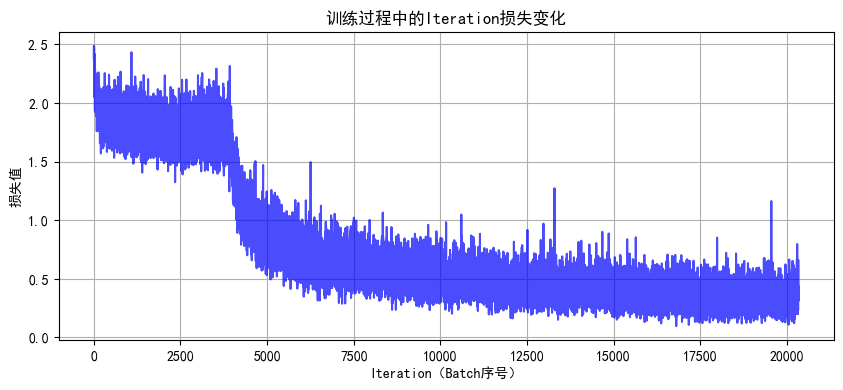
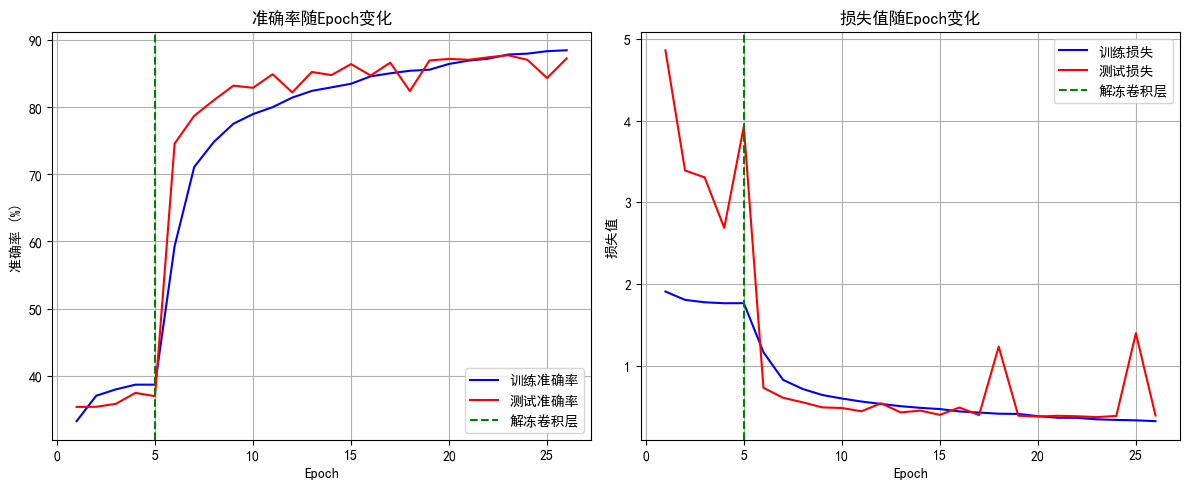
训练完成!最佳测试准确率: 87.71% (第 23 轮)
模型已保存至: resnet50_cifar10_finetuned.pth





 扫一扫
扫一扫


 被折叠的 条评论
为什么被折叠?
被折叠的 条评论
为什么被折叠?
 到【灌水乐园】发言





