


目录
一、基本并查集实现两个操作
1. 合并两个集合
2. 查询某个元素的祖宗节点
二、两个优化
1. 路径压缩 O(logn)
2. 按秩合并O(logn) ------ 不常用
三、并查集扩展
1. 记录每个集合的大小( 绑定到根节点上 )
2. 记录每个点到根节点的距离( 绑定到每个元素上 ) ------ 可以处理这个点与根节点的关系的问题
四、Acwing --- 1250 - 格子游戏
原题链接:https://www.acwing.com/problem/content/1252/
代码如下:
//技巧:一维 (x,y) --> x*n+y ( x,y从0开始 )
#include<bits/stdc++.h>

using namespace std;
typedef long long ll;
const int N=40010;
int n,m;
int p[N];
int get(int x,int y){
	return x*n+y;
}
int find(int x){
	if(x!=p[x])p[x]=find(p[x]);
	return p[x];
}
void solve(){
	cin>>n>>m;
	for(int i=0;i<n*n;i++)p[i]=i;
	int ans=0;
	for(int i=1;i<=m;i++){
		int x,y;
		char d;
		cin>>x>>y>>d;
		x--,y--;
		int a=get(x,y);//坐标对应的编号
		int b;
		if(d=='D')b=get(x+1,y);
		else b=get(x,y+1);
		int pa=find(a),pb=find(b);
		if(pa==pb){
			ans=i;
			break;
		}
		p[pa]=pb;
	}
	if(!ans)puts("draw");
	else cout<<ans<<endl;

}
int main(){
    int t;
    t=1;
    //cin>>t;
    while(t--){
        solve();
    }
    return 0;
}
五、Acwing --- 1252 - 搭配购买
原题链接:https://www.acwing.com/problem/content/1254/
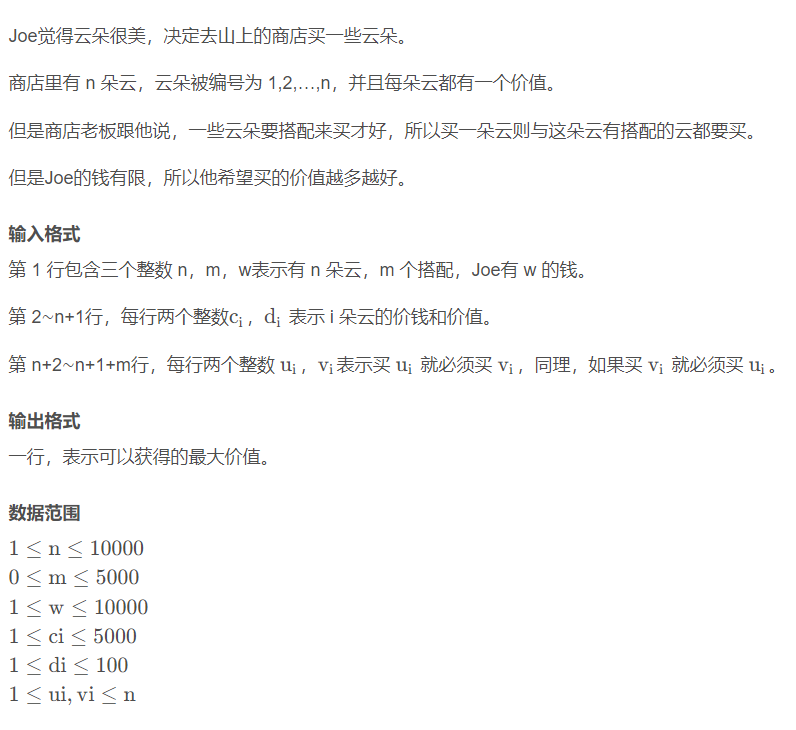
思路:搭配在一起的花相当于一个连通块(并查集做),可以看成一个物品,然后做01背包。
代码如下:
//并查集 + 01背包
#include<bits/stdc++.h>

using namespace std;
typedef long long ll;
const int N=10010;
int n,m,k;
int p[N];
int v[N],w[N];
int f[N];

int find(int x){
	if(x!=p[x])p[x]=find(p[x]);
	return p[x];
}
void solve(){
	cin>>n>>m>>k;
	for(int i=1;i<=n;i++)p[i]=i;
	for(int i=1;i<=n;i++)cin>>v[i]>>w[i];
	while(m--){
		int a,b;
		cin>>a>>b;
		int pa=find(a),pb=find(b);
		if(pa!=pb){
			v[pb]+=v[pa];
			w[pb]+=w[pa];
			p[pa]=p[pb];
		}
	}
	for(int i=1;i<=n;i++){
		if(p[i]==i){
			for(int j=k;j>=v[i];j--){
				f[j]=max(f[j],f[j-v[i]]+w[i]);
			}
		}
	}
	cout<<f[k]<<endl;

}
int main(){
    int t;
    t=1;
    //cin>>t;
    while(t--){
        solve();
    }
    return 0;
}
六、Acwing --- 237 - 程序自动分析
原题链接:https://www.acwing.com/problem/content/239/
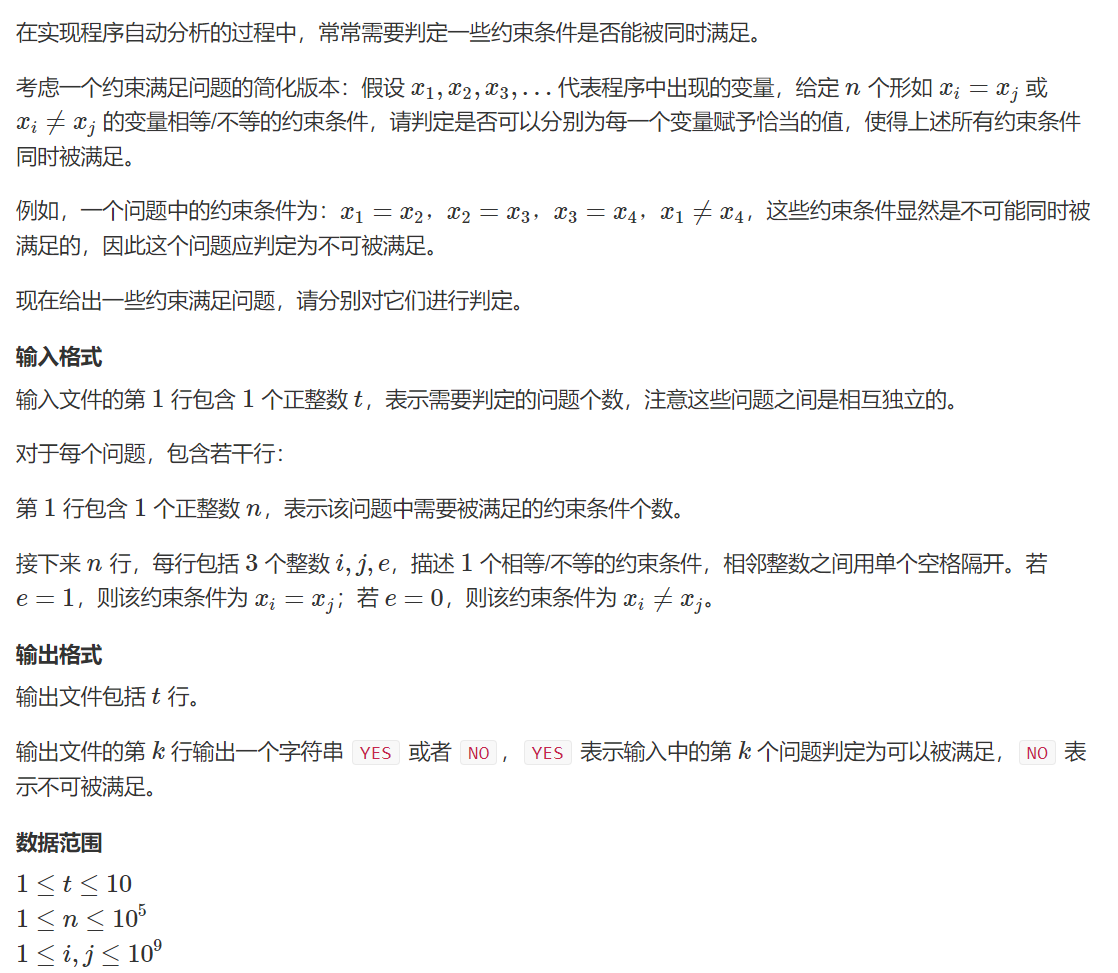
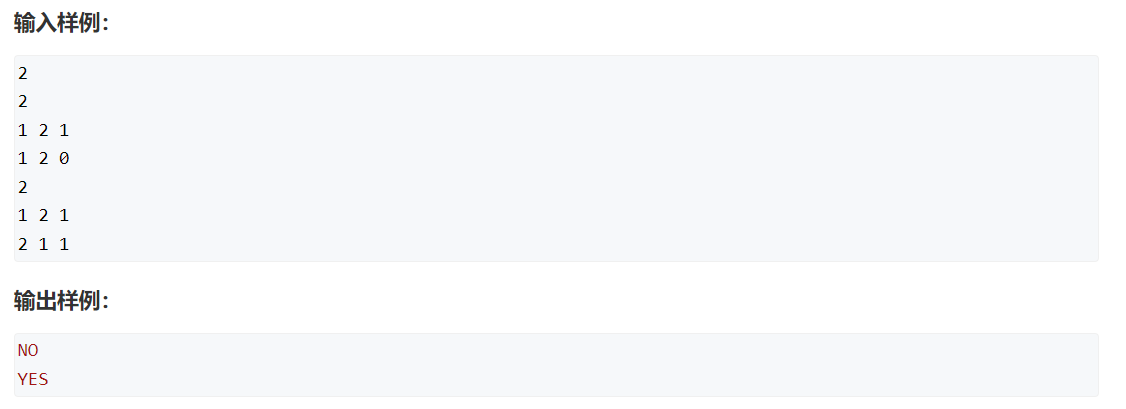
步骤:
1. 离散化 ---- 1e9 --> 2e6
离散化的要求:1. 保序 --- 排序+判重+二分
2. 不要求保序 :1)map 2)hash
2. 约束条件的顺序“无所谓”
1)先考虑所有相等约束,将所有相等约束合并---不可能有矛盾
2)再考虑不等条件,依次判断每个不等条件 i , j 是否在同一个集合中----可能有矛盾
代码如下:
#include<bits/stdc++.h>

using namespace std;
typedef long long ll;
const int N=200010;
int n,m;
int p[N];
unordered_map<int,int> S;
struct Node{
    int x,y,e;
}no[N];
int get(int x){
    if(S.count(x)==0)S[x]=++n;
    return S[x];
}
int find(int x){
	if(x!=p[x])p[x]=find(p[x]);
	return p[x];
}
void solve(){
    n=0;
    S.clear();
	scanf("%d",&m);
	for(int i=0;i<m;i++){
	    int x,y,e;
	    scanf("%d%d%d",&x,&y,&e);
	    no[i]={get(x),get(y),e};
	}
	for(int i=1;i<=n;i++)p[i]=i;
	//合并所有相等的约束条件
	for(int i=0;i<m;i++){
	    if(no[i].e==1){
	        int pa=find(no[i].x),pb=find(no[i].y);
	        p[pa]=pb;
	    }
	}
	//检查所有的不等条件
	bool flag=false;
	for(int i=0;i<m;i++){
	    if(no[i].e==0){
	        int pa=find(no[i].x),pb=find(no[i].y);
	        if(pa==pb){
	            flag=true;
	            break;
	        }
	    }
	}
	if(flag)cout<<"NO"<<endl;
	else cout<<"YES"<<endl;

}
int main(){
    int t;
    //t=1;
    scanf("%d",&t);
    while(t--){
        solve();
    }
    return 0;
}
七、Acwing --- 238 - 银河英雄传说
https://www.acwing.com/problem/content/240/
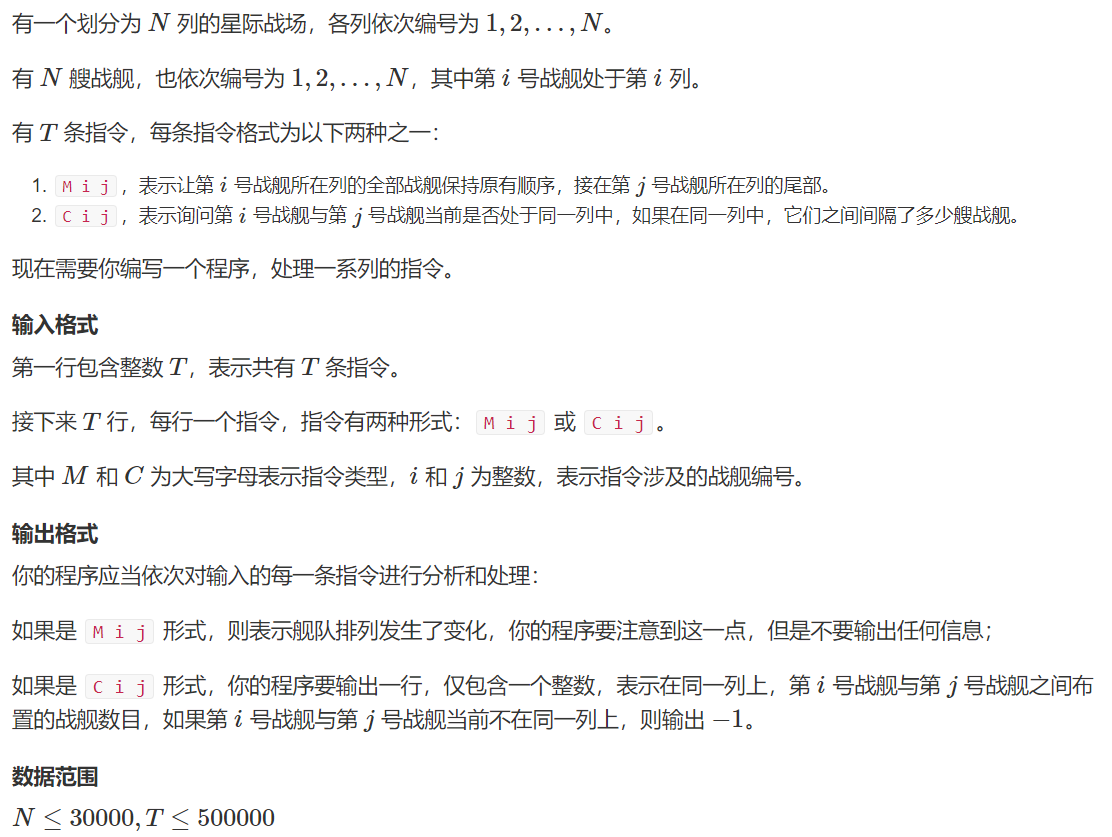
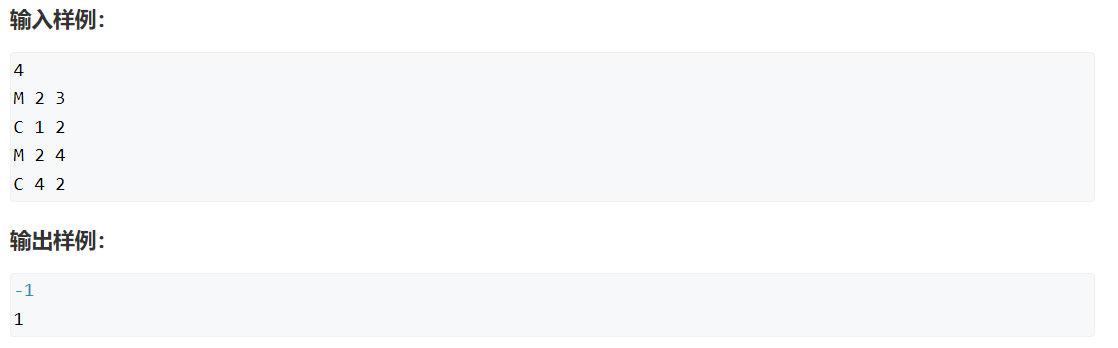
怎么做 :1. 不问间隔多少战舰 ----简单的并查集
2. 同时维护间隔多少战舰 --- 统一维护当前战舰到排头的距离 ( 前缀和思想 )
思路:1. 让排头当根节点
2. 假设把a放在b后面,则d[pa]=s[pb] , s[pb] += s[pa]
代码如下:
#include<bits/stdc++.h>

using namespace std;
typedef long long ll;
const int N=30010;
int m;
int p[N],s[N],d[N];//d[x]表示x到p[x]的距离
int find(int x){
	if(x!=p[x]){
	    int root=find(p[x]);
	    d[x]+=d[p[x]];
	    p[x]=root;
	}
	return p[x];
}
void solve(){
	scanf("%d",&m);
	for(int i=1;i<N;i++){
	    p[i]=i;
	    s[i]=1;
	}
	while(m--){
	    char op[2];
	    int a,b;
	    scanf("%s%d%d",op,&a,&b);
	    int pa=find(a),pb=find(b);
	    if(op[0]=='M'){
	        if(pa!=pb){
	            d[pa]=s[pb];
	            s[pb]+=s[pa];
	            p[pa]=pb;
	        }

	    }else{
	        if(pa!=pb)puts("-1");
	        else printf("%d\n",max(abs(d[a]-d[b])-1,0));
	    }
	}
}
int main(){
    int t;
    t=1;
    //cin>>t;
    while(t--)solve();

    return 0;
}
八、Acwing --- 239 - 奇偶游戏
原题链接:https://www.acwing.com/problem/content/241/
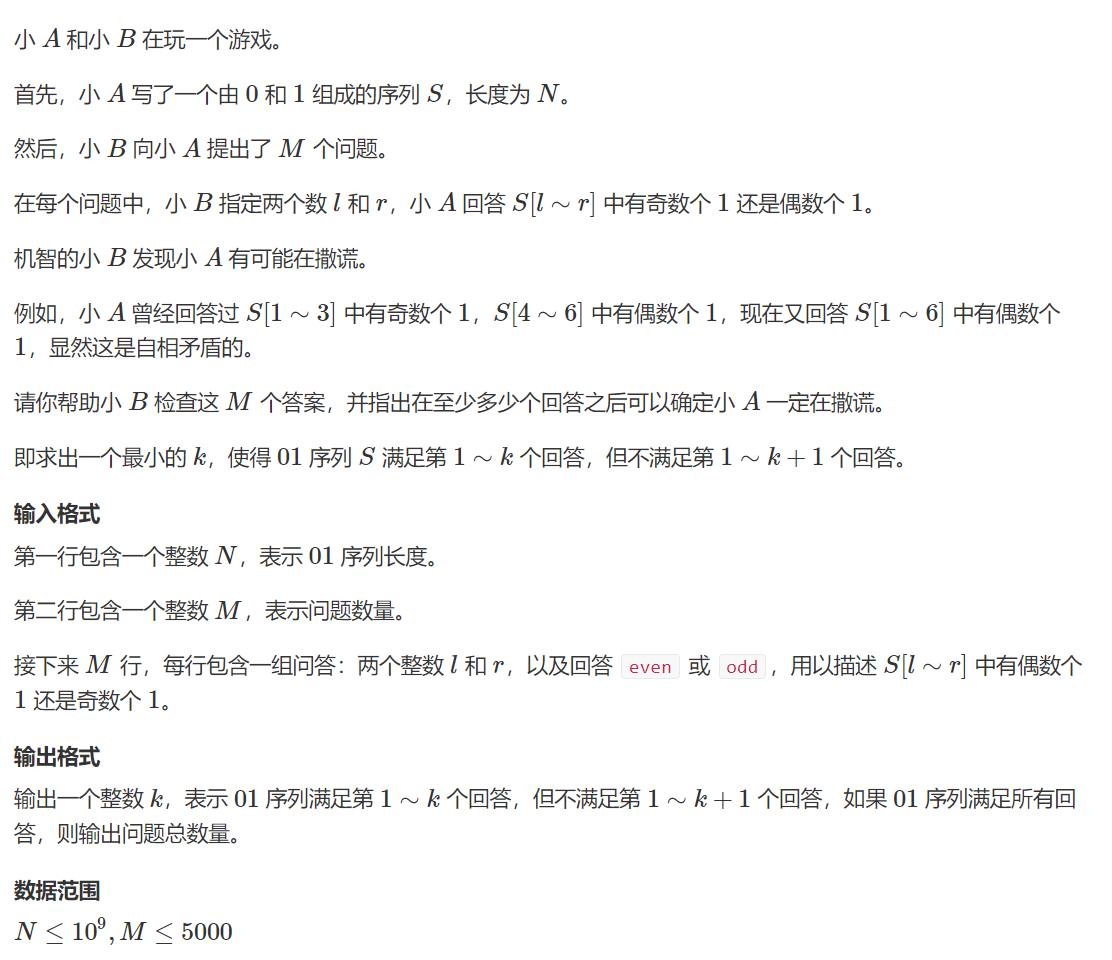
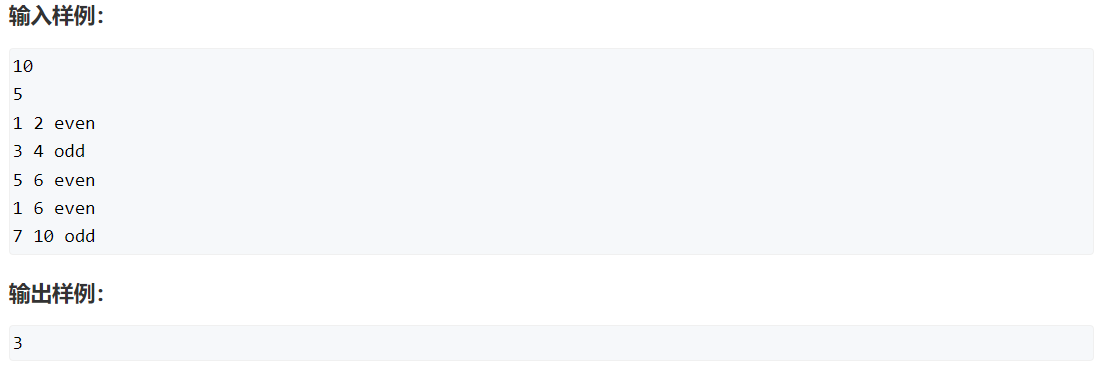
代码如下:
1. 带边权的并查集
//并查集 + 离散化
#include<bits/stdc++.h>
using namespace std;
typedef long long ll;
const int N=10010;
int n,m;
int p[N],d[N];
unordered_map<int,int> S;
int get(int x){
    if(S.count(x)==0)S[x]=++n;
    return S[x];
}
int find(int x){
    if(x!=p[x]){
        int t=find(p[x]);
        d[x]^=d[p[x]];
        p[x]=t;
    }
    return p[x];
}
void solve(){
    cin>>n>>m;
    n=0;
    for(int i=0;i<N;i++)p[i]=i;
    int res=m;
    for(int i=1;i<=m;i++){
        int a,b;
        string type;
        cin>>a>>b>>type;
        a=get(a-1),b=get(b);
        int t=0;
        if(type=="odd")t=1;
        int pa=find(a),pb=find(b);
        if(pa==pb){
            if((d[a]^d[b])!=t){
                res=i-1;
                break;
            }
        }else{
            p[pa]=pb;
            d[pa]=d[a]^d[b]^t;
        }
    }
    cout<<res<<endl;

}
int main(){
    ios::sync_with_stdio(0);
    cin.tie(0);
    cout.tie(0);
    int t;
    t=1;
    //cin>>t;
    while(t--){
        solve();
    }
    return 0;
}
2. 扩展域方式
枚举思想
1) 如果x,y是同类,若 x 奇则 y 奇,若 x 偶则 y 偶
( 1 )合并x+n , y+n ( 2 )合并x , y
2) 如果异类 ,若 x 奇则 y 偶,若 x 偶则 y 奇
( 1 )合并x+n , y ( 2 )合并x , y+n
//并查集 + 离散化
#include<bits/stdc++.h>
using namespace std;
typedef long long ll;
const int N=20010,M=N/2;
int n,m;
int p[N];
unordered_map<int,int> S;
int get(int x){
    if(S.count(x)==0)S[x]=++n;
    return S[x];
}
int find(int x){
    if(x!=p[x])p[x]=find(p[x]);
    return p[x];
}
void solve(){
    cin>>n>>m;
    n=0;
    for(int i=0;i<N;i++)p[i]=i;
    int res=m;
    for(int i=1;i<=m;i++){
        int a,b;
        string type;
        cin>>a>>b>>type;
        a=get(a-1),b=get(b);
        if(type=="even"){
            if(find(a+M)==find(b)){
                res=i-1;
                break;
            }
            p[find(a)]=find(b);
            p[find(a+M)]=find(b+M);
        }else{
            if(find(a)==find(b)){
                res=i-1;
                break;
            }
            p[find(a)]=find(b+M);
            p[find(a+M)]=find(b);
        }

    }
    cout<<res<<endl;

}
int main(){
    ios::sync_with_stdio(0);
    cin.tie(0);
    cout.tie(0);
    int t;
    t=1;
    //cin>>t;
    while(t--){
        solve();
    }
    return 0;
}





 扫一扫
扫一扫


 被折叠的 条评论
为什么被折叠?
被折叠的 条评论
为什么被折叠?
 到【灌水乐园】发言





