



 本文介绍学术论文英文摘要的写作方法。涵盖基本格式,如字体、字号、行间距;基本要求,包括正式文体、用词规范等;强调时态和语态的运用;阐述理想的摘要内容,含目的范围、方法过程、结果结论;还给出常用的开头和结尾技巧。
如何写学术论文英文摘要
背景介绍
写学术论文的英文摘要是深造必经的一个训练,所以本文作者在查阅诸多资料的基础上,写下此文章,供分享和备忘。
基本格式
-
一般以本学校或投稿要求决定
-
若没有具体要求,我常用以下格式:
- 字体:Times New Roman
- 字号:小四
- 行间距:20磅
- 效果如下
-
ps:整体看起来比较美观,由于英文字体有其自有的特点,这样的排版使得看上去不密密麻麻,也更容易阅读和修改。
基本要求
- 正式文体
- 用词规范
- 句子完整
- 少用缩写词,如果用,要做好标注
- 精炼
- 尽量不要举例子
- 整体内容衔接紧凑,有因有果,有条理性(连接词是个好方法)
- 具体
- 每个概念表述具体,尽量不要写“与……有关”,直接写“show what”,“demonstrate what”……
- 完成了什么,实现了什么效果,说清楚好办事
重要:时态和语态
- 一般现在时:说明研究目的,研究内容,描述结果,得出结论,提出建议,公认事实,自然规律等等
- 常用的句式如:this study is/shows……,** this paper** develops……,the result shows……
- 一般过去式:描述过去的发现,某一个研究过程实验等等
- 完成时比较少用,过去完成时描述过去的过去
- 语态:一般用被动语态,多用第三人称
- 语态例句:A and B were evaluated by……. To describe……,this paper illustrates……
- 重要注意点:
- 在介绍背景资料时,如果是不受时间影响的普遍事实,使用现在时;如果是对某种研究趋势的概述,可以用现在完成时。
- 在叙述研究目的或主要研究活动时,如果采用“论文导向”,多使用现在时,比如 This paper presents…,因为论文写作的时间是现在;如果采用“研究导向”,则使用过去时,比如 This study investigated…,因为研究已经完成。
- 在概述主要结果时,通常用现在时。
- 叙述结论或建议时,可使用现在时和将来时。
理想的摘要内容
- 目的和范围:简明扼要的说明研究的目的和范围,或者说明写文章的原因,暗示该项研究的特点,结果和意义
- 例如:
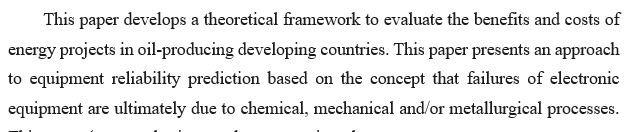
- This paper develops a theoretical framework to evaluate the benefits and costs of energy projects in oil-producing developing countries. This paper presents an approach to equipment reliability prediction based on the concept that failures of electronic equipment are ultimately due to chemical, mechanical and/or metallurgical processes. This paper ( report, thesis,work, presentation, document, account, etc.) describes ( reports, explains, outlines, summarizes, documents, evaluates, surveys, develops, investigates, discusses, focuses on, analyzes, etc. ) the results (approach, role, framework, etc.) of … This paper ( article, report, etc.) addresses ( is concerned with, argues, specifies, covers, etc.) the following questions… This paper has three main objectives… This research project is devoted to… The objective ( purpose, motivation, etc.) of this paper ( report, program, etc.) is… Our goal has been to develop…
- 方法和过程:一般使用常用名词短语前置,重点内容显著强调,特别注重描述新方法,注意使用连接词使之前后连贯
- 例如:
- Procedures for testing atmospheric transport and dispersion models for distances of several hundred to 1000 km from sources of pollutants are reviewed. The first known measurement of the differential cross section for electron capture to the continuum (ECC) from atomic hydrogen is presented.
- 结果和结论:清楚清楚清楚的展现
- 结果:包括实验和理论结果,观察到的现象规律等等
- 结论:结果的价值、用途与意义,也包括假设和建议等等
- 例如:
- It was found that both molecular weight an d its distribution affected tensile strength It has been observed (shown, proved , etc.) that… These experiments indicate (reveal, show, demonstrate, etc.) that… The approach (method, framework, etc.) promises to be very useful for… The (experimental) results show (indicate, suggest, etc.)that… It is shown (concluded, proposed, etc.)that… This could imply that… This strategy appeared to be effective in… These studies are of significance to … These results have direct application to…
常用技巧
开头
- 开门见山
- This paper describes recent modeling and experimental studies of reverse combustion (RC) linking, aimed at understanding the propagation of dynamics of a RC front.
- 引人入胜
- Recent research on parallel systems has shown that the most difficult problem for system designers and users is inter-processor connection and communication. A methodology for the automated design and implementation of inter-processor communication for certain multiple-processor systems has been developed and is presented in this paper.
结尾
- 使用结论结尾,而不只是结果
- The results indicate that the sludge ash could be used as a partial replacement for cement in concrete. Hot hardness testing promises to be very useful for geoscientific purposes and applicable to a wide range of experimental research.





 扫一扫
扫一扫


 644
644

 被折叠的 条评论
为什么被折叠?
被折叠的 条评论
为什么被折叠?
 到【灌水乐园】发言





