


 本文深入解析了Python中的reduce函数,详细介绍了其工作原理和应用场景。reduce函数能够将一个二元函数应用于序列的元素上,从左到右累积计算,最终将整个序列缩减为单一值。文章通过具体实例展示了如何使用reduce函数进行矩阵维度降低,将三维矩阵转换为二维矩阵,适用于数据处理和数学计算等场景。
python的reduce函数
官方说明:
def reduce(function, sequence, initial=None): # real signature unknown; restored from __doc__
    """
    reduce(function, sequence[, initial]) -> value

    Apply a function of two arguments cumulatively to the items of a sequence,
    from left to right, so as to reduce the sequence to a single value.
    For example, reduce(lambda x, y: x+y, [1, 2, 3, 4, 5]) calculates
    ((((1+2)+3)+4)+5).  If initial is present, it is placed before the items
    of the sequence in the calculation, and serves as a default when the
    sequence is empty.
    """
    pass
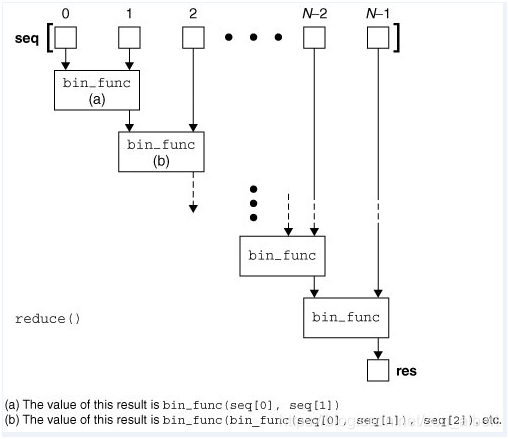
function是一个二元函数,随后的参数可以进行累加的,如图
尝试举例:
max1  = [
    [[0,1],
     [1,2],
     [1,1]],
    [[2,3],
     [3,4],
     [3,3]]
    ]

ten = reduce(np.add,max1)
print ten
输出结果:
[[2 4]
 [4 6]
 [4 4]]
显然可以看出来,reduce是用来降低维度的,从2×3×2三维变成3*2二维的矩阵,对应位置上的元素相加的





 扫一扫
扫一扫


 1317
1317

 被折叠的 条评论
为什么被折叠?
被折叠的 条评论
为什么被折叠?
 到【灌水乐园】发言





