





代码段
# Ultralytics 🚀 AGPL-3.0 License - https://ultralytics.com/license
import ast
import json
import platform
import zipfile
from collections import OrderedDict, namedtuple
from pathlib import Path
import cv2
import numpy as np
import torch
import torch.nn as nn
from PIL import Image
from ultralytics.utils import ARM64, IS_JETSON, IS_RASPBERRYPI, LINUX, LOGGER, PYTHON_VERSION, ROOT, yaml_load
from ultralytics.utils.checks import check_requirements, check_suffix, check_version, check_yaml, is_rockchip
from ultralytics.utils.downloads import attempt_download_asset, is_url
def check_class_names(names):
"""
Check class names.
Map imagenet class codes to human-readable names if required. Convert lists to dicts.
"""
if isinstance(names, list): # names is a list
names = dict(enumerate(names)) # convert to dict
if isinstance(names, dict):
# Convert 1) string keys to int, i.e. '0' to 0, and non-string values to strings, i.e. True to 'True'
names = {int(k): str(v) for k, v in names.items()}
n = len(names)
if max(names.keys()) >= n:
raise KeyError(
f"{n}-class dataset requires class indices 0-{n - 1}, but you have invalid class indices "
f"{min(names.keys())}-{max(names.keys())} defined in your dataset YAML."
)
if isinstance(names[0], str) and names[0].startswith("n0"): # imagenet class codes, i.e. 'n01440764'
names_map = yaml_load(ROOT / "cfg/datasets/ImageNet.yaml")["map"] # human-readable names
names = {k: names_map[v] for k, v in names.items()}
return names
def default_class_names(data=None):
"""Applies default class names to an input YAML file or returns numerical class names."""
if data:
try:
return yaml_load(check_yaml(data))["names"]
except Exception:
pass
return {i: f"class{i}" for i in range(999)} # return default if above errors
class AutoBackend(nn.Module):
"""
Handles dynamic backend selection for running inference using Ultralytics YOLO models.
The AutoBackend class is designed to provide an abstraction layer for various inference engines. It supports a wide
range of formats, each with specific naming conventions as outlined below:
Supported Formats and Naming Conventions:
| Format | File Suffix |
| --------------------- | ----------------- |
| PyTorch | *.pt |
| TorchScript | *.torchscript |
| ONNX Runtime | *.onnx |
| ONNX OpenCV DNN | *.onnx (dnn=True) |
| OpenVINO | *openvino_model/ |
| CoreML | *.mlpackage |
| TensorRT | *.engine |
| TensorFlow SavedModel | *_saved_model/ |
| TensorFlow GraphDef | *.pb |
| TensorFlow Lite | *.tflite |
| TensorFlow Edge TPU | *_edgetpu.tflite |
| PaddlePaddle | *_paddle_model/ |
| MNN | *.mnn |
| NCNN | *_ncnn_model/ |
| IMX | *_imx_model/ |
| RKNN | *_rknn_model/ |
This class offers dynamic backend switching capabilities based on the input model format, making it easier to deploy
models across various platforms.
"""
@torch.no_grad()
def __init__(
self,
weights="yolo11n.pt",
device=torch.device("cpu"),
dnn=False,
data=None,
fp16=False,
batch=1,
fuse=True,
verbose=True,
):
"""
Initialize the AutoBackend for inference.
Args:
weights (str | torch.nn.Module): Path to the model weights file or a module instance. Defaults to 'yolo11n.pt'.
device (torch.device): Device to run the model on. Defaults to CPU.
dnn (bool): Use OpenCV DNN module for ONNX inference. Defaults to False.
data (str | Path | optional): Path to the additional data.yaml file containing class names. Optional.
fp16 (bool): Enable half-precision inference. Supported only on specific backends. Defaults to False.
batch (int): Batch-size to assume for inference.
fuse (bool): Fuse Conv2D + BatchNorm layers for optimization. Defaults to True.
verbose (bool): Enable verbose logging. Defaults to True.
"""
super().__init__()
w = str(weights[0] if isinstance(weights, list) else weights)
nn_module = isinstance(weights, torch.nn.Module)
(
pt,
jit,
onnx,
xml,
engine,
coreml,
saved_model,
pb,
tflite,
edgetpu,
tfjs,
paddle,
mnn,
ncnn,
imx,
rknn,
triton,
) = self._model_type(w)
fp16 &= pt or jit or onnx or xml or engine or nn_module or triton # FP16
nhwc = coreml or saved_model or pb or tflite or edgetpu or rknn # BHWC formats (vs torch BCWH)
stride = 32 # default stride
end2end = False # default end2end
model, metadata, task = None, None, None
# Set device
cuda = torch.cuda.is_available() and device.type != "cpu" # use CUDA
if cuda and not any([nn_module, pt, jit, engine, onnx, paddle]): # GPU dataloader formats
device = torch.device("cpu")
cuda = False
# Download if not local
if not (pt or triton or nn_module):
w = attempt_download_asset(w)
# In-memory PyTorch model
if nn_module:
model = weights.to(device)
if fuse:
model = model.fuse(verbose=verbose)
if hasattr(model, "kpt_shape"):
kpt_shape = model.kpt_shape # pose-only
stride = max(int(model.stride.max()), 32) # model stride
names = model.module.names if hasattr(model, "module") else model.names # get class names
model.half() if fp16 else model.float()
self.model = model # explicitly assign for to(), cpu(), cuda(), half()
pt = True
# PyTorch
elif pt:
from ultralytics.nn.tasks import attempt_load_weights
model = attempt_load_weights(
weights if isinstance(weights, list) else w, device=device, inplace=True, fuse=fuse
)
if hasattr(model, "kpt_shape"):
kpt_shape = model.kpt_shape # pose-only
stride = max(int(model.stride.max()), 32) # model stride
names = model.module.names if hasattr(model, "module") else model.names # get class names
model.half() if fp16 else model.float()
self.model = model # explicitly assign for to(), cpu(), cuda(), half()
# TorchScript
elif jit:
LOGGER.info(f"Loading {w} for TorchScript inference...")
extra_files = {"config.txt": ""} # model metadata
model = torch.jit.load(w, _extra_files=extra_files, map_location=device)
model.half() if fp16 else model.float()
if extra_files["config.txt"]: # load metadata dict
metadata = json.loads(extra_files["config.txt"], object_hook=lambda x: dict(x.items()))
# ONNX OpenCV DNN
elif dnn:
LOGGER.info(f"Loading {w} for ONNX OpenCV DNN inference...")
check_requirements("opencv-python>=4.5.4")
net = cv2.dnn.readNetFromONNX(w)
# ONNX Runtime and IMX
elif onnx or imx:
LOGGER.info(f"Loading {w} for ONNX Runtime inference...")
check_requirements(("onnx", "onnxruntime-gpu" if cuda else "onnxruntime"))
if IS_RASPBERRYPI or IS_JETSON:
# Fix 'numpy.linalg._umath_linalg' has no attribute '_ilp64' for TF SavedModel on RPi and Jetson
check_requirements("numpy==1.23.5")
import onnxruntime
providers = ["CPUExecutionProvider"]
if cuda and "CUDAExecutionProvider" in onnxruntime.get_available_providers():
providers.insert(0, "CUDAExecutionProvider")
elif cuda: # Only log warning if CUDA was requested but unavailable
LOGGER.warning("WARNING ⚠️ Failed to start ONNX Runtime with CUDA. Using CPU...")
device = torch.device("cpu")
cuda = False
LOGGER.info(f"Using ONNX Runtime {providers[0]}")
if onnx:
session = onnxruntime.InferenceSession(w, providers=providers)
else:
check_requirements(
["model-compression-toolkit==2.1.1", "sony-custom-layers[torch]==0.2.0", "onnxruntime-extensions"]
)
w = next(Path(w).glob("*.onnx"))
LOGGER.info(f"Loading {w} for ONNX IMX inference...")
import mct_quantizers as mctq
from sony_custom_layers.pytorch.object_detection import nms_ort # noqa
session = onnxruntime.InferenceSession(
w, mctq.get_ort_session_options(), providers=["CPUExecutionProvider"]
)
task = "detect"
output_names = [x.name for x in session.get_outputs()]
metadata = session.get_modelmeta().custom_metadata_map
dynamic = isinstance(session.get_outputs()[0].shape[0], str)
fp16 = True if "float16" in session.get_inputs()[0].type else False
if not dynamic:
io = session.io_binding()
bindings = []
for output in session.get_outputs():
out_fp16 = "float16" in output.type
y_tensor = torch.empty(output.shape, dtype=torch.float16 if out_fp16 else torch.float32).to(device)
io.bind_output(
name=output.name,
device_type=device.type,
device_id=device.index if cuda else 0,
element_type=np.float16 if out_fp16 else np.float32,
shape=tuple(y_tensor.shape),
buffer_ptr=y_tensor.data_ptr(),
)
bindings.append(y_tensor)
# OpenVINO
elif xml:
LOGGER.info(f"Loading {w} for OpenVINO inference...")
check_requirements("openvino>=2024.0.0")
import openvino as ov
core = ov.Core()
w = Path(w)
if not w.is_file(): # if not *.xml
w = next(w.glob("*.xml")) # get *.xml file from *_openvino_model dir
ov_model = core.read_model(model=str(w), weights=w.with_suffix(".bin"))
if ov_model.get_parameters()[0].get_layout().empty:
ov_model.get_parameters()[0].set_layout(ov.Layout("NCHW"))
# OpenVINO inference modes are 'LATENCY', 'THROUGHPUT' (not recommended), or 'CUMULATIVE_THROUGHPUT'
inference_mode = "CUMULATIVE_THROUGHPUT" if batch > 1 else "LATENCY"
LOGGER.info(f"Using OpenVINO {inference_mode} mode for batch={batch} inference...")
ov_compiled_model = core.compile_model(
ov_model,
device_name="AUTO", # AUTO selects best available device, do not modify
config={"PERFORMANCE_HINT": inference_mode},
)
input_name = ov_compiled_model.input().get_any_name()
metadata = w.parent / "metadata.yaml"
# TensorRT
elif engine:
LOGGER.info(f"Loading {w} for TensorRT inference...")
if IS_JETSON and PYTHON_VERSION <= "3.8.0":
# fix error: `np.bool` was a deprecated alias for the builtin `bool` for JetPack 4 with Python <= 3.8.0
check_requirements("numpy==1.23.5")
try:
import tensorrt as trt # noqa https://developer.nvidia.com/nvidia-tensorrt-download
except ImportError:
if LINUX:
check_requirements("tensorrt>7.0.0,!=10.1.0")
import tensorrt as trt # noqa
check_version(trt.__version__, ">=7.0.0", hard=True)
check_version(trt.__version__, "!=10.1.0", msg="https://github.com/ultralytics/ultralytics/pull/14239")
if device.type == "cpu":
device = torch.device("cuda:0")
Binding = namedtuple("Binding", ("name", "dtype", "shape", "data", "ptr"))
logger = trt.Logger(trt.Logger.INFO)
# Read file
with open(w, "rb") as f, trt.Runtime(logger) as runtime:
try:
meta_len = int.from_bytes(f.read(4), byteorder="little") # read metadata length
metadata = json.loads(f.read(meta_len).decode("utf-8")) # read metadata
except UnicodeDecodeError:
f.seek(0) # engine file may lack embedded Ultralytics metadata
dla = metadata.get("dla", None)
if dla is not None:
runtime.DLA_core = int(dla)
model = runtime.deserialize_cuda_engine(f.read()) # read engine
# Model context
try:
context = model.create_execution_context()
except Exception as e: # model is None
LOGGER.error(f"ERROR: TensorRT model exported with a different version than {trt.__version__}\n")
raise e
bindings = OrderedDict()
output_names = []
fp16 = False # default updated below
dynamic = False
is_trt10 = not hasattr(model, "num_bindings")
num = range(model.num_io_tensors) if is_trt10 else range(model.num_bindings)
for i in num:
if is_trt10:
name = model.get_tensor_name(i)
dtype = trt.nptype(model.get_tensor_dtype(name))
is_input = model.get_tensor_mode(name) == trt.TensorIOMode.INPUT
if is_input:
if -1 in tuple(model.get_tensor_shape(name)):
dynamic = True
context.set_input_shape(name, tuple(model.get_tensor_profile_shape(name, 0)[1]))
if dtype == np.float16:
fp16 = True
else:
output_names.append(name)
shape = tuple(context.get_tensor_shape(name))
else: # TensorRT < 10.0
name = model.get_binding_name(i)
dtype = trt.nptype(model.get_binding_dtype(i))
is_input = model.binding_is_input(i)
if model.binding_is_input(i):
if -1 in tuple(model.get_binding_shape(i)): # dynamic
dynamic = True
context.set_binding_shape(i, tuple(model.get_profile_shape(0, i)[1]))
if dtype == np.float16:
fp16 = True
else:
output_names.append(name)
shape = tuple(context.get_binding_shape(i))
im = torch.from_numpy(np.empty(shape, dtype=dtype)).to(device)
bindings[name] = Binding(name, dtype, shape, im, int(im.data_ptr()))
binding_addrs = OrderedDict((n, d.ptr) for n, d in bindings.items())
batch_size = bindings["images"].shape[0] # if dynamic, this is instead max batch size
# CoreML
elif coreml:
LOGGER.info(f"Loading {w} for CoreML inference...")
import coremltools as ct
model = ct.models.MLModel(w)
metadata = dict(model.user_defined_metadata)
# TF SavedModel
elif saved_model:
LOGGER.info(f"Loading {w} for TensorFlow SavedModel inference...")
import tensorflow as tf
keras = False # assume TF1 saved_model
model = tf.keras.models.load_model(w) if keras else tf.saved_model.load(w)
metadata = Path(w) / "metadata.yaml"
# TF GraphDef
elif pb: # https://www.tensorflow.org/guide/migrate#a_graphpb_or_graphpbtxt
LOGGER.info(f"Loading {w} for TensorFlow GraphDef inference...")
import tensorflow as tf
from ultralytics.engine.exporter import gd_outputs
def wrap_frozen_graph(gd, inputs, outputs):
"""Wrap frozen graphs for deployment."""
x = tf.compat.v1.wrap_function(lambda: tf.compat.v1.import_graph_def(gd, name=""), []) # wrapped
ge = x.graph.as_graph_element
return x.prune(tf.nest.map_structure(ge, inputs), tf.nest.map_structure(ge, outputs))
gd = tf.Graph().as_graph_def() # TF GraphDef
with open(w, "rb") as f:
gd.ParseFromString(f.read())
frozen_func = wrap_frozen_graph(gd, inputs="x:0", outputs=gd_outputs(gd))
try: # find metadata in SavedModel alongside GraphDef
metadata = next(Path(w).resolve().parent.rglob(f"{Path(w).stem}_saved_model*/metadata.yaml"))
except StopIteration:
pass
# TFLite or TFLite Edge TPU
elif tflite or edgetpu: # https://www.tensorflow.org/lite/guide/python#install_tensorflow_lite_for_python
try: # https://coral.ai/docs/edgetpu/tflite-python/#update-existing-tf-lite-code-for-the-edge-tpu
from tflite_runtime.interpreter import Interpreter, load_delegate
except ImportError:
import tensorflow as tf
Interpreter, load_delegate = tf.lite.Interpreter, tf.lite.experimental.load_delegate
if edgetpu: # TF Edge TPU https://coral.ai/software/#edgetpu-runtime
device = device[3:] if str(device).startswith("tpu") else ":0"
LOGGER.info(f"Loading {w} on device {device[1:]} for TensorFlow Lite Edge TPU inference...")
delegate = {"Linux": "libedgetpu.so.1", "Darwin": "libedgetpu.1.dylib", "Windows": "edgetpu.dll"}[
platform.system()
]
interpreter = Interpreter(
model_path=w,
experimental_delegates=[load_delegate(delegate, options={"device": device})],
)
device = "cpu" # Required, otherwise PyTorch will try to use the wrong device
else: # TFLite
LOGGER.info(f"Loading {w} for TensorFlow Lite inference...")
interpreter = Interpreter(model_path=w) # load TFLite model
interpreter.allocate_tensors() # allocate
input_details = interpreter.get_input_details() # inputs
output_details = interpreter.get_output_details() # outputs
# Load metadata
try:
with zipfile.ZipFile(w, "r") as model:
meta_file = model.namelist()[0]
metadata = ast.literal_eval(model.read(meta_file).decode("utf-8"))
except zipfile.BadZipFile:
pass
# TF.js
elif tfjs:
raise NotImplementedError("YOLOv8 TF.js inference is not currently supported.")
# PaddlePaddle
elif paddle:
LOGGER.info(f"Loading {w} for PaddlePaddle inference...")
check_requirements("paddlepaddle-gpu" if cuda else "paddlepaddle")
import paddle.inference as pdi # noqa
w = Path(w)
if not w.is_file(): # if not *.pdmodel
w = next(w.rglob("*.pdmodel")) # get *.pdmodel file from *_paddle_model dir
config = pdi.Config(str(w), str(w.with_suffix(".pdiparams")))
if cuda:
config.enable_use_gpu(memory_pool_init_size_mb=2048, device_id=0)
predictor = pdi.create_predictor(config)
input_handle = predictor.get_input_handle(predictor.get_input_names()[0])
output_names = predictor.get_output_names()
metadata = w.parents[1] / "metadata.yaml"
# MNN
elif mnn:
LOGGER.info(f"Loading {w} for MNN inference...")
check_requirements("MNN") # requires MNN
import os
import MNN
config = {"precision": "low", "backend": "CPU", "numThread": (os.cpu_count() + 1) // 2}
rt = MNN.nn.create_runtime_manager((config,))
net = MNN.nn.load_module_from_file(w, [], [], runtime_manager=rt, rearrange=True)
def torch_to_mnn(x):
return MNN.expr.const(x.data_ptr(), x.shape)
metadata = json.loads(net.get_info()["bizCode"])
# NCNN
elif ncnn:
LOGGER.info(f"Loading {w} for NCNN inference...")
check_requirements("git+https://github.com/Tencent/ncnn.git" if ARM64 else "ncnn") # requires NCNN
import ncnn as pyncnn
net = pyncnn.Net()
net.opt.use_vulkan_compute = cuda
w = Path(w)
if not w.is_file(): # if not *.param
w = next(w.glob("*.param")) # get *.param file from *_ncnn_model dir
net.load_param(str(w))
net.load_model(str(w.with_suffix(".bin")))
metadata = w.parent / "metadata.yaml"
# NVIDIA Triton Inference Server
elif triton:
check_requirements("tritonclient[all]")
from ultralytics.utils.triton import TritonRemoteModel
model = TritonRemoteModel(w)
metadata = model.metadata
# RKNN
elif rknn:
if not is_rockchip():
raise OSError("RKNN inference is only supported on Rockchip devices.")
LOGGER.info(f"Loading {w} for RKNN inference...")
check_requirements("rknn-toolkit-lite2")
from rknnlite.api import RKNNLite
w = Path(w)
if not w.is_file(): # if not *.rknn
w = next(w.rglob("*.rknn")) # get *.rknn file from *_rknn_model dir
rknn_model = RKNNLite()
rknn_model.load_rknn(w)
rknn_model.init_runtime()
metadata = Path(w).parent / "metadata.yaml"
# Any other format (unsupported)
else:
from ultralytics.engine.exporter import export_formats
raise TypeError(
f"model='{w}' is not a supported model format. Ultralytics supports: {export_formats()['Format']}\n"
f"See https://docs.ultralytics.com/modes/predict for help."
)
# Load external metadata YAML
if isinstance(metadata, (str, Path)) and Path(metadata).exists():
metadata = yaml_load(metadata)
if metadata and isinstance(metadata, dict):
for k, v in metadata.items():
if k in {"stride", "batch"}:
metadata[k] = int(v)
elif k in {"imgsz", "names", "kpt_shape", "args"} and isinstance(v, str):
metadata[k] = eval(v)
stride = metadata["stride"]
task = metadata["task"]
batch = metadata["batch"]
imgsz = metadata["imgsz"]
names = metadata["names"]
kpt_shape = metadata.get("kpt_shape")
end2end = metadata.get("args", {}).get("nms", False)
elif not (pt or triton or nn_module):
LOGGER.warning(f"WARNING ⚠️ Metadata not found for 'model={weights}'")
# Check names
if "names" not in locals(): # names missing
names = default_class_names(data)
names = check_class_names(names)
# Disable gradients
if pt:
for p in model.parameters():
p.requires_grad = False
self.__dict__.update(locals()) # assign all variables to self
def forward(self, im, augment=False, visualize=False, embed=None):
"""
Runs inference on the YOLOv8 MultiBackend model.
Args:
im (torch.Tensor): The image tensor to perform inference on.
augment (bool): whether to perform data augmentation during inference, defaults to False
visualize (bool): whether to visualize the output predictions, defaults to False
embed (list, optional): A list of feature vectors/embeddings to return.
Returns:
(tuple): Tuple containing the raw output tensor, and processed output for visualization (if visualize=True)
"""
b, ch, h, w = im.shape # batch, channel, height, width
if self.fp16 and im.dtype != torch.float16:
im = im.half() # to FP16
if self.nhwc:
im = im.permute(0, 2, 3, 1) # torch BCHW to numpy BHWC shape(1,320,192,3)
# PyTorch
if self.pt or self.nn_module:
y = self.model(im, augment=augment, visualize=visualize, embed=embed)
# TorchScript
elif self.jit:
y = self.model(im)
# ONNX OpenCV DNN
elif self.dnn:
im = im.cpu().numpy() # torch to numpy
self.net.setInput(im)
y = self.net.forward()
# ONNX Runtime
elif self.onnx or self.imx:
if self.dynamic:
im = im.cpu().numpy() # torch to numpy
y = self.session.run(self.output_names, {self.session.get_inputs()[0].name: im})
else:
if not self.cuda:
im = im.cpu()
self.io.bind_input(
name="images",
device_type=im.device.type,
device_id=im.device.index if im.device.type == "cuda" else 0,
element_type=np.float16 if self.fp16 else np.float32,
shape=tuple(im.shape),
buffer_ptr=im.data_ptr(),
)
self.session.run_with_iobinding(self.io)
y = self.bindings
if self.imx:
# boxes, conf, cls
y = np.concatenate([y[0], y[1][:, :, None], y[2][:, :, None]], axis=-1)
# OpenVINO
elif self.xml:
im = im.cpu().numpy() # FP32
if self.inference_mode in {"THROUGHPUT", "CUMULATIVE_THROUGHPUT"}: # optimized for larger batch-sizes
n = im.shape[0] # number of images in batch
results = [None] * n # preallocate list with None to match the number of images
def callback(request, userdata):
"""Places result in preallocated list using userdata index."""
results[userdata] = request.results
# Create AsyncInferQueue, set the callback and start asynchronous inference for each input image
async_queue = self.ov.runtime.AsyncInferQueue(self.ov_compiled_model)
async_queue.set_callback(callback)
for i in range(n):
# Start async inference with userdata=i to specify the position in results list
async_queue.start_async(inputs={self.input_name: im[i : i + 1]}, userdata=i) # keep image as BCHW
async_queue.wait_all() # wait for all inference requests to complete
y = np.concatenate([list(r.values())[0] for r in results])
else: # inference_mode = "LATENCY", optimized for fastest first result at batch-size 1
y = list(self.ov_compiled_model(im).values())
# TensorRT
elif self.engine:
if self.dynamic and im.shape != self.bindings["images"].shape:
if self.is_trt10:
self.context.set_input_shape("images", im.shape)
self.bindings["images"] = self.bindings["images"]._replace(shape=im.shape)
for name in self.output_names:
self.bindings[name].data.resize_(tuple(self.context.get_tensor_shape(name)))
else:
i = self.model.get_binding_index("images")
self.context.set_binding_shape(i, im.shape)
self.bindings["images"] = self.bindings["images"]._replace(shape=im.shape)
for name in self.output_names:
i = self.model.get_binding_index(name)
self.bindings[name].data.resize_(tuple(self.context.get_binding_shape(i)))
s = self.bindings["images"].shape
assert im.shape == s, f"input size {im.shape} {'>' if self.dynamic else 'not equal to'} max model size {s}"
self.binding_addrs["images"] = int(im.data_ptr())
self.context.execute_v2(list(self.binding_addrs.values()))
y = [self.bindings[x].data for x in sorted(self.output_names)]
# CoreML
elif self.coreml:
im = im[0].cpu().numpy()
im_pil = Image.fromarray((im * 255).astype("uint8"))
# im = im.resize((192, 320), Image.BILINEAR)
y = self.model.predict({"image": im_pil}) # coordinates are xywh normalized
if "confidence" in y:
raise TypeError(
"Ultralytics only supports inference of non-pipelined CoreML models exported with "
f"'nms=False', but 'model={w}' has an NMS pipeline created by an 'nms=True' export."
)
# TODO: CoreML NMS inference handling
# from ultralytics.utils.ops import xywh2xyxy
# box = xywh2xyxy(y['coordinates'] * [[w, h, w, h]]) # xyxy pixels
# conf, cls = y['confidence'].max(1), y['confidence'].argmax(1).astype(np.float32)
# y = np.concatenate((box, conf.reshape(-1, 1), cls.reshape(-1, 1)), 1)
y = list(y.values())
if len(y) == 2 and len(y[1].shape) != 4: # segmentation model
y = list(reversed(y)) # reversed for segmentation models (pred, proto)
# PaddlePaddle
elif self.paddle:
im = im.cpu().numpy().astype(np.float32)
self.input_handle.copy_from_cpu(im)
self.predictor.run()
y = [self.predictor.get_output_handle(x).copy_to_cpu() for x in self.output_names]
# MNN
elif self.mnn:
input_var = self.torch_to_mnn(im)
output_var = self.net.onForward([input_var])
y = [x.read() for x in output_var]
# NCNN
elif self.ncnn:
mat_in = self.pyncnn.Mat(im[0].cpu().numpy())
with self.net.create_extractor() as ex:
ex.input(self.net.input_names()[0], mat_in)
# WARNING: 'output_names' sorted as a temporary fix for https://github.com/pnnx/pnnx/issues/130
y = [np.array(ex.extract(x)[1])[None] for x in sorted(self.net.output_names())]
# NVIDIA Triton Inference Server
elif self.triton:
im = im.cpu().numpy() # torch to numpy
y = self.model(im)
# RKNN
elif self.rknn:
im = (im.cpu().numpy() * 255).astype("uint8")
im = im if isinstance(im, (list, tuple)) else [im]
y = self.rknn_model.inference(inputs=im)
# TensorFlow (SavedModel, GraphDef, Lite, Edge TPU)
else:
im = im.cpu().numpy()
if self.saved_model: # SavedModel
y = self.model(im, training=False) if self.keras else self.model(im)
if not isinstance(y, list):
y = [y]
elif self.pb: # GraphDef
y = self.frozen_func(x=self.tf.constant(im))
else: # Lite or Edge TPU
details = self.input_details[0]
is_int = details["dtype"] in {np.int8, np.int16} # is TFLite quantized int8 or int16 model
if is_int:
scale, zero_point = details["quantization"]
im = (im / scale + zero_point).astype(details["dtype"]) # de-scale
self.interpreter.set_tensor(details["index"], im)
self.interpreter.invoke()
y = []
for output in self.output_details:
x = self.interpreter.get_tensor(output["index"])
if is_int:
scale, zero_point = output["quantization"]
x = (x.astype(np.float32) - zero_point) * scale # re-scale
if x.ndim == 3: # if task is not classification, excluding masks (ndim=4) as well
# Denormalize xywh by image size. See https://github.com/ultralytics/ultralytics/pull/1695
# xywh are normalized in TFLite/EdgeTPU to mitigate quantization error of integer models
if x.shape[-1] == 6 or self.end2end: # end-to-end model
x[:, :, [0, 2]] *= w
x[:, :, [1, 3]] *= h
if self.task == "pose":
x[:, :, 6::3] *= w
x[:, :, 7::3] *= h
else:
x[:, [0, 2]] *= w
x[:, [1, 3]] *= h
if self.task == "pose":
x[:, 5::3] *= w
x[:, 6::3] *= h
y.append(x)
# TF segment fixes: export is reversed vs ONNX export and protos are transposed
if len(y) == 2: # segment with (det, proto) output order reversed
if len(y[1].shape) != 4:
y = list(reversed(y)) # should be y = (1, 116, 8400), (1, 160, 160, 32)
if y[1].shape[-1] == 6: # end-to-end model
y = [y[1]]
else:
y[1] = np.transpose(y[1], (0, 3, 1, 2)) # should be y = (1, 116, 8400), (1, 32, 160, 160)
y = [x if isinstance(x, np.ndarray) else x.numpy() for x in y]
# for x in y:
# print(type(x), len(x)) if isinstance(x, (list, tuple)) else print(type(x), x.shape) # debug shapes
if isinstance(y, (list, tuple)):
if len(self.names) == 999 and (self.task == "segment" or len(y) == 2): # segments and names not defined
nc = y[0].shape[1] - y[1].shape[1] - 4 # y = (1, 32, 160, 160), (1, 116, 8400)
self.names = {i: f"class{i}" for i in range(nc)}
return self.from_numpy(y[0]) if len(y) == 1 else [self.from_numpy(x) for x in y]
else:
return self.from_numpy(y)
def from_numpy(self, x):
"""
Convert a numpy array to a tensor.
Args:
x (np.ndarray): The array to be converted.
Returns:
(torch.Tensor): The converted tensor
"""
return torch.tensor(x).to(self.device) if isinstance(x, np.ndarray) else x
def warmup(self, imgsz=(1, 3, 640, 640)):
"""
Warm up the model by running one forward pass with a dummy input.
Args:
imgsz (tuple): The shape of the dummy input tensor in the format (batch_size, channels, height, width)
"""
import torchvision # noqa (import here so torchvision import time not recorded in postprocess time)
warmup_types = self.pt, self.jit, self.onnx, self.engine, self.saved_model, self.pb, self.triton, self.nn_module
if any(warmup_types) and (self.device.type != "cpu" or self.triton):
im = torch.empty(*imgsz, dtype=torch.half if self.fp16 else torch.float, device=self.device) # input
for _ in range(2 if self.jit else 1):
self.forward(im) # warmup
@staticmethod
def _model_type(p="path/to/model.pt"):
"""
Takes a path to a model file and returns the model type. Possibles types are pt, jit, onnx, xml, engine, coreml,
saved_model, pb, tflite, edgetpu, tfjs, ncnn or paddle.
Args:
p (str): path to the model file. Defaults to path/to/model.pt
Examples:
>>> model = AutoBackend(weights="path/to/model.onnx")
>>> model_type = model._model_type() # returns "onnx"
"""
from ultralytics.engine.exporter import export_formats
sf = export_formats()["Suffix"] # export suffixes
if not is_url(p) and not isinstance(p, str):
check_suffix(p, sf) # checks
name = Path(p).name
types = [s in name for s in sf]
types[5] |= name.endswith(".mlmodel") # retain support for older Apple CoreML *.mlmodel formats
types[8] &= not types[9] # tflite &= not edgetpu
if any(types):
triton = False
else:
from urllib.parse import urlsplit
url = urlsplit(p)
triton = bool(url.netloc) and bool(url.path) and url.scheme in {"http", "grpc"}
return types + [triton]
内容主要就是 兼容各种模型格式,然后支持各种forward
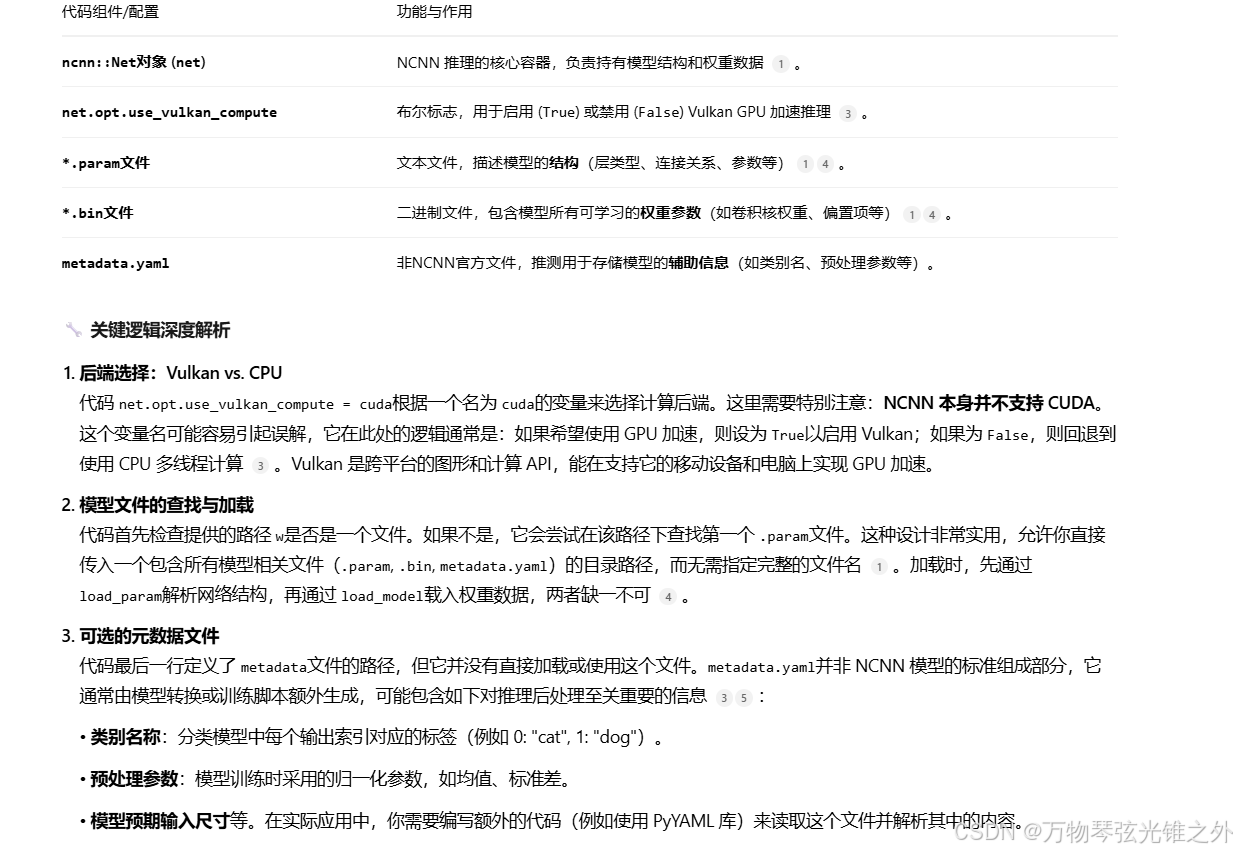
ncnn
        elif ncnn:
            LOGGER.info(f"Loading {w} for NCNN inference...")
            check_requirements("git+https://github.com/Tencent/ncnn.git" if ARM64 else "ncnn")  # requires NCNN
            import ncnn as pyncnn

            net = pyncnn.Net()
            net.opt.use_vulkan_compute = cuda
            w = Path(w)
            if not w.is_file():  # if not *.param
                w = next(w.glob("*.param"))  # get *.param file from *_ncnn_model dir
            net.load_param(str(w))
            net.load_model(str(w.with_suffix(".bin")))
            metadata = w.parent / "metadata.yaml"
onnx
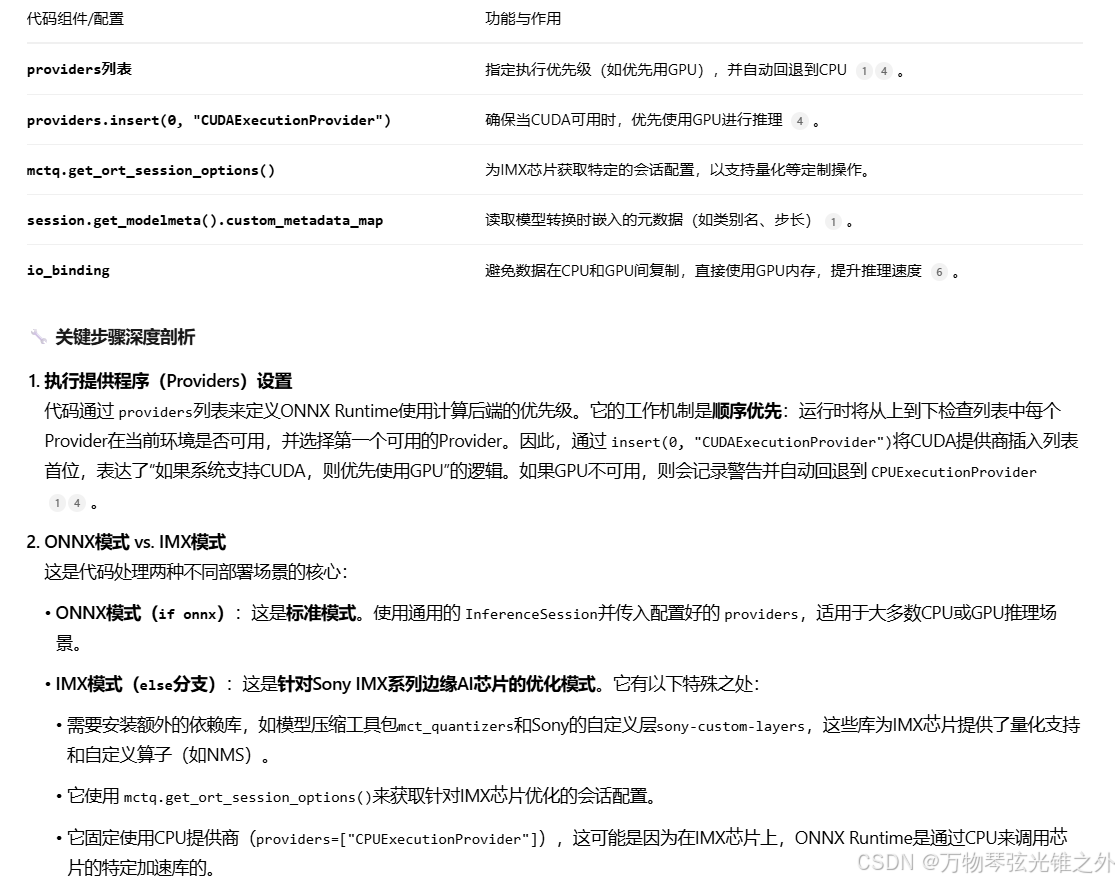
        # ONNX Runtime and IMX
        elif onnx or imx:
            LOGGER.info(f"Loading {w} for ONNX Runtime inference...")
            check_requirements(("onnx", "onnxruntime-gpu" if cuda else "onnxruntime"))
            if IS_RASPBERRYPI or IS_JETSON:
                # Fix 'numpy.linalg._umath_linalg' has no attribute '_ilp64' for TF SavedModel on RPi and Jetson
                check_requirements("numpy==1.23.5")
            import onnxruntime

            providers = ["CPUExecutionProvider"]
            if cuda and "CUDAExecutionProvider" in onnxruntime.get_available_providers():
                providers.insert(0, "CUDAExecutionProvider")
            elif cuda:  # Only log warning if CUDA was requested but unavailable
                LOGGER.warning("WARNING ⚠️ Failed to start ONNX Runtime with CUDA. Using CPU...")
                device = torch.device("cpu")
                cuda = False
            LOGGER.info(f"Using ONNX Runtime {providers[0]}")
            if onnx:
                session = onnxruntime.InferenceSession(w, providers=providers)
            else:
                check_requirements(
                    ["model-compression-toolkit==2.1.1", "sony-custom-layers[torch]==0.2.0", "onnxruntime-extensions"]
                )
                w = next(Path(w).glob("*.onnx"))
                LOGGER.info(f"Loading {w} for ONNX IMX inference...")
                import mct_quantizers as mctq
                from sony_custom_layers.pytorch.object_detection import nms_ort  # noqa

                session = onnxruntime.InferenceSession(
                    w, mctq.get_ort_session_options(), providers=["CPUExecutionProvider"]
                )
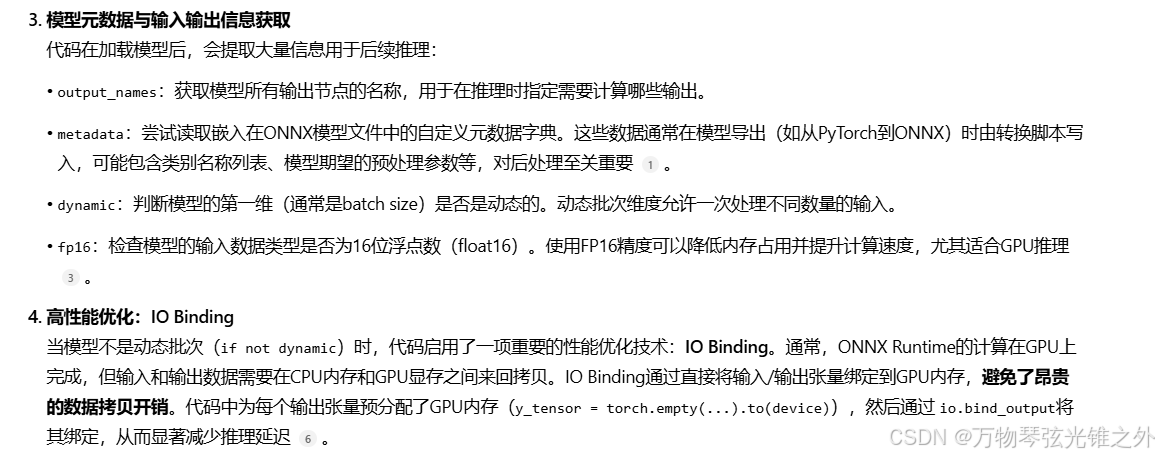
                task = "detect"

            output_names = [x.name for x in session.get_outputs()]
            metadata = session.get_modelmeta().custom_metadata_map
            dynamic = isinstance(session.get_outputs()[0].shape[0], str)
            fp16 = True if "float16" in session.get_inputs()[0].type else False
            if not dynamic:
                io = session.io_binding()
                bindings = []
                for output in session.get_outputs():
                    out_fp16 = "float16" in output.type
                    y_tensor = torch.empty(output.shape, dtype=torch.float16 if out_fp16 else torch.float32).to(device)
                    io.bind_output(
                        name=output.name,
                        device_type=device.type,
                        device_id=device.index if cuda else 0,
                        element_type=np.float16 if out_fp16 else np.float32,
                        shape=tuple(y_tensor.shape),
                        buffer_ptr=y_tensor.data_ptr(),
                    )





 扫一扫
扫一扫


 被折叠的 条评论
为什么被折叠?
被折叠的 条评论
为什么被折叠?
 到【灌水乐园】发言





