





 本文详细解读了yolox-pytorch库中nets/yolo.py文件中的YOLOXHead和YOLOPAFPN模块,介绍了网络结构、卷积操作和多尺度特征融合的过程。
yolox-pytorch:nets/yolo.py
仓库
https://github.com/bubbliiiing/yolox-pytorch
添加链接描述
yolox网络结构

yolox-pytorch目录

nets目录
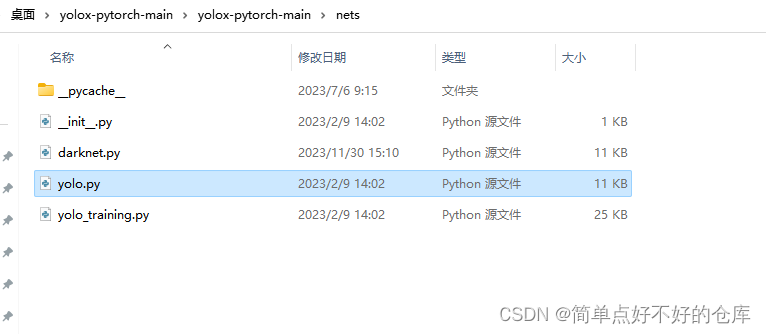
今天解析注释nets/yolo.py
import torch
import torch.nn as nn

from .darknet import BaseConv, CSPDarknet, CSPLayer, DWConv

###################################################################################
class YOLOXHead(nn.Module):
    def __init__(self, num_classes, width = 1.0, in_channels = [256, 512, 1024], act = "silu", depthwise = False,):
        super().__init__()  # 调用父类的初始化方法

        # 根据depthwise的值选择卷积类型,如果是深度可分离卷积,则使用DWConv,否则使用BaseConv
        Conv            = DWConv if depthwise else BaseConv

        # 初始化存储不同部分预测结果的列表
        self.cls_convs  = nn.ModuleList()  # 分类卷积层
        self.reg_convs  = nn.ModuleList()  # 回归卷积层
        self.cls_preds  = nn.ModuleList()  # 分类预测层
        self.reg_preds  = nn.ModuleList()  # 回归预测层
        self.obj_preds  = nn.ModuleList()  # 目标存在性预测层
        self.stems      = nn.ModuleList()  # stem卷积层,用于调整输入通道数

        # 遍历每一个输入通道数
        for i in range(len(in_channels)):
            # stem卷积层,用于将输入通道数调整为指定的输出通道数
            self.stems.append(BaseConv(in_channels = int(in_channels[i] * width), out_channels = int(256 * width), ksize = 1, stride = 1, act = act))

            # 分类卷积层,包括两个卷积操作
            self.cls_convs.append(nn.Sequential(*[
                Conv(in_channels = int(256 * width), out_channels = int(256 * width), ksize = 3, stride = 1, act = act),
                Conv(in_channels = int(256 * width), out_channels = int(256 * width), ksize = 3, stride = 1, act = act),
            ]))
            # 分类预测层,输出通道数为num_classes,表示每个像素位置可能的类别数量
            self.cls_preds.append(
                nn.Conv2d(in_channels = int(256 * width), out_channels = num_classes, kernel_size = 1, stride = 1, padding = 0)
            )

            # 回归卷积层,包括两个卷积操作
            self.reg_convs.append(nn.Sequential(*[
                Conv(in_channels = int(256 * width), out_channels = int(256 * width), ksize = 3, stride = 1, act = act),
                Conv(in_channels = int(256 * width), out_channels = int(256 * width), ksize = 3, stride = 1, act = act)
            ]))
            # 回归预测层,输出通道数为4,表示每个目标的边框位置信息(x, y, w, h)
            self.reg_preds.append(
                nn.Conv2d(in_channels = int(256 * width), out_channels = 4, kernel_size = 1, stride = 1, padding = 0)
            )
            # 目标存在性预测层,输出通道数为1,表示每个像素位置是否有目标存在
            self.obj_preds.append(
                nn.Conv2d(in_channels = int(256 * width), out_channels = 1, kernel_size = 1, stride = 1, padding = 0)
            )
	  def forward(self, inputs):
	        #---------------------------------------------------#
	        #   inputs输入
	        #   P3_out  80, 80, 256
	        #   P4_out  40, 40, 512
	        #   P5_out  20, 20, 1024
	        #---------------------------------------------------#
	        outputs = []
	        for k, x in enumerate(inputs):
	            #---------------------------------------------------#
	            #   利用1x1卷积进行通道整合
	            #---------------------------------------------------#
	            x       = self.stems[k](x)
	            #---------------------------------------------------#
	            #   利用两个卷积标准化激活函数来进行特征提取
	            #---------------------------------------------------#
	            cls_feat    = self.cls_convs[k](x)
	            #---------------------------------------------------#
	            #   判断特征点所属的种类
	            #   80, 80, num_classes
	            #   40, 40, num_classes
	            #   20, 20, num_classes
	            #---------------------------------------------------#
	            cls_output  = self.cls_preds[k](cls_feat)

	            #---------------------------------------------------#
	            #   利用两个卷积标准化激活函数来进行特征提取
	            #---------------------------------------------------#
	            reg_feat    = self.reg_convs[k](x)
	            #---------------------------------------------------#
	            #   特征点的回归系数
	            #   reg_pred 80, 80, 4
	            #   reg_pred 40, 40, 4
	            #   reg_pred 20, 20, 4
	            #---------------------------------------------------#
	            reg_output  = self.reg_preds[k](reg_feat)
	            #---------------------------------------------------#
	            #   判断特征点是否有对应的物体
	            #   obj_pred 80, 80, 1
	            #   obj_pred 40, 40, 1
	            #   obj_pred 20, 20, 1
	            #---------------------------------------------------#
	            obj_output  = self.obj_preds[k](reg_feat)
				# 将回归、目标存在性和分类的输出在第二个维度上进行拼接
				output = torch.cat([reg_output, obj_output, cls_output], 1)
				# 将拼接后的输出添加到outputs列表中
				outputs.append(output)
				# 返回包含所有尺度或所有层预测结果的outputs列表

	        return outputs


###################################################################################

# 导入PyTorch的nn模块
class YOLOPAFPN(nn.Module):
    def __init__(self, depth = 1.0, width = 1.0, in_features = ("dark3", "dark4", "dark5"), in_channels = [256, 512, 1024], depthwise = False, act = "silu"):
        super().__init__()  # 调用父类nn.Module的初始化方法

        # 根据depthwise的值选择卷积方式,如果是True则使用DWConv,否则使用BaseConv
        Conv                = DWConv if depthwise else BaseConv

        # 创建CSPDarknet作为backbone网络,其参数由外部传入
        self.backbone       = CSPDarknet(depth, width, depthwise = depthwise, act = act)

        # 存储输入特征层的名称
        self.in_features    = in_features

        # 定义上采样层,用于将特征图放大一倍
        self.upsample       = nn.Upsample(scale_factor=2, mode="nearest")

        # 以下部分是定义不同的卷积层和CSPLayer,用于特征提取和融合
        # 注释中的数字表示特征图的尺寸和通道数,例如20, 20, 1024表示宽高为20,通道数为1024的特征图
        #-------------------------------------------#
        #   20, 20, 1024 -> 20, 20, 512
        #-------------------------------------------#
        self.lateral_conv0  = BaseConv(int(in_channels[2] * width), int(in_channels[1] * width), 1, 1, act=act)

        #-------------------------------------------#
        #   40, 40, 1024 -> 40, 40, 512
        #-------------------------------------------#
        self.C3_p4 = CSPLayer(
            int(2 * in_channels[1] * width),
            int(in_channels[1] * width),
            round(3 * depth),
            False,
            depthwise = depthwise,
            act = act,
        )

        #-------------------------------------------#
        #   40, 40, 512 -> 40, 40, 256
        #-------------------------------------------#
        self.reduce_conv1   = BaseConv(int(in_channels[1] * width), int(in_channels[0] * width), 1, 1, act=act)

        #-------------------------------------------#
        #   80, 80, 512 -> 80, 80, 256
        #-------------------------------------------#
        self.C3_p3 = CSPLayer(
            int(2 * in_channels[0] * width),
            int(in_channels[0] * width),
            round(3 * depth),
            False,
            depthwise = depthwise,
            act = act,
        )

        #-------------------------------------------#
        #   80, 80, 256 -> 40, 40, 256
        #-------------------------------------------#
        # 这里是一个卷积操作,但代码被注释掉了,所以没有实际执行任何操作
        # 定义一个卷积层,输入和输出的通道数都是in_channels[0] * width,卷积核大小为3,步长为2,激活函数为act
		self.bu_conv2       = Conv(int(in_channels[0] * width), int(in_channels[0] * width), 3, 2, act=act)

		# 注释说明:该卷积层将特征图的尺寸从40x40变为20x20,通道数从256变为512
		#-------------------------------------------#
		#   40, 40, 256 -> 40, 40, 512
		#-------------------------------------------#

		# 定义一个CSPLayer,输入通道数为2 * in_channels[0] * width,输出通道数为in_channels[1] * width,其他参数由外部传入
		self.C3_n3 = CSPLayer(
		    int(2 * in_channels[0] * width),
		    int(in_channels[1] * width),
		    round(3 * depth),
		    False,
		    depthwise = depthwise,
		    act = act,
		)

		# 定义另一个卷积层,输入和输出的通道数都是in_channels[1] * width,卷积核大小为3,步长为2,激活函数为act
		self.bu_conv1       = Conv(int(in_channels[1] * width), int(in_channels[1] * width), 3, 2, act=act)

		# 注释说明:该卷积层将特征图的尺寸从40x40变为20x20,通道数从512变为1024
		#-------------------------------------------#
		#   40, 40, 512 -> 20, 20, 512
		#-------------------------------------------#

		# 定义另一个CSPLayer,输入通道数为2 * in_channels[1] * width,输出通道数为in_channels[2] * width,其他参数由外部传入
		self.C3_n4 = CSPLayer(
		    int(2 * in_channels[1] * width),
		    int(in_channels[2] * width),
		    round(3 * depth),
		    False,
		    depthwise = depthwise,
		    act = act,
		)
   def forward(self, input):
        out_features            = self.backbone.forward(input)
        [feat1, feat2, feat3]   = [out_features[f] for f in self.in_features]

        #-------------------------------------------#
        #   20, 20, 1024 -> 20, 20, 512
        #-------------------------------------------#
        P5          = self.lateral_conv0(feat3)
        #-------------------------------------------#
        #  20, 20, 512 -> 40, 40, 512
        #-------------------------------------------#
        P5_upsample = self.upsample(P5)
        #-------------------------------------------#
        #  40, 40, 512 + 40, 40, 512 -> 40, 40, 1024
        #-------------------------------------------#
        P5_upsample = torch.cat([P5_upsample, feat2], 1)
        #-------------------------------------------#
        #   40, 40, 1024 -> 40, 40, 512
        #-------------------------------------------#
        P5_upsample = self.C3_p4(P5_upsample)

        #-------------------------------------------#
        #   40, 40, 512 -> 40, 40, 256
        #-------------------------------------------#
        P4          = self.reduce_conv1(P5_upsample)
        #-------------------------------------------#
        #   40, 40, 256 -> 80, 80, 256
        #-------------------------------------------#
        P4_upsample = self.upsample(P4)
        #-------------------------------------------#
        #   80, 80, 256 + 80, 80, 256 -> 80, 80, 512
        #-------------------------------------------#
        P4_upsample = torch.cat([P4_upsample, feat1], 1)
        #-------------------------------------------#
        #   80, 80, 512 -> 80, 80, 256
        #-------------------------------------------#
        P3_out      = self.C3_p3(P4_upsample)

        #-------------------------------------------#
        #   80, 80, 256 -> 40, 40, 256
        #-------------------------------------------#
        P3_downsample   = self.bu_conv2(P3_out)
        #-------------------------------------------#
        #   40, 40, 256 + 40, 40, 256 -> 40, 40, 512
        #-------------------------------------------#
        P3_downsample   = torch.cat([P3_downsample, P4], 1)
        #-------------------------------------------#
        #   40, 40, 256 -> 40, 40, 512
        #-------------------------------------------#
        P4_out          = self.C3_n3(P3_downsample)

        #-------------------------------------------#
        #   40, 40, 512 -> 20, 20, 512
        #-------------------------------------------#
        P4_downsample   = self.bu_conv1(P4_out)
        #-------------------------------------------#
        #   20, 20, 512 + 20, 20, 512 -> 20, 20, 1024
        #-------------------------------------------#
        P4_downsample   = torch.cat([P4_downsample, P5], 1)
        #-------------------------------------------#
        #   20, 20, 1024 -> 20, 20, 1024
        #-------------------------------------------#
        P5_out          = self.C3_n4(P4_downsample)

        return (P3_out, P4_out, P5_out)

###################################################################################
# 定义了一个名为YoloBody的类,它继承了nn.Module,是PyTorch中的一个神经网络模型。
class YoloBody(nn.Module):
    # 初始化函数,当创建YoloBody类的实例时会被调用。
    def __init__(self, num_classes, phi):
        # 调用父类nn.Module的初始化函数。
        super().__init__()

        # 定义了两个字典,分别存储了不同phi值对应的深度和宽度系数。
        depth_dict = {'nano': 0.33, 'tiny': 0.33, 's' : 0.33, 'm' : 0.67, 'l' : 1.00, 'x' : 1.33,}
        width_dict = {'nano': 0.25, 'tiny': 0.375, 's' : 0.50, 'm' : 0.75, 'l' : 1.00, 'x' : 1.25,}

        # 根据输入的phi值,从字典中获取对应的深度和宽度系数。
        depth, width = depth_dict[phi], width_dict[phi]

        # 判断phi值是否为'nano',如果是,则depthwise为True,否则为False。
        depthwise = True if phi == 'nano' else False

        # 创建YOLOPAFPN的实例作为backbone,参数包括depth、width和depthwise。
        self.backbone = YOLOPAFPN(depth, width, depthwise=depthwise)

        # 创建YOLOXHead的实例作为head,参数包括num_classes、width和depthwise。
        self.head = YOLOXHead(num_classes, width, depthwise=depthwise)

    # 定义前向传播函数。
    def forward(self, x):
        # 将输入x传递给backbone,得到fpn_outs。
        fpn_outs = self.backbone.forward(x)

        # 将fpn_outs传递给head,得到outputs。
        outputs = self.head.forward(fpn_outs)

        # 返回outputs。
        return outputs


###################################################################################


###################################################################################






 扫一扫
扫一扫


 4245
4245

 被折叠的 条评论
为什么被折叠?
被折叠的 条评论
为什么被折叠?
 到【灌水乐园】发言





