



 本文针对LeetCode上的一个较难的问题提供了两种解决方案。一种是在原始数据结构上直接进行修改,但可能会因为频繁的删除操作而导致效率低下;另一种是通过创建新的数据结构来避免这一问题,并详细解释了每种方法的具体实现步骤。
题目
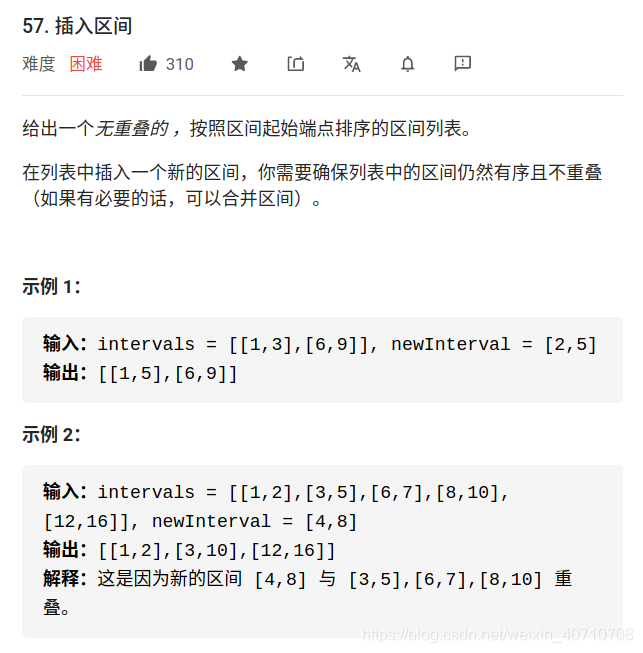 leetcode的每日一题,看到是hard有些慌,但是看题目似乎并不难; 有两种想法,在本地空间对intervals进行修改,或新建vector来插入
本地修改的方法需要做很多判断,而且需要在本地vector进行多次erase操作,效率并不会比新建vector效率高!
本地修改代码(要是遇到很多需要合并的单元会导致很多erase操作,很耗时!):
class Solution {
public:
    vector<vector<int>> insert(vector<vector<int>>& intervals, vector<int>& newInterval) {
        int count = 0;
        if(intervals.size()>0){
            if((intervals.front())[0]>newInterval[0] && (intervals.back())[1]<newInterval[1]){
                // 用于应对测试用例中最后一个超长输入
                // 这也是直接在intervals上操作的坏处,要是intervals有很多需要合并的单元,那么需要很多次erase,容易导致超时!
                vector<vector<int>> res;
                res.push_back(newInterval);
                return res;
            }
        }
        for(vector<vector<int>>::iterator iter=intervals.begin();iter!=intervals.end();){
            if(newInterval[1]<(*iter)[0]){
                // newInterval在左侧
                if(count == 0){
                    intervals.insert(iter,newInterval);
                    count ++;
                }
                return intervals;
            }
            else{
                if(newInterval[0]>(*iter)[1]){
                // newInterval在右侧
                    iter++;
                    continue;
                }
                else{
                    //  有交集
                    int left = min((*iter)[0],newInterval[0]);
                    int right = max((*iter)[1],newInterval[1]);
                    intervals.erase(iter);
                    newInterval = {left,right};
                }
            }
        }
        if(count == 0)
            intervals.push_back(newInterval);
        return intervals;
    }
};
新建vector:
class Solution {
public:
    vector<vector<int>> insert(vector<vector<int>>& intervals, vector<int>& newInterval) {
        vector<vector<int>> res;
        int count = 0;
        for(int i=0;i<intervals.size();i++){
            if(newInterval[1]<intervals[i][0]){
                // newInterval在左侧,且无交集
                if(count == 0){
                    res.push_back(newInterval);
                    count++;
                }
                res.push_back(intervals[i]);
            }
            else{
                if(newInterval[0]>intervals[i][1]){
                    // newInterval在右侧,且无交集
                    res.push_back(intervals[i]);
                }
                else{
                    // 有交集
                    int left = min(newInterval[0],intervals[i][0]);
                    int right = max(newInterval[1],intervals[i][1]);
                    newInterval = {left,right};
                }
            }
        }
        if(count == 0)
            res.push_back(newInterval);
        return res;

    }
};





 扫一扫
扫一扫


 156
156

 被折叠的 条评论
为什么被折叠?
被折叠的 条评论
为什么被折叠?
 到【灌水乐园】发言





