 Lowbit函数与二叉搜索树查询


 本文介绍了一个利用Lowbit函数解决二叉搜索树中查询子树最大最小值的问题。通过输入节点数,程序可以快速计算出指定子树内的最小及最大数值。
BST
| Time Limit: 1000MS | Memory Limit: 65536K | |
| Total Submissions: 8440 | Accepted: 5093 |
Description
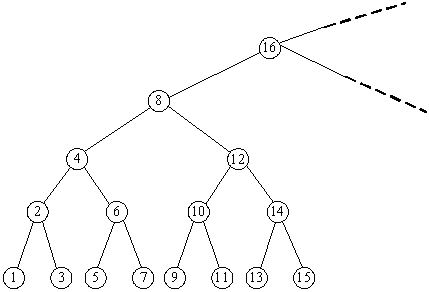
Consider an infinite full binary search tree (see the figure below), the numbers in the nodes are 1, 2, 3, .... In a subtree whose root node is X, we can get the minimum number in this subtree by repeating going down the left node until the last level, and we can also find the maximum number by going down the right node. Now you are given some queries as "What are the minimum and maximum numbers in the subtree whose root node is X?" Please try to find answers for there queries.
Input
In the input, the first line contains an integer N, which represents the number of queries. In the next N lines, each contains a number representing a subtree with root number X (1 <= X <= 231 - 1).
Output
There are N lines in total, the i-th of which contains the answer for the i-th query.
Sample Input
2
8
10
Sample Output
1 15
9 11


==================================================================
这题就是Lowbit函数的使用,理解了Lowbit,这题就很容易了
#include <stdio.h>
#include <string.h>
#include <stdlib.h>
#include <algorithm>
#include <math.h>

#define MAxx 1000

int Lowbit(int x)
{
    return x&(-x);
}
int main()
{
    int i,j,n,m;
    scanf("%d",&n);
    for(i=0;i<n;i++)
    {
        scanf("%d",&m);
        int cas=Lowbit(m);
        printf("%d %d\n",m-cas+1,m+cas-1);
    }
    return 0;
}





 扫一扫
扫一扫


 302
302

 被折叠的 条评论
为什么被折叠?
被折叠的 条评论
为什么被折叠?
 到【灌水乐园】发言





