





1.三角形面积
描述
求两邻边长为3.5和4.72米,两边夹角为37°的三角形的面积。pi=3.1416,结果保留四位小数。
输入
无
输出
该三角形的面积
提示
三角形面积:S=(absinx)/2; (x为a,b两边的夹角的弧度)
代码:
#include <stdio.h>
#include <stdlib.h>
#include<math.h>

#define PI 3.1416

int main() {
	double a=3.5,b=4.72;
	double angle_degree=37.0;
	double angle_radian=angle_degree*(PI/180.0);

	double area=0.5*a*b*sin(angle_radian);

	printf("%.4f\n",area);

	return 0;
}
2.n的阶乘
描述
编写函数实现,计算n的阶乘
函数接口:
int fact(int num){函数体};
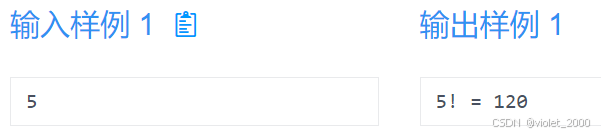
输入
一个正整数n (0<n<15)
输出
n! = n的阶乘
提示
递归
代码:
#include <stdio.h>
#include <stdlib.h>
#include<math.h>

int fact(int number)
{
	int i,result=1;
	for(i=1;i<=number;i++)
	{
		result*=i;
	}
	return result;
}

int main() {
	int n;
	scanf("%d",&n);

	int factorial=fact(n);

	printf("%d\n",factorial);

	return 0;
}
cpp代码:
1.递归:当num不为0或1时,就一直调用本函数。
缺点:递归函数效率低,在多次调用时性能会下降
#include <iostream>
#include <iomanip>
#include <string>
#include <cmath>
#include <algorithm>//min
#include <bitset>//去除前缀0
using namespace std;

//递归算法求函数阶乘
long long fact(int num){
	if(num==0||num==1){
		return 1;
	}
	return num*fact(num-1);
}

int main() {
	int n;
	cin>>n;

	cout<<n<<"! = "<<fact(n)<<endl;

    return 0;
}
2.迭代:通过循环更新每次函数的值
#include <iostream>
#include <iomanip>
#include <string>
#include <cmath>
#include <algorithm>//min
#include <bitset>//去除前缀0
using namespace std;

//迭代算法求函数阶乘
long long fact(int num){
	long long result=1;
	for(int i=1;i<=num;i++){
		result*=i;
	}
	return result;
}

int main() {
	int n;
	cin>>n;

	cout<<n<<"! = "<<fact(n)<<endl;

    return 0;
}
3.一元二次方程的根
描述
编写函数,实现:传入三个参数,分别为一元二次方程 ax^2+bx+c=0 的三个系数a,b,c,求解此二次方程的根,且打印输出。
函数接口:
void root(int a,int b,int c)
{
函数体
}
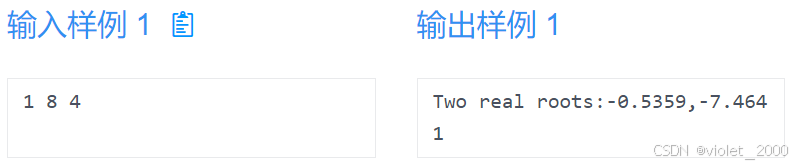
输入
三个系数a、b、c。a,b,c为整数
输出
如果有两个实根,则输出:Two real roots:x1,x2(保留4位小数,且x1>x2)
如果有一个实根,则输出:One real root:x1(保留4位小数)
如果无实根,则输出:No real root
代码:
#include <stdio.h>
#include <stdlib.h>
#include<math.h>

void root(int a,int b,int c)
{
	if(b*b-4*a*c<0)
	{
		printf("No real root");
	}else if(b*b-4*a*c==0)
	{
		double result=0.5*(-b)/a;
		printf("One real root:%.4f",result);
	}else
	{
		double result1=0.5*(-b+sqrt(b*b-4*a*c))/a;
		double result2=0.5*(-b-sqrt(b*b-4*a*c))/a;
		printf("Two real roots:%.4f,%.4f",result1,result2);
	}
}

int main() {
	int a,b,c;
	scanf("%d%d%d",&a,&b,&c);

	root(a,b,c);

	return 0;
}
4.乘法表
描述
编写函数实现:传入整数n,输出n*n的乘法表
函数接口:
void Print(int n)
{函数体}
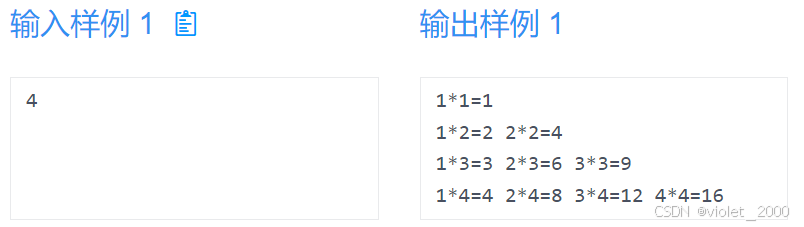
输入
一个整数 n (1<=n<=100)
输出
n*n 的乘法表
提示
每个等式后面有一个空格
代码:
#include <stdio.h>
#include <stdlib.h>
#include<math.h>

void Print(int n)
{
	int i,j;
	for(i=1;i<=n;i++)
	{
		for(j=1;j<=i;j++)
		{
			printf("%d*%d=%d",j,i,i*j);
			if(j<i)printf(" ");
		}
		printf("\n");
	}
}

int main() {
	int n;
	scanf("%d",&n);

	Print(n);

	return 0;
}
5.平均值
描述
编写函数实现:传入一个整数数组a,和该数组的长度,返回该数组的平均值。
函数接口:
int Average(int a[],int n)
{函数体}
在主函数中,输入整数数组,打印输出该数组的平均值。
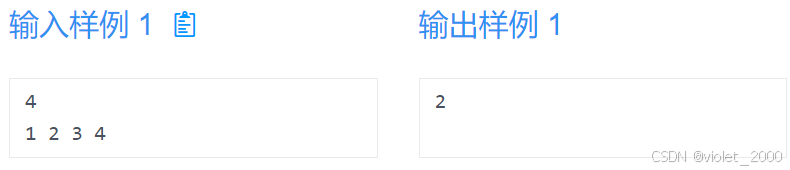
输入
第一行是一个整数n,代表数组的长度,(1<=n<=100)
第二行是n个整数,代表该数组中每个数的值x (x<1e5)
输出
该数组的平均值,结果保留整数
代码:
#include <stdio.h>
#include <stdlib.h>
#include<math.h>

int Average(int array[],int n)
{
	int i,sum=0;
	for(i=0;i<n;i++)
	{
		sum+=array[i];
	}
	int aver=(int)sum/n;
	return aver;
}

int main() {
	int n;
	scanf("%d",&n);
	int array[n];
	int i;
	for(i=0;i<n;i++)
	{
		scanf("%d",&array[i]);
	}

	printf("%d",Average(array,n));

	return 0;
}
6.统计数字
描述
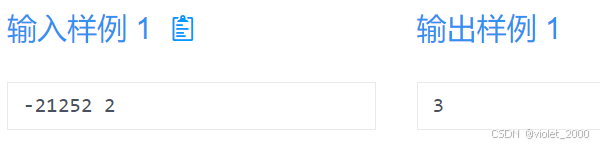
编写函数实现,统计某一整数中某个位数出现的次数
函数接口:
int Count_Digit ( int num, int d ){函数体}
输入
第一行是需要统计的一个整数n(n不超过int范围)
第二行是[0,9]中的某一个数字d
输出
输出n中数字d出现的次数
代码:
#include <stdio.h>
#include <stdlib.h>
#include <math.h>
#include <limits.h>

//function declaration
int Count_Digit(int num,int d);

int main() {
	int n,d;
	scanf("%d%d",&n,&d);
	int count=0;

	count=Count_Digit(n,d);
	//最大输入一个9位数,再大就超过int范围了

	printf("%d",count);

	return 0;
}

//function definition
int Count_Digit(int num,int d)
{
	int count=0;
	//convert to absolute value first
	num=abs(num);

	//check the numbers bit by bit and count them
	while(num>0)
	{
		int last_digit=num%10;
		if(last_digit==d)count++;

		num/=10;
	}

	return count;
}
7.十进制转换
描述
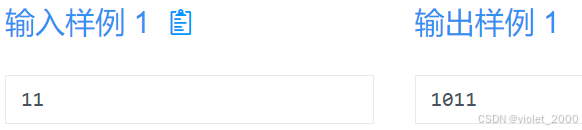
编写函数实现,将一个十进制数转换为二进制数并输出
函数接口:
void Change(int num){函数体};
输入
一个正整数n(1<=n<=1e6)
输出
n的二进制表示
代码:
#include <stdio.h>
#include <stdlib.h>
#include <math.h>
#include <string.h>

void Change(int num);

int main() {
	int n;
	scanf("%d",&n);

	Change(n);

	return 0;
}

void Change(int num)
{
	//special situation
	if(num==0)
	{
		printf("0");
		return;
	}

	char binary[33];//存放了33个元素,保证能放下int能表示的二进制位数
	binary[32]='\0';//保证数组以'\0'结尾
	int index=0,i;

	while(num>0)
	{
		binary[index]=(num%2)?1:0;
//num%2成真,即num为单数,赋值1,否则赋值0
		index++;//最后index多+1,要减去
		//binary[index++]=(num%2)?1:0;  是后缀,赋值完index才会+1

		num/=2;
	 }

	//逆序输出
	for(i=index-1;i>=0;i--)
	{
		printf("%d",binary[i]);
	 }
}
cpp代码:
代码1:引入bitset类型(需要去除前缀0),将int转化为二进制字符串
头文件:#include <bitset>
bitset<32> b(num);//建立一个bitset类型并用num初始化,此时b就是num的二进制形式了 to_string();//将其转化为字符串
substr(b.to_string().find(‘1’));//
#include <iostream>
#include <iomanip>
#include <string>
#include <cmath>
#include <algorithm>//min
#include <bitset>//去除前缀0
using namespace std;

//十进制转二进制
void Change(int num){
	bitset<32> b(num);
	cout<<b.to_string().substr(b.to_string().find('1'))<<endl;
}


int main() {
	int n;
	cin>>n;

	Change(n);

    return 0;
}
代码2:与C语言的方法一致
#include <iostream>
#include <iomanip>
#include <string>
#include <cmath>
#include <algorithm>//min
#include <bitset>//去除前缀0
using namespace std;

//十进制转二进制
void Change(int num){
	//speicial situation
	if(num==0){
		cout<<"0"<<endl;//不要直接输出num,num是int类型,不是二进制字符串
		return;
	}

	char digits[33];//最多32位,最后一位是'\0'
	int index=0;//位数

	while(num>0){
		digits[index]=(num%2)?'1':'0';//奇数-字符1 偶数-字符0
		index++;//位数+1
		num/=2;//num减半
	}

	//逆序输出
	for(int i=index-1;i>=0;i--){
		cout<<digits[i];
	}
	cout<<endl;
}


int main() {
	int n;
	cin>>n;

	Change(n);

    return 0;
}
8.表格输出
描述
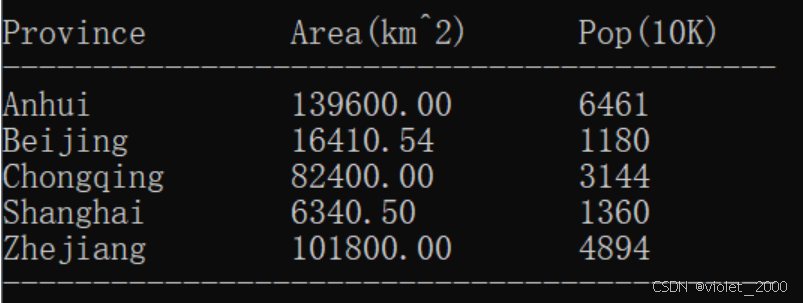
如表格所示,建立Province的结构体,
struct Province{
char name[20];
double area;
int pop;
};
将5个省的信息存入结构体,然后打印输出。
输入
无输入
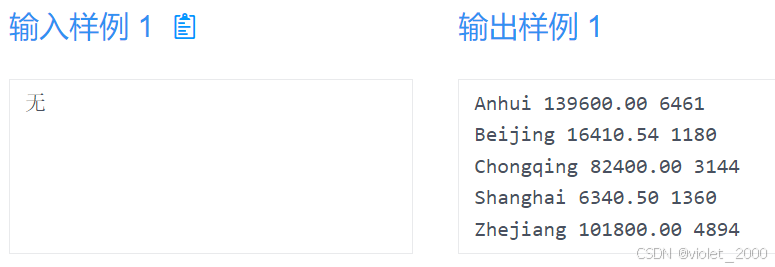
输出
每一行代表一个省的数据,数据之间用空格隔开,最后一个数据后面没有空格。
代码:
#include <stdio.h>
#include <stdlib.h>
#include <math.h>
#include <string.h>

struct Province
{
	char name[20];
	double area;
	int pop;
};

int main() {
	struct Province pro[]=
	{
		{"Anhui",139600.00,6461},
		{"Beijing",16410.54,1180},
		{"Chongqing",82400.00,3144},
		{"Shanghai",6340.50,1360},
		{"Zhejiang",101800.00,4894},
	};

	int num=sizeof(pro)/sizeof(pro[0]);
	int i;
	for(i=0;i<num;i++)
	{
		printf("%s %.2f %d",pro[i].name,pro[i].area,pro[i].pop);
		if(i!=num-1)printf("\n");
	}

	return 0;
}
9.同一年生日
描述
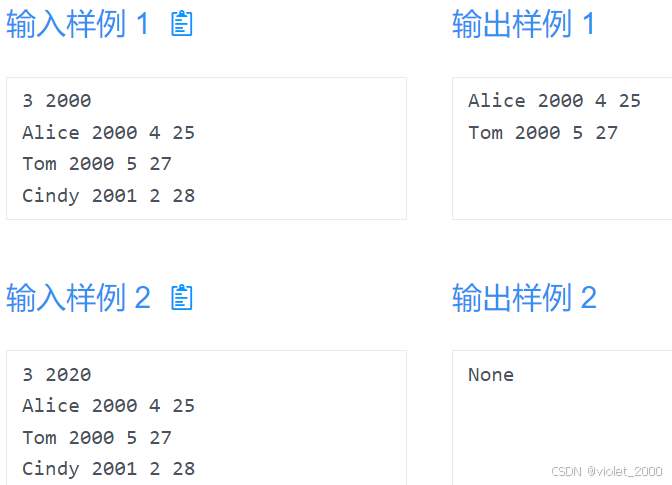
编写程序,实现在所有人中,输出某一年出生的人的姓名和出生年月日。
出生年月日和人的结构体:
struct Date{ int year,month,day;};
struct Person{ char name[20]; Date birth;};
输入
第一行两个整数 ,第一个 n 代表人的个数,第二个 year 代表需要统计的年份。(1<=n<=1000)
后面 n 行,每一行代表一个人的姓名,出生年,月,日
输出
输出 year 年出生的人的姓名,出生年月日,一个人一行。
如果没有,则输出 "None".
代码:
#include <stdio.h>
#include <stdlib.h>
#include <stdbool.h>
#include <math.h>
#include <string.h>

struct Date
{
	int year,month,day;
};

struct Person
{
	char name[20];
	struct Date birth;//使用了上一个结构体
};

int main() {
	int n,year;
	int i;
	scanf("%d%d",&n,&year);

	struct Person people[1000];
	bool found=false;//初始化为假

	//input
	for(i=0;i<n;i++)
	{
		scanf("%s %d %d %d",people[i].name,
		&people[i].birth.year,&people[i].birth.month,&people[i].birth.day);
	 }

	//judgment
	for(i=0;i<n;i++)
	{
		if(people[i].birth.year==year)
		{
			printf("%s %d %d %d\n",people[i].name,
			people[i].birth.year,people[i].birth.month,people[i].birth.day);
			found=true;
		}
	}

	if(!found)//found为假,非found为真,成真即执行if语句
	{
		printf("None");
	}

	return 0;
}
10.多个学生信息打印
描述
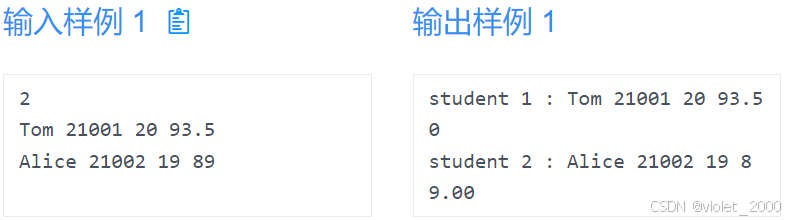
编写程序,实现输出多个学生的姓名,学号,年龄,和成绩。
学生结构体:struct Student{ char name[20]; int id; int age; float score;};
输入
第一行一个整数 n ,代表学生的个数(1<=n<=100)
下面 i 行,每一行分别代表一个学生的姓名,学号,年龄,成绩。
输出
按照格式输出每个学生的信息,一个学生一行,成绩保留两位小数。注意空格
代码:
#include <stdio.h>
#include <stdlib.h>
#include <stdbool.h>
#include <math.h>
#include <string.h>

struct Student
{
	char name[20];
	int id;
	int age;
	float score;
};

int main() {
	int n;
	scanf("%d",&n);
	struct Student stu[1000];
	int i;
	for(i=0;i<n;i++)
	{
		scanf("%s %d %d %f",stu[i].name,&stu[i].id,
		&stu[i].age,&stu[i].score);
	}

	for(i=0;i<n;i++)
	{
		printf("student %d : %s %d %d %.2f\n",
		i+1,stu[i].name,stu[i].id,stu[i].age,stu[i].score);
	}

	return 0;
}





 扫一扫
扫一扫


 5339
5339

 被折叠的 条评论
为什么被折叠?
被折叠的 条评论
为什么被折叠?
 到【灌水乐园】发言





