





 本文介绍了一种解决树中两个节点最近公共祖先问题的方法,包括输入格式、算法实现及输出示例。
Closest Common Ancestors
| Time Limit: 2000MS | Memory Limit: 10000K | |
| Total Submissions: 15403 | Accepted: 4919 |
Description
Write a program that takes as input a rooted tree and a list of pairs of vertices. For each pair (u,v) the program determines the closest common ancestor of u and v in the tree. The closest common ancestor of two nodes u and v is the node w that is an ancestor
of both u and v and has the greatest depth in the tree. A node can be its own ancestor (for example in Figure 1 the ancestors of node 2 are 2 and 5)
Input
The data set, which is read from a the std input, starts with the tree description, in the form:
nr_of_vertices
vertex:(nr_of_successors) successor1 successor2 ... successorn
...
where vertices are represented as integers from 1 to n ( n <= 900 ). The tree description is followed by a list of pairs of vertices, in the form:
nr_of_pairs
(u v) (x y) ...
The input file contents several data sets (at least one).
Note that white-spaces (tabs, spaces and line breaks) can be used freely in the input.
nr_of_vertices
vertex:(nr_of_successors) successor1 successor2 ... successorn
...
where vertices are represented as integers from 1 to n ( n <= 900 ). The tree description is followed by a list of pairs of vertices, in the form:
nr_of_pairs
(u v) (x y) ...
The input file contents several data sets (at least one).
Note that white-spaces (tabs, spaces and line breaks) can be used freely in the input.
Output
For each common ancestor the program prints the ancestor and the number of pair for which it is an ancestor. The results are printed on the standard output on separate lines, in to the ascending order of the vertices, in the format: ancestor:times
For example, for the following tree:
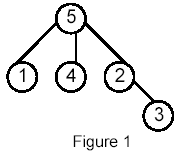
For example, for the following tree:
Sample Input
5
5:(3) 1 4 2
1:(0)
4:(0)
2:(1) 3
3:(0)
6
(1 5) (1 4) (4 2)
      (2 3)
(1 3) (4 3)
Sample Output
2:1
5:5
题意:求两个点的最近公共祖先。
思路:LCA模板题。
AC代码如下:
#include<cstdio>
#include<cstring>
#include<algorithm>
#include<cmath>
#include<vector>
#include<iostream>
using namespace std;
vector <int> G[1010];
int parent[30][1010],depth[1010],root,vis[1010],ans[1010];
char c,s[110];
void kong()
{ while(true)
  { c=cin.peek();
    if(c==' ' || c=='\n')
     cin.ignore();
    else
     break;
  }
}
void dfs(int v,int p,int d)
{ parent[0][v]=p;
  depth[v]=d;
  int i,len=G[v].size();
  for(i=0;i<len;i++)
   if(G[v][i]!=p)
    dfs(G[v][i],v,d+1);
}
void init(int V)
{ dfs(root,-1,0);
  int k,v;
  for(k=0;k+1<30;k++)
   for(v=0;v<V;v++)
    if(parent[k][v]<0)
     parent[k+1][v]=-1;
    else
     parent[k+1][v]=parent[k][parent[k][v]];
}
int lca(int u,int v)
{ int i,k;
  if(depth[u]>depth[v])
   swap(u,v);
  for(k=0;k<30;k++)
   if((depth[v]-depth[u])>>k &1)
    v=parent[k][v];
  if(u==v)
   return u;
  for(k=29;k>=0;k--)
   if(parent[k][u]!=parent[k][v])
   { u=parent[k][u];
     v=parent[k][v];
   }
  return parent[0][u];
}
int main()
{ int t=0,n,m,i,j,k,u,v;
  while(~scanf("%d",&n))
  { t++;
    for(i=0;i<=n;i++)
     G[i].clear();
    for(i=1;i<=n;i++)
    { scanf("%d:(%d)",&u,&m);
      while(m--)
      { scanf("%d",&v);
        G[u].push_back(v);
        vis[v]=t;
      }
    }
    for(i=1;i<=n;i++)
     if(vis[i]!=t)
     { root=i;
       break;
     }
    init(n+1);
    memset(ans,0,sizeof(ans));
    scanf("%d",&m);
    for(i=1;i<=m;i++)
    { kong();
      scanf("%c",&c);
      scanf("%d",&u);
      kong();
      scanf("%dc",&v,&c);
      if(c!=')')
      { kong();
        scanf("%c",&c);
      }
      ans[lca(u,v)]++;
    }
    for(i=1;i<=n;i++)
     if(ans[i]>0)
      printf("%d:%d\n",i,ans[i]);
  }
}





 扫一扫
扫一扫


 638
638

 被折叠的 条评论
为什么被折叠?
被折叠的 条评论
为什么被折叠?
 到【灌水乐园】发言





