



前一章Android应用进程启动过程(一)-优快云博客介绍了AMS向Zygote的Socket请求应用进程的过程,我们接着看Zygote接收到请求后是如何处理并创建进程的。
先看一下整体的时序图:
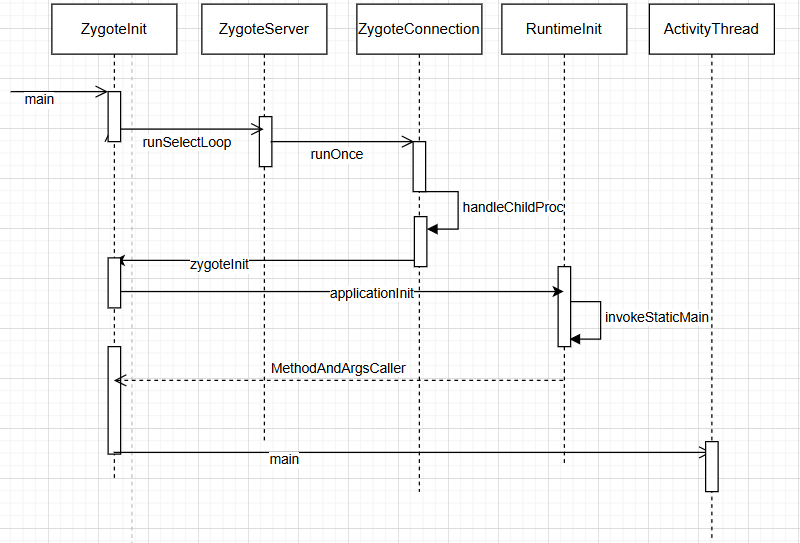
上文讲到,zygoteSendArgsAndGetResult方法的作用是将请求参数写到ZygoteState中,这样Zygote进程就可以收到创建新的进程请求。我们回到来看ZygoteInit的main方法:
frameworks/base/core/java/com/android/internal/os/ZygoteInit.java
public static void main(String argv[]) {
        ZygoteServer zygoteServer = new ZygoteServer();
...
        try {
            // Report Zygote start time to tron unless it is a runtime restart
            if (!"1".equals(SystemProperties.get("sys.boot_completed"))) {
                MetricsLogger.histogram(null, "boot_zygote_init",
                        (int) SystemClock.elapsedRealtime());
            }

            String bootTimeTag = Process.is64Bit() ? "Zygote64Timing" : "Zygote32Timing";
            BootTimingsTraceLog bootTimingsTraceLog = new BootTimingsTraceLog(bootTimeTag,
                    Trace.TRACE_TAG_DALVIK);
            bootTimingsTraceLog.traceBegin("ZygoteInit");
            RuntimeInit.enableDdms();
            // Start profiling the zygote initialization.
            SamplingProfilerIntegration.start();

            boolean startSystemServer = false;
            String socketName = "zygote";
            String abiList = null;
            boolean enableLazyPreload = false;
            for (int i = 1; i < argv.length; i++) {
                if ("start-system-server".equals(argv[i])) {
                    startSystemServer = true;
                } else if ("--enable-lazy-preload".equals(argv[i])) {
                    enableLazyPreload = true;
                } else if (argv[i].startsWith(ABI_LIST_ARG)) {
                    abiList = argv[i].substring(ABI_LIST_ARG.length());
                } else if (argv[i].startsWith(SOCKET_NAME_ARG)) {
                    socketName = argv[i].substring(SOCKET_NAME_ARG.length());
                } else {
                    throw new RuntimeException("Unknown command line argument: " + argv[i]);
                }
            }

            if (abiList == null) {
                throw new RuntimeException("No ABI list supplied.");
            }

//------------------------1-------------------------
            zygoteServer.registerServerSocket(socketName);
            // In some configurations, we avoid preloading resources and classes eagerly.
            // In such cases, we will preload things prior to our first fork.
            if (!enableLazyPreload) {
                bootTimingsTraceLog.traceBegin("ZygotePreload");
                EventLog.writeEvent(LOG_BOOT_PROGRESS_PRELOAD_START,
                    SystemClock.uptimeMillis());
                preload(bootTimingsTraceLog);
                EventLog.writeEvent(LOG_BOOT_PROGRESS_PRELOAD_END,
                    SystemClock.uptimeMillis());
                bootTimingsTraceLog.traceEnd(); // ZygotePreload
            } else {
                Zygote.resetNicePriority();
            }

            // Finish profiling the zygote initialization.
            SamplingProfilerIntegration.writeZygoteSnapshot();

            // Do an initial gc to clean up after startup
            bootTimingsTraceLog.traceBegin("PostZygoteInitGC");
            gcAndFinalize();
            bootTimingsTraceLog.traceEnd(); // PostZygoteInitGC

            bootTimingsTraceLog.traceEnd(); // ZygoteInit
            // Disable tracing so that forked processes do not inherit stale tracing tags from
            // Zygote.
            Trace.setTracingEnabled(false);

            // Zygote process unmounts root storage spaces.
            Zygote.nativeUnmountStorageOnInit();

            // Set seccomp policy
            Seccomp.setPolicy();

            ZygoteHooks.stopZygoteNoThreadCreation();

            if (startSystemServer) {
//------------------------2-------------------------
                startSystemServer(abiList, socketName, zygoteServer);
            }

            Log.i(TAG, "Accepting command socket connections");
//------------------------3-------------------------
            zygoteServer.runSelectLoop(abiList);

            zygoteServer.closeServerSocket();
        } catch (Zygote.MethodAndArgsCaller caller) {
            caller.run();
        } catch (Throwable ex) {
            Log.e(TAG, "System zygote died with exception", ex);
            zygoteServer.closeServerSocket();
            throw ex;
        }
    }
main方法作为入口方法,它里面主要处理了这三件事(对应注释):
- 创建Server端socket,socketName值为“zygote”
- 启动SystemServer进程
- 调用runSelectLoop方法,等待AMS请求
下面查看ZygoteServer的对应方法:
frameworks/base/core/java/com/android/internal/os/ZygoteServer.java
 /**
     * Runs the zygote process's select loop. Accepts new connections as
     * they happen, and reads commands from connections one spawn-request's
     * worth at a time.
     *
     * @throws Zygote.MethodAndArgsCaller in a child process when a main()
     * should be executed.
     */
    void runSelectLoop(String abiList) throws Zygote.MethodAndArgsCaller {
        ArrayList<FileDescriptor> fds = new ArrayList<FileDescriptor>();
//------------------------1-------------------------
        ArrayList<ZygoteConnection> peers = new ArrayList<ZygoteConnection>();

        fds.add(mServerSocket.getFileDescriptor());
        peers.add(null);

        while (true) {
            StructPollfd[] pollFds = new StructPollfd[fds.size()];
            for (int i = 0; i < pollFds.length; ++i) {
                pollFds[i] = new StructPollfd();
                pollFds[i].fd = fds.get(i);
                pollFds[i].events = (short) POLLIN;
            }
            try {
                Os.poll(pollFds, -1);
            } catch (ErrnoException ex) {
                throw new RuntimeException("poll failed", ex);
            }
            for (int i = pollFds.length - 1; i >= 0; --i) {
                if ((pollFds[i].revents & POLLIN) == 0) {
                    continue;
                }
                if (i == 0) {
                    ZygoteConnection newPeer = acceptCommandPeer(abiList);
                    peers.add(newPeer);
                    fds.add(newPeer.getFileDesciptor());
                } else {
//------------------------2-------------------------
                    boolean done = peers.get(i).runOnce(this);
                    if (done) {
                        peers.remove(i);
                        fds.remove(i);
                    }
                }
            }
        }
    }
}
"1“处维护了一个ZygoteConnect列表,用于循环遍历处理每个请求,接下来看它的runOnce方法
frameworks/base/core/java/com/android/internal/os/ZygoteConnection.java
  /**
     * Reads one start command from the command socket. If successful,
     * a child is forked and a {@link Zygote.MethodAndArgsCaller}
     * exception is thrown in that child while in the parent process,
     * the method returns normally. On failure, the child is not
     * spawned and messages are printed to the log and stderr. Returns
     * a boolean status value indicating whether an end-of-file on the command
     * socket has been encountered.
     *
     * @return false if command socket should continue to be read from, or
     * true if an end-of-file has been encountered.
     * @throws Zygote.MethodAndArgsCaller trampoline to invoke main()
     * method in child process
     */
    boolean runOnce(ZygoteServer zygoteServer) throws Zygote.MethodAndArgsCaller {

        String args[];
        Arguments parsedArgs = null;
        FileDescriptor[] descriptors;

        try {
//------------------------1-------------------------
            args = readArgumentList();
            descriptors = mSocket.getAncillaryFileDescriptors();
        } catch (IOException ex) {
            Log.w(TAG, "IOException on command socket " + ex.getMessage());
            closeSocket();
            return true;
        }

        if (args == null) {
            // EOF reached.
            closeSocket();
            return true;
        }

        /** the stderr of the most recent request, if avail */
        PrintStream newStderr = null;

        if (descriptors != null && descriptors.length >= 3) {
            newStderr = new PrintStream(
                    new FileOutputStream(descriptors[2]));
        }

        int pid = -1;
        FileDescriptor childPipeFd = null;
        FileDescriptor serverPipeFd = null;

        try {
            parsedArgs = new Arguments(args);

            if (parsedArgs.abiListQuery) {
                return handleAbiListQuery();
            }

            if (parsedArgs.preloadDefault) {
                return handlePreload();
            }

            if (parsedArgs.preloadPackage != null) {
                return handlePreloadPackage(parsedArgs.preloadPackage,
                        parsedArgs.preloadPackageLibs, parsedArgs.preloadPackageCacheKey);
            }

            if (parsedArgs.permittedCapabilities != 0 || parsedArgs.effectiveCapabilities != 0) {
                throw new ZygoteSecurityException("Client may not specify capabilities: " +
                        "permitted=0x" + Long.toHexString(parsedArgs.permittedCapabilities) +
                        ", effective=0x" + Long.toHexString(parsedArgs.effectiveCapabilities));
            }

            applyUidSecurityPolicy(parsedArgs, peer);
            applyInvokeWithSecurityPolicy(parsedArgs, peer);

            applyDebuggerSystemProperty(parsedArgs);
            applyInvokeWithSystemProperty(parsedArgs);

            int[][] rlimits = null;

            if (parsedArgs.rlimits != null) {
                rlimits = parsedArgs.rlimits.toArray(intArray2d);
            }

            int[] fdsToIgnore = null;

            if (parsedArgs.invokeWith != null) {
                FileDescriptor[] pipeFds = Os.pipe2(O_CLOEXEC);
                childPipeFd = pipeFds[1];
                serverPipeFd = pipeFds[0];
                Os.fcntlInt(childPipeFd, F_SETFD, 0);
                fdsToIgnore = new int[] { childPipeFd.getInt$(), serverPipeFd.getInt$() };
            }

            /**
             * In order to avoid leaking descriptors to the Zygote child,
             * the native code must close the two Zygote socket descriptors
             * in the child process before it switches from Zygote-root to
             * the UID and privileges of the application being launched.
             *
             * In order to avoid "bad file descriptor" errors when the
             * two LocalSocket objects are closed, the Posix file
             * descriptors are released via a dup2() call which closes
             * the socket and substitutes an open descriptor to /dev/null.
             */

            int [] fdsToClose = { -1, -1 };

            FileDescriptor fd = mSocket.getFileDescriptor();

            if (fd != null) {
                fdsToClose[0] = fd.getInt$();
            }

            fd = zygoteServer.getServerSocketFileDescriptor();

            if (fd != null) {
                fdsToClose[1] = fd.getInt$();
            }

            fd = null;
//------------------------2-------------------------

            pid = Zygote.forkAndSpecialize(parsedArgs.uid, parsedArgs.gid, parsedArgs.gids,
                    parsedArgs.debugFlags, rlimits, parsedArgs.mountExternal, parsedArgs.seInfo,
                    parsedArgs.niceName, fdsToClose, fdsToIgnore, parsedArgs.instructionSet,
                    parsedArgs.appDataDir);
        } catch (ErrnoException ex) {
            logAndPrintError(newStderr, "Exception creating pipe", ex);
        } catch (IllegalArgumentException ex) {
            logAndPrintError(newStderr, "Invalid zygote arguments", ex);
        } catch (ZygoteSecurityException ex) {
            logAndPrintError(newStderr,
                    "Zygote security policy prevents request: ", ex);
        }

        try {
            if (pid == 0) {
                // in child
                zygoteServer.closeServerSocket();
                IoUtils.closeQuietly(serverPipeFd);
                serverPipeFd = null;
                handleChildProc(parsedArgs, descriptors, childPipeFd, newStderr);

                // should never get here, the child is expected to either
                // throw Zygote.MethodAndArgsCaller or exec().
                return true;
            } else {
                // in parent...pid of < 0 means failure
                IoUtils.closeQuietly(childPipeFd);
                childPipeFd = null;
                return handleParentProc(pid, descriptors, serverPipeFd, parsedArgs);
            }
        } finally {
            IoUtils.closeQuietly(childPipeFd);
            IoUtils.closeQuietly(serverPipeFd);
        }
    }
这段逻辑中最重要的方法就是Zygote.forkAndSpecialize,前面通过1处读流并封装参数比较简单,都是为forkAndSpecialize发放服务。它的主要作用就是通过fork当前进程来创建子进程。若pid为0,则说明当前代码逻辑都运行在子进程,也就是应用进程中,并调用handleChild方法处理应哟个进程:
 /**
     * Handles post-fork setup of child proc, closing sockets as appropriate,
     * reopen stdio as appropriate, and ultimately throwing MethodAndArgsCaller
     * if successful or returning if failed.
     *
     * @param parsedArgs non-null; zygote args
     * @param descriptors null-ok; new file descriptors for stdio if available.
     * @param pipeFd null-ok; pipe for communication back to Zygote.
     * @param newStderr null-ok; stream to use for stderr until stdio
     * is reopened.
     *
     * @throws Zygote.MethodAndArgsCaller on success to
     * trampoline to code that invokes static main.
     */
    private void handleChildProc(Arguments parsedArgs,
            FileDescriptor[] descriptors, FileDescriptor pipeFd, PrintStream newStderr)
            throws Zygote.MethodAndArgsCaller {
        /**
         * By the time we get here, the native code has closed the two actual Zygote
         * socket connections, and substituted /dev/null in their place.  The LocalSocket
         * objects still need to be closed properly.
         */

        closeSocket();
        if (descriptors != null) {
            try {
                Os.dup2(descriptors[0], STDIN_FILENO);
                Os.dup2(descriptors[1], STDOUT_FILENO);
                Os.dup2(descriptors[2], STDERR_FILENO);

                for (FileDescriptor fd: descriptors) {
                    IoUtils.closeQuietly(fd);
                }
                newStderr = System.err;
            } catch (ErrnoException ex) {
                Log.e(TAG, "Error reopening stdio", ex);
            }
        }

        if (parsedArgs.niceName != null) {
            Process.setArgV0(parsedArgs.niceName);
        }

        // End of the postFork event.
        Trace.traceEnd(Trace.TRACE_TAG_ACTIVITY_MANAGER);
        if (parsedArgs.invokeWith != null) {
            WrapperInit.execApplication(parsedArgs.invokeWith,
                    parsedArgs.niceName, parsedArgs.targetSdkVersion,
                    VMRuntime.getCurrentInstructionSet(),
                    pipeFd, parsedArgs.remainingArgs);
        } else {
            ZygoteInit.zygoteInit(parsedArgs.targetSdkVersion,
                    parsedArgs.remainingArgs, null /* classLoader */);
        }
    }
从前面代码可以知道应用程序创建时parseArgs为空,会走else分支的ZygoteInit的同名静态方法zygoteInit,方法如下
/**
* The main function called when started through the zygote process. This
* could be unified with main(), if the native code in nativeFinishInit()
* were rationalized with Zygote startup.<p>
*
* Current recognized args:
* <ul>
* <li> <code> [--] <start class name> <args>
* </ul>
*
* @param targetSdkVersion target SDK version
* @param argv arg strings
*/
public static final void zygoteInit(int targetSdkVersion, String[] argv,
ClassLoader classLoader) throws Zygote.MethodAndArgsCaller {
if (RuntimeInit.DEBUG) {
Slog.d(RuntimeInit.TAG, "RuntimeInit: Starting application from zygote");
}
Trace.traceBegin(Trace.TRACE_TAG_ACTIVITY_MANAGER, "ZygoteInit");
RuntimeInit.redirectLogStreams();
RuntimeInit.commonInit();
//------------------------1-------------------------
ZygoteInit.nativeZygoteInit();
//------------------------2-------------------------
RuntimeInit.applicationInit(targetSdkVersion, argv, classLoader);
}1处调用native的方法,使用JNI方式,创建Binder线程池,这里的过程不是重点,我们只需要知道binder线程池在这时被创建即可。2处调用方法调用RuntimeInit方法:
frameworks/base/core/java/com/android/internal/os/RuntimeInit.java
protected static void applicationInit(int targetSdkVersion, String[] argv, ClassLoader classLoader)
            throws Zygote.MethodAndArgsCaller {
        // If the application calls System.exit(), terminate the process
        // immediately without running any shutdown hooks.  It is not possible to
        // shutdown an Android application gracefully.  Among other things, the
        // Android runtime shutdown hooks close the Binder driver, which can cause
        // leftover running threads to crash before the process actually exits.
        nativeSetExitWithoutCleanup(true);

        // We want to be fairly aggressive about heap utilization, to avoid
        // holding on to a lot of memory that isn't needed.
        VMRuntime.getRuntime().setTargetHeapUtilization(0.75f);
        VMRuntime.getRuntime().setTargetSdkVersion(targetSdkVersion);

        final Arguments args;
        try {
            args = new Arguments(argv);
        } catch (IllegalArgumentException ex) {
            Slog.e(TAG, ex.getMessage());
            // let the process exit
            return;
        }

        // The end of of the RuntimeInit event (see #zygoteInit).
        Trace.traceEnd(Trace.TRACE_TAG_ACTIVITY_MANAGER);

        // Remaining arguments are passed to the start class's static main
        invokeStaticMain(args.startClass, args.startArgs, classLoader);
    }
最重要的方法就是invokeStaticMain,而前一篇文章提到的"android.app.ActivityThread"作为参数传递给args.startArgs,它的作用需要再看到具体的方法实现:
frameworks/base/core/java/com/android/internal/os/RuntimeInit.java
 /**
     * Invokes a static "main(argv[]) method on class "className".
     * Converts various failing exceptions into RuntimeExceptions, with
     * the assumption that they will then cause the VM instance to exit.
     *
     * @param className Fully-qualified class name
     * @param argv Argument vector for main()
     * @param classLoader the classLoader to load {@className} with
     */
    private static void invokeStaticMain(String className, String[] argv, ClassLoader classLoader)
            throws Zygote.MethodAndArgsCaller {
        Class<?> cl;

        try {
//----------------------------------1-----------------------------
            cl = Class.forName(className, true, classLoader);
        } catch (ClassNotFoundException ex) {
            throw new RuntimeException(
                    "Missing class when invoking static main " + className,
                    ex);
        }

        Method m;
//----------------------------------2-----------------------------
        try {
            m = cl.getMethod("main", new Class[] { String[].class });
        } catch (NoSuchMethodException ex) {
            throw new RuntimeException(
                    "Missing static main on " + className, ex);
        } catch (SecurityException ex) {
            throw new RuntimeException(
                    "Problem getting static main on " + className, ex);
        }

        int modifiers = m.getModifiers();
        if (! (Modifier.isStatic(modifiers) && Modifier.isPublic(modifiers))) {
            throw new RuntimeException(
                    "Main method is not public and static on " + className);
        }

        /*
         * This throw gets caught in ZygoteInit.main(), which responds
         * by invoking the exception's run() method. This arrangement
         * clears up all the stack frames that were required in setting
         * up the process.
         */
//----------------------------------3-----------------------------
        throw new Zygote.MethodAndArgsCaller(m, argv);
    }
可以看到1处通过反射获取android.app.ActivityThread类,并在2调用了其main方法,并将它传入3处的构造方法中。在这里使用了抛出MethodAndArgsCaller异常。看下Zygote的这个方法处理了什么
 public static class MethodAndArgsCaller extends Exception
            implements Runnable {
        /** method to call */
        private final Method mMethod;

        /** argument array */
        private final String[] mArgs;

        public MethodAndArgsCaller(Method method, String[] args) {
            mMethod = method;
            mArgs = args;
        }

        public void run() {
            try {
                mMethod.invoke(null, new Object[] { mArgs });
            } catch (IllegalAccessException ex) {
                throw new RuntimeException(ex);
            } catch (InvocationTargetException ex) {
                Throwable cause = ex.getCause();
                if (cause instanceof RuntimeException) {
                    throw (RuntimeException) cause;
                } else if (cause instanceof Error) {
                    throw (Error) cause;
                }
                throw new RuntimeException(ex);
            }
        }
    }
MethodAndArgsCaller继承了Exception并实现Runnable接口,作用就是去调用main方法。那么,为什么采用抛异常处理呢,而不是直接调用ActivityThread的main方法呢?
其实这种写法的好处是抛出异常的处理会清除掉所有设置过程中的堆栈帧,并让ActivityThread的main方法看起来像是程序进程的入口方法。再来看ZygoteInit的main方法:
  public static void main(String argv[]) {
        ...

            zygoteServer.closeServerSocket();
        } catch (Zygote.MethodAndArgsCaller caller) {
            caller.run();
        } catch (Throwable ex) {
            Log.e(TAG, "System zygote died with exception", ex);
            zygoteServer.closeServerSocket();
            throw ex;
        }
    }
当捕获到MethodAndArgsCaller异常时,会调用到caller的run方法,回到之前MethodAndArgsCaller的代码可以知道,其run方法会通过反射调用到main方法。这样,应用程序就完成了创建并且运行了主线程的管理类ActivityThread。
PS: 消息列队Looper可以说是android中非常重要的一个机制。它的创建也是在应用进程创建时做的,因此我不得不多提一嘴。





 扫一扫
扫一扫


 2569
2569

 被折叠的 条评论
为什么被折叠?
被折叠的 条评论
为什么被折叠?
 到【灌水乐园】发言





