


导出onnx模型
import torch
import numpy as np
import pointnet2_utils


class CustomModel(torch.nn.Module):
    def __init__(self):
        super(CustomModel, self).__init__()

    def forward(self, features, idx, weight):
        return tpointnet2_utils.three_interpolate(features, idx, weight) p


model = CustomModel().cuda()
features = torch.randn(1, 256, 256).cuda()
idx = torch.randn(1, 512, 3).cuda().to(torch.int32)
weight = torch.randn(1, 512, 3).cuda()
np.savetxt("features.txt", features.reshape(256, 256).detach().cpu().numpy())
np.savetxt("idx.txt", idx.reshape(512, 3).detach().cpu().numpy())
np.savetxt("weight.txt", weight.reshape(512, 3).detach().cpu().numpy())

torch.onnx.export(model, (features, idx, weight), "three_interpolate.onnx", opset_version=13)
其中pointnet2_utils来自https://github.com/erikwijmans/Pointnet2_PyTorch。
导出onnx模型结构如下: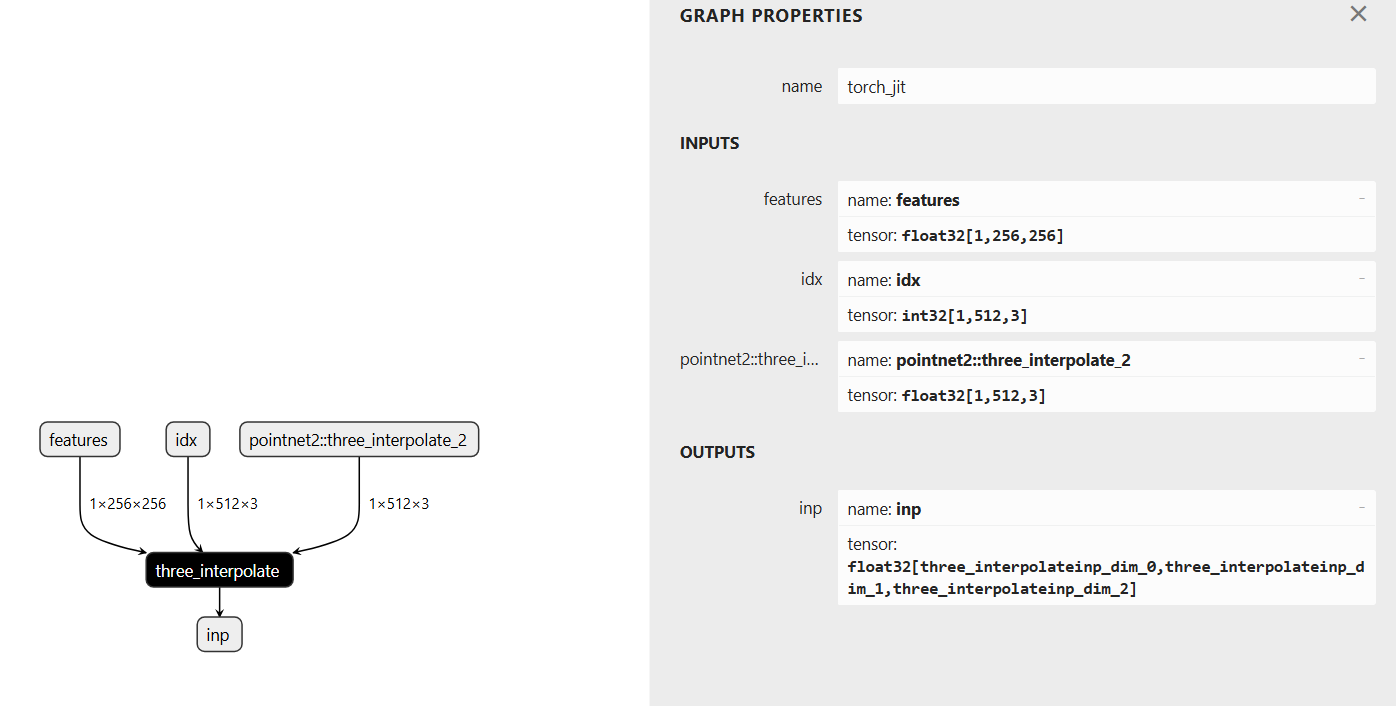
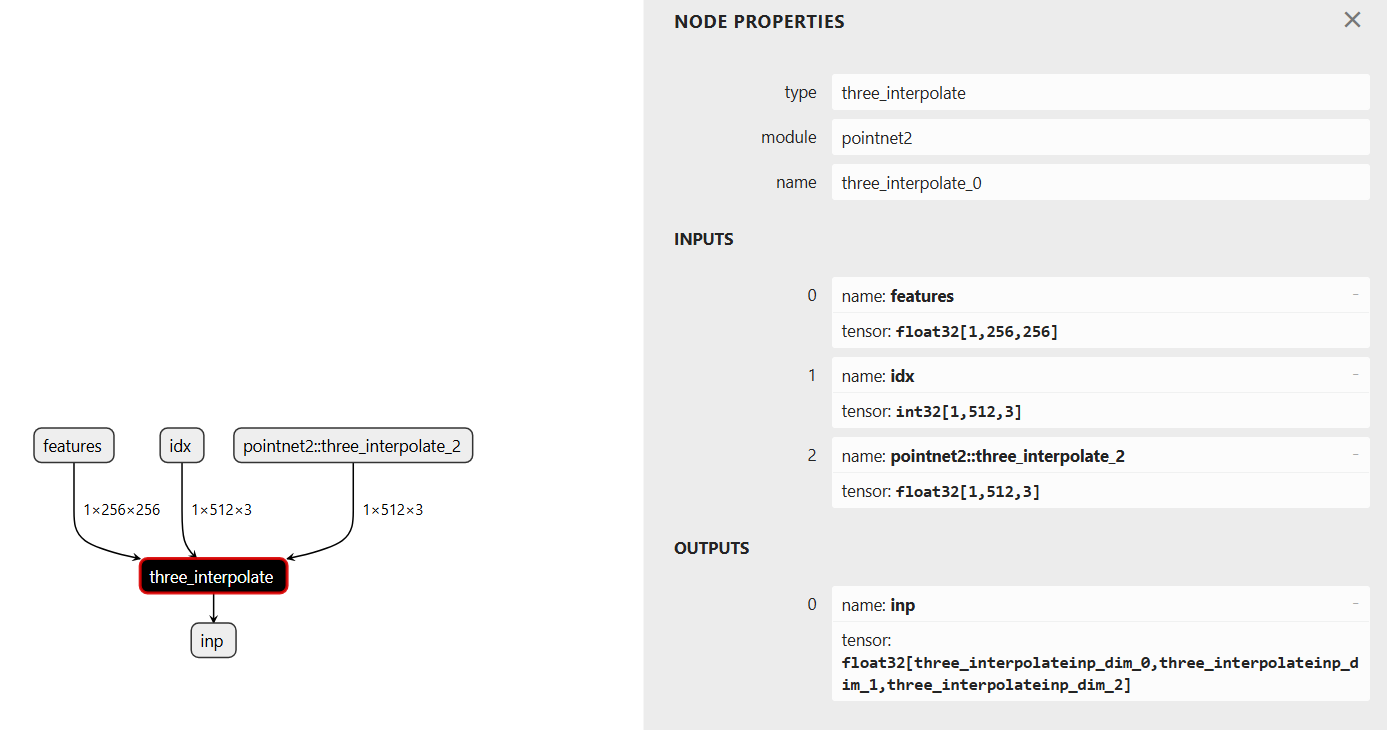
编写tensorrt插件
采用TensorRT-10.6.0.26。由于TensorRT是部分开源,首先在https://developer.nvidia.com/tensorrt/download/10x下载TensorRT-10.6.0.26的库,然后在https://github.com/NVIDIA/TensorRT/tree/v10.6.0下载源代码。
在TensorRT/plugin下新建threeInterpolate文件夹,添加下面文件:
threeInterpolate.h
#ifndef TRT_THREE_INTERPOLATE_PLUGIN_H
#define TRT_THREE_INTERPOLATE_PLUGIN_H


#include "NvInfer.h"
#include "NvInferPlugin.h"
#include "common/plugin.h"
#include "common/cuda_utils.h"

#include <vector>
#include <cstring>

namespace nvinfer1
{
namespace plugin
{
void three_interpolate_kernel_wrapper(int b, int c, int m, int n,
                                      const float *points, const int *idx,
                                      const float *weight, float *out, cudaStream_t stream);

class ThreeInterpolate : public nvinfer1::IPluginV2DynamicExt
{
public:
    ThreeInterpolate();

    ThreeInterpolate(void const* data, size_t length);

    ~ThreeInterpolate() override;

    // 插件基本信息
    char const* getPluginType() const noexcept override;
    char const* getPluginVersion() const noexcept override;
    int getNbOutputs() const noexcept override;

    // 输出维度计算
    nvinfer1::DimsExprs getOutputDimensions(int outputIndex,
		const nvinfer1::DimsExprs* inputs, int nbInputs, nvinfer1::IExprBuilder& exprBuilder) noexcept override;

    // 初始化与销毁
    int initialize() noexcept override;
    void terminate() noexcept override;

    // 执行相关
    int enqueue(const nvinfer1::PluginTensorDesc* inputDesc, const nvinfer1::PluginTensorDesc* outputDesc,
		const void* const* inputs, void* const* outputs, void* workspace, cudaStream_t stream) noexcept override;
    size_t getWorkspaceSize(const nvinfer1::PluginTensorDesc* inputs,
		int nbInputs, const nvinfer1::PluginTensorDesc* outputs,
		int nbOutputs) const noexcept override;

    // 数据类型与格式支持
    DataType getOutputDataType(int index, DataType const* inputTypes, int nbInputs) const noexcept override;
    bool supportsFormatCombination(int pos, const nvinfer1::PluginTensorDesc* inOut, int nbInputs,int nbOutputs) noexcept override;

    // 配置插件
    void configurePlugin(const  nvinfer1::DynamicPluginTensorDesc* in, int nbInputs,
		const  nvinfer1::DynamicPluginTensorDesc* out, int nbOutputs) noexcept override;

    // 序列化
    size_t getSerializationSize() const noexcept override;
    void serialize(void* buffer) const noexcept override;

    // 其他接口
    nvinfer1::IPluginV2DynamicExt* clone() const noexcept override;
    void destroy() noexcept override;
    void setPluginNamespace(char const* libNamespace) noexcept override;
    char const* getPluginNamespace() const noexcept override;

private:
    std::string mPluginNamespace;
    Dims mInputDims;    // 点云输入维度 (B, N, 3)
    Dims mSampleDims;   // 采样点数输入维度(通常是标量或 (B,))
};

class ThreeInterpolateCreator : public nvinfer1::IPluginCreator
{
public:
    ThreeInterpolateCreator();
    ~ThreeInterpolateCreator() override = default;

    char const* getPluginName() const noexcept override;
    char const* getPluginVersion() const noexcept override;
    PluginFieldCollection const* getFieldNames() noexcept override;
    IPluginV2* createPlugin(char const* name, PluginFieldCollection const* fc) noexcept override;
    IPluginV2* deserializePlugin(char const* name, void const* serialData, size_t serialLength) noexcept override;
    void setPluginNamespace(nvinfer1::AsciiChar const* pluginNamespace) noexcept override;
	const char* getPluginNamespace() const noexcept override;

private:
    static PluginFieldCollection mFC;
    static std::vector<PluginField> mPluginAttributes;
    std::string mNamespace;
};

} // namespace plugin
} // namespace nvinfer1

#endif // TRT_THREE_INTERPOLATE_PLUGIN_H
threeInterpolate.cpp
#include "threeInterpolate.h"
#include "common/dimsHelpers.h"

using namespace nvinfer1;
using namespace nvinfer1::pluginInternal;
using nvinfer1::plugin::ThreeInterpolate;
using nvinfer1::plugin::ThreeInterpolateCreator;

// 插件实现
ThreeInterpolate::ThreeInterpolate()
{
    //std::cout<<"ThreeInterpolate"<<std::endl;
}

ThreeInterpolate::ThreeInterpolate(void const* data, size_t length)
{

}

ThreeInterpolate::~ThreeInterpolate() {}

// 插件基本信息
char const* ThreeInterpolate::getPluginType() const noexcept
{
    //std::cout<<"getPluginType"<<std::endl;
    return "three_interpolate";
}

char const* ThreeInterpolate::getPluginVersion() const noexcept
{
    //std::cout<<"getPluginVersion"<<std::endl;
    return "1";
}

int ThreeInterpolate::getNbOutputs() const noexcept
{
    //std::cout<<"getNbOutputs"<<std::endl;
    return 1;
}

nvinfer1::DimsExprs ThreeInterpolate::getOutputDimensions(int outputIndex,
	const nvinfer1::DimsExprs* inputs, int nbInputs, nvinfer1::IExprBuilder& exprBuilder) noexcept
{
    //std::cout << "getOutputDimensions" << std::endl;
    // 验证输出索引和输入数量
    PLUGIN_ASSERT(outputIndex == 0 && nbInputs == 3);

    nvinfer1::DimsExprs outputDims;
    outputDims.nbDims = 3;

    outputDims.d[0] = exprBuilder.constant(static_cast<int>(inputs[0].d[0]->getConstantValue()));
    outputDims.d[1] = exprBuilder.constant(static_cast<int>(inputs[0].d[1]->getConstantValue()));
    outputDims.d[2] = exprBuilder.constant(static_cast<int>(inputs[1].d[1]->getConstantValue()));
    return outputDims;
}

// 初始化
int ThreeInterpolate::initialize() noexcept
{
    return STATUS_SUCCESS;
}

// 销毁资源
void ThreeInterpolate::terminate() noexcept {}

// 执行核函数
int ThreeInterpolate::enqueue(const nvinfer1::PluginTensorDesc* inputDesc, const nvinfer1::PluginTensorDesc* outputDesc,
	const void* const* inputs, void* const* outputs, void* workspace, cudaStream_t stream) noexcept
{
    //std::cout << "enqueue" << std::endl;
    try
    {
        // 输入维度校验
        PLUGIN_ASSERT(inputDesc[0].dims.nbDims == 3);
        PLUGIN_ASSERT(inputDesc[1].dims.nbDims == 3);
        PLUGIN_ASSERT(inputDesc[2].dims.nbDims == 3);
        PLUGIN_ASSERT(outputDesc[0].dims.nbDims == 3);

        // 数据类型校验
        PLUGIN_ASSERT(inputDesc[0].type == nvinfer1::DataType::kFLOAT);
        PLUGIN_ASSERT(inputDesc[1].type == nvinfer1::DataType::kINT32);
        PLUGIN_ASSERT(inputDesc[2].type == nvinfer1::DataType::kFLOAT);
        PLUGIN_ASSERT(outputDesc[0].type == nvinfer1::DataType::kFLOAT);

        // 提取维度信息
        int b = inputDesc[0].dims.d[0];  // 批次大小
        int c = inputDesc[0].dims.d[1];  // 特征通道数
        int m = inputDesc[0].dims.d[2];  // 原始点数量
        int n = inputDesc[1].dims.d[1];  // 插值后点数量

        // 验证维度有效性
        PLUGIN_ASSERT(b > 0 && c > 0 && m > 0 && n > 0);
        PLUGIN_ASSERT(inputDesc[1].dims.d[2] == 3);  // 每个目标点对应3个源点索引
        PLUGIN_ASSERT(inputDesc[2].dims.d[1] == n && inputDesc[2].dims.d[2] == 3);  // weight维度与idx匹配

        // 转换输入输出数据指针
        const float* points = static_cast<const float*>(inputs[0]);  // 源点特征 (B, C, M)
        const int* idx = static_cast<const int*>(inputs[1]);         // 索引 (B, N, 3)
        const float* weight = static_cast<const float*>(inputs[2]);  // 权重 (B, N, 3)
        float* out = static_cast<float*>(outputs[0]);                // 输出特征 (B, C, N)

        // 调用CUDA核函数包装器执行插值计算
        three_interpolate_kernel_wrapper(b, c, m, n, points, idx, weight,out, stream);

        return STATUS_SUCCESS;
    }
    catch (std::exception const& e)
    {
        caughtError(e);
    }
    return -1;
}

// 工作空间大小
size_t ThreeInterpolate::getWorkspaceSize(const nvinfer1::PluginTensorDesc* inputs,
		int nbInputs, const nvinfer1::PluginTensorDesc* outputs,
		int nbOutputs) const noexcept
{
    return 0;
}

// 输出数据类型:索引为INT32
DataType ThreeInterpolate::getOutputDataType(int index, DataType const* inputTypes, int nbInputs) const noexcept
{
    //std::cout<<"getOutputDataType"<<std::endl;
    PLUGIN_ASSERT(index == 0 && nbInputs == 3);
    return DataType::kFLOAT;
}

// 支持的格式:输入float32,输出int32,均为线性格式
bool ThreeInterpolate::supportsFormatCombination(int pos, const nvinfer1::PluginTensorDesc* inOut, int nbInputs, int nbOutputs) noexcept
{
    //std::cout << "supportsFormatCombination" << std::endl;
    PLUGIN_ASSERT(pos < nbInputs + nbOutputs);

    if (pos == 0)
    {
        return (inOut[pos].type == nvinfer1::DataType::kFLOAT)
            && (inOut[pos].format == nvinfer1::PluginFormat::kLINEAR);
    }
    else if (pos == 1)
    {
        return (inOut[pos].type == nvinfer1::DataType::kINT32)
            && (inOut[pos].format == nvinfer1::PluginFormat::kLINEAR);
    }
    else if (pos == 2)
    {
        return (inOut[pos].type == nvinfer1::DataType::kFLOAT)
            && (inOut[pos].format == nvinfer1::PluginFormat::kLINEAR);
    }
    else if (pos == 3)
    {
        return (inOut[pos].type == nvinfer1::DataType::kFLOAT)
            && (inOut[pos].format == nvinfer1::PluginFormat::kLINEAR);
    }

    return false;
}

void ThreeInterpolate::configurePlugin(const nvinfer1::DynamicPluginTensorDesc* in, int nbInputs,
		const nvinfer1::DynamicPluginTensorDesc* out, int nbOutputs) noexcept
{
    //std::cout<<"configurePlugin"<<std::endl;
    try
    {
        PLUGIN_ASSERT(nbInputs == 3 && nbOutputs == 1); // 确认3个输入和1个输出
    }
    catch (std::exception const& e)
    {
        caughtError(e);
    }
}

// 序列化:仅需保存采样点数
size_t ThreeInterpolate::getSerializationSize() const noexcept
{
    //std::cout<<"getSerializationSize"<<std::endl;
    return 0 ;
}

void ThreeInterpolate::serialize(void* buffer) const noexcept
{

}

// 克隆插件
nvinfer1::IPluginV2DynamicExt* ThreeInterpolate::clone() const noexcept
{
    //std::cout<<"clone"<<std::endl;
    try
    {
        return new ThreeInterpolate();
    }
    catch (std::exception const& e)
    {
        caughtError(e);
    }
    return nullptr;
}

void ThreeInterpolate::destroy() noexcept
{
    delete this;
}

// 命名空间管理
void ThreeInterpolate::setPluginNamespace(char const* pluginNamespace) noexcept
{
    //std::cout<<"setPluginNamespace"<<std::endl;
    try
    {
        mPluginNamespace = pluginNamespace;
    }
    catch (std::exception const& e)
    {
        caughtError(e);
    }
}

char const* ThreeInterpolate::getPluginNamespace() const noexcept
{
    //std::cout<<"getPluginNamespace"<<std::endl;
    return mPluginNamespace.c_str();
}

// 插件创建器实现
PluginFieldCollection ThreeInterpolateCreator::mFC{};
std::vector<PluginField> ThreeInterpolateCreator::mPluginAttributes;

ThreeInterpolateCreator::ThreeInterpolateCreator()
{
    //std::cout<<"ThreeInterpolateCreator"<<std::endl;
    mPluginAttributes.clear();
    mFC.nbFields = mPluginAttributes.size();
    mFC.nbFields = mPluginAttributes.size();
    mFC.fields = mPluginAttributes.data();
}

char const* ThreeInterpolateCreator::getPluginName() const noexcept
{
    //std::cout<<"getPluginName"<<std::endl;
    return "three_interpolate";
}

char const* ThreeInterpolateCreator::getPluginVersion() const noexcept
{
    //std::cout<<"getPluginVersion"<<std::endl;
    return "1";
}

PluginFieldCollection const* ThreeInterpolateCreator::getFieldNames() noexcept
{
    //std::cout<<"getFieldNames"<<std::endl;
    return &mFC;
}

IPluginV2* ThreeInterpolateCreator::createPlugin(char const* name, PluginFieldCollection const* fc) noexcept
{
    //std::cout<<"createPlugin"<<std::endl;
    try
    {
        return new ThreeInterpolate();
    }
    catch (std::exception const& e)
    {
        caughtError(e);
    }
    return nullptr;
}

IPluginV2* ThreeInterpolateCreator::deserializePlugin(char const* name, void const* serialData, size_t serialLength) noexcept
{
    //std::cout<<"deserializePlugin"<<std::endl;
    try
    {
        // This object will be deleted when the network is destroyed, which will
        // call Concat::destroy()
        IPluginV2Ext* plugin = new ThreeInterpolate();
        plugin->setPluginNamespace(mNamespace.c_str());
        return plugin;
    }
    catch (std::exception const& e)
    {
        caughtError(e);
    }
    return nullptr;
}

void ThreeInterpolateCreator::setPluginNamespace(char const* libNamespace) noexcept
{
	//std::cout<<"setPluginNamespace"<<std::endl;
	mNamespace = libNamespace;
}

char const* ThreeInterpolateCreator::getPluginNamespace() const noexcept
{
	//std::cout<<"getPluginNamespace"<<std::endl;
	return mNamespace.c_str();
}
threeInterpolate.cu
#include <stdio.h>
#include <stdlib.h>

#include "NvInfer.h"
#include "threeInterpolate.h"
#include <cuda_runtime.h>

namespace nvinfer1
{
namespace plugin
{

// input: points(b, c, m), idx(b, n, 3), weight(b, n, 3)
// output: out(b, c, n)
__global__ void three_interpolate_kernel(int b, int c, int m, int n,
                                         const float *__restrict__ points,
                                         const int *__restrict__ idx,
                                         const float *__restrict__ weight,
                                         float *__restrict__ out) {
  int batch_index = blockIdx.x;
  points += batch_index * m * c;

  idx += batch_index * n * 3;
  weight += batch_index * n * 3;

  out += batch_index * n * c;

  const int index = threadIdx.y * blockDim.x + threadIdx.x;
  const int stride = blockDim.y * blockDim.x;
  for (int i = index; i < c * n; i += stride) {
    const int l = i / n;
    const int j = i % n;
    float w1 = weight[j * 3 + 0];
    float w2 = weight[j * 3 + 1];
    float w3 = weight[j * 3 + 2];

    int i1 = idx[j * 3 + 0];
    int i2 = idx[j * 3 + 1];
    int i3 = idx[j * 3 + 2];

    out[i] = points[l * m + i1] * w1 + points[l * m + i2] * w2 +
             points[l * m + i3] * w3;
  }
}

void three_interpolate_kernel_wrapper(int b, int c, int m, int n,
                                      const float *points, const int *idx,
                                      const float *weight, float *out, cudaStream_t stream) {
  three_interpolate_kernel<<<b, opt_block_config(n, c), 0, stream>>>(
      b, c, m, n, points, idx, weight, out);

  CUDA_CHECK_ERRORS();
}

}
}
CMakeLists.txt
file(GLOB SRCS *.cpp)
set(PLUGIN_SOURCES ${PLUGIN_SOURCES} ${SRCS})
set(PLUGIN_SOURCES ${PLUGIN_SOURCES} PARENT_SCOPE)
file(GLOB CU_SRCS *.cu)
set(PLUGIN_CU_SOURCES ${PLUGIN_CU_SOURCES} ${CU_SRCS})
set(PLUGIN_CU_SOURCES ${PLUGIN_CU_SOURCES} PARENT_SCOPE)
在TensorRT/plugin/inferPlugin.cpp的开头添加
#include "threeInterpolate/threeInterpolate.h"
并在initLibNvInferPlugins函数中添加
initializePlugin<nvinfer1::plugin::ThreeInterpolateCreator>(logger, libNamespace);
在TensorRT/plugin/CMakeLists.txt的set(PLUGIN_LISTS添加
threeInterpolate
在TensorRT/CMakeLists.txt中设置TRT_LIB_DIR、TRT_OUT_DIR,再重新编译tensorrt。
tensorrt推理测试
运行下面的命令把onnx 转为engine模型:
TensorRT-10.6.0.26/bin/trtexec --onnx=three_interpolate.onnx --saveEngine=three_interpolate.engine
编写python推理脚本:
import numpy as np
import tensorrt as trt
import common


logger = trt.Logger(trt.Logger.WARNING)
trt.init_libnvinfer_plugins(logger, "")
with open("three_interpolate.engine", "rb") as f, trt.Runtime(logger) as runtime:
    engine = runtime.deserialize_cuda_engine(f.read())
context = engine.create_execution_context()
inputs, outputs, bindings, stream = common.allocate_buffers(engine)

features = np.loadtxt("features.txt").reshape(1, 256, 256).astype(np.float32)
idx = np.loadtxt("idx.txt").reshape(1, 512, 3).astype(np.int32)
weight = np.loadtxt("weight.txt").reshape(1, 512, 3).astype(np.float32)
np.copyto(inputs[0].host, features.ravel())
np.copyto(inputs[1].host, idx.ravel())
np.copyto(inputs[2].host, weight.ravel())

output = common.do_inference(context,engine=engine, bindings=bindings, inputs=inputs, outputs=outputs, stream=stream)
print(output[0].reshape(1, 256, 512))
np.savetxt("output[0].txt", output[0].reshape(256, 512))






 扫一扫
扫一扫


 458
458

 被折叠的 条评论
为什么被折叠?
被折叠的 条评论
为什么被折叠?
 到【灌水乐园】发言





