


new关键字的作用【背】
实例 化 创建对象
1.自动创建了一个空对象 {}
2.将空对象 指向 this this ={}
将this return返回 出来
function Phone(type,price,color,system,size){
//1+2 this = {}
this.type = type;
this.price = price;
this.color = color;
this.system = system;
this.size = size;
this.start = function(){
console.log('已经开机');
}
//加上new关键字后 相当于
//return this
}
const p1 = new Phone('华为',3500,'白色','鸿蒙os',512)
const p2 = new Phone('华为',3500,'白色','鸿蒙os',512)
this 在构造函数中 其实 就是 实例对象
高阶JS-原型与原型链
-
原型
-
原型链
-
this指向问题
-
借用this
-
类的继承
原型图解
每个构造函数都有一个原型空间 叫做显式原型 prototype
显式原型protopyte是一个对象,有一个constructor属性,指向构造函数本身
每一个实例化对象都有一个隐式原型
__proto__指向自己的构造函数的显式原型prototype
原型链
实例对象的方法 或属性值 的 查找规则:(根据原型
__proto__)逐级向上,就近原则首先 在自己本身对象中 查找是否有这个属性或方法,如果有就直接使用
如果本身没有属性或方法,会自动的去原型空间找 是否有,如果有就直接使用
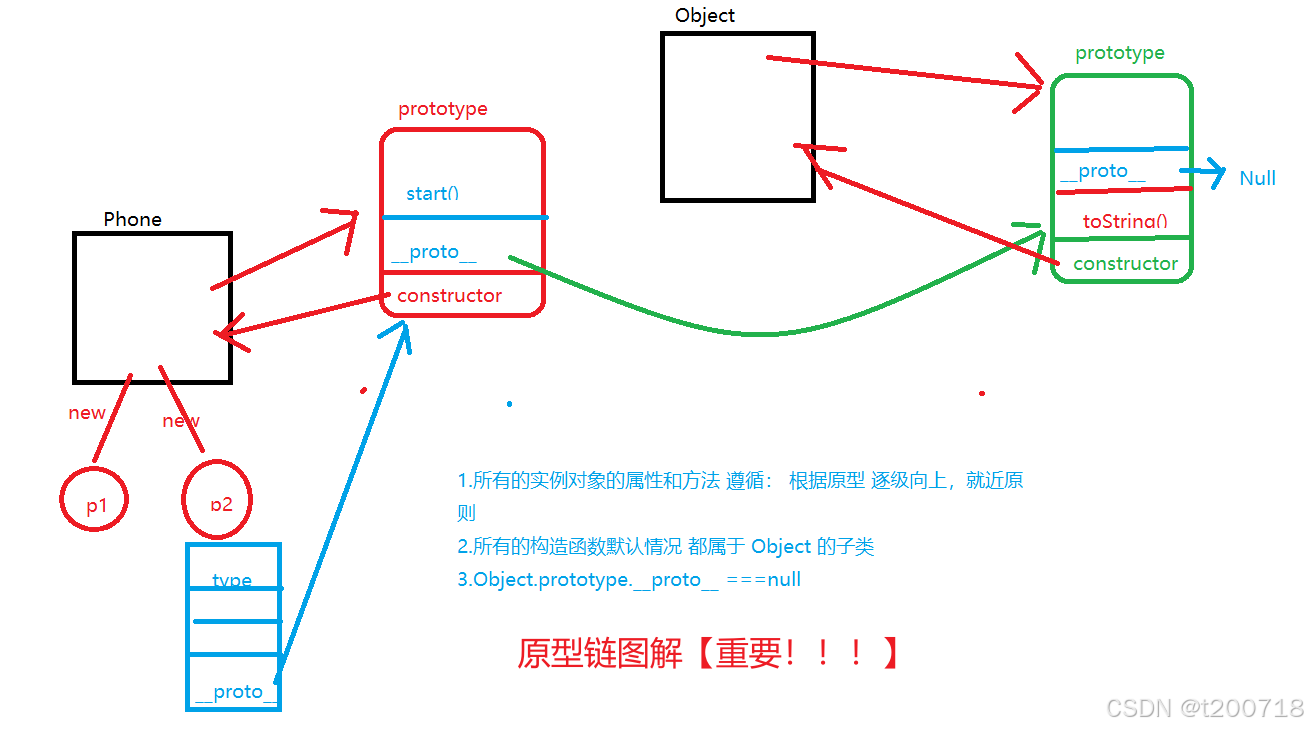
p1.toString == p1.__proto__.__proto__.toString
this指向问题-6个
-
全局的this 指向Window
-
函数中的this——>谁调用就指向谁
-
对象.函数()——>对象
-
一般函数——>Window
-
-
箭头函数 没有this——>指向的是:上一级作用域的this
-
事件中的this——>指向的是:事件源(监听的那个dom对象就指向哪个)
-
构造函数中的this——>指向的是:实例对象
-
定时器/延时器中的this——>Window
手写数组方法
-
indexof:用于查找特定元素在数组中的第一个索引位置。如果找到了该元素,则返回其索引;如果没有找到,则返回 -1。这个方法可以接受两个参数:要查找的元素和一个可选的起始索引,表示从哪个位置开始查找。
  Array.prototype.indexof = null;
  Array.prototype.lastindexof = null;
  Array.prototype.MyIndexOf = function(item){
    //定义一个索引  -1
    let index = -1;
    //循环数组 查找数组中元素 ==item  构造函数中的this指向的是实例对象  即arr
    for(let i = 0;i<this.length;i++){
       //找到更改索引值 并结束 返回    没有返回索引-1
      if(this[i] === item){
        index = i;
        break;
      }
    }
    return index;
  }
  let arr = [1,5,2,2,6,8]
  console.log(arr.MyIndexOf(2))
  console.log(arr.MyLastIndexOf(2))//这个就不要break  一直找到最后一个或者倒着循环
-
forEach:
forEach方法不会改变原数组,它会对数组的每个元素按顺序调用一个回调函数,这个回调函数可以接受三个参数:当前元素的值、当前元素的索引以及调用forEach的数组本身。forEach方法常用于遍历数组并对每个元素执行特定的操作,比如打印每个元素、修改元素的值等。虽然forEach不会返回新的数组,但它可以用于对数组进行操作或执行副作用。
  /*接收的只有一个参数 就是
  function(item,index,arr){
    let b = 100;
    console.log(item+b)
  })
  这段函数体,用callback去接*/
  Array.prototype.myForEach = function(callback){
    //执行callback
    for(let i = 0;i<this.length;i++){
      //每循环一次执行一次callback,callback是那段函数体,所以要有参数
      callback(this[i],i,this)
    }

  }
  let arr = [1,8,6,3,4,2]
  //先写一次foreach  在写myForEach
  arr.myForEach(function(item,index,arr){
    let b = 100;
    console.log(item+b)
  })
-
map:用于遍历数组并对每个元素执行一个提供的函数。
map方法会对数组中的每个元素调用一次提供的函数,并返回一个由每次函数调用的结果组成的新的数组。原数组不会被修改。
// map 返回新数组 原数组不会修改
Array.prototype.myMap = function(callback){
//map要返回一个新数组 所以先定一个空数组
let arr = [];
//业务逻辑--循环一次 执行一次callback(),这里callback会返回一个东西 所以要去接 即let x = callback()
//callback每次循环返回的东西其实就是一个元素 return出来后放到arr里面去
for(let i=0;i<this.length;i++){
arr[i]=callback(this[i],i,this)
}
return arr;
}
let arr = [1015,4,54,545,4,54,5]
let arr1 = arr.myMap(function(item,index,arr){
return item+100;
})
console.log(arr1);
// arr1 [1115,104,154,645,104,154,105]
let arr2 = [{name:'xxx',age:40},{name:'yyy',age:5}]
let arr3 = arr2.myMap(item=>{item.age+=50;return item})
console.log(arr3);
this借用
-
立即执行--调用
-
要借的对象.要借的函数.call(借给谁,参数1,参数2...)
-
要借的对象.要借的函数.apply(借给谁,[参数1,参数2])
-
-
永久借用--新的函数
-
let fn = 要借的对象.要借的函数.bind(借给谁,参数1,参数2)
-
<script>
let students1 = {
name: 'xxx',
study: function (address, book) {
return this.name + '在' + address + '学习:' + book;
}
}
let students2 = {
name: '嘻嘻嘻'
}
// 立即执行--调用
// - 要借的对象.要借的函数.call(借给谁,参数1,参数2...)
console.log(students1.study.call(students2, '家里', '数学'));
// - 要借的对象.要借的函数.apply(借给谁,[参数1,参数2])
console.log(students1.study.apply(students2, ['家里', '语文']));
// 永久借用--新的函数
// - let fn = 要借的对象.要借的函数.bind(借给谁,参数1,参数2)
let fn = students1.study.bind(students2, '图书馆', '英语')
console.log(fn());





 扫一扫
扫一扫


 428
428

 被折叠的 条评论
为什么被折叠?
被折叠的 条评论
为什么被折叠?
 到【灌水乐园】发言





