



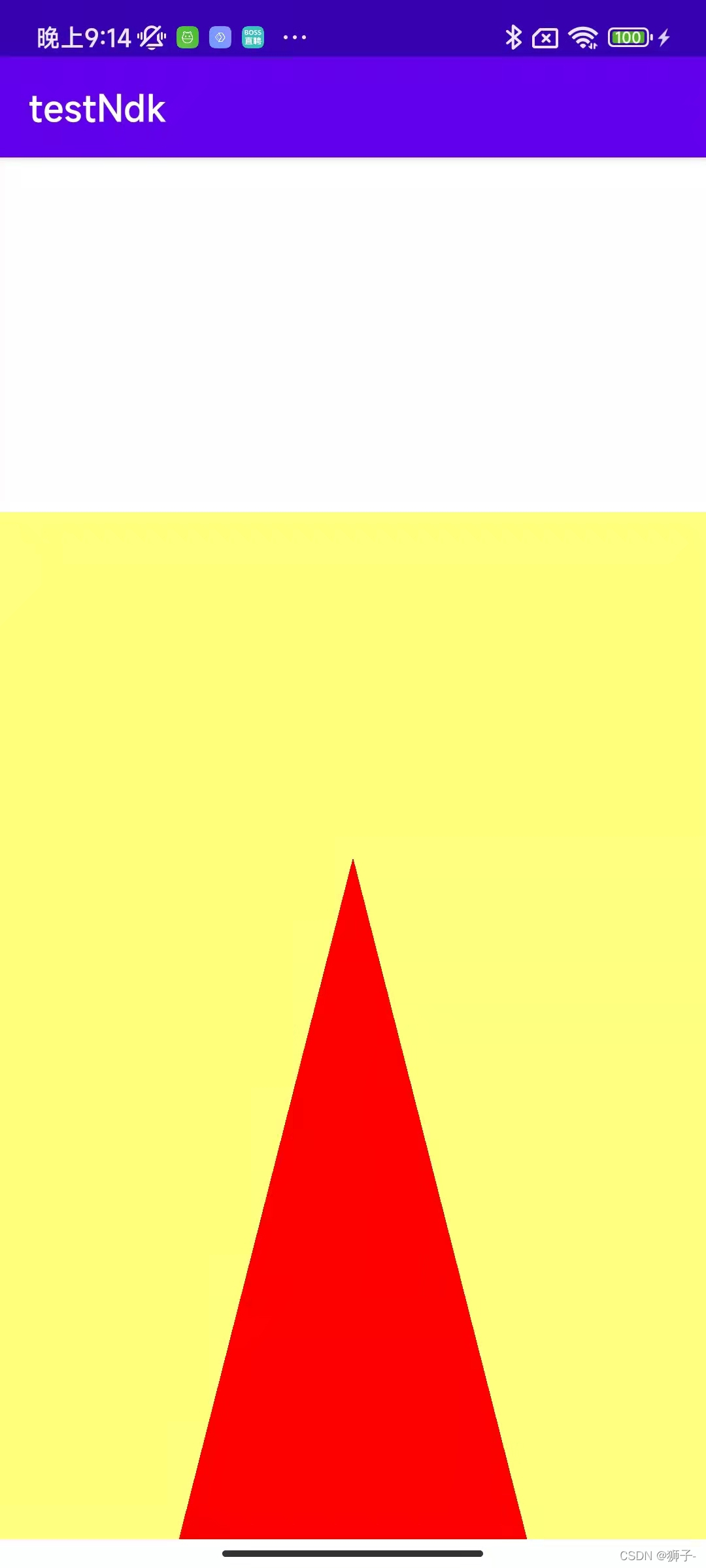
上篇文章我们讲到了如何构建一个OpenGL3.0的android开发环境,这次我们来实现一个简单的三角形。
下面是一些需要提前了解的知识点:
- 顶点着色器
- 片段着色器
- OpenGL ES着色语言
- 程序
可以通过阅读《OpenGL ES 3.0 编程指南》来了解这些知识~~,本文参考自https://mp.weixin.qq.com/s/8AGsjStVUa4WIwlCxjnzZA
下面直接进入主题:
1.首先我们需要一个native和java充当桥梁的类,来辅助绘制。
public class MyNativeRender {


    public native void native_OnInit();

    public native void native_OnUnInit();

    public native void native_SetImageData(int format, int width, int height, byte[] bytes);

    public native void native_OnSurfaceCreated();

    public native void native_OnSurfaceChanged(int width, int height);

    public native void native_onDrawFrame();
}
2.还需要一个自定义的GLSurfaceView和自定义的Renderer。
public class MyGLSurfaceView extends GLSurfaceView {

    private static final String TAG = "com.example.opengl1.MyGLSurfaceView";
    private MyNativeRender myNativeRender;
    private MyGLRender myGLRender;
    public MyGLSurfaceView(Context context) {
        super(context);
    }

    public MyGLSurfaceView(Context context, AttributeSet attrs) {
        super(context, attrs);
        this.setEGLContextClientVersion(3);
        myNativeRender = new MyNativeRender();
        myGLRender = new MyGLRender(myNativeRender);
        setRenderer(myGLRender);
        setRenderMode(RENDERMODE_CONTINUOUSLY);
    }

    public static class MyGLRender implements Renderer {
        private MyNativeRender myNativeRender;
        MyGLRender(MyNativeRender nativeRender){
            myNativeRender = nativeRender;
        }

        @Override
        public void onSurfaceCreated(GL10 gl10, EGLConfig eglConfig) {
            Log.d(TAG, "onSurfaceCreated() called with: gl = [" + gl10 + "], config = [" + eglConfig + "]");
            myNativeRender.native_OnSurfaceCreated();
        }

        @Override
        public void onSurfaceChanged(GL10 gl10, int width, int height) {
            Log.d(TAG, "onSurfaceChanged() called with: width = [" + width + "], height = [" + height + "]");
            myNativeRender.native_OnSurfaceChanged(width, height);
        }

        @Override
        public void onDrawFrame(GL10 gl10) {
            Log.d(TAG, "onDrawFrame() called with: gl10 = [" + gl10 + "]");
            myNativeRender.native_onDrawFrame();
        }
    }
}
ps:接下来就开始native层的代码啦
3.我们先定义一个工具类来构造着色器
头文件:
#ifndef TRIANGLE_SAMPLE_H
#include <stdlib.h>
#include <GLES3/gl3.h>

GLuint LoadShader(GLenum shaderType, const char *pSource);

GLuint CreateProgram(const char *pVertexShaderSource, const char *pFragShaderSource, GLuint &vertexShaderHandle, GLuint &fragShaderHandle);

void DeleteProgram(GLuint &program);

void CheckGLError(const char *pGLOperation);
#endif
cpp:
#include "GLUtils.h"
#include <stdlib.h>
#include <GLES3/gl3.h>
#include <EGL/egl.h>
#include <EGL/eglext.h>
using namespace std;
GLuint LoadShader(GLenum shaderType, const char *pSource)
{
    GLuint shader = 0;
        shader = glCreateShader(shaderType); //创建着色器(两种类型:顶点着色器和片段着色器)
        if (shader)
        {
            glShaderSource(shader, 1, &pSource, NULL); // 加载着色器程序
            glCompileShader(shader); //编译
            GLint compiled = 0;
            glGetShaderiv(shader, GL_COMPILE_STATUS, &compiled); // 取编译结果,用来判断是否编译成功
            if (!compiled)  // 不成功
            {
                GLint infoLen = 0;
                glGetShaderiv(shader, GL_INFO_LOG_LENGTH, &infoLen);
                if (infoLen)
                {
                    char* buf = (char*) malloc((size_t)infoLen);
                    if (buf)
                    {
                        glGetShaderInfoLog(shader, infoLen, NULL, buf);
                        free(buf);
                    }
                    glDeleteShader(shader);
                    shader = 0;
                }
            }
        }
    return shader;
}

GLuint CreateProgram(const char *pVertexShaderSource, const char *pFragShaderSource, GLuint &vertexShaderHandle, GLuint &fragShaderHandle)
{
        GLuint program = 0;
        vertexShaderHandle = LoadShader(GL_VERTEX_SHADER, pVertexShaderSource);
        if (!vertexShaderHandle) return program;

        fragShaderHandle = LoadShader(GL_FRAGMENT_SHADER, pFragShaderSource);
        if (!fragShaderHandle) return program;

        program = glCreateProgram(); //创建一个程序对象
        if (program)
        {
            glAttachShader(program, vertexShaderHandle); //绑定程序与着色器程序
            CheckGLError("glAttachShader");
            glAttachShader(program, fragShaderHandle);
            CheckGLError("glAttachShader");
            glLinkProgram(program);
            GLint linkStatus = GL_FALSE;
            glGetProgramiv(program, GL_LINK_STATUS, &linkStatus);

            glDetachShader(program, vertexShaderHandle);
            glDeleteShader(vertexShaderHandle);
            vertexShaderHandle = 0;
            glDetachShader(program, fragShaderHandle);
            glDeleteShader(fragShaderHandle);
            fragShaderHandle = 0;
            if (linkStatus != GL_TRUE)
            {
                GLint bufLength = 0;
                glGetProgramiv(program, GL_INFO_LOG_LENGTH, &bufLength);
                if (bufLength)
                {
                    char* buf = (char*) malloc((size_t)bufLength);
                    if (buf)
                    {
                        glGetProgramInfoLog(program, bufLength, NULL, buf);
                        free(buf);
                    }
                }
                glDeleteProgram(program);
                program = 0;
            }
        }
    return program;
}

void DeleteProgram(GLuint &program)
{
    if (program)
    {
        glUseProgram(0);
        glDeleteProgram(program);
        program = 0;
    }
}

void CheckGLError(const char *pGLOperation)
{
    for (GLint error = glGetError(); error; error = glGetError())
    {
    }

}
4.接下来是绘制三角形的相关代码:
头文件:
#ifndef TRIANGLE_SAMPLE_H
#define TRIANGLE_SAMPLE_H

#include <stdlib.h>
#include <GLES3/gl3.h>
#include "EGL/egl.h"
#include "android/window.h"
#include "GLUtils.h"

class TriangleSample {
    public :
    GLuint m_ProgramObj;
    GLuint m_VertexShader;
    GLuint m_FragmentShader;
    public :
    void Init();
    void Draw();
    TriangleSample();
    ~TriangleSample();
};
#endif
cpp:
//
// Created by ByteFlow on 2019/7/9.
//
#include "GLUtils.h"
#include "TriangleSample.h"
#include "LogUtil.h"
using namespace std;

TriangleSample::TriangleSample()
{

}

TriangleSample::~TriangleSample()
{
    if (m_ProgramObj)
    {
        glDeleteProgram(m_ProgramObj);
    }

}

void TriangleSample::Init()
{
    char vShaderStr[] =
            "#version 300 es                          \n" //GL版本
            "layout(location = 0) in vec4 vPosition;  \n" // 输入变量(图形的顶点位置)
            "void main()                              \n"
            "{                                        \n"
            "   gl_Position = vPosition;              \n" // 将输入变量赋值给gl_position
            "}                                        \n";

    char fShaderStr[] =
            "#version 300 es                              \n" //GL 版本
            "precision mediump float;                     \n" //精度限定符号
            "out vec4 fragColor;                          \n" //输出变量(颜色)
            "void main()                                  \n"
            "{                                            \n"
            "   fragColor = vec4 ( 1.0, 0.0, 0.0, 1.0 );  \n" //等价于红色
            "}                                            \n";

    m_ProgramObj = CreateProgram(vShaderStr, fShaderStr, m_VertexShader, m_FragmentShader);

}

void TriangleSample::Draw()
{
    GLfloat vVertices[] = {
            0.0f,  0.5f, 0.0f,
            -0.5f, -0.5f, 0.0f,
            0.5f, -0.5f, 0.0f,
    };

    if(m_ProgramObj == 0)
        return;

    // Use the program object
    glUseProgram (m_ProgramObj);

    // Load the vertex data
    glVertexAttribPointer (0, 3, GL_FLOAT, GL_FALSE, 0, vVertices );
    glEnableVertexAttribArray (0);

    glDrawArrays (GL_TRIANGLES, 0, 3);

}
5.我们定义一个操作绘制的中间类。
头文件:
#ifndef MY_GLRENDER_CONTEXT_H
#define MY_GLRENDER_CONTEXT_H
#include "TriangleSample.h"
#include "TextureMapSample.h"
using namespace std;
struct NativeImage {
    int format;
    int width;
    int height;
    uint8_t** ppPlane;
};
class MyGLRenderContext {
    public :
    TriangleSample m_Sample;
    TextureMapSample* m_TextureSample;
    NativeImage m_NativeImage;
    static MyGLRenderContext* m_pContext;
    public :
    MyGLRenderContext(const MyGLRenderContext &mPContext);
    MyGLRenderContext();
    ~MyGLRenderContext();
    void SetImageData(int format, int width, int height, uint8_t *pData);
    void OnSurfaceCreated();
    void OnSurfaceChanged(int width, int height);
    void OnDrawFrame();
    static MyGLRenderContext *GetInstance();
    static void DestroyInstance();
};
#endif
cpp:
#include "TriangleSample.h"
#include "MyGLRenderContext.h"
#include "LogUtil.h"

MyGLRenderContext* MyGLRenderContext::m_pContext = nullptr;
MyGLRenderContext::MyGLRenderContext()
{
    m_TextureSample = new TextureMapSample();
}

MyGLRenderContext::~MyGLRenderContext()
{
    if(m_TextureSample) {
        delete m_TextureSample;
    }
}

void MyGLRenderContext::SetImageData(int format, int width, int height, uint8_t *pData)
{

    RenderImage* renderImage = new RenderImage;
    renderImage->ppPlane = new uint8_t*[1];
    renderImage->width = width;
    renderImage->height = height;
    renderImage->ppPlane[0] = pData;
    m_TextureSample->setImage(renderImage);

    /*switch (format)
    {
        case IMAGE_FORMAT_NV12:
        case IMAGE_FORMAT_NV21:
            nativeImage.ppPlane[1] = nativeImage.ppPlane[0] + width * height;
            break;
        case IMAGE_FORMAT_I420:
            nativeImage.ppPlane[1] = nativeImage.ppPlane[0] + width * height;
            nativeImage.ppPlane[2] = nativeImage.ppPlane[1] + width * height / 4;
            break;
        default:
            break;
    }*/

    //m_TextureMapSample->LoadImage(&nativeImage);

}

void MyGLRenderContext::OnSurfaceCreated()
{
    glClearColor(1.0f,1.0f,0.5f, 1.0f);
    m_Sample.Init();

}

void MyGLRenderContext::OnSurfaceChanged(int width, int height)
{

    glViewport(0, 0, width, height);
}

void MyGLRenderContext::OnDrawFrame()
{

    glClear(GL_DEPTH_BUFFER_BIT | GL_COLOR_BUFFER_BIT);

    m_Sample.Draw();


}

MyGLRenderContext *MyGLRenderContext::GetInstance()
{
    if (m_pContext == nullptr)
    {
        m_pContext = new MyGLRenderContext();
    }
    return m_pContext;
}

void MyGLRenderContext::DestroyInstance()
{
    if (m_pContext)
    {
        delete m_pContext;
        m_pContext = nullptr;
    }

}
6.最后就是我们jni代码啦。
头文件
/* DO NOT EDIT THIS FILE - it is machine generated */
#include <jni.h>
#include <jni.h>
/* Header for class com_example_opengl1_MyNativeRender */

#ifndef _Included_com_example_opengl1_MyNativeRender
#define _Included_com_example_opengl1_MyNativeRender
#ifdef __cplusplus
extern "C" {
#endif

#ifdef __cplusplus
}
#endif
#endif

extern "C"
cpp:
#include "MyNativeRender.h"
#include "MyGLRenderContext.h"
#include "jni.h"

using namespace std;
#define NATIVE_RENDER_CLASS_NAME "com/byteflow/app/MyNativeRender"

#ifdef __cplusplus
extern "C" {
#endif

JNIEXPORT void JNICALL
Java_com_example_testndk_MyNativeRender_native_1OnInit(JNIEnv *env, jobject thiz) {
    // TODO: implement native_OnInit()
    MyGLRenderContext::GetInstance();

}


JNIEXPORT void JNICALL
Java_com_example_testndk_MyNativeRender_native_1OnUnInit(JNIEnv *env, jobject thiz)
{
    MyGLRenderContext::DestroyInstance();
}


JNIEXPORT void JNICALL Java_com_example_testndk_MyNativeRender_native_1SetImageData
        (JNIEnv *env, jobject instance, jint format, jint width, jint height, jbyteArray imageData)
{
    int len = env->GetArrayLength (imageData);
    uint8_t* buf = new uint8_t[len];
    env->GetByteArrayRegion(imageData, 0, len, reinterpret_cast<jbyte*>(buf));
    printf("stx-----start");
    MyGLRenderContext::GetInstance()->SetImageData(format, width, height, buf);
    printf("stx-----end");
    delete[] buf;
    env->DeleteLocalRef(imageData);
}


JNIEXPORT void JNICALL Java_com_example_testndk_MyNativeRender_native_1OnSurfaceCreated(JNIEnv *env, jobject instance)
{
    MyGLRenderContext::GetInstance()->OnSurfaceCreated();
}


JNIEXPORT void JNICALL Java_com_example_testndk_MyNativeRender_native_1OnSurfaceChanged
        (JNIEnv *env, jobject instance, jint width, jint height)
{
    MyGLRenderContext::GetInstance()->OnSurfaceChanged(width, height);

}


JNIEXPORT void JNICALL Java_com_example_testndk_MyNativeRender_native_1onDrawFrame(JNIEnv *env, jobject instance)
{
    MyGLRenderContext::GetInstance()->OnDrawFrame();

}

#ifdef __cplusplus
}
#endif
最后一定要记得将相关类加入到CMakeLists.txt中!!!
cmake_minimum_required(VERSION 3.18.1)


project("testndk")


add_library( # Sets the name of the library.
        testndk

        # Sets the library as a shared library.
        SHARED

        # Provides a relative path to your source file(s).
        native-lib.cpp
        MyNativeRender.h
        MyNativeRender.cpp
        MyGLRenderContext.h
        MyGLRenderContext.cpp
        TriangleSample.h
        TriangleSample.cpp

        GLUtils.h
        GLUtils.cpp

       )


find_library( # Sets the name of the path variable.
        log-lib

        # Specifies the name of the NDK library that
        # you want CMake to locate.
        log)


target_link_libraries( # Specifies the target library.
        testndk
        EGL
        GLESv3
        android
        # Links the target library to the log library
        # included in the NDK.
        ${log-lib})
下面是运行截图:





 扫一扫
扫一扫


 8万+
8万+

 被折叠的 条评论
为什么被折叠?
被折叠的 条评论
为什么被折叠?
 到【灌水乐园】发言





