



 unordered_multimap是C++标准库中的一个无序关联容器,允许存储键值对并快速访问。它使用哈希函数来组织元素到桶中,提供平均常数时间复杂度的搜索、插入和删除操作。桶接口包括begin和end方法,用于访问特定桶的首尾元素。示例代码展示了如何插入元素、使用自定义哈希和等价函数以及遍历桶。
定义于头文件 <unordered_map>
| template<
class Key, | (1) | (C++11 起) |
| namespace pmr {
template <class Key, class T, | (2) | (C++17 起) |
unordered_multimap 是无序关联容器,支持等价的关键(一个 unordered_multimap 可含有每个关键值的多个副本)和将关键与另一类型的值关联。 unordered_multimap 类支持向前迭代器。搜索、插入和移除拥有平均常数时间复杂度。
元素在内部不以任何特定顺序排序,而是组织到桶中。元素被放进哪个桶完全依赖于其关键的哈希。这允许到单独元素的快速访问,因为哈希一旦计算,则它指代元素被放进的准确的桶。
不要求此容器的迭代顺序稳定(故例如 std::equal 不能用于比较二个 std::unordered_multimap ),除了关键比较等价(以 key_eq() 为比较器比较相等)的每组元素在迭代顺序中组成相接的子范围,它亦可用 equal_range() 访问。
桶接口
返回一个迭代器,指向指定的桶的开始
std::unordered_multimap<Key,T,Hash,KeyEqual,Allocator>::begin(size_type),
std::unordered_multimap<Key,T,Hash,KeyEqual,Allocator>::cbegin(size_type)
|
local_iterator begin( size_type n ); | (C++11 起) | |
|
const_local_iterator begin( size_type n ) const; | (C++11 起) | |
|
const_local_iterator cbegin( size_type n ) const; | (C++11 起) |
返回指向下标为 n 的桶首元素的迭代器。
参数
| n | - | 要访问的桶的下标 |
返回值
指向首元素的迭代器。
复杂度
常数。
返回一个迭代器,指向指定的桶的末尾
std::unordered_multimap<Key,T,Hash,KeyEqual,Allocator>::end(size_type),
std::unordered_multimap<Key,T,Hash,KeyEqual,Allocator>::cend(size_type)
|
local_iterator end( size_type n ); | (C++11 起) | |
|
const_local_iterator end( size_type n ) const; | (C++11 起) | |
|
const_local_iterator cend( size_type n ) const; | (C++11 起) |
返回后随下标为 n 的桶的最后元素的元素的迭代器。此元素表现为占位符,试图访问它会导致未定义行为。
参数
| n | - | 要访问的桶的下标 |
返回值
指向后随最后元素的元素的迭代器。
复杂度
常数
调用示例
#include <iostream>
#include <forward_list>
#include <string>
#include <iterator>
#include <algorithm>
#include <functional>
#include <unordered_map>
#include <time.h>

using namespace std;

struct Cell
{
    int x;
    int y;

    Cell() = default;
    Cell(int a, int b): x(a), y(b) {}

    Cell &operator +=(const Cell &cell)
    {
        x += cell.x;
        y += cell.y;
        return *this;
    }

    Cell &operator +(const Cell &cell)
    {
        x += cell.x;
        y += cell.y;
        return *this;
    }

    Cell &operator *(const Cell &cell)
    {
        x *= cell.x;
        y *= cell.y;
        return *this;
    }

    Cell &operator ++()
    {
        x += 1;
        y += 1;
        return *this;
    }


    bool operator <(const Cell &cell) const
    {
        if (x == cell.x)
        {
            return y < cell.y;
        }
        else
        {
            return x < cell.x;
        }
    }

    bool operator >(const Cell &cell) const
    {
        if (x == cell.x)
        {
            return y > cell.y;
        }
        else
        {
            return x > cell.x;
        }
    }

    bool operator ==(const Cell &cell) const
    {
        return x == cell.x && y == cell.y;
    }
};

struct myCompare
{
    bool operator()(const int &a, const int &b)
    {
        return a < b;
    }
};

std::ostream &operator<<(std::ostream &os, const Cell &cell)
{
    os << "{" << cell.x << "," << cell.y << "}";
    return os;
}

std::ostream &operator<<(std::ostream &os, const std::pair<Cell, string> &pCell)
{
    os << pCell.first << "-" << pCell.second;
    return os;
}

struct CHash
{
    size_t operator()(const Cell& cell) const
    {
        size_t thash = std::hash<int>()(cell.x) | std::hash<int>()(cell.y);
//        std::cout << "CHash: " << thash << std::endl;
        return thash;
    }
};

struct CEqual
{
    bool operator()(const Cell &a, const Cell &b) const
    {
        return a.x == b.x && a.y == b.y;
    }
};

int main()
{
    auto generate = []()
    {
        int n = std::rand() % 10 + 110;
        Cell cell{n, n};
        return std::pair<Cell, string>(cell, std::to_string(n));
    };

    std::unordered_multimap<Cell, string, CHash, CEqual> unordered_multimap1;
    //6) 插入来自 initializer_list ilist 的元素。
    while (unordered_multimap1.size() < 5)
    {
        unordered_multimap1.insert({generate()});
    }

    std::cout << "unordered_multimap1:   ";
    std::copy(unordered_multimap1.begin(), unordered_multimap1.end(),
              std::ostream_iterator<pair<Cell, string>>(std::cout, " "));
    std::cout << std::endl;
    std::cout << std::endl;

    for (std::unordered_multimap<Cell, string, CHash, CEqual>::const_iterator cit =
                unordered_multimap1.cbegin(); cit != unordered_multimap1.end(); cit++)
    {
        //返回关键 key 的桶的下标。始终会在此桶中找到关键等于 key 的元素(若存在)。
        //返回值仅对 bucket_count() 返回相同值的容器实例合法。
        size_t bucket = unordered_multimap1.bucket(cit->first);
        std::cout << "unordered_multimap1 bucket(" << cit->first << ") :    "
                  << bucket << "    ";

        //返回指向下标为 n 的桶首元素的迭代器。
        std::unordered_multimap<Cell, string, CHash, CEqual>::const_local_iterator clit
            = unordered_multimap1.begin(bucket);
        std::cout << "const_local_iterator begin(" << bucket << "):    " << *clit << std::endl;
    }
    std::cout << std::endl;


    for (std::unordered_multimap<Cell, string, CHash, CEqual>::const_iterator cit =
                unordered_multimap1.cbegin(); cit != unordered_multimap1.end(); cit++)
    {
        //返回关键 key 的桶的下标。始终会在此桶中找到关键等于 key 的元素(若存在)。
        //返回值仅对 bucket_count() 返回相同值的容器实例合法。
        size_t bucket = unordered_multimap1.bucket(cit->first);
        std::cout << "unordered_multimap1 bucket(" << cit->first << ") :    "
                  << bucket << "    ";

        //返回指向下标为 n 的桶首元素的迭代器。
        std::unordered_multimap<Cell, string, CHash, CEqual>::local_iterator clit =
            unordered_multimap1.begin(bucket);
        std::cout << "local_iterator begin(" << bucket << "):    " << *clit << std::endl;
    }
    std::cout << std::endl;


    for (std::unordered_multimap<Cell, string, CHash, CEqual>::const_iterator cit =
                unordered_multimap1.cbegin(); cit != unordered_multimap1.end(); cit++)
    {
        //返回关键 key 的桶的下标。始终会在此桶中找到关键等于 key 的元素(若存在)。
        //返回值仅对 bucket_count() 返回相同值的容器实例合法。
        size_t bucket = unordered_multimap1.bucket(cit->first);
        std::cout << "unordered_multimap1 bucket(" << cit->first << ") :    "
                  << bucket << "    ";

        //返回指向下标为 n 的桶首元素的迭代器。
        std::unordered_multimap<Cell, string, CHash, CEqual>::const_local_iterator clit =
            unordered_multimap1.cbegin(bucket);
        std::cout << "const_local_iterator cbegin(" << bucket << "):    " << *clit << std::endl;
    }

    return 0;
}
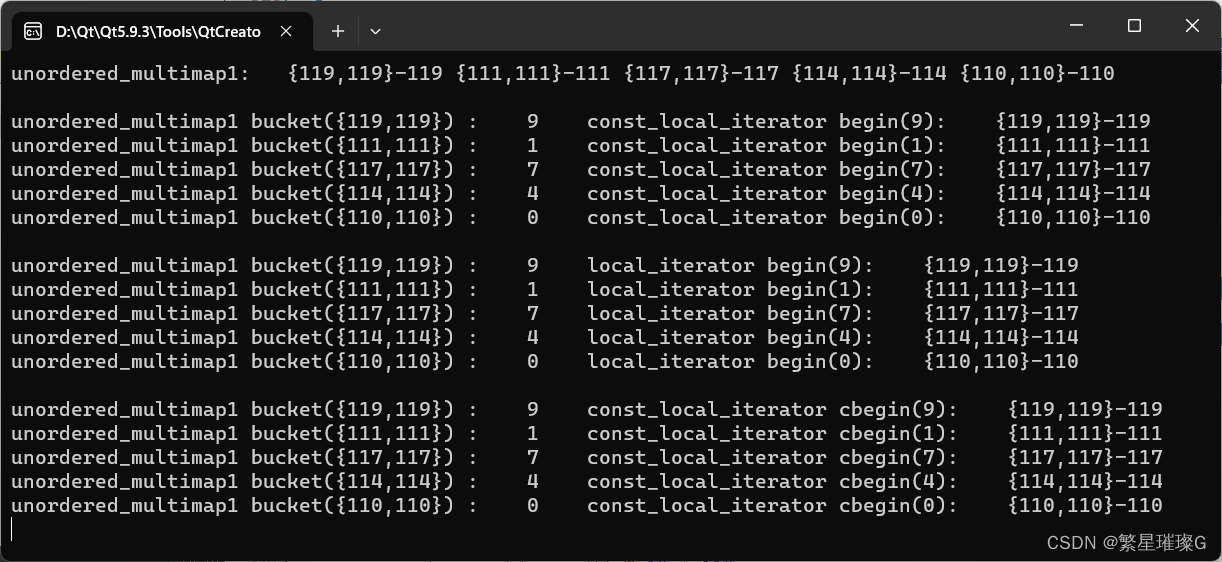
输出





 扫一扫
扫一扫


 980
980

 被折叠的 条评论
为什么被折叠?
被折叠的 条评论
为什么被折叠?
 到【灌水乐园】发言





