





基于python语言,实现经典自适应大邻域搜索算法(ALNS)对带有时间窗的车辆路径规划问题( VRPTW )进行求解。
往期优质资源
- python实现6种智能算法求解CVRP问题
- python实现7种智能算法求解MDVRP问题
- python实现7种智能算法求解MDVRPTW问题
- Python版MDHFVRPTW问题智能求解算法代码【TS算法】
- Python版MDHFVRPTW问题智能求解算法代码【SA算法】
- Python版MDHFVRPTW问题智能求解算法代码【GA算法】
- Python版MDHFVRPTW问题智能求解算法代码【DPSO算法】
- Python版MDHFVRPTW问题智能求解算法代码【DE算法】
- Python版MDHFVRPTW问题智能求解算法代码【ACO算法】
- Python版HVRP问题智能求解算法代码【GA算法】
- Python版HVRP问题智能求解算法代码【DPSO算法】
1. 适用场景
- 求解VRPTW
- 车辆类型单一
- 车辆容量不小于需求节点最大需求
- 车辆路径长度或运行时间无限制
- 需求节点服务成本满足三角不等式
- 节点时间窗至少满足车辆路径只包含一个需求节点的情况
- 单个车辆基地
- 各车场车辆总数满足实际需求
2. 求解效果
(1)收敛曲线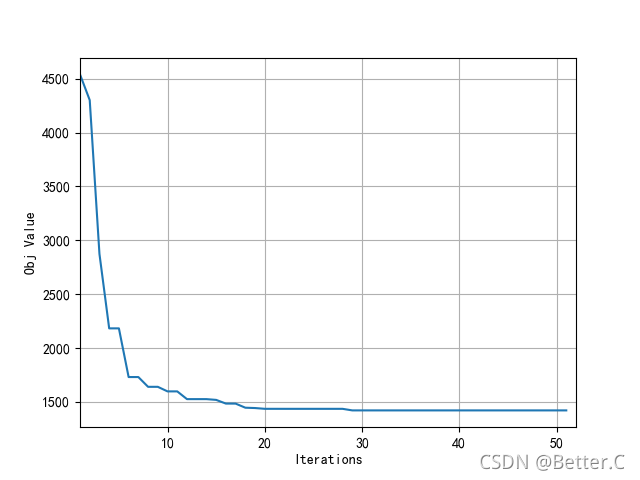
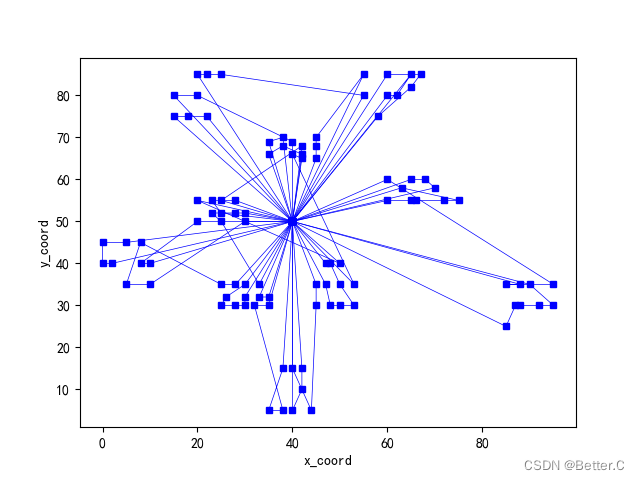
(2)车辆路径
3. 代码分析
应用ALNS算法求解MDVRPTW时保留了已有代码的架构与思路,为能够求解带有时间窗的(多车场)车辆路径规划问题,这里参考既有文献对路径分割算法进行了改进("splitRoutes"函数),在分割车辆路径时不仅考虑了车辆容量限制,还考虑了节点的时间窗约束,以此使得分割后的路径可行。在此改进下继承了大量原有代码,降低了代码改进量。
4. 数据格式
以csv文件储存数据,其中demand.csv文件记录需求节点数据,共包含需求节点id,需求节点横坐标,需求节点纵坐标,需求量;depot.csv文件记录车场节点数据,共包含车场id,车场横坐标,车场纵坐标,车队数量。需要注意的是:需求节点id应为整数,车场节点id任意,但不可与需求节点id重复。 可参考github主页相关文件。
5. 分步实现
(1)数据结构
定义Sol()类,Node()类,Model()类,其属性如下表:
- Sol()类,表示一个可行解
| 属性 | 描述 |
|---|---|
| obj | 优化目标值 |
| node_id_list | 需求节点id有序排列集合 |
| cost_of_distance | 距离成本 |
| cost_of_time | 时间成本 |
| action_id | 解所对应的算子id,用于禁用算子 |
| route_list | 车辆路径集合,对应MDVRPTW的解 |
| timetable_list | 车辆节点访问时间集合,对应MDVRPTW的解 |
- Node()类,表示一个网络节点
| 属性 | 描述 |
|---|---|
| id | 物理节点id,需唯一 |
| x_coord | 物理节点x坐标 |
| y_coord | 物理节点y坐标 |
| demand | 物理节点需求 |
| depot_capacity | 车辆基地车队规模 |
| start_time | 最早开始服务(被服务)时间 |
| end_time | 最晚结束服务(被服务)时间 |
| service_time | 需求节点服务时间 |
- Model()类,存储算法参数
| 属性 | 描述 |
|---|---|
| best_sol | 全局最优解,值类型为Sol() |
| demand_dict | 需求节点集合(字典),值类型为Node() |
| depot_dict | 车场节点集合(字典),值类型为Node() |
| depot_id_list | 车场节点id集合 |
| demand_id_list | 需求节点id集合 |
| distance_matrix | 节点距离矩阵 |
| time_matrix | 节点旅行时间矩阵 |
| number_of_demands | 需求节点数量 |
| opt_type | 优化目标类型,0:最小旅行距离,1:最小时间成本 |
| vehicle_cap | 车辆容量 |
| vehicle_speed | 车辆行驶速度,用于计算旅行时间 |
| rand_d_max | 随机破坏程度上限 |
| rand_d_min | 随机破坏程度下限 |
| worst_d_max | 最坏破坏程度上限 |
| worst_d_min | 最坏破坏程度下限 |
| regret_n | 次优位置个数 |
| r1 | 算子奖励1 |
| r2 | 算子奖励2 |
| r3 | 算子奖励3 |
| rho | 算子权重衰减系数 |
| d_weight | 破坏算子权重 |
| d_select | 破坏算子被选中次数/每轮 |
| d_score | 破坏算子被奖励得分/每轮 |
| d_history_select | 破坏算子历史共计被选中次数 |
| d_history_score | 破坏算子历史共计被奖励得分 |
| r_weight | 修复算子权重 |
| r_select | 修复算子被选中次数/每轮 |
| r_score | 修复算子被奖励得分/每轮 |
| r_history_select | 修复算子历史共计被选中次数 |
| r_history_score | 修复算子历史共计被奖励得分 |
(2)文件读取
def readCSVFile(demand_file,depot_file,model):
    with open(demand_file,'r') as f:
        demand_reader=csv.DictReader(f)
        for row in demand_reader:
            node = Node()
            node.id = int(row['id'])
            node.x_coord = float(row['x_coord'])
            node.y_coord = float(row['y_coord'])
            node.demand = float(row['demand'])
            node.start_time=float(row['start_time'])
            node.end_time=float(row['end_time'])
            node.service_time=float(row['service_time'])
            model.demand_dict[node.id] = node
            model.demand_id_list.append(node.id)
        model.number_of_demands=len(model.demand_id_list)

    with open(depot_file, 'r') as f:
        depot_reader = csv.DictReader(f)
        for row in depot_reader:
            node = Node()
            node.id = row['id']
            node.x_coord = float(row['x_coord'])
            node.y_coord = float(row['y_coord'])
            node.depot_capacity = float(row['capacity'])
            node.start_time=float(row['start_time'])
            node.end_time=float(row['end_time'])
            model.depot_dict[node.id] = node
            model.depot_id_list.append(node.id)
(3)计算距离&时间矩阵
def calDistanceTimeMatrix(model):
    for i in range(len(model.demand_id_list)):
        from_node_id = model.demand_id_list[i]
        for j in range(i + 1, len(model.demand_id_list)):
            to_node_id = model.demand_id_list[j]
            dist = math.sqrt((model.demand_dict[from_node_id].x_coord - model.demand_dict[to_node_id].x_coord) ** 2
                             + (model.demand_dict[from_node_id].y_coord - model.demand_dict[to_node_id].y_coord) ** 2)
            model.distance_matrix[from_node_id, to_node_id] = dist
            model.distance_matrix[to_node_id, from_node_id] = dist
            model.time_matrix[from_node_id,to_node_id] = math.ceil(dist/model.vehicle_speed)
            model.time_matrix[to_node_id,from_node_id] = math.ceil(dist/model.vehicle_speed)
        for _, depot in model.depot_dict.items():
            dist = math.sqrt((model.demand_dict[from_node_id].x_coord - depot.x_coord) ** 2
                             + (model.demand_dict[from_node_id].y_coord - depot.y_coord) ** 2)
            model.distance_matrix[from_node_id, depot.id] = dist
            model.distance_matrix[depot.id, from_node_id] = dist
            model.time_matrix[from_node_id,depot.id] = math.ceil(dist/model.vehicle_speed)
            model.time_matrix[depot.id,from_node_id] = math.ceil(dist/model.vehicle_speed)
(4)目标值计算
适应度计算依赖" splitRoutes "函数对有序节点序列行解分割得到车辆行驶路线,同时在得到各车辆形式路线后在满足车场车队规模条件下分配最近车场,之后调用 " calTravelCost "函数确定车辆访问各路径节点的到达和离开时间点,并计算旅行距离成本和旅行时间成本。
def calTravelCost(route_list,model):
    timetable_list=[]
    cost_of_distance=0
    cost_of_time=0
    for route in route_list:
        timetable=[]
        for i in range(len(route)):
            if i == 0:
                depot_id=route[i]
                next_node_id=route[i+1]
                travel_time=model.time_matrix[depot_id,next_node_id]
                departure=max(0,model.demand_dict[next_node_id].start_time-travel_time)
                timetable.append((departure,departure))
            elif 1<= i <= len(route)-2:
                last_node_id=route[i-1]
                current_node_id=route[i]
                current_node = model.demand_dict[current_node_id]
                travel_time=model.time_matrix[last_node_id,current_node_id]
                arrival=max(timetable[-1][1]+travel_time,current_node.start_time)
                departure=arrival+current_node.service_time
                timetable.append((arrival,departure))
                cost_of_distance += model.distance_matrix[last_node_id, current_node_id]
                cost_of_time += model.time_matrix[last_node_id, current_node_id]+ current_node.service_time\
                                + max(current_node.start_time - timetable[-1][1] + travel_time, 0)
            else:
                last_node_id = route[i - 1]
                depot_id=route[i]
                travel_time = model.time_matrix[last_node_id,depot_id]
                departure = timetable[-1][1]+travel_time
                timetable.append((departure,departure))
                cost_of_distance +=model.distance_matrix[last_node_id,depot_id]
                cost_of_time+=model.time_matrix[last_node_id,depot_id]
        timetable_list.append(timetable)
    return timetable_list,cost_of_time,cost_of_distance

def calObj(sol,model):

    node_id_list=copy.deepcopy(sol.node_id_list)
    num_vehicle, sol.route_list = splitRoutes(node_id_list, model)
    # travel cost
    sol.timetable_list,sol.cost_of_time,sol.cost_of_distance =calTravelCost(sol.route_list,model)
    if model.opt_type == 0:
        sol.obj=sol.cost_of_distance
    else:
        sol.obj=sol.cost_of_time
(5)初始解
def genInitialSol(node_id_list):
    node_id_list=copy.deepcopy(node_id_list)
    random.seed(0)
    random.shuffle(node_id_list)
    return node_id_list
(6)定义destroy算子(破坏算子)
def createRandomDestory(model):
    d=random.uniform(model.rand_d_min,model.rand_d_max)
    reomve_list=random.sample(range(len(model.demand_id_list)),int(d*len(model.demand_id_list)))
    return reomve_list

def createWorseDestory(model,sol):
    deta_f=[]
    for node_id in sol.node_id_list:
        sol_=copy.deepcopy(sol)
        sol_.node_id_list.remove(node_id)
        calObj(sol_,model)
        deta_f.append(sol.obj-sol_.obj)
    sorted_id = sorted(range(len(deta_f)), key=lambda k: deta_f[k], reverse=True)
    d=random.randint(model.worst_d_min,model.worst_d_max)
    remove_list=sorted_id[:d]
    return remove_list
(7)定义repair算子(修复算子)
def createRandomRepair(remove_list,model,sol):
    unassigned_nodes_id=[]
    assigned_nodes_id = []
    # remove node from current solution
    for i in range(len(model.demand_id_list)):
        if i in remove_list:
            unassigned_nodes_id.append(sol.node_id_list[i])
        else:
            assigned_nodes_id.append(sol.node_id_list[i])
    # insert
    for node_id in unassigned_nodes_id:
        index=random.randint(0,len(assigned_nodes_id)-1)
        assigned_nodes_id.insert(index,node_id)
    new_sol=Sol()
    new_sol.node_id_list=copy.deepcopy(assigned_nodes_id)
    calObj(new_sol,model)
    return new_sol

def findGreedyInsert(unassigned_nodes_id,assigned_nodes_id,model):
    best_insert_node_id=None
    best_insert_index = None
    best_insert_cost = float('inf')
    sol_1=Sol()
    sol_1.node_id_list=assigned_nodes_id
    calObj(sol_1,model)
    for node_id in unassigned_nodes_id:
        for i in range(len(assigned_nodes_id)):
            sol_2=Sol()
            sol_2.node_id_list=copy.deepcopy(assigned_nodes_id)
            sol_2.node_id_list.insert(i, node_id)
            calObj(sol_2, model)
            deta_f = sol_2.obj -sol_1.obj
            if deta_f<best_insert_cost:
                best_insert_index=i
                best_insert_node_id=node_id
                best_insert_cost=deta_f
    return best_insert_node_id,best_insert_index

def createGreedyRepair(remove_list,model,sol):
    unassigned_nodes_id = []
    assigned_nodes_id = []
    # remove node from current solution
    for i in range(len(model.demand_id_list)):
        if i in remove_list:
            unassigned_nodes_id.append(sol.node_id_list[i])
        else:
            assigned_nodes_id.append(sol.node_id_list[i])
    #insert
    while len(unassigned_nodes_id)>0:
        insert_node_id,insert_index=findGreedyInsert(unassigned_nodes_id,assigned_nodes_id,model)
        assigned_nodes_id.insert(insert_index,insert_node_id)
        unassigned_nodes_id.remove(insert_node_id)
    new_sol=Sol()
    new_sol.node_id_list=copy.deepcopy(assigned_nodes_id)
    calObj(new_sol,model)
    return new_sol

def findRegretInsert(unassigned_nodes_id,assigned_nodes_id,model):
    opt_insert_node_id = None
    opt_insert_index = None
    opt_insert_cost = -float('inf')
    sol_=Sol()
    for node_id in unassigned_nodes_id:
        n_insert_cost=np.zeros((len(assigned_nodes_id),3))
        for i in range(len(assigned_nodes_id)):
            sol_.node_id_list=copy.deepcopy(assigned_nodes_id)
            sol_.node_id_list.insert(i,node_id)
            calObj(sol_,model)
            n_insert_cost[i,0]=node_id
            n_insert_cost[i,1]=i
            n_insert_cost[i,2]=sol_.obj
        n_insert_cost= n_insert_cost[n_insert_cost[:, 2].argsort()]
        deta_f=0
        for i in range(1,model.regret_n):
            deta_f=deta_f+n_insert_cost[i,2]-n_insert_cost[0,2]
        if deta_f>opt_insert_cost:
            opt_insert_node_id = int(n_insert_cost[0, 0])
            opt_insert_index=int(n_insert_cost[0,1])
            opt_insert_cost=deta_f
    return opt_insert_node_id,opt_insert_index

def createRegretRepair(remove_list,model,sol):
    unassigned_nodes_id = []
    assigned_nodes_id = []
    # remove node from current solution
    for i in range(len(model.demand_id_list)):
        if i in remove_list:
            unassigned_nodes_id.append(sol.node_id_list[i])
        else:
            assigned_nodes_id.append(sol.node_id_list[i])
    # insert
    while len(unassigned_nodes_id)>0:
        insert_node_id,insert_index=findRegretInsert(unassigned_nodes_id,assigned_nodes_id,model)
        assigned_nodes_id.insert(insert_index,insert_node_id)
        unassigned_nodes_id.remove(insert_node_id)
    new_sol = Sol()
    new_sol.node_id_list = copy.deepcopy(assigned_nodes_id)
    calObj(new_sol, model)
    return new_sol
(8)随机选择算子
def selectDestoryRepair(model):
    d_weight=model.d_weight
    d_cumsumprob = (d_weight / sum(d_weight)).cumsum()
    d_cumsumprob -= np.random.rand()
    destory_id= list(d_cumsumprob > 0).index(True)

    r_weight=model.r_weight
    r_cumsumprob = (r_weight / sum(r_weight)).cumsum()
    r_cumsumprob -= np.random.rand()
    repair_id = list(r_cumsumprob > 0).index(True)
    return destory_id,repair_id
(9)执行destory算子
def doDestory(destory_id,model,sol):
    if destory_id==0:
        reomve_list=createRandomDestory(model)
    else:
        reomve_list=createWorseDestory(model,sol)
    return reomve_list
(10)执行repair算子
def doRepair(repair_id,reomve_list,model,sol):
    if repair_id==0:
        new_sol=createRandomRepair(reomve_list,model,sol)
    elif repair_id==1:
        new_sol=createGreedyRepair(reomve_list,model,sol)
    else:
        new_sol=createRegretRepair(reomve_list,model,sol)
    return new_sol
(11)重置算子得分
def resetScore(model):

    model.d_select = np.zeros(2)
    model.d_score = np.zeros(2)

    model.r_select = np.zeros(3)
    model.r_score = np.zeros(3)
(12)更新算子权重
def updateWeight(model):

    for i in range(model.d_weight.shape[0]):
        if model.d_select[i]>0:
            model.d_weight[i]=model.d_weight[i]*(1-model.rho)+model.rho*model.d_score[i]/model.d_select[i]
        else:
            model.d_weight[i] = model.d_weight[i] * (1 - model.rho)
    for i in range(model.r_weight.shape[0]):
        if model.r_select[i]>0:
            model.r_weight[i]=model.r_weight[i]*(1-model.rho)+model.rho*model.r_score[i]/model.r_select[i]
        else:
            model.r_weight[i] = model.r_weight[i] * (1 - model.rho)
    model.d_history_select = model.d_history_select + model.d_select
    model.d_history_score = model.d_history_score + model.d_score
    model.r_history_select = model.r_history_select + model.r_select
    model.r_history_score = model.r_history_score + model.r_score
(13)绘制收敛曲线
def plotObj(obj_list):
    plt.rcParams['font.sans-serif'] = ['SimHei'] #show chinese
    plt.rcParams['axes.unicode_minus'] = False  # Show minus sign
    plt.plot(np.arange(1,len(obj_list)+1),obj_list)
    plt.xlabel('Iterations')
    plt.ylabel('Obj Value')
    plt.grid()
    plt.xlim(1,len(obj_list)+1)
    plt.show()
(14)绘制车辆路线
def plotRoutes(model):
    for route in model.best_sol.route_list:
        x_coord=[model.depot_dict[route[0]].x_coord]
        y_coord=[model.depot_dict[route[0]].y_coord]
        for node_id in route[1:-1]:
            x_coord.append(model.demand_dict[node_id].x_coord)
            y_coord.append(model.demand_dict[node_id].y_coord)
        x_coord.append(model.depot_dict[route[-1]].x_coord)
        y_coord.append(model.depot_dict[route[-1]].y_coord)
        plt.grid()
        if route[0]=='d1':
            plt.plot(x_coord,y_coord,marker='o',color='black',linewidth=0.5,markersize=5)
        elif route[0]=='d2':
            plt.plot(x_coord,y_coord,marker='o',color='orange',linewidth=0.5,markersize=5)
        else:
            plt.plot(x_coord,y_coord,marker='o',color='b',linewidth=0.5,markersize=5)
    plt.xlabel('x_coord')
    plt.ylabel('y_coord')
    plt.show()
(15)输出结果
def outPut(model):
    work=xlsxwriter.Workbook('result.xlsx')
    worksheet=work.add_worksheet()
    worksheet.write(0, 0, 'cost_of_time')
    worksheet.write(0, 1, 'cost_of_distance')
    worksheet.write(0, 2, 'opt_type')
    worksheet.write(0, 3, 'obj')
    worksheet.write(1,0,model.best_sol.cost_of_time)
    worksheet.write(1,1,model.best_sol.cost_of_distance)
    worksheet.write(1,2,model.opt_type)
    worksheet.write(1,3,model.best_sol.obj)
    worksheet.write(2,0,'vehicleID')
    worksheet.write(2,1,'route')
    worksheet.write(2,2,'timetable')
    for row,route in enumerate(model.best_sol.route_list):
        worksheet.write(row+3,0,'v'+str(row+1))
        r=[str(i)for i in route]
        worksheet.write(row+3,1, '-'.join(r))
        r=[str(i)for i in model.best_sol.timetable_list[row]]
        worksheet.write(row+3,2, '-'.join(r))
    work.close()
(16)主函数
def run(demand_file,depot_file,rand_d_max,rand_d_min,worst_d_min,worst_d_max,regret_n,r1,r2,r3,rho,phi,epochs,pu,v_cap,
        v_speed,opt_type):
    """
    :param demand_file: demand file path
    :param depot_file: depot file path
    :param rand_d_max: max degree of random destruction
    :param rand_d_min: min degree of random destruction
    :param worst_d_max: max degree of worst destruction
    :param worst_d_min: min degree of worst destruction
    :param regret_n:  n next cheapest insertions
    :param r1: score if the new solution is the best one found so far.
    :param r2: score if the new solution improves the current solution.
    :param r3: score if the new solution does not improve the current solution, but is accepted.
    :param rho: reaction factor of action weight
    :param phi: the reduction factor of threshold
    :param epochs: Iterations
    :param pu: the frequency of weight adjustment
    :param v_cap: Vehicle capacity
    :param opt_type: Optimization type:0:Minimize the number of vehicles,1:Minimize travel distance
    :return:
    """
    model=Model()
    model.rand_d_max=rand_d_max
    model.rand_d_min=rand_d_min
    model.worst_d_min=worst_d_min
    model.worst_d_max=worst_d_max
    model.regret_n=regret_n
    model.r1=r1
    model.r2=r2
    model.r3=r3
    model.rho=rho
    model.vehicle_cap=v_cap
    model.opt_type=opt_type
    model.vehicle_speed=v_speed
    readCSVFile(demand_file,depot_file, model)
    calDistanceTimeMatrix(model)
    history_best_obj = []
    sol = Sol()
    sol.node_id_list = genInitialSol(model.demand_id_list)
    calObj(sol, model)
    model.best_sol = copy.deepcopy(sol)
    history_best_obj.append(sol.obj)
    for ep in range(epochs):
        T=sol.obj*0.2
        resetScore(model)
        for k in range(pu):
            destory_id,repair_id=selectDestoryRepair(model)
            model.d_select[destory_id]+=1
            model.r_select[repair_id]+=1
            reomve_list=doDestory(destory_id,model,sol)
            new_sol=doRepair(repair_id,reomve_list,model,sol)
            if new_sol.obj<sol.obj:
                sol=copy.deepcopy(new_sol)
                if new_sol.obj<model.best_sol.obj:
                    model.best_sol=copy.deepcopy(new_sol)
                    model.d_score[destory_id]+=model.r1
                    model.r_score[repair_id]+=model.r1
                else:
                    model.d_score[destory_id]+=model.r2
                    model.r_score[repair_id]+=model.r2
            elif new_sol.obj-sol.obj<T:
                sol=copy.deepcopy(new_sol)
                model.d_score[destory_id] += model.r3
                model.r_score[repair_id] += model.r3
            T=T*phi
            print("%s/%s:%s/%s, best obj: %s" % (ep,epochs,k,pu, model.best_sol.obj))
            history_best_obj.append(model.best_sol.obj)
        updateWeight(model)

    plotObj(history_best_obj)
    plotRoutes(model)
    outPut(model)
    print("random destory weight is {:.3f}\tselect is {}\tscore is {:.3f}".format(model.d_weight[0],
                                                                        model.d_history_select[0],
                                                                        model.d_history_score[0]))
    print("worse destory weight is {:.3f}\tselect is {}\tscore is {:.3f} ".format(model.d_weight[1],
                                                                        model.d_history_select[1],
                                                                        model.d_history_score[1]))
    print("random repair weight is {:.3f}\tselect is {}\tscore is {:.3f}".format(model.r_weight[0],
                                                                       model.r_history_select[0],
                                                                       model.r_history_score[0]))
    print("greedy repair weight is {:.3f}\tselect is {}\tscore is {:.3f}".format(model.r_weight[1],
                                                                       model.r_history_select[1],
                                                                       model.r_history_score[1]))
    print("regret repair weight is {:.3f}\tselect is {}\tscore is {:.3f}".format(model.r_weight[2],
                                                                       model.r_history_select[2],
                                                                       model.r_history_score[2]))
6. 完整代码
有偿,私信
 272


 扫一扫


 被折叠的 条评论
为什么被折叠?
 到【灌水乐园】发言


