pku 1681 Painter's Problem(高斯消元)

华为OD机试 - 停车场费用统计 - HashSet(Python/JS/C/C++ 双机位C卷 100分) 本专栏收录于《华为OD机试真题(Python/JS/C/C++)》。刷的越多,抽中的概率越大,私信哪吒,备注华为OD,加入华为OD刷题交流群,每一题都有详细的答题思路、详细的代码注释、3个测试用例、为什么这道题采用XX算法、XX算法的适用场景,发现新题目,随时更新。停车场统计当日总收费,包月的车不统计,不包月的车半个小时收一块钱,不满半小时不收费,如果超过半小时,零头不满半小时按半小时算,每天11:30-13:30时间段不收费,如果一辆车停车时间超过8小时后不收费。现提供停车场进出车辆的统计信息,需要你来计 阅读详情
Painter's Problem
Time Limit: 1000MS Memory Limit: 10000K
Total Submissions: 3462 Accepted: 1710

Description

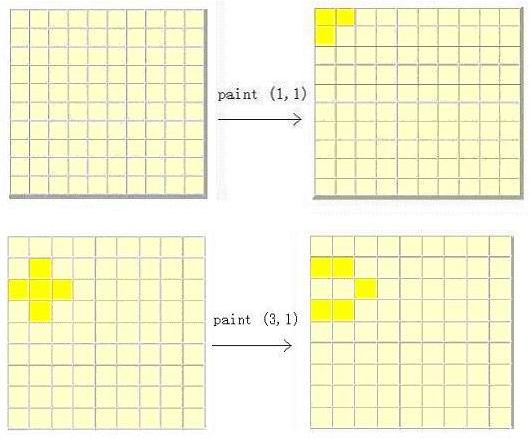
There is a square wall which is made of n*n small square bricks. Some bricks are white while some bricks are yellow. Bob is a painter and he wants to paint all the bricks yellow. But there is something wrong with Bob's brush. Once he uses this brush to paint brick (i, j), the bricks at (i, j), (i-1, j), (i+1, j), (i, j-1) and (i, j+1) all change their color. Your task is to find the minimum number of bricks Bob should paint in order to make all the bricks yellow.
Input

The first line contains a single integer t (1 <= t <= 20) that indicates the number of test cases. Then follow the t cases. Each test case begins with a line contains an integer n (1 <= n <= 15), representing the size of wall. The next n lines represent the original wall. Each line contains n characters. The j-th character of the i-th line figures out the color of brick at position (i, j). We use a 'w' to express a white brick while a 'y' to express a yellow brick.

Output

For each case, output a line contains the minimum number of bricks Bob should paint. If Bob can't paint all the bricks yellow, print 'inf'.

Sample Input

2
3
yyy
yyy
yyy
5
wwwww
wwwww
wwwww
wwwww
wwwww

Sample Output

0
15

Source

╮(╯▽╰)╭,因为数组开的不够大RE了几次
 
 
#include<iostream>
#include<cstring>
using namespace std;
const int mm=937;
int map[mm][mm+1];
int ans[mm];
int var,equ;
int max_ans;
void debug();
void swap(int&a,int &b)
{
  int tmp;tmp=a;a=b;b=tmp;
}
/*
int abs(int x)
{
  if(x<0)return -x;return x;
}*/
int gcd(int a,int b)
{
  int t;
  while(b!=0)
  {
    t=b;b=a%b;a=t;
  }return a;
}
int lcm(int a,int b)
{
  return a*b/gcd(a,b);
}
void dfs(int z,int dep,int k,int kans)
{
  ans[var-dep]=z;
  if(dep==k)
  {
    for(int i=var-k-1;i>=0;i--)
    {
    int tmp;
    tmp=map[i][var]%2;
    for(int j=i+1;j<var;j++)
    if(map[i][j])
    tmp=(tmp-(map[i][j]*ans[j])%2+2)%2;
    ans[i]=(tmp/map[i][i])%2;if(ans[i])++kans;
    }
    if(kans<max_ans)max_ans=kans;
    //cout<<"ans="<<kans<<endl;
  }
  else
  {
     dfs(1,dep+1,k,kans+1);dfs(0,dep+1,k,kans);
  }
}
int Guss()
{
  int k,col;;
  for(k=0,col=0;k<equ&&col<var;k++,col++)
  {/**行变换消元*/
    int max_i=k;
    for(int i=k+1;i<equ;i++)
    if(map[i][col]>map[max_i][col])max_i=i;
    if(max_i!=k)
    {//for(int i=k;i<var+1;i++)好像也OK
      for(int i=col;i<var+1;i++)//是K不是col因为k--;
      swap(map[k][i],map[max_i][i]);
    }
    /**除去对角线0,列变换*/
for(int i = 0; i <equ; ++i)//每一行主元素化为非零
if(!map[i][i])
{
int j;
for(j = i+1;j<var;++j)
if(map[i][j])
break;
if(j == var)
break;
for(int kk = 0;kk < equ; ++kk)
swap(map[kk][i],map[kk][j]);
}
/**遇到对角线0,k退1*/
    if(map[k][col]==0)
    {
      k--;continue;
    }
    /**消元*/
    for(int i=k+1;i<equ;i++)
    if(map[i][col]!=0)
     {
      int LCM=lcm(map[k][col],map[i][col]);
      int ta,tb;
      ta=LCM/map[i][col];tb=LCM/map[k][col];
      if(map[i][col]*map[k][col]<0)tb=-tb;
      for(int j=col;j<var+1;j++)
      {
        map[i][j]=((map[i][j]*ta)%2-(map[k][j]*tb)%2+2)%2;
      }
     }
    // cout<<"k="<<k<<endl;
  }
  //debug();
  ///判断回代
  for(int i=k;i<equ;i++)
  if(map[i][col])return -1;
  if(var==k)
  for(int i=k-1;i>=0;i--)
  {
    int tmp;
    tmp=map[i][var]%2;
    for(int j=i+1;j<var;j++)
    if(map[i][j])
    tmp=(tmp-(map[i][j]*ans[j])%2+2)%2;
    ans[i]=(tmp/map[i][i])%2;if(ans[i])max_ans++;
  }
  else
  {    max_ans=999999;
      dfs(1,1,var-k,1);dfs(0,1,var-k,0);
  }
  return 0;
}
void debug()
{
  for(int i=0;i<var;i++)
  {for(int j=0;j<var+1;j++)
  cout<<map[i][j];
  cout<<"\n";
  }
}
int main()
{
  int cas,num;
  cin>>cas;
  char s;
  while(cas--)
  {memset(map,0,sizeof(map));
  memset(ans,0,sizeof(ans));
  max_ans=0;
    cin>>num;
    var=equ=num*num;
    for(int i=0;i<num;i++)
    {
      for(int j=0;j<num;j++)
      {  map[i*num+j][i*num+j]=1;
        if(i!=0)map[i*num+j][(i-1)*num+j]=1;
        if(j!=0)map[i*num+j][i*num+j-1]=1;
        if(i!=num-1)map[i*num+j][(i+1)*num+j]=1;
        if(j!=num-1)map[i*num+j][i*num+j+1]=1;
        cin>>s;
        if(s=='y')map[i*num+j][var]=0;
        else map[i*num+j][var]=1;
        //cout<<map[i*num+j][var];
        //cout<<"i="<<i<<"j="<<j<<endl;
      }
    }
    int flag=Guss();
    //debug();
    if(flag==-1)cout<<"inf\n";
    else
    {
      cout<<max_ans<<"\n";
    }
  }
}

Redis下载安装与配置(windows) 一、Redis下载 二、Redis安装 三、启动Redis临时服务并测试连接(可跳过) 四、Redis配置 阅读详情

相关推荐

《UE4游戏开发》之 《音效系统的实现》

音效系统需要负责管理什么事情: 1.1 确定声音控制的分类:如背景音乐、技能音效、界面音效、角色配音等,不同游戏对声音有不同的分类 1.2 控制每个分类的声音的开启与关闭,以及调节每个分类声音的大小 解决如何分类: 2.1 首先需要知道ue4为声音分类提供了什么:SoundClass通常需要一个根分类【SC_RPG_Master】,便于总体控制音效,以及指定引擎默认启动的音效 打开SoundClass资产【SC_RPG_Master】,对根控制的设置,将逐级传递并按比例进行设置,以此达到控制一类声音的目的.

qq_21919621的博客 2126

poj1681

Painter's Problem Description There is a square wall which is made of n*n small square bricks. Some bricks are white while some bricks are yellow. Bob is a painter and he wants to paint all the

◆◇丶生如夏花。谁来订阅我的悲伤 726

Win10安全模式下修改C盘权限的完整指南(附解决开始菜单失灵方案)

本文提供了一份在Win10安全模式下修复因C盘权限误改导致开始菜单失灵的完整指南。文章深入剖析了权限体系,特别是TrustedInstaller角色的重要性,并详细讲解了通过安全模式进入系统、使用ICACLS命令或图形界面精准重置C盘关键目录权限的步骤,最终恢复系统核心功能。

weixin_29250403的博客 234

POJ 1681 Painter's Problem(画家问题)

总时间限制: 1000ms 内存限制: 65536kB 描述有一个正方形的墙,由N*N个正方形的砖组成,其中一些砖是白色的,另外一些砖是黄色的。Bob是个画家,想把全部的砖都涂成黄色。但他的画笔不好使。当他用画笔涂画第(i, j)个位置的砖时, 位置(i-1, j)、 (i+1, j)、 (i, j-1)、 (i, j+1)上的砖都会改变颜色。请你帮助Bob计算出最少需要涂画多少块砖,才能使所有砖的

不若乘风来 2453

STM32 AFIO时钟开启时机与复用功能解析

在嵌入式系统开发中,GPIO复用是微控制器外设配置的核心技术之一。通过复用功能,单个物理引脚可以动态切换不同功能模式,如USART通信或普通IO。其实现原理依赖于芯片内部的时钟树架构和寄存器配置机制。AFIO(Alternate Function I/O)模块作为STM32的特色设计,专门处理引脚重映射、外部中断配置等高级功能。正确理解复用功能与AFIO时钟的关系,能显著提升嵌入式开发效率,避免资源浪费。本文以STM32为例,结合引脚重映射和USART配置等典型场景,详解AFIO时钟的实际应用规范与优化实践

weixin_42389113的博客 578

RISC-V嵌入式开发实战:手把手教你读懂并修改CH32V103的链接脚本(.ld)

本文深入解析RISC-V嵌入式开发中CH32V103链接脚本(.ld)的编写与优化技巧。从内存布局、段分配到实战调试,详细讲解如何解决程序跑飞、变量异常等典型问题,特别针对RISC-V架构的gp寄存器优化、中断向量表处理等特性提供专业指导,帮助开发者充分利用64KB Flash和20KB RAM资源。

weixin_33704234的博客 175

Painter's Problem POJ1681

Painter's Problem Time Limit: 1000MS   Memory Limit: 10000K Total Submissions: 2917   Accepted: 1450 Description There is a square wall which is made of n*n small squ

天堂人间 2261

尝试使用CubeMX做stm32开发之九:SYS配置

参考《STM32中文参考手册_V10》,研究CubeMX中有关SYS的配置

Forster-C的博客 9420

Painter's Problem (高斯消元)

There is a square wall which is made of n*n small square bricks. Some bricks are white while some bricks are yellow. Bob is a painter and he wants to paint all the bricks yellow. But there is ...

weixin_30876945的博客 192

阿里云天池大数据长期赛:金融风控-贷款违约预测(含代码)

本次比赛让自己在大数据的处理流程上有了更明确的认知,从数据清洗、特征工程、数据建模,每一个过程都能学到很多经验和知识,值得去历练。

weixin_46685991的博客 1万+

vscode使用continue插件连接LM studio的模型

本文详细介绍了如何使用VSCode的Continue插件连接LM Studio模型。主要步骤包括:在LM Studio中加载模型并设置相关参数,启动API服务,修改Continue配置文件以集成LM Studio模型,并进行测试以验证连接是否成功。通过这些步骤,用户可以将LM Studio中的预训练模型与VSCode的Continue插件无缝对接,实现高效的自然语言处理和编程辅助功能。

weixin_43590837的博客 8628

POJ1681:Painter's Problem(高斯消元 & 格子转换 & 二进制)

Painter's Problem Time Limit: 1000MS   Memory Limit: 10000K Total Submissions: 7113   Accepted: 3388 Description There is a square wall which is made of n*n small squar

junior19的博客 391

用Python爬虫抓取大宗交易成交数据:全面解析与实战代码

大宗交易是指在证券市场中,涉及大额买卖的交易。此类交易通常由机构投资者进行,其交易量较大,对市场的影响显著。大宗交易数据包含了买卖双方的成交价格、成交量等关键信息,这些数据对于投资者和分析师而言,具有重要的市场预测意义。Python爬虫是一种自动化抓取互联网上数据的工具。通过爬虫,我们可以定期获取大宗交易数据,节省人工查询的时间。爬虫的工作原理通常包括:发送HTTP请求、获取响应数据、解析网页内容、提取关键信息、存储和展示数据。

2201_76125261的博客 417

Painter's Problem【高斯消元】

Description There is a square wall which is made of n*n small square bricks. Some bricks are white while some bricks are yellow. Bob is a painter and he wants to paint all the bricks yellow. But th

zhang_di233的专栏 504

假人有限元模型

假人模型,车辆碰撞假人有限元模型,适合做乘员安全的研究者利用

深度学习工具包 DeepLearningToolbox

深度学习工具包Deprecation notice.-----This toolbox is outdated and no longer maintained.There are much better tools available for deep learning than this toolbox, e.g. [Theano](http://deeplearning.net/software/theano/), [torch](http://torch.ch/) or [tensorflow](http://www.tensorflow.org/)I would suggest you use one of the tools mentioned above rather than use this toolbox.Best, Rasmus.DeepLearnToolbox================A Matlab toolbox for Deep Learning.Deep Learning is a new subfield of machine learning that focuses on learning deep hierarchical models of data.It is inspired by the human brain's apparent deep (layered, hierarchical) architecture.A good overview of the theory of Deep Learning theory is[Learning Deep Architectures for AI](http://www.iro.umontreal.ca/~bengioy/papers/ftml_book.pdf)For a more informal introduction, see the following videos by Geoffrey Hinton and Andrew Ng.* [The Next Generation of Neural Networks](http://www.youtube.com/watch?v=AyzOUbkUf3M) (Hinton, 2007)* [Recent Developments in Deep Learning](http://www.youtube.com/watch?v=VdIURAu1-aU) (Hinton, 2010)* [Unsupervised Feature Learning and Deep Learning](http://www.youtube.com/watch?v=ZmNOAtZIgIk) (Ng, 2011)If you use this toolbox in your research please cite [Prediction as a candidate for learning deep hierarchical models of data](http://www2.imm.dtu.dk/pubdb/views/publication_details.php?id=6284)```@MASTERSTHESIS\{IMM2012-06284, author = "R. B. Palm", title = "Prediction as a candidate for learning deep hierarchical models of data", year = "2012",}```Contact: rasmusbergpalm at gmail dot comDirectories included in the toolbox-----------------------------------`NN/` - A library for Feedforward Backpropagation Neural Networks`CNN/` - A library for Convolutional Neural Networks`DBN/` - A library for Deep Belief Networks`SAE/` - A library for Stacked Auto-Encoders`CAE/` - A library for Convolutional Auto-Encoders`util/` - Utility functions used by the libraries`data/` - Data used by the examples`tests/` - unit tests to verify toolbox is workingFor references on each library check REFS.mdSetup-----1. Download.2. addpath(genpath('DeepLearnToolbox'));Example: Deep Belief Network---------------------```matlabfunction test_example_DBNload mnist_uint8;train_x = double(train_x) / 255;test_x = double(test_x) / 255;train_y = double(train_y);test_y = double(test_y);%% ex1 train a 100 hidden unit RBM and visualize its weightsrand('state',0)dbn.sizes = [100];opts.numepochs = 1;opts.batchsize = 100;opts.momentum = 0;opts.alpha = 1;dbn = dbnsetup(dbn, train_x, opts);dbn = dbntrain(dbn, train_x, opts);figure; visualize(dbn.rbm{1}.W'); % Visualize the RBM weights%% ex2 train a 100-100 hidden unit DBN and use its weights to initialize a NNrand('state',0)%train dbndbn.sizes = [100 100];opts.numepochs = 1;opts.batchsize = 100;opts.momentum = 0;opts.alpha = 1;dbn = dbnsetup(dbn, train_x, opts);dbn = dbntrain(dbn, train_x, opts);%unfold dbn to nnnn = dbnunfoldtonn(dbn, 10);nn.activation_function = 'sigm';%train nnopts.numepochs = 1;opts.batchsize = 100;nn = nntrain(nn, train_x, train_y, opts);[er, bad] = nntest(nn, test_x, test_y);assert(er < 0.10, 'Too big error');```Example: Stacked Auto-Encoders---------------------```matlabfunction test_example_SAEload mnist_uint8;train_x = double(train_x)/255;test_x = double(test_x)/255;train_y = double(train_y);test_y = double(test_y);%% ex1 train a 100 hidden unit SDAE and use it to initialize a FFNN% Setup and train a stacked denoising autoencoder (SDAE)rand('state',0)sae = saesetup([784 100]);sae.ae{1}.activation_function = 'sigm';sae.ae{1}.learningRate = 1;sae.ae{1}.inputZeroMaskedFraction = 0.5;opts.numepochs = 1;opts.batchsize = 100;sae = saetrain(sae, train_x, opts);visualize(sae.ae{1}.W{1}(:,2:end)')% Use the SDAE to initialize a FFNNnn = nnsetup([784 100 10]);nn.activation_function = 'sigm';nn.learningRate = 1;nn.W{1} = sae.ae{1}.W{1};% Train the FFNNopts.numepochs = 1;opts.batchsize = 100;nn = nntrain(nn, train_x, train_y, opts);[er, bad] = nntest(nn, test_x, test_y);assert(er < 0.16, 'Too big error');```Example: Convolutional Neural Nets---------------------```matlabfunction test_example_CNNload mnist_uint8;train_x = double(reshape(train_x',28,28,60000))/255;test_x = double(reshape(test_x',28,28,10000))/255;train_y = double(train_y');test_y = double(test_y');%% ex1 Train a 6c-2s-12c-2s Convolutional neural network %will run 1 epoch in about 200 second and get around 11% error. %With 100 epochs you'll get around 1.2% errorrand('state',0)cnn.layers = { struct('type', 'i') %input layer struct('type', 'c', 'outputmaps', 6, 'kernelsize', 5) %convolution layer struct('type', 's', 'scale', 2) %sub sampling layer struct('type', 'c', 'outputmaps', 12, 'kernelsize', 5) %convolution layer struct('type', 's', 'scale', 2) %subsampling layer};cnn = cnnsetup(cnn, train_x, train_y);opts.alpha = 1;opts.batchsize = 50;opts.numepochs = 1;cnn = cnntrain(cnn, train_x, train_y, opts);[er, bad] = cnntest(cnn, test_x, test_y);%plot mean squared errorfigure; plot(cnn.rL);assert(er<0.12, 'Too big error');```Example: Neural Networks---------------------```matlabfunction test_example_NNload mnist_uint8;train_x = double(train_x) / 255;test_x = double(test_x) / 255;train_y = double(train_y);test_y = double(test_y);% normalize[train_x, mu, sigma] = zscore(train_x);test_x = normalize(test_x, mu, sigma);%% ex1 vanilla neural netrand('state',0)nn = nnsetup([784 100 10]);opts.numepochs = 1; % Number of full sweeps through dataopts.batchsize = 100; % Take a mean gradient step over this many samples[nn, L] = nntrain(nn, train_x, train_y, opts);[er, bad] = nntest(nn, test_x, test_y);assert(er < 0.08, 'Too big error');%% ex2 neural net with L2 weight decayrand('state',0)nn = nnsetup([784 100 10]);nn.weightPenaltyL2 = 1e-4; % L2 weight decayopts.numepochs = 1; % Number of full sweeps through dataopts.batchsize = 100; % Take a mean gradient step over this many samplesnn = nntrain(nn, train_x, train_y, opts);[er, bad] = nntest(nn, test_x, test_y);assert(er < 0.1, 'Too big error');%% ex3 neural net with dropoutrand('state',0)nn = nnsetup([784 100 10]);nn.dropoutFraction = 0.5; % Dropout fraction opts.numepochs = 1; % Number of full sweeps through dataopts.batchsize = 100; % Take a mean gradient step over this many samplesnn = nntrain(nn, train_x, train_y, opts);[er, bad] = nntest(nn, test_x, test_y);assert(er < 0.1, 'Too big error');%% ex4 neural net with sigmoid activation functionrand('state',0)nn = nnsetup([784 100 10]);nn.activation_function = 'sigm'; % Sigmoid activation functionnn.learningRate = 1; % Sigm require a lower learning rateopts.numepochs = 1; % Number of full sweeps through dataopts.batchsize = 100; % Take a mean gradient step over this many samplesnn = nntrain(nn, train_x, train_y, opts);[er, bad] = nntest(nn, test_x, test_y);assert(er < 0.1, 'Too big error');%% ex5 plotting functionalityrand('state',0)nn = nnsetup([784 20 10]);opts.numepochs = 5; % Number of full sweeps through datann.output = 'softmax'; % use softmax outputopts.batchsize = 1000; % Take a mean gradient step over this many samplesopts.plot = 1; % enable plottingnn = nntrain(nn, train_x, train_y, opts);[er, bad] = nntest(nn, test_x, test_y);assert(er < 0.1, 'Too big error');%% ex6 neural net with sigmoid activation and plotting of validation and training error% split training data into training and validation datavx = train_x(1:10000,:);tx = train_x(10001:end,:);vy = train_y(1:10000,:);ty = train_y(10001:end,:);rand('state',0)nn = nnsetup([784 20 10]); nn.output = 'softmax'; % use softmax outputopts.numepochs = 5; % Number of full sweeps through dataopts.batchsize = 1000; % Take a mean gradient step over this many samplesopts.plot = 1; % enable plottingnn = nntrain(nn, tx, ty, opts, vx, vy); % nntrain takes validation set as last two arguments (optionally)[er, bad] = nntest(nn, test_x, test_y);assert(er < 0.1, 'Too big error');```[![Bitdeli Badge](https://d2weczhvl823v0.cloudfront.net/rasmusbergpalm/deeplearntoolbox/trend.png)](https://bitdeli.com/free "Bitdeli Badge")

Painter's Problem POJ - 1681

题意: 涂色,每涂一个格子就会将其临近的格子都改变,黄的变成白的,白的变成黄的, 给出画板初始情况,问最少多少次操作可以使得画板全部变成黄色 思路: 消元后,自由变元的取值情况的变化会造成后边的解的变化 剩下最后n个变元,遍历每种取值情况后,回溯找到解中操作次数最少的 #include #include #include #include using namespace std; co

a7f650ebd327889c的博客 483

SAP B1中文培訓教材_SDK

公司内部培训资料,对开发工具 ,DIAPI, UIAPI,Add-ON有详细解说

Painter's Problem POJ - 1681(高斯消元)

POJ - 1681 There is a square wall which is made of n*n small square bricks. Some bricks are white while some bricks are yellow. Bob is a painter and he wants to paint all the bricks yellow. But the...

FIVE 386

ET2012新版免狗免安装绿色软件

ET2012新版免狗免安祖昂绿色软件。,新界面,新视觉,

POJ 1681 Painter's Problem (高斯消元)

Description There is a square wall which is made of n×n small square bricks. Some bricks are white while some bricks are yellow. Bob is a painter and he wants to paint all the bricks yellow. But ther

小坏蛋_千千 729

POJ1681-Painter's Problem[十字枚举]

Painter's Problem Time Limit: 1000MS   Memory Limit: 10000K Total Submissions: 6306   Accepted: 3006 Description There is a square wall which is made of n*n small squar

vCodes的博客 626

POJ1681-Painter's Problem

Description There is a square wall which is made of n*n small square bricks. Some bricks are white while some bricks are yellow. Bob is a painter and he wants to paint all the bricks yellow. But th

豆腐脑是咸的 495

【POJ1681】Painter's Problem 高斯消元,求最小∑系数的异或方程组

-+-+-+-+-+-+-+-+-+-+-+-+-+-+-+-+-+-+-+-+-+-+-+-+-+-+-+-+-+-+ 题意: 多组数据、 有个n*n的正方形,然后你要对某些位置进行操作,使得最后灯的状态都变成y。 操作:这个灯位置的上下左右以及自己这五盏灯状态都取反。 然后求最小操作次数。 -+-+-+-+-+-+-+-+-+-+-+-+-+-+

辗转山河弋流歌 1657

POJ1681 Painter's Problem

总时间限制:5000ms内存限制:65536kB 描述 There is a square wall which is made of n*n small square bricks. Some bricks are white while some bricks are yellow. Bob is a painter and he wants to paint all the bri...

weixin_30609331的博客 144

poj 1681 Painter's Problem 高斯消元

http://poj.org/problem?id=1681

cstdio_hao的专栏 630

POJ 1681 Painter's Problem(高斯消元)

高斯消元 + 构造矩阵

代码改变世界 2565

poj 1681 Painter's Problem 【高斯消元 + 状压枚举自由变元】

Painter's Problem Time Limit: 1000MS   Memory Limit: 10000K Total Submissions: 5075   Accepted: 2458 Description There is a square wall which is made of n*n small square

世界很大 878

POJ 1681 Painter's Problem(开关问题)

开关问题的解法:把第一行的数开或关有2^n次方种可能00000-11111.遍历这么多种可能,给第一行赋值,第二行考虑让自己能影响到的第一行的数成立,第三行考虑让自己能影响到的第二行的数成立……最后判断一下是否所有的数都能成立。复杂度为(n*n*2^n)所以n必须是一个小的值 #include "cstdio" #include "iostream" #include "cstring" usi

但求心安的博客 403

poj 1681 Painter's Problem (高斯消元)

Painter's Problem Time Limit: 1000MS   Memory Limit: 10000K Total Submissions: 6197   Accepted: 2963 Description There is a square wall which is made of n*n small square

clover_hxy的博客 700
上一篇: 林大陈宇老师的原创高斯
下一篇: pku 1753 Flip Game(高斯消元+枚举)
剑不飞
博客等级 码龄15年 86粉丝 505原创
评论
成就一亿技术人!
拼手气红包6.0元
还能输入1000个字符
 
 条评论被折叠 查看
添加红包

请填写红包祝福语或标题

个

红包个数最小为10个

元

红包金额最低5元

当前余额3.43元 前往充值 >
需支付:10.00元
成就一亿技术人!
领取后你会自动成为博主和红包主的粉丝 规则
hope_wisdom
发出的红包
实付元
使用余额支付
点击重新获取
扫码支付
钱包余额 0

抵扣说明:

1.余额是钱包充值的虚拟货币,按照1:1的比例进行支付金额的抵扣。
2.余额无法直接购买下载,可以购买VIP、付费专栏及课程。

余额充值