


 本文详细解析了螺旋遍历矩阵的两种方法:模拟路径法和层遍历法,通过实例展示了如何将矩阵元素按顺时针螺旋顺序输出,适用于算法理解和编程实践。
Spiral Matrix (M)
Given a matrix of m x n elements (m rows, n columns), return all elements of the matrix in spiral order.
Example 1:
Input:
[
 [ 1, 2, 3 ],
 [ 4, 5, 6 ],
 [ 7, 8, 9 ]
]
Output: [1,2,3,6,9,8,7,4,5]
Example 2:
Input:
[
  [1, 2, 3, 4],
  [5, 6, 7, 8],
  [9,10,11,12]
]
Output: [1,2,3,4,8,12,11,10,9,5,6,7]
题意
将给定矩阵中的元素按照从外圈到内圈,顺时针螺旋输出。
思路
直接模拟从外到内的顺时针路径,输出每一个路径上的元素。从左上角顶点开始,初始方向向右,每次按照指定方向前进一个元素,如果下一个元素在矩阵外或已经在之前被访问过,则将前进方向顺时针转90°。重复上述操作,直到最后一次到达的位置在矩阵外或已经被访问过。
官方解答中还介绍了一种层遍历的方法:
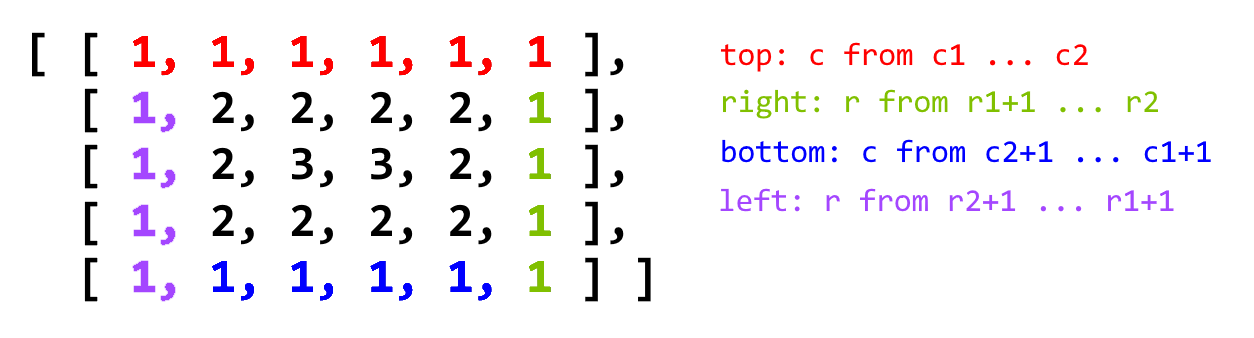
如图,每次遍历一层,将当前层中元素按照红色行从左到右、绿色列从上到下、蓝色行从右到左、紫色列从下到上的顺序添加到结果集中,完成后将上下左右四个边界各向内推进一层,重复操作。
代码实现 - 模拟
class Solution {
    public List<Integer> spiralOrder(int[][] matrix) {
        List<Integer> ans = new ArrayList<>();
        // 空矩阵处理
        if (matrix.length == 0) {
            return ans;
        }

        int m = matrix.length, n = matrix[0].length;
        boolean[][] visited = new boolean[m][n];	// 记录已访问过元素
        int[] iPlus = {0, 1, 0, -1};
        int[] jPlus = {1, 0, -1, 0};
        int direction = 0;							// 下一次前进方向,0123分别为右下左上
        int i = 0, j = 0;							// 当前位置

        for (int count = 0; count < m * n; count++) {
            ans.add(matrix[i][j]);
            visited[i][j] = true;

            // 先判断以当前方向走到的下一个位置是否合法,不合法则转向
            int nextI = i + iPlus[direction];
            int nextJ = j + jPlus[direction];
            if (nextI == -1 || nextJ == -1 || nextI == m || nextJ == n || visited[nextI][nextJ]) {
                direction = (direction + 1) % 4;
                i += iPlus[direction];
                j += jPlus[direction];
            } else {
                i = nextI;
                j = nextJ;
            }
        }

        return ans;
    }
}
代码实现 - 层遍历
class Solution {
    public List<Integer> spiralOrder(int[][] matrix) {
        List<Integer> ans = new ArrayList<>();
        if (matrix.length == 0) {
            return ans;
        }

        int m = matrix.length, n = matrix[0].length;

        // 四个参数确定四个边
        int rowUp = 0, rowDown = m - 1;
        int colLeft = 0, colRight = n - 1;

        while (rowUp <= rowDown && colLeft <= colRight) {
            for (int c = colLeft; c <= colRight; c++) {
                ans.add(matrix[rowUp][c]);
            }
            for (int r = rowUp + 1; r <= rowDown; r++) {
                ans.add(matrix[r][colRight]);
            }

            // 只有当前层不是一直线时,才有下边和左边
            if (rowUp < rowDown && colLeft < colRight) {
                for (int c = colRight - 1; c >= colLeft + 1; c--) {
                    ans.add(matrix[rowDown][c]);
                }
                for (int r = rowDown; r >= rowUp + 1; r--) {
                    ans.add(matrix[r][colLeft]);
                }
            }

            // 向内缩小
            rowUp++;
            rowDown--;
            colLeft++;
            colRight--;
        }

        return ans;
    }
}





 扫一扫
扫一扫


 512
512

 被折叠的 条评论
为什么被折叠?
被折叠的 条评论
为什么被折叠?
 到【灌水乐园】发言





