



 这篇博客主要介绍了LeetCode第505题《The Maze II》的解题思路和解决方案。作者指出在解决这类寻找最短路径的问题时,使用BFS(广度优先搜索)通常比DFS(深度优先搜索)更有效。在给定的迷宫中,有一个球从起始位置开始滚动,直到碰到墙才会停止。目标是找到使球到达目的地的最短距离,返回-1表示无法到达。博客内容包括具体例子、注意事项以及采用BFS的代码实现,通过维护一个队列和使用地图记录已访问位置的最短路径来解决问题。
题目:
There is a ball in a maze with empty spaces and walls. The ball can go through empty spaces by rolling up, down, left or right, but it won't stop rolling until hitting a wall. When the ball stops, it could choose the next direction.
Given the ball's start position, the destination and the maze, find the shortest distance for the ball to stop at the destination. The distance is defined by the number of empty spaces traveled by the ball from the start position (excluded) to the destination (included). If the ball cannot stop at the destination, return -1.
The maze is represented by a binary 2D array. 1 means the wall and 0 means the empty space. You may assume that the borders of the maze are all walls. The start and destination coordinates are represented by row and column indexes.
Example 1
Input 1: a maze represented by a 2D array

0 0 1 0 0
0 0 0 0 0
0 0 0 1 0
1 1 0 1 1
0 0 0 0 0

Input 2: start coordinate (rowStart, colStart) = (0, 4)
Input 3: destination coordinate (rowDest, colDest) = (4, 4)

Output: 12
Explanation: One shortest way is : left -> down -> left -> down -> right -> down -> right.
             The total distance is 1 + 1 + 3 + 1 + 2 + 2 + 2 = 12.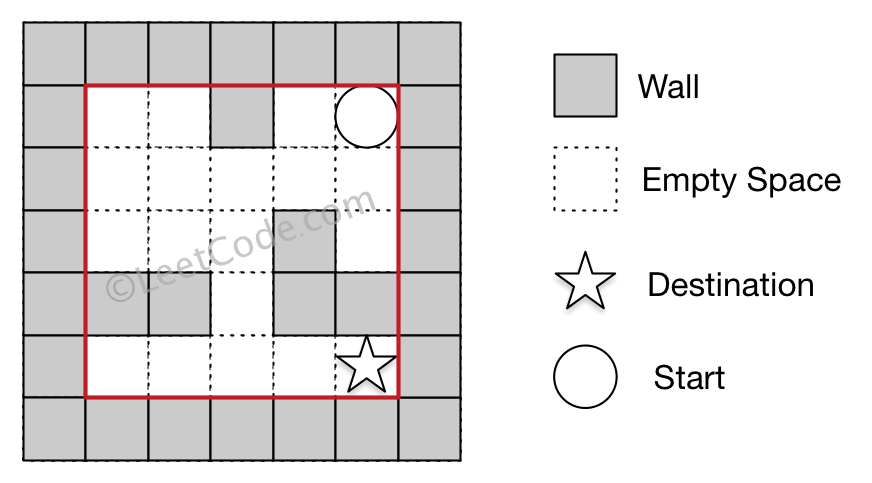
Example 2
Input 1: a maze represented by a 2D array

0 0 1 0 0
0 0 0 0 0
0 0 0 1 0
1 1 0 1 1
0 0 0 0 0

Input 2: start coordinate (rowStart, colStart) = (0, 4)
Input 3: destination coordinate (rowDest, colDest) = (3, 2)

Output: -1
Explanation: There is no way for the ball to stop at the destination.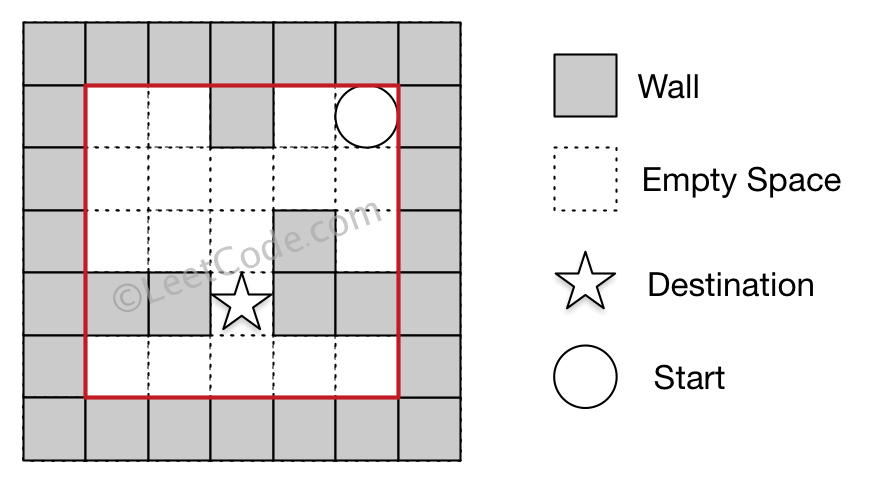
Note:
- There is only one ball and one destination in the maze.
- Both the ball and the destination exist on an empty space, and they will not be at the same position initially.
- The given maze does not contain border (like the red rectangle in the example pictures), but you could assume the border of the maze are all walls.
- The maze contains at least 2 empty spaces, and both the width and height of the maze won't exceed 100.
思路:
这种求最短路径的题目一般还是BFS比DFS靠谱一些。下面的代码是在[Leetcode] 490. The Maze 解题报告的基础上修改而来的。我们用一个map来记录已经访问过的位置以及其对应的最短路径。然后维护一个队列。每次取出队列头部,如果发现是destination了,就更新最终结果;否则就朝着四个方向前进直到到达障碍或者边界。此时如果发现结尾点的路径还要长一些,就需要进队列再次进行搜索了。当然本题目也可以不用map而直接用二维数组记录当前的各个位置上的搜索路径,虽然可能空间复杂度更高一些,但是时间复杂度会有所下降。
代码:
class Solution {
public:
    int shortestDistance(vector<vector<int>>& maze, vector<int>& start, vector<int>& destination) {
        map<vector<int>, int> visited;
        vector<vector<int>> dirs = {{0, 1}, {0, -1}, {1, 0}, {-1, 0}};
        int ret = INT_MAX;
        visited[start] = 0;
        queue<vector<int>> q;
        q.push(start);
        while (!q.empty()) {
            vector<int> pos = q.front();
            q.pop();
            if (pos == destination) {
                ret = min(ret, visited[pos]);
            }
            else {
                for (int i = 0; i < 4; ++i) {
                    vector<int> res = go2End(maze, pos, dirs[i]);
                    int line_length = i <= 1 ? abs(pos[1] - res[1]) : abs(pos[0] - res[0]);
                    if (visited.find(res) == visited.end() || visited[res] > visited[pos] + line_length) {
                        visited[res] = visited[pos] + line_length;
                        q.push(res);
                    }
                }
            }
        }
        return ret == INT_MAX ? -1 : ret;
    }
private:
    vector<int> go2End(vector<vector<int>> &maze, vector<int> start, vector<int> &dir) {
        vector<int> new_start = {start[0] + dir[0], start[1] + dir[1]};
        int row_num = maze.size(), col_num = maze[0].size();
        if(new_start[0] < 0 || new_start[0] >= row_num ||
           new_start[1] < 0 || new_start[1] >= col_num ||
           maze[new_start[0]][new_start[1]] == 1) {             // already at the end
            return start;
        }
        return go2End(maze, new_start, dir);
    }
};





 扫一扫
扫一扫


 957
957

 被折叠的 条评论
为什么被折叠?
被折叠的 条评论
为什么被折叠?
 到【灌水乐园】发言





