



 本文介绍了一种使用位运算的方法来高效验证数独的有效性。该方法通过记录每一行、每一列及每个九宫格中出现过的数字进行快速判断,避免了传统方法中的重复检查。
题目:
Determine if a Sudoku is valid, according to: Sudoku Puzzles - The Rules.
The Sudoku board could be partially filled, where empty cells are filled with the character '.'.
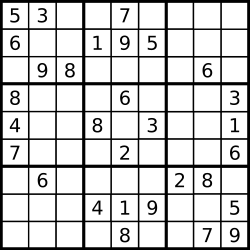
A partially filled sudoku which is valid.
Note:
A valid Sudoku board (partially filled) is not necessarily solvable. Only the filled cells need to be validated.
思路:
最简单直观的思路就是:针对每一行、每一列以及每一个九宫格执行检查。如果发现里面有非法数字或者越界数字或者重复数字,就代表数独不合法。
刚刚在网上看到一个更为巧妙的解法,就是采用位运算的方式,记录每一行,每一列,以及每一个九宫格的的字符与操作的结果。这样如果在某一行,某一列或者某一九宫格内出现了相同的数字,则与操作的结果不为零。直接通过代码来理解吧。
个人感觉位操作在很多情况下特别有用,关键在于它的执行速度特别快!
代码:
class Solution {
public:
    bool isValidSudoku(vector<vector<char>>& board) {
        int m = board.size(), n = board[0].size();
        vector<int> row(9, 0), col(9, 0), square(9, 0);
        for(int i = 0; i < m; i++)
        {
            for(int j = 0; j < n; j++)
            {
                if(board[i][j] == '.')
                    continue;
                if(board[i][j] < '0' || board[i][j] > '9')
                    return false;
                int val = 1 << (board[i][j] - '0');
                if((row[i] & val) || (col[j] & val) || (square[i/3*3+j/3] & val))
                    return false;
                row[i] |= val, col[j] |= val, square[i/3*3+j/3] |= val;
            }
        }
        return true;
    }
};





 扫一扫
扫一扫


 688
688

 被折叠的 条评论
为什么被折叠?
被折叠的 条评论
为什么被折叠?
 到【灌水乐园】发言





