


实验三内容展示:

图一 实验三内容展示
实验任务1.(数据结构之链表)
1. 编写程序link.h,实现教材例9-6的链表类,在测试程序中声明两个整型链表A和B,分别插入5个元素,并把B中元素加入A的尾部。
#pragma once
#include <stdio.h>
#include <stdlib.h>
#include <assert.h>
#include <iostream>

using namespace std;

// 定义链表节点的结构
template <typename T>
class SListNode {
public:
    T data;               // 存储的数据
    SListNode* next;      // 指向下一个节点的地址

    SListNode(T val) : data(val), next(nullptr) {}
};

// 链表的类模板
template <typename T>
class SinglyLinkedList {
private:
    SListNode<T>* head; // 链表的头指针

public:
    // 构造函数
    SinglyLinkedList() : head(nullptr) {}

    // 析构函数
    ~SinglyLinkedList() {
        clear();
    }

    // 清空链表
    void clear() {
        SListNode<T>* current = head;
        while (current != nullptr) {
            SListNode<T>* next = current->next;
            delete current;
            current = next;
        }
        head = nullptr;
    }

    // 尾插法
    void pushBack(T x) {
        SListNode<T>* newNode = new SListNode<T>(x);
        if (head == nullptr) {
            head = newNode;
        }
        else {
            SListNode<T>* current = head;
            while (current->next != nullptr) {
                current = current->next;
            }
            current->next = newNode;
        }
    }

    // 头插法
    void pushFront(T x) {
        SListNode<T>* newNode = new SListNode<T>(x);
        newNode->next = head;
        head = newNode;
    }

    // 尾删除
    void popBack() {
        assert(head != nullptr && "Cannot pop from an empty list");
        if (head->next == nullptr) {
            delete head;
            head = nullptr;
        }
        else {
            SListNode<T>* current = head;
            while (current->next->next != nullptr) {
                current = current->next;
            }
            delete current->next;
            current->next = nullptr;
        }
    }

    // 头删除
    void popFront() {
        assert(head != nullptr && "Cannot pop from an empty list");
        SListNode<T>* nextNode = head->next;
        delete head;
        head = nextNode;
    }

    // 打印链表
    void print() const {
        SListNode<T>* current = head;
        while (current != nullptr) {
            cout << current->data << " ";
            current = current->next;
        }
        printf("\n");
    }
};
这个测试比较简单,就不单独拿出来了。
实验任务2.(数据结构之栈,队列)
2. 下面任务二选一,也可双选:
(1)编写程序queue.h,用链表实现队列类。在测试程序中声明一个整型队列对象,插入5个整数,压入队列,再依据顺序取出并显示出来。
(2)编写程序stack.h,用链表实现栈类。在测试程序中声明一个整型栈对象,插入5个整数,压入栈,再依据相应顺序取出并显示出来。
#pragma once
#include <iostream>
#include <stdlib.h>
#include <stdbool.h>
#include <assert.h>

template <typename T>
struct QueueNode {
    T val;
    QueueNode* next;

    QueueNode(T v) : val(v), next(nullptr) {}
};

template <typename T>
class Queue {
private:
    QueueNode<T>* phead;
    QueueNode<T>* ptail;
    int size;

public:
    Queue() : phead(nullptr), ptail(nullptr), size(0) {}

    ~Queue() {
        QueueDestroy();
    }

    void QueueInit() {
        phead = ptail = nullptr;
        size = 0;
    }

    void QueueDestroy() {
        while (phead != nullptr) {
            QueueNode<T>* next = phead->next;
            delete phead;
            phead = next;
        }
        ptail = nullptr;
        size = 0;
    }

    void QueuePush(T x) {
        QueueNode<T>* newNode = new QueueNode<T>(x);
        if (ptail == nullptr) {
            phead = ptail = newNode;
        }
        else {
            ptail->next = newNode;
            ptail = newNode;
        }
        size++;
    }

    void QueuePop() {
        assert(phead != nullptr && "Cannot pop from an empty queue");
        QueueNode<T>* temp = phead;
        phead = phead->next;
        if (phead == nullptr) {
            ptail = nullptr;
        }
        delete temp;
        size--;
    }

    T QueueFront() const {
        assert(phead != nullptr && "Front called on empty queue");
        return phead->val;
    }

    T QueueBack() const {
        assert(ptail != nullptr && "Back called on empty queue");
        return ptail->val;
    }

    bool QueueEmpty() const {
        return phead == nullptr;
    }

    int QueueSize() const {
        return size;
    }
};
分别写到queue.h和stack.h
#pragma once
#include <stdio.h>
#include <stdlib.h>
#include <stdbool.h>
#include <assert.h>

template <typename T>
class Stack {
private:
    T* a;                // 存储栈内元素的数组
    int top;             // 栈顶索引
    int capacity;        // 栈的最大容量

public:
    // 构造函数
    Stack(int size = 10) : capacity(size), top(-1) {
        a = new T[capacity];
    }

    // 析构函数
    ~Stack() {
        destroy();
    }

    // 初始化栈
    void init() {
        top = -1;
    }

    // 销毁栈,释放内存
    void destroy() {
        delete[] a;
        a = nullptr;
        top = -1;
        capacity = 0;
    }

    // 压栈操作
    void push(T x) {
        if (top == capacity) {
            int newcapacity = capacity * 2;
            T* tmp = (T*)realloc(a, newcapacity * sizeof(T));
            if (tmp == NULL)
            {
                perror("realloc fail");
                return;
            }
            a = tmp;
        }

        a[++top] = x;
    }

    // 出栈操作
    void pop() {
        assert(top > -1 && "Stack underflow");
        top--;
    }

    // 获取栈顶元素
    T topValue() const {
        assert(top > -1 && "Stack is empty");
        return a[top];
    }

    // 获取栈的大小
    int size() const {
        return top + 1;
    }

    // 检查栈是否为空
    bool empty() const {
        return top == -1;
    }
};
实验任务3.(排序算法)
3. 将直接插入排序、直接选择排序、冒泡排序与顺序查找函数封装到数组类中,作为成员函数,实现并设计这个类。
#pragma once
#include <iostream>
#include <utility> // For std::swap

template <typename T>
class Array {
private:
    T* data;
    size_t capacity;
    size_t length;

public:
    // 构造函数
    Array(size_t size) : capacity(size), length(0), data(new T[size]) {}

    // 析构函数
    ~Array() {
        delete[] data;
    }

    // 禁止拷贝构造函数和赋值运算符
    Array(const Array&) = delete;
    Array& operator=(const Array&) = delete;

    // 插入元素
    void insert(const T& value) {
        if (length >= capacity) {
            capacity *= 2;
            T* tmp = (T*)realloc(data, sizeof(T) * capacity);
            if (tmp == NULL)
            {
                perror("realloc fail");
                return;
            }
            data = tmp;
        }

        data[length++] = value;
    }

    // 直接插入排序
    void insertionSort() {
        for (size_t i = 1; i < length; ++i) {
            T key = data[i];
            //j一定从后往前来,避免覆盖掉已有元素
            size_t j = i - 1;
            while (j >= 0 && data[j] > key) {
                data[j + 1] = data[j];
                --j;
            }
            data[j + 1] = key;
        }
    }
/*
void InsertSort(int* a, int n)
{
    for (int i = 0; i < n-1; i++)
    {
        // [0, end] end+1
        int end = i;
        int tmp = a[end + 1];
        while (end >= 0)
        {
            if (tmp < a[end])
            {
                a[end + 1] = a[end];
                --end;
            }
            else
            {
                break;
            }
        }

        a[end + 1] = tmp;
    }
}
*/

    // 直接选择排序
    void selectionSort() {
        for (size_t i = 0; i < length - 1; ++i) {
            size_t minIndex = i;
            for (size_t j = i + 1; j < length; ++j) {
                if (data[j] < data[minIndex]) {
                    minIndex = j;
                }
            }
            std::swap(data[minIndex], data[i]);
        }
    }

    // 冒泡排序
    void bubbleSort() {
        for (size_t i = 0; i < length - 1; ++i) {
            for (size_t j = 0; j < length - i - 1; ++j) {
                if (data[j] > data[j + 1]) {
                    std::swap(data[j], data[j + 1]);
                }
            }
        }
    }

    // 顺序查找
    size_t linearSearch(const T& value) const {
        for (size_t i = 0; i < length; ++i) {
            if (data[i] == value) {
                return i;
            }
        }
        return -1; // Not found
    }

    // 打印数组
    void print() const {
        for (size_t i = 0; i < length; ++i) {
            std::cout << data[i] << " ";
        }
        std::cout << std::endl;
    }

    void print_pointer() const {
        for (size_t i = 0; i < length; ++i) {
            std::cout << *(T*)data[i] << " ";
        }
        std::cout << std::endl;
    }


    // 获取数组长度
    size_t size() const {
        return length;
    }
};
这里试图写通过cout遍历打印的函数,数据是指针类型的没有成功。
实验任务4.(综合系统实现)
4. 声明一个对people类对象数组按编号排序的函数,一个按编号查找people对象的函数。在测试程序中使用前面实验得到的结果声明教师数组和学生数组,分别对你教师数组和学生数组进行排序和查找。
原有的函数不够用,新写一点东西,让他适应更强大的功能
#pragma once
#include <iostream>
#include <utility> // For std::swap

template <typename T>
class Array {
private:
    T* data;
    size_t capacity;
    size_t length;

public:
    // 构造函数
    Array(size_t size) : capacity(size), length(0), data(new T[size]) {}

    // 析构函数
    ~Array() {
        delete[] data;
    }

    // 禁止拷贝构造函数和赋值运算符
    Array(const Array&) = delete;
    Array& operator=(const Array&) = delete;

    // 插入元素
    void insert(const T& value) {
        if (length >= capacity) {
            capacity *= 2;
            T* tmp = (T*)realloc(data, sizeof(T) * capacity);
            if (tmp == NULL)
            {
                perror("realloc fail");
                return;
            }
            data = tmp;
        }

        data[length++] = value;
    }

    // 直接插入排序
    void insertionSort() {
        for (size_t i = 1; i < length; ++i) {
            T key = data[i];
            //j一定从后往前来,避免覆盖掉已有元素
            size_t j = i - 1;
            while (j >= 0 && data[j] > key) {
                data[j + 1] = data[j];
                --j;
            }
            data[j + 1] = key;
        }
    }
/*
void InsertSort(int* a, int n)
{
    for (int i = 0; i < n-1; i++)
    {
        // [0, end] end+1
        int end = i;
        int tmp = a[end + 1];
        while (end >= 0)
        {
            if (tmp < a[end])
            {
                a[end + 1] = a[end];
                --end;
            }
            else
            {
                break;
            }
        }

        a[end + 1] = tmp;
    }
}
*/

    // 直接选择排序
    void selectionSort() {
        for (size_t i = 0; i < length - 1; ++i) {
            size_t minIndex = i;
            for (size_t j = i + 1; j < length; ++j) {
                if (data[j] < data[minIndex]) {
                    minIndex = j;
                }
            }
            std::swap(data[minIndex], data[i]);
        }
    }

    // 冒泡排序
    void bubbleSort(int (*cmp)(const void* p1, const void* p2)) {
        for (size_t i = 0; i < length - 1; ++i) {
            for (size_t j = 0; j < length - i - 1; ++j) {
                if (cmp(data[j], data[j + 1]) > 0) {
                    std::swap(data[j], data[j + 1]);
                }
            }
        }
    }

    // 顺序查找
    size_t linearSearch(void* value,int(*cmp)(const void* p1, const void* p2)) const {
        for (size_t i = 0; i < length; ++i) {
            if (cmp(data[i], value)) {
                return i;
            }
        }
        return -1; // Not found
    }

    // 打印数组
    void print() const {
        for (size_t i = 0; i < length; ++i) {
            std::cout << data[i] << " ";
        }
        std::cout << std::endl;
    }

    void print_pointer() const {
        for (size_t i = 0; i < length; ++i) {
            std::cout << *(T*)data[i] << " ";
        }
        std::cout << std::endl;
    }


    // 获取数组长度
    size_t size() const {
        return length;
    }

    T* getpointer() {
        return data;
    }

};
这下,比较就可以写各种比较方式了,按什么查找也可以写相应的方法函数
#include "link.h"
#include "queue.h"
#include "stack.h"
#include "array_sort.h"
#include "test_people.h"


int cmp_num(const void* p1, const void* p2)
{
    civil* pp1 = (civil*)p1;
    civil* pp2 = (civil*)p2;
    return pp1->num-pp2->num;
}

int cmp_search(const void* p1, const void* p2) {
    civil* pp1 = (civil*)p1;
    string* pp2 = (string*)p2;
    return pp1->identified() == (*pp2);
}

int test2() {
    civil* cp = nullptr;
    Student* s1 = new Student("张三", 1, "211103000012030000", MAN);
    Student* s2 = new Student("张三三", 5, "211103000012030004", MAN);
    Teacher* t1 = new Teacher("李四", 2, "211003000012030001", MAN);
    DoctorHelpTeacher* Dht1 = new DoctorHelpTeacher("王五", 3, "211003000012030002", MAN);
    Doctor* D1 = new Doctor("赵六", 4, "211003000012030003", MAN);

    Array<civil*> arr_stu(1);
    arr_stu.insert(s1);
    arr_stu.insert(D1);
    arr_stu.insert(Dht1);
    arr_stu.insert(s2);
    //插入数量超额自动扩容为二倍
//   arr_stu.print_pointer();
    for (int i = 0; i < arr_stu.size();i++) {
        arr_stu.getpointer()[i]->printinfo(cout);
    }
    cout << "排序后" << endl;
    arr_stu.bubbleSort(cmp_num);
    for (int i = 0; i < arr_stu.size(); i++) {
        arr_stu.getpointer()[i]->printinfo(cout);
    }
    string tmp = "211103000012030004";
    cout << arr_stu.linearSearch(&tmp,cmp_search);

    Array<civil*> arr_teacher(1);
    arr_teacher.insert(Dht1);
    arr_teacher.insert(t1);
//    arr_teacher.print_pointer();


    return 0;
}
这里学生和老师类一样就没再测试,我们看看这段测试代码的输出结果吧
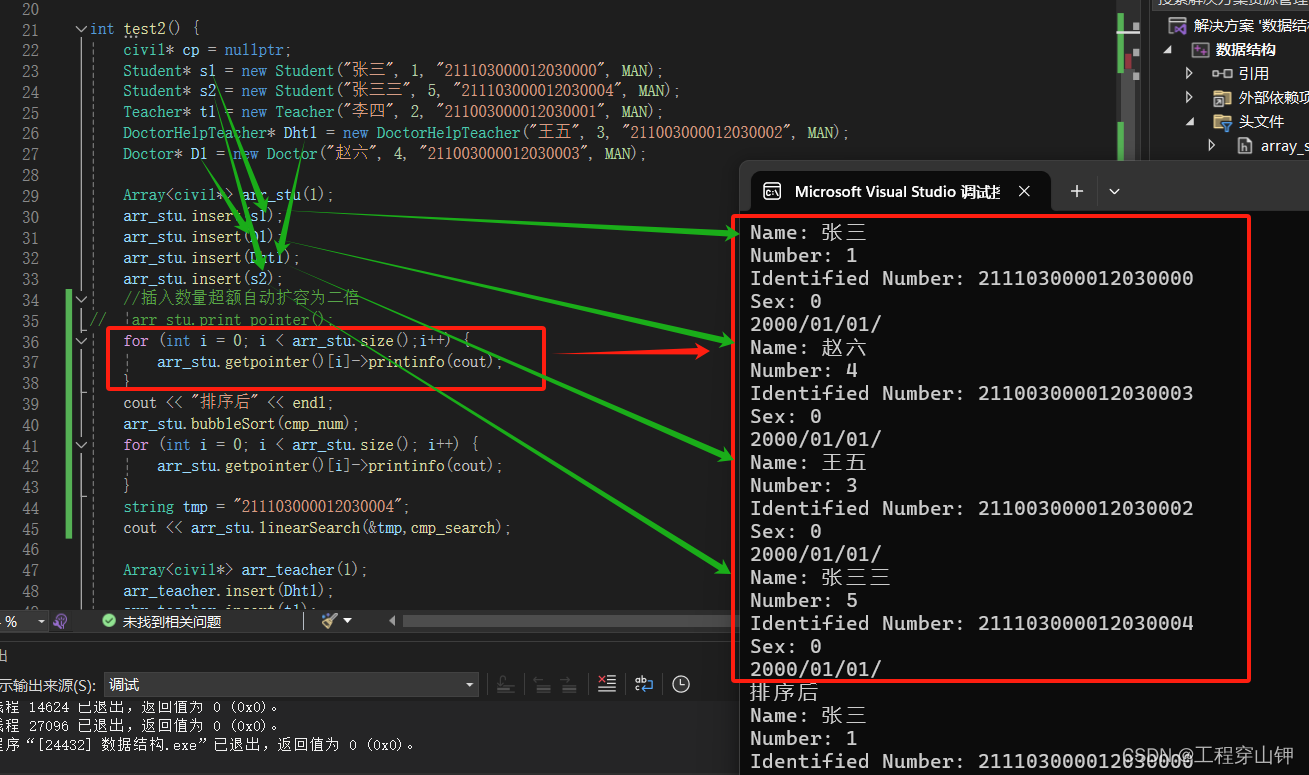 先看排序前,数据与插入时一一对应,证明正确。
接下来看排序后
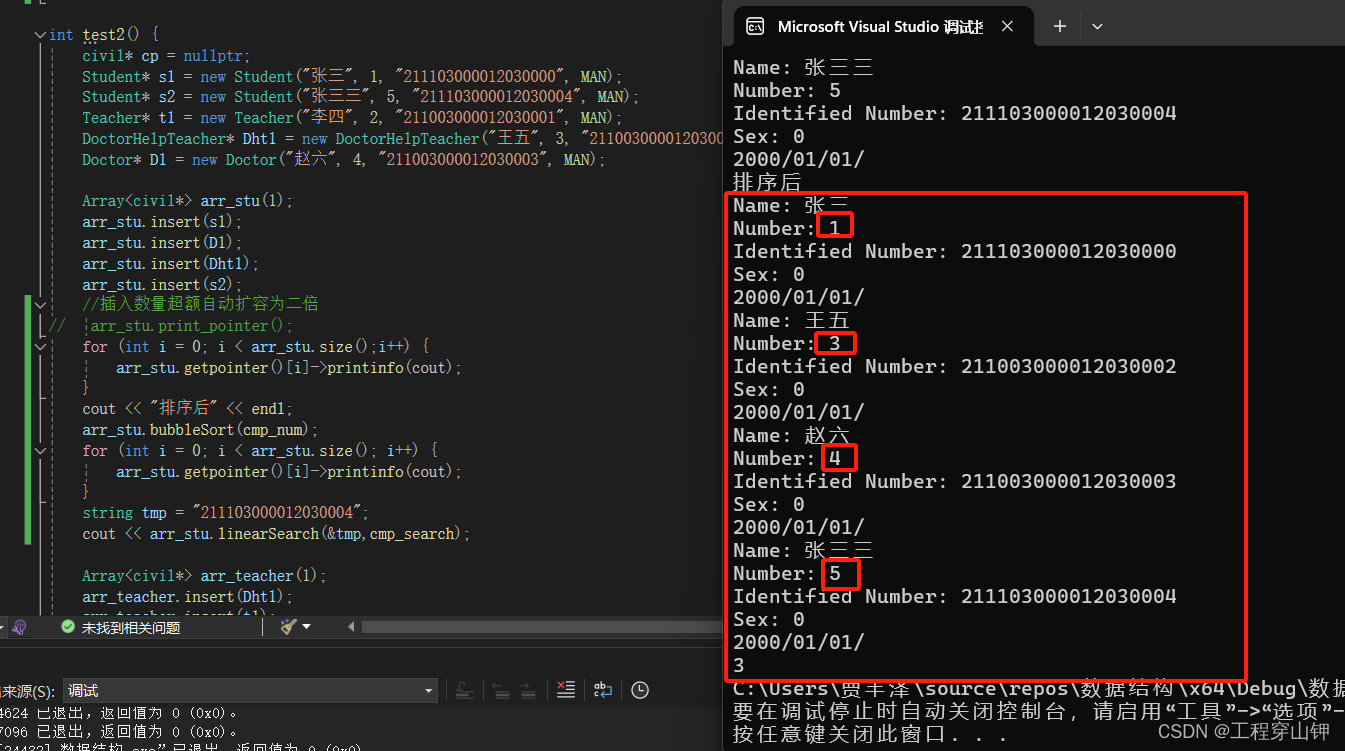 是按序号顺序,说明排序没问题。
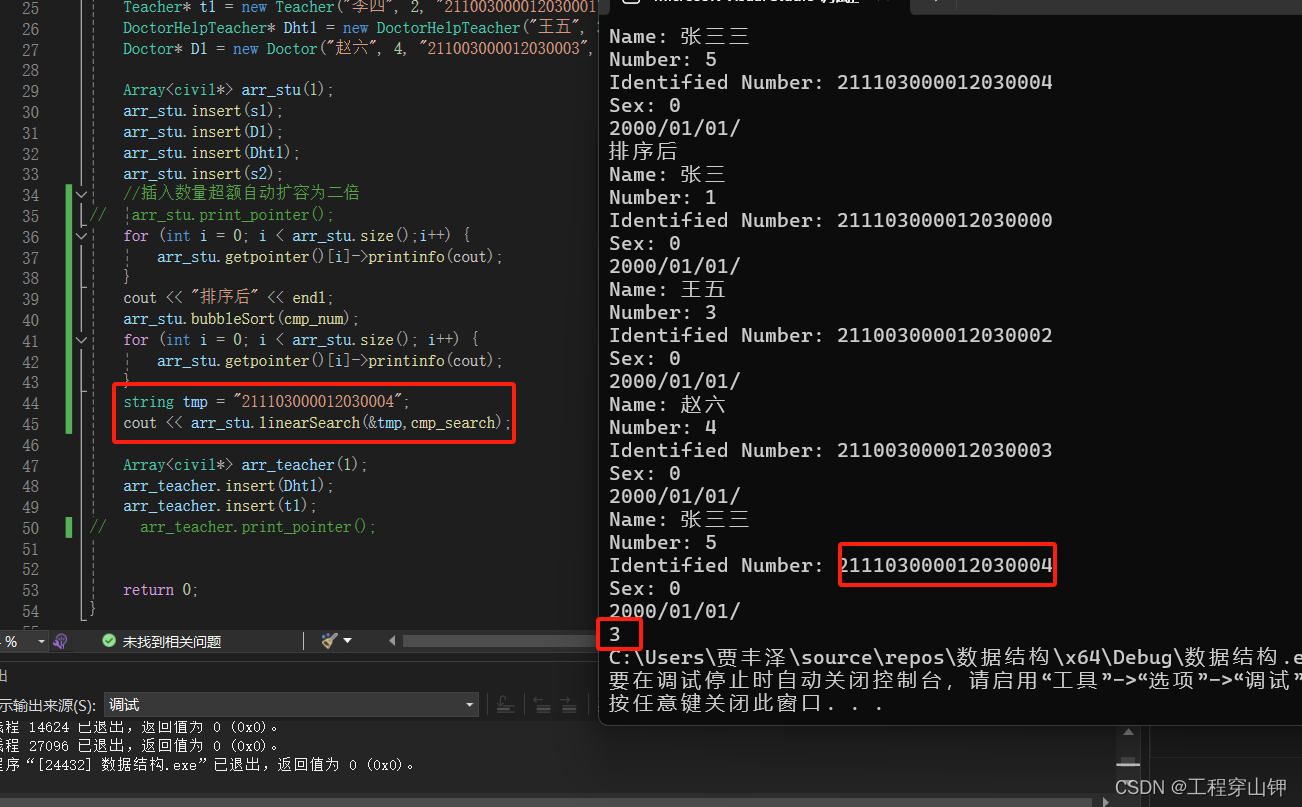 打印出了查找到的学生的下标,说明查找没错
这种回调函数使用方法可以查找相关博客





 扫一扫
扫一扫


 3012
3012

 被折叠的 条评论
为什么被折叠?
被折叠的 条评论
为什么被折叠?
 到【灌水乐园】发言





