/**************************************************************************//**
* @file core_cmInstr.h
* @brief CMSIS Cortex-M Core Instruction Access Header File
* @version V4.10
* @date 18. March 2015
*
* @note
*
******************************************************************************/
/* Copyright (c) 2009 - 2014 ARM LIMITED
All rights reserved.
Redistribution and use in source and binary forms, with or without
modification, are permitted provided that the following conditions are met:
- Redistributions of source code must retain the above copyright
notice, this list of conditions and the following disclaimer.
- Redistributions in binary form must reproduce the above copyright
notice, this list of conditions and the following disclaimer in the
documentation and/or other materials provided with the distribution.
- Neither the name of ARM nor the names of its contributors may be used
to endorse or promote products derived from this software without
specific prior written permission.
*
THIS SOFTWARE IS PROVIDED BY THE COPYRIGHT HOLDERS AND CONTRIBUTORS "AS IS"
AND ANY EXPRESS OR IMPLIED WARRANTIES, INCLUDING, BUT NOT LIMITED TO, THE
IMPLIED WARRANTIES OF MERCHANTABILITY AND FITNESS FOR A PARTICULAR PURPOSE
ARE DISCLAIMED. IN NO EVENT SHALL COPYRIGHT HOLDERS AND CONTRIBUTORS BE
LIABLE FOR ANY DIRECT, INDIRECT, INCIDENTAL, SPECIAL, EXEMPLARY, OR
CONSEQUENTIAL DAMAGES (INCLUDING, BUT NOT LIMITED TO, PROCUREMENT OF
SUBSTITUTE GOODS OR SERVICES; LOSS OF USE, DATA, OR PROFITS; OR BUSINESS
INTERRUPTION) HOWEVER CAUSED AND ON ANY THEORY OF LIABILITY, WHETHER IN
CONTRACT, STRICT LIABILITY, OR TORT (INCLUDING NEGLIGENCE OR OTHERWISE)
ARISING IN ANY WAY OUT OF THE USE OF THIS SOFTWARE, EVEN IF ADVISED OF THE
POSSIBILITY OF SUCH DAMAGE.
---------------------------------------------------------------------------*/
#ifndef __CORE_CMINSTR_H
#define __CORE_CMINSTR_H
/* ########################## Core Instruction Access ######################### */
/** \defgroup CMSIS_Core_InstructionInterface CMSIS Core Instruction Interface
Access to dedicated instructions
@{
*/
#if defined ( __CC_ARM ) /*------------------RealView Compiler -----------------*/
/* ARM armcc specific functions */
#if (__ARMCC_VERSION < 400677)
#error "Please use ARM Compiler Toolchain V4.0.677 or later!"
#endif
/** \brief No Operation
No Operation does nothing. This instruction can be used for code alignment purposes.
*/
#define __NOP __nop
/** \brief Wait For Interrupt
Wait For Interrupt is a hint instruction that suspends execution
until one of a number of events occurs.
*/
#define __WFI __wfi
/** \brief Wait For Event
Wait For Event is a hint instruction that permits the processor to enter
a low-power state until one of a number of events occurs.
*/
#define __WFE __wfe
/** \brief Send Event
Send Event is a hint instruction. It causes an event to be signaled to the CPU.
*/
#define __SEV __sev
/** \brief Instruction Synchronization Barrier
Instruction Synchronization Barrier flushes the pipeline in the processor,
so that all instructions following the ISB are fetched from cache or
memory, after the instruction has been completed.
*/
#define __ISB() do {\
__schedule_barrier();\
__isb(0xF);\
__schedule_barrier();\
} while (0)
/** \brief Data Synchronization Barrier
This function acts as a special kind of Data Memory Barrier.
It completes when all explicit memory accesses before this instruction complete.
*/
#define __DSB() do {\
__schedule_barrier();\
__dsb(0xF);\
__schedule_barrier();\
} while (0)
/** \brief Data Memory Barrier
This function ensures the apparent order of the explicit memory operations before
and after the instruction, without ensuring their completion.
*/
#define __DMB() do {\
__schedule_barrier();\
__dmb(0xF);\
__schedule_barrier();\
} while (0)
/** \brief Reverse byte order (32 bit)
This function reverses the byte order in integer value.
\param [in] value Value to reverse
\return Reversed value
*/
#define __REV __rev
/** \brief Reverse byte order (16 bit)
This function reverses the byte order in two unsigned short values.
\param [in] value Value to reverse
\return Reversed value
*/
#ifndef __NO_EMBEDDED_ASM
__attribute__((section(".rev16_text"))) __STATIC_INLINE __ASM uint32_t __REV16(uint32_t value)
{
rev16 r0, r0
bx lr
}
#endif
/** \brief Reverse byte order in signed short value
This function reverses the byte order in a signed short value with sign extension to integer.
\param [in] value Value to reverse
\return Reversed value
*/
#ifndef __NO_EMBEDDED_ASM
__attribute__((section(".revsh_text"))) __STATIC_INLINE __ASM int32_t __REVSH(int32_t value)
{
revsh r0, r0
bx lr
}
#endif
/** \brief Rotate Right in unsigned value (32 bit)
This function Rotate Right (immediate) provides the value of the contents of a register rotated by a variable number of bits.
\param [in] value Value to rotate
\param [in] value Number of Bits to rotate
\return Rotated value
*/
#define __ROR __ror
/** \brief Breakpoint
This function causes the processor to enter Debug state.
Debug tools can use this to investigate system state when the instruction at a particular address is reached.
\param [in] value is ignored by the processor.
If required, a debugger can use it to store additional information about the breakpoint.
*/
#define __BKPT(value) __breakpoint(value)
/** \brief Reverse bit order of value
This function reverses the bit order of the given value.
\param [in] value Value to reverse
\return Reversed value
*/
#if (__CORTEX_M >= 0x03) || (__CORTEX_SC >= 300)
#define __RBIT __rbit
#else
__attribute__((always_inline)) __STATIC_INLINE uint32_t __RBIT(uint32_t value)
{
uint32_t result;
int32_t s = 4 /*sizeof(v)*/ * 8 - 1; // extra shift needed at end
result = value; // r will be reversed bits of v; first get LSB of v
for (value >>= 1; value; value >>= 1)
{
result <<= 1;
result |= value & 1;
s--;
}
result <<= s; // shift when v's highest bits are zero
return(result);
}
#endif
/** \brief Count leading zeros
This function counts the number of leading zeros of a data value.
\param [in] value Value to count the leading zeros
\return number of leading zeros in value
*/
#define __CLZ __clz
#if (__CORTEX_M >= 0x03) || (__CORTEX_SC >= 300)
/** \brief LDR Exclusive (8 bit)
This function executes a exclusive LDR instruction for 8 bit value.
\param [in] ptr Pointer to data
\return value of type uint8_t at (*ptr)
*/
#define __LDREXB(ptr) ((uint8_t ) __ldrex(ptr))
/** \brief LDR Exclusive (16 bit)
This function executes a exclusive LDR instruction for 16 bit values.
\param [in] ptr Pointer to data
\return value of type uint16_t at (*ptr)
*/
#define __LDREXH(ptr) ((uint16_t) __ldrex(ptr))
/** \brief LDR Exclusive (32 bit)
This function executes a exclusive LDR instruction for 32 bit values.
\param [in] ptr Pointer to data
\return value of type uint32_t at (*ptr)
*/
#define __LDREXW(ptr) ((uint32_t ) __ldrex(ptr))
/** \brief STR Exclusive (8 bit)
This function executes a exclusive STR instruction for 8 bit values.
\param [in] value Value to store
\param [in] ptr Pointer to location
\return 0 Function succeeded
\return 1 Function failed
*/
#define __STREXB(value, ptr) __strex(value, ptr)
/** \brief STR Exclusive (16 bit)
This function executes a exclusive STR instruction for 16 bit values.
\param [in] value Value to store
\param [in] ptr Pointer to location
\return 0 Function succeeded
\return 1 Function failed
*/
#define __STREXH(value, ptr) __strex(value, ptr)
/** \brief STR Exclusive (32 bit)
This function executes a exclusive STR instruction for 32 bit values.
\param [in] value Value to store
\param [in] ptr Pointer to location
\return 0 Function succeeded
\return 1 Function failed
*/
#define __STREXW(value, ptr) __strex(value, ptr)
/** \brief Remove the exclusive lock
This function removes the exclusive lock which is created by LDREX.
*/
#define __CLREX __clrex
/** \brief Signed Saturate
This function saturates a signed value.
\param [in] value Value to be saturated
\param [in] sat Bit position to saturate to (1..32)
\return Saturated value
*/
#define __SSAT __ssat
/** \brief Unsigned Saturate
This function saturates an unsigned value.
\param [in] value Value to be saturated
\param [in] sat Bit position to saturate to (0..31)
\return Saturated value
*/
#define __USAT __usat
/** \brief Rotate Right with Extend (32 bit)
This function moves each bit of a bitstring right by one bit.
The carry input is shifted in at the left end of the bitstring.
\param [in] value Value to rotate
\return Rotated value
*/
#ifndef __NO_EMBEDDED_ASM
__attribute__((section(".rrx_text"))) __STATIC_INLINE __ASM uint32_t __RRX(uint32_t value)
{
rrx r0, r0
bx lr
}
#endif
/** \brief LDRT Unprivileged (8 bit)
This function executes a Unprivileged LDRT instruction for 8 bit value.
\param [in] ptr Pointer to data
\return value of type uint8_t at (*ptr)
*/
#define __LDRBT(ptr) ((uint8_t ) __ldrt(ptr))
/** \brief LDRT Unprivileged (16 bit)
This function executes a Unprivileged LDRT instruction for 16 bit values.
\param [in] ptr Pointer to data
\return value of type uint16_t at (*ptr)
*/
#define __LDRHT(ptr) ((uint16_t) __ldrt(ptr))
/** \brief LDRT Unprivileged (32 bit)
This function executes a Unprivileged LDRT instruction for 32 bit values.
\param [in] ptr Pointer to data
\return value of type uint32_t at (*ptr)
*/
#define __LDRT(ptr) ((uint32_t ) __ldrt(ptr))
/** \brief STRT Unprivileged (8 bit)
This function executes a Unprivileged STRT instruction for 8 bit values.
\param [in] value Value to store
\param [in] ptr Pointer to location
*/
#define __STRBT(value, ptr) __strt(value, ptr)
/** \brief STRT Unprivileged (16 bit)
This function executes a Unprivileged STRT instruction for 16 bit values.
\param [in] value Value to store
\param [in] ptr Pointer to location
*/
#define __STRHT(value, ptr) __strt(value, ptr)
/** \brief STRT Unprivileged (32 bit)
This function executes a Unprivileged STRT instruction for 32 bit values.
\param [in] value Value to store
\param [in] ptr Pointer to location
*/
#define __STRT(value, ptr) __strt(value, ptr)
#endif /* (__CORTEX_M >= 0x03) || (__CORTEX_SC >= 300) */
#elif defined ( __GNUC__ ) /*------------------ GNU Compiler ---------------------*/
/* GNU gcc specific functions */
/* Define macros for porting to both thumb1 and thumb2.
* For thumb1, use low register (r0-r7), specified by constrant "l"
* Otherwise, use general registers, specified by constrant "r" */
#if defined (__thumb__) && !defined (__thumb2__)
#define __CMSIS_GCC_OUT_REG(r) "=l" (r)
#define __CMSIS_GCC_USE_REG(r) "l" (r)
#else
#define __CMSIS_GCC_OUT_REG(r) "=r" (r)
#define __CMSIS_GCC_USE_REG(r) "r" (r)
#endif
/** \brief No Operation
No Operation does nothing. This instruction can be used for code alignment purposes.
*/
__attribute__((always_inline)) __STATIC_INLINE void __NOP(void)
{
__ASM volatile ("nop");
}
/** \brief Wait For Interrupt
Wait For Interrupt is a hint instruction that suspends execution
until one of a number of events occurs.
*/
__attribute__((always_inline)) __STATIC_INLINE void __WFI(void)
{
__ASM volatile ("wfi");
}
/** \brief Wait For Event
Wait For Event is a hint instruction that permits the processor to enter
a low-power state until one of a number of events occurs.
*/
__attribute__((always_inline)) __STATIC_INLINE void __WFE(void)
{
__ASM volatile ("wfe");
}
/** \brief Send Event
Send Event is a hint instruction. It causes an event to be signaled to the CPU.
*/
__attribute__((always_inline)) __STATIC_INLINE void __SEV(void)
{
__ASM volatile ("sev");
}
/** \brief Instruction Synchronization Barrier
Instruction Synchronization Barrier flushes the pipeline in the processor,
so that all instructions following the ISB are fetched from cache or
memory, after the instruction has been completed.
*/
__attribute__((always_inline)) __STATIC_INLINE void __ISB(void)
{
__ASM volatile ("isb 0xF":::"memory");
}
/** \brief Data Synchronization Barrier
This function acts as a special kind of Data Memory Barrier.
It completes when all explicit memory accesses before this instruction complete.
*/
__attribute__((always_inline)) __STATIC_INLINE void __DSB(void)
{
__ASM volatile ("dsb 0xF":::"memory");
}
/** \brief Data Memory Barrier
This function ensures the apparent order of the explicit memory operations before
and after the instruction, without ensuring their completion.
*/
__attribute__((always_inline)) __STATIC_INLINE void __DMB(void)
{
__ASM volatile ("dmb 0xF":::"memory");
}
/** \brief Reverse byte order (32 bit)
This function reverses the byte order in integer value.
\param [in] value Value to reverse
\return Reversed value
*/
__attribute__((always_inline)) __STATIC_INLINE uint32_t __REV(uint32_t value)
{
#if (__GNUC__ > 4) || (__GNUC__ == 4 && __GNUC_MINOR__ >= 5)
return __builtin_bswap32(value);
#else
uint32_t result;
__ASM volatile ("rev %0, %1" : __CMSIS_GCC_OUT_REG (result) : __CMSIS_GCC_USE_REG (value) );
return(result);
#endif
}
/** \brief Reverse byte order (16 bit)
This function reverses the byte order in two unsigned short values.
\param [in] value Value to reverse
\return Reversed value
*/
__attribute__((always_inline)) __STATIC_INLINE uint32_t __REV16(uint32_t value)
{
uint32_t result;
__ASM volatile ("rev16 %0, %1" : __CMSIS_GCC_OUT_REG (result) : __CMSIS_GCC_USE_REG (value) );
return(result);
}
/** \brief Reverse byte order in signed short value
This function reverses the byte order in a signed short value with sign extension to integer.
\param [in] value Value to reverse
\return Reversed value
*/
__attribute__((always_inline)) __STATIC_INLINE int32_t __REVSH(int32_t value)
{
#if (__GNUC__ > 4) || (__GNUC__ == 4 && __GNUC_MINOR__ >= 8)
return (short)__builtin_bswap16(value);
#else
uint32_t result;
__ASM volatile ("revsh %0, %1" : __CMSIS_GCC_OUT_REG (result) : __CMSIS_GCC_USE_REG (value) );
return(result);
#endif
}
/** \brief Rotate Right in unsigned value (32 bit)
This function Rotate Right (immediate) provides the value of the contents of a register rotated by a variable number of bits.
\param [in] value Value to rotate
\param [in] value Number of Bits to rotate
\return Rotated value
*/
__attribute__((always_inline)) __STATIC_INLINE uint32_t __ROR(uint32_t op1, uint32_t op2)
{
return (op1 >> op2) | (op1 << (32 - op2));
}
/** \brief Breakpoint
This function causes the processor to enter Debug state.
Debug tools can use this to investigate system state when the instruction at a particular address is reached.
\param [in] value is ignored by the processor.
If required, a debugger can use it to store additional information about the breakpoint.
*/
#define __BKPT(value) __ASM volatile ("bkpt "#value)
/** \brief Reverse bit order of value
This function reverses the bit order of the given value.
\param [in] value Value to reverse
\return Reversed value
*/
__attribute__((always_inline)) __STATIC_INLINE uint32_t __RBIT(uint32_t value)
{
uint32_t result;
#if (__CORTEX_M >= 0x03) || (__CORTEX_SC >= 300)
__ASM volatile ("rbit %0, %1" : "=r" (result) : "r" (value) );
#else
int32_t s = 4 /*sizeof(v)*/ * 8 - 1; // extra shift needed at end
result = value; // r will be reversed bits of v; first get LSB of v
for (value >>= 1; value; value >>= 1)
{
result <<= 1;
result |= value & 1;
s--;
}
result <<= s; // shift when v's highest bits are zero
#endif
return(result);
}
/** \brief Count leading zeros
This function counts the number of leading zeros of a data value.
\param [in] value Value to count the leading zeros
\return number of leading zeros in value
*/
#define __CLZ __builtin_clz
#if (__CORTEX_M >= 0x03) || (__CORTEX_SC >= 300)
/** \brief LDR Exclusive (8 bit)
This function executes a exclusive LDR instruction for 8 bit value.
\param [in] ptr Pointer to data
\return value of type uint8_t at (*ptr)
*/
__attribute__((always_inline)) __STATIC_INLINE uint8_t __LDREXB(volatile uint8_t *addr)
{
uint32_t result;
#if (__GNUC__ > 4) || (__GNUC__ == 4 && __GNUC_MINOR__ >= 8)
__ASM volatile ("ldrexb %0, %1" : "=r" (result) : "Q" (*addr) );
#else
/* Prior to GCC 4.8, "Q" will be expanded to [rx, #0] which is not
accepted by assembler. So has to use following less efficient pattern.
*/
__ASM volatile ("ldrexb %0, [%1]" : "=r" (result) : "r" (addr) : "memory" );
#endif
return ((uint8_t) result); /* Add explicit type cast here */
}
/** \brief LDR Exclusive (16 bit)
This function executes a exclusive LDR instruction for 16 bit values.
\param [in] ptr Pointer to data
\return value of type uint16_t at (*ptr)
*/
__attribute__((always_inline)) __STATIC_INLINE uint16_t __LDREXH(volatile uint16_t *addr)
{
uint32_t result;
#if (__GNUC__ > 4) || (__GNUC__ == 4 && __GNUC_MINOR__ >= 8)
__ASM volatile ("ldrexh %0, %1" : "=r" (result) : "Q" (*addr) );
#else
/* Prior to GCC 4.8, "Q" will be expanded to [rx, #0] which is not
accepted by assembler. So has to use following less efficient pattern.
*/
__ASM volatile ("ldrexh %0, [%1]" : "=r" (result) : "r" (addr) : "memory" );
#endif
return ((uint16_t) result); /* Add explicit type cast here */
}
/** \brief LDR Exclusive (32 bit)
This function executes a exclusive LDR instruction for 32 bit values.
\param [in] ptr Pointer to data
\return value of type uint32_t at (*ptr)
*/
__attribute__((always_inline)) __STATIC_INLINE uint32_t __LDREXW(volatile uint32_t *addr)
{
uint32_t result;
__ASM volatile ("ldrex %0, %1" : "=r" (result) : "Q" (*addr) );
return(result);
}
/** \brief STR Exclusive (8 bit)
This function executes a exclusive STR instruction for 8 bit values.
\param [in] value Value to store
\param [in] ptr Pointer to location
\return 0 Function succeeded
\return 1 Function failed
*/
__attribute__((always_inline)) __STATIC_INLINE uint32_t __STREXB(uint8_t value, volatile uint8_t *addr)
{
uint32_t result;
__ASM volatile ("strexb %0, %2, %1" : "=&r" (result), "=Q" (*addr) : "r" ((uint32_t)value) );
return(result);
}
/** \brief STR Exclusive (16 bit)
This function executes a exclusive STR instruction for 16 bit values.
\param [in] value Value to store
\param [in] ptr Pointer to location
\return 0 Function succeeded
\return 1 Function failed
*/
__attribute__((always_inline)) __STATIC_INLINE uint32_t __STREXH(uint16_t value, volatile uint16_t *addr)
{
uint32_t result;
__ASM volatile ("strexh %0, %2, %1" : "=&r" (result), "=Q" (*addr) : "r" ((uint32_t)value) );
return(result);
}
/** \brief STR Exclusive (32 bit)
This function executes a exclusive STR instruction for 32 bit values.
\param [in] value Value to store
\param [in] ptr Pointer to location
\return 0 Function succeeded
\return 1 Function failed
*/
__attribute__((always_inline)) __STATIC_INLINE uint32_t __STREXW(uint32_t value, volatile uint32_t *addr)
{
uint32_t result;
__ASM volatile ("strex %0, %2, %1" : "=&r" (result), "=Q" (*addr) : "r" (value) );
return(result);
}
/** \brief Remove the exclusive lock
This function removes the exclusive lock which is created by LDREX.
*/
__attribute__((always_inline)) __STATIC_INLINE void __CLREX(void)
{
__ASM volatile ("clrex" ::: "memory");
}
/** \brief Signed Saturate
This function saturates a signed value.
\param [in] value Value to be saturated
\param [in] sat Bit position to saturate to (1..32)
\return Saturated value
*/
#define __SSAT(ARG1,ARG2) \
({ \
uint32_t __RES, __ARG1 = (ARG1); \
__ASM ("ssat %0, %1, %2" : "=r" (__RES) : "I" (ARG2), "r" (__ARG1) ); \
__RES; \
})
/** \brief Unsigned Saturate
This function saturates an unsigned value.
\param [in] value Value to be saturated
\param [in] sat Bit position to saturate to (0..31)
\return Saturated value
*/
#define __USAT(ARG1,ARG2) \
({ \
uint32_t __RES, __ARG1 = (ARG1); \
__ASM ("usat %0, %1, %2" : "=r" (__RES) : "I" (ARG2), "r" (__ARG1) ); \
__RES; \
})
/** \brief Rotate Right with Extend (32 bit)
This function moves each bit of a bitstring right by one bit.
The carry input is shifted in at the left end of the bitstring.
\param [in] value Value to rotate
\return Rotated value
*/
__attribute__((always_inline)) __STATIC_INLINE uint32_t __RRX(uint32_t value)
{
uint32_t result;
__ASM volatile ("rrx %0, %1" : __CMSIS_GCC_OUT_REG (result) : __CMSIS_GCC_USE_REG (value) );
return(result);
}
/** \brief LDRT Unprivileged (8 bit)
This function executes a Unprivileged LDRT instruction for 8 bit value.
\param [in] ptr Pointer to data
\return value of type uint8_t at (*ptr)
*/
__attribute__((always_inline)) __STATIC_INLINE uint8_t __LDRBT(volatile uint8_t *addr)
{
uint32_t result;
#if (__GNUC__ > 4) || (__GNUC__ == 4 && __GNUC_MINOR__ >= 8)
__ASM volatile ("ldrbt %0, %1" : "=r" (result) : "Q" (*addr) );
#else
/* Prior to GCC 4.8, "Q" will be expanded to [rx, #0] which is not
accepted by assembler. So has to use following less efficient pattern.
*/
__ASM volatile ("ldrbt %0, [%1]" : "=r" (result) : "r" (addr) : "memory" );
#endif
return ((uint8_t) result); /* Add explicit type cast here */
}
/** \brief LDRT Unprivileged (16 bit)
This function executes a Unprivileged LDRT instruction for 16 bit values.
\param [in] ptr Pointer to data
\return value of type uint16_t at (*ptr)
*/
__attribute__((always_inline)) __STATIC_INLINE uint16_t __LDRHT(volatile uint16_t *addr)
{
uint32_t result;
#if (__GNUC__ > 4) || (__GNUC__ == 4 && __GNUC_MINOR__ >= 8)
__ASM volatile ("ldrht %0, %1" : "=r" (result) : "Q" (*addr) );
#else
/* Prior to GCC 4.8, "Q" will be expanded to [rx, #0] which is not
accepted by assembler. So has to use following less efficient pattern.
*/
__ASM volatile ("ldrht %0, [%1]" : "=r" (result) : "r" (addr) : "memory" );
#endif
return ((uint16_t) result); /* Add explicit type cast here */
}
/** \brief LDRT Unprivileged (32 bit)
This function executes a Unprivileged LDRT instruction for 32 bit values.
\param [in] ptr Pointer to data
\return value of type uint32_t at (*ptr)
*/
__attribute__((always_inline)) __STATIC_INLINE uint32_t __LDRT(volatile uint32_t *addr)
{
uint32_t result;
__ASM volatile ("ldrt %0, %1" : "=r" (result) : "Q" (*addr) );
return(result);
}
/** \brief STRT Unprivileged (8 bit)
This function executes a Unprivileged STRT instruction for 8 bit values.
\param [in] value Value to store
\param [in] ptr Pointer to location
*/
__attribute__((always_inline)) __STATIC_INLINE void __STRBT(uint8_t value, volatile uint8_t *addr)
{
__ASM volatile ("strbt %1, %0" : "=Q" (*addr) : "r" ((uint32_t)value) );
}
/** \brief STRT Unprivileged (16 bit)
This function executes a Unprivileged STRT instruction for 16 bit values.
\param [in] value Value to store
\param [in] ptr Pointer to location
*/
__attribute__((always_inline)) __STATIC_INLINE void __STRHT(uint16_t value, volatile uint16_t *addr)
{
__ASM volatile ("strht %1, %0" : "=Q" (*addr) : "r" ((uint32_t)value) );
}
/** \brief STRT Unprivileged (32 bit)
This function executes a Unprivileged STRT instruction for 32 bit values.
\param [in] value Value to store
\param [in] ptr Pointer to location
*/
__attribute__((always_inline)) __STATIC_INLINE void __STRT(uint32_t value, volatile uint32_t *addr)
{
__ASM volatile ("strt %1, %0" : "=Q" (*addr) : "r" (value) );
}
#endif /* (__CORTEX_M >= 0x03) || (__CORTEX_SC >= 300) */
#elif defined ( __ICCARM__ ) /*------------------ ICC Compiler -------------------*/
/* IAR iccarm specific functions */
#include <cmsis_iar.h>
#elif defined ( __TMS470__ ) /*---------------- TI CCS Compiler ------------------*/
/* TI CCS specific functions */
#include <cmsis_ccs.h>
#elif defined ( __TASKING__ ) /*------------------ TASKING Compiler --------------*/
/* TASKING carm specific functions */
/*
* The CMSIS functions have been implemented as intrinsics in the compiler.
* Please use "carm -?i" to get an up to date list of all intrinsics,
* Including the CMSIS ones.
*/
#elif defined ( __CSMC__ ) /*------------------ COSMIC Compiler -------------------*/
/* Cosmic specific functions */
#include <cmsis_csm.h>
#endif
/*@}*/ /* end of group CMSIS_Core_InstructionInterface */
#endif /* __CORE_CMINSTR_H */
这段代码什么意思 可以修改吗
最新发布



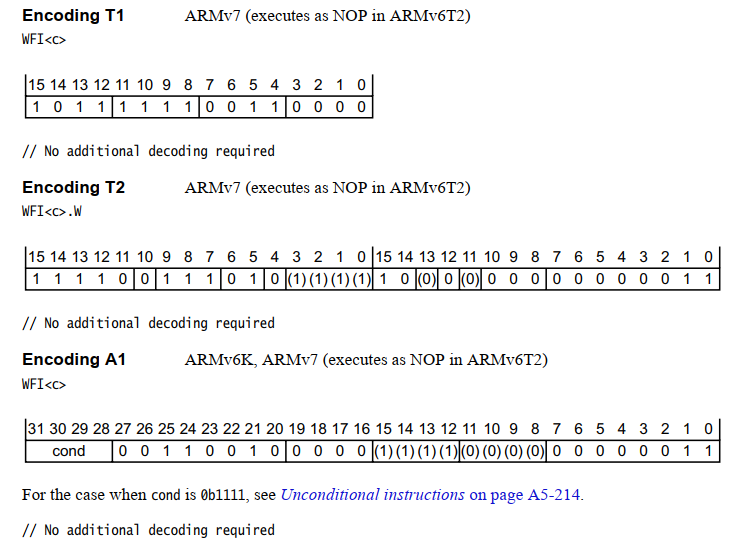
 本文详细解析ARM架构中的WFI指令,探讨其作为Hint指令的作用,如何让CPU进入standby模式等待中断,并介绍唤醒事件、使用注意事项及唤醒机制。





 扫一扫
扫一扫


 2231
2231


 到【灌水乐园】发言



