

leetcode l236. Lowest Common Ancestor of a Binary Tree

本文探讨了在给定二叉树中寻找两个节点的最低公共祖先(LCA)的问题,详细解析了算法原理,并提供了具体实现代码。通过实例演示了如何在不同情况下找到正确的LCA。

Given a binary tree, find the lowest common ancestor (LCA) of two given nodes in the tree.

According to the definition of LCA on Wikipedia: “The lowest common ancestor is defined between two nodes p and q as the lowest node in T that has both p and q as descendants (where we allow a node to be a descendant of itself).”

Given the following binary tree: root = [3,5,1,6,2,0,8,null,null,7,4]
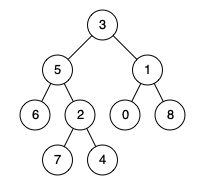
在这里插入图片描述

Example 1:

Input: root = [3,5,1,6,2,0,8,null,null,7,4], p = 5, q = 1 Output: 3
Explanation: The LCA of nodes 5 and 1 is 3. Example 2:

Input: root = [3,5,1,6,2,0,8,null,null,7,4], p = 5, q = 4 Output: 5
Explanation: The LCA of nodes 5 and 4 is 5, since a node can be a descendant of itself according to the LCA definition.

/**
 * Definition for a binary tree node.
 * struct TreeNode {
 *     int val;
 *     TreeNode *left;
 *     TreeNode *right;
 *     TreeNode(int x) : val(x), left(NULL), right(NULL) {}
 * };
 */
class Solution {
public:
    TreeNode* lowestCommonAncestor(TreeNode* root, TreeNode* p, TreeNode* q) {
        if(hasNode(root -> left, p) && hasNode(root -> left, q)){
            return lowestCommonAncestor(root -> left, p, q);
        }
        if(hasNode(root -> right, p) && hasNode(root -> right, q)){
            return lowestCommonAncestor(root -> right, p, q);
        }
        return root;
    }
    bool hasNode(TreeNode* root, TreeNode *p){
        if(root == NULL){
            return false;
        }
        if(root == p){
            return true;
        }
        return hasNode(root -> left, p) || hasNode(root -> right, p);
    }
};
跟网型逆变器小干扰稳定性分析与控制策略优化研究(Simulink仿真实现)内容概要:本文围绕跟网型逆变器的小干扰稳定性展开分析,重点研究其在电力系统中的动态响应特性及控制策略优化问题。通过构建基于Simulink的仿真模型,对逆变器在不同工况下的小信号稳定性进行建模与分析,识别系统可能存在的振荡风险,并提出相应的控制优化方法以提升系统稳定性和动态性能。研究内容涵盖数学建模、稳定性判据分析、控制器设计与参数优化,并结合仿真验证所提策略的有效性,为新能源并网系统的稳定运行提供理论支持和技术参考。; 适合人群:具备电力电子、自动控制或电力系统相关背景,熟悉Matlab/Simulink仿真工具,从事新能源并网、微电网或电力系统稳定性研究的研究生、科研人员及工程技术人员。; 使用场景及目标:① 分析跟网型逆变器在弱电网条件下的小干扰稳定性问题;② 设计并优化逆变器外环与内环控制器以提升系统阻尼特性;③ 利用Simulink搭建仿真模型验证理论分析与控制策略的有效性;④ 支持科研论文撰写、课题研究或工程项目中的稳定性评估与改进。; 阅读建议:建议读者结合文中提供的Simulink仿真模型,深入理解状态空间建模、特征值分析及控制器设计过程,重点关注控制参数变化对系统极点分布的影响,并通过动手仿真加深对小干扰稳定性机理的认识。
1. Two Sum 2. Add Two Numbers 3. Longest Substring Without Repeating Characters 4. Median of Two Sorted Arrays 5. Longest Palindromic Substring 6. ZigZag Conversion 7. Reverse Integer 8. String to Integer (atoi) 9. Palindrome Number 10. Regular Expression Matching 11. Container With Most Water 12. Integer to Roman 13. Roman to Integer 14. Longest Common Prefix 15. 3Sum 16. 3Sum Closest 17. Letter Combinations of a Phone Number 18. 4Sum 19. Remove Nth Node From End of List 20. Valid Parentheses 21. Merge Two Sorted Lists 22. Generate Parentheses 23. Swap Nodes in Pairs 24. Reverse Nodes in k-Group 25. Remove Duplicates from Sorted Array 26. Remove Element 27. Implement strStr() 28. Divide Two Integers 29. Substring with Concatenation of All Words 30. Next Permutation 31. Longest Valid Parentheses 32. Search in Rotated Sorted Array 33. Search for a Range 34. Find First and Last Position of Element in Sorted Array 35. Valid Sudoku 36. Sudoku Solver 37. Count and Say 38. Combination Sum 39. Combination Sum II 40. First Missing Positive 41. Trapping Rain Water 42. Jump Game 43. Merge Intervals 44. Insert Interval 45. Unique Paths 46. Minimum Path Sum 47. Climbing Stairs 48. Permutations 49. Permutations II 50. Rotate Image 51. Group Anagrams 52. Pow(x, n) 53. Maximum Subarray 54. Spiral Matrix 55. Jump Game II 56. Merge k Sorted Lists 57. Insertion Sort List 58. Sort List 59. Largest Rectangle in Histogram 60. Valid Number 61. Word Search 62. Minimum Window Substring 63. Unique Binary Search Trees 64. Unique Binary Search Trees II 65. Interleaving String 66. Maximum Product Subarray 67. Binary Tree Inorder Traversal 68. Binary Tree Preorder Traversal 69. Binary Tree Postorder Traversal 70. Flatten Binary Tree to Linked List 71. Construct Binary Tree from Preorder and Inorder Traversal 72. Construct Binary Tree from Inorder and Postorder Traversal 73. Binary Tree Level Order Traversal 74. Binary Tree Zigzag Level Order Traversal 75. Convert Sorted Array to Binary Search Tree 76. Convert Sorted List to Binary Search Tree 77. Recover Binary Search Tree 78. Sum Root to Leaf Numbers 79. Path Sum 80. Path Sum II 81. Binary Tree Maximum Path Sum 82. Populating Next Right Pointers in Each Node 83. Populating Next Right Pointers in Each Node II 84. Reverse Linked List 85. Reverse Linked List II 86. Partition List 87. Rotate List 88. Remove Duplicates from Sorted List 89. Remove Duplicates from Sorted List II 90. Intersection of Two Linked Lists 91. Linked List Cycle 92. Linked List Cycle II 93. Reorder List 94. Binary Tree Upside Down 95. Binary Tree Right Side View 96. Palindrome Linked List 97. Convert Binary Search Tree to Sorted Doubly Linked List 98. Lowest Common Ancestor of a Binary Tree 99. Lowest Common Ancestor of a Binary Search Tree 100. Binary Tree Level Order Traversal II
评论
成就一亿技术人!
拼手气红包6.0元
还能输入1000个字符
 
红包 添加红包
表情包 插入表情
 条评论被折叠 查看
添加红包

请填写红包祝福语或标题

红包个数最小为10个

红包金额最低5元

当前余额3.43前往充值 >
需支付:10.00
成就一亿技术人!
领取后你会自动成为博主和红包主的粉丝 规则
hope_wisdom
发出的红包
实付
使用余额支付
点击重新获取
扫码支付
钱包余额 0

抵扣说明:

1.余额是钱包充值的虚拟货币,按照1:1的比例进行支付金额的抵扣。
2.余额无法直接购买下载,可以购买VIP、付费专栏及课程。

余额充值


