



文章目录
推荐阅读:
【01】Netty从0到1系列之I/O模型
【02】Netty从0到1系列之NIO
【03】Netty从0到1系列之Selector
【04】Netty从0到1系列之Channel
【05】Netty从0到1系列之Buffer(上)
【06】Netty从0到1系列之Buffer(下)
【07】Netty从0到1系列之零拷贝技术
【08】Netty从0到1系列之整体架构、入门程序
【09】Netty从0到1系列之EventLoop
【10】Netty从0到1系列之EventLoopGroup
【11】Netty从0到1系列之Future
【12】Netty从0到1系列之Promise
【13】Netty从0到1系列之Netty Channel
【14】Netty从0到1系列之ChannelFuture
【15】Netty从0到1系列之CloseFuture
【16】Netty从0到1系列之Netty Handler
【17】Netty从0到1系列之Netty Pipeline【上】
一、Netty Pipeline:责任链模式的核心实现【下】
1.6 Pipeline的底层实现原理
1.6.1 Pipeline 的双向链表结构
Pipeline 内部使用双向链表来管理所有的 ChannelHandler,每个 Handler 都被包装在 ChannelHandlerContext 中:
// Netty简化的 Pipeline 实现原理
public class DefaultChannelPipeline implements ChannelPipeline {
    // 头尾虚拟节点(内部类实例)
    final AbstractChannelHandlerContext head;
    final AbstractChannelHandlerContext tail;

    private final Channel channel;

    public DefaultChannelPipeline(Channel channel) {
        this.channel = channel;

        // 创建头尾虚拟节点
        tail = new TailContext(this);
        head = new HeadContext(this);

        // 构建双向链表
        head.next = tail;
        tail.prev = head;
    }

    // 添加处理器到链表尾部
    @Override
    public ChannelPipeline addLast(String name, ChannelHandler handler) {
        // 创建新的上下文节点
        AbstractChannelHandlerContext newCtx = new DefaultChannelHandlerContext(this, name, handler);

        // 添加到链表尾部(tail之前)
        synchronized (this) {
            AbstractChannelHandlerContext prev = tail.prev;
            newCtx.prev = prev;
            newCtx.next = tail;
            prev.next = newCtx;
            tail.prev = newCtx;
        }

        // 调用handlerAdded回调
        callHandlerAdded0(newCtx);
        return this;
    }

    // 事件传播机制
    @Override
    public ChannelPipeline fireChannelRead(Object msg) {
        // 从头节点开始传播事件
        AbstractChannelHandlerContext.invokeChannelRead(head, msg);
        return this;
    }
}

// Handler 上下文实现
class DefaultChannelHandlerContext extends AbstractChannelHandlerContext {
    private final ChannelHandler handler;
    volatile DefaultChannelHandlerContext next;
    volatile DefaultChannelHandlerContext prev;

    // 调用具体Handler的方法
    private void invokeChannelRead(Object msg) {
        try {
            ((ChannelInboundHandler) handler).channelRead(this, msg);
        } catch (Throwable t) {
            notifyHandlerException(t);
        }
    }

    // 传播事件到下一个Handler
    @Override
    public ChannelHandlerContext fireChannelRead(Object msg) {
        // 找到下一个入站处理器
        DefaultChannelHandlerContext next = findContextInbound();
        next.invokeChannelRead(msg);
        return this;
    }
}
addLast():将Handler包装成Context,插入链表尾部remove():从链表中移除Context- HeadContext:链表头,既是 Inbound 处理器也是 Outbound 处理器
- TailContext:链表尾,默认实现了一些基本的异常处理
- ChannelHandlerContext:处理器上下文,维护了处理器之间的关联关系,提供了事件传播方法
1.6.2 入站和出站的事件传播机制
Pipeline 中的事件传播遵循严格的规则:
-
入站事件 (Inbound)
- 从 Head 向 Tail 方向传播
- 常见事件:channelActive、channelRead、channelReadComplete 等
-
出站事件 (Outbound)
- 从 Tail 向 Head 方向传播
- 常见事件:bind、connect、write、flush 等
// HeadContext - 入站起点和出站终点
final class HeadContext extends AbstractChannelHandlerContext
        implements ChannelOutboundHandler, ChannelInboundHandler {

    private final Unsafe unsafe;

    // 入站事件:从head开始向后传播
    @Override
    public void channelRead(ChannelHandlerContext ctx, Object msg) {
        ctx.fireChannelRead(msg); // 传递给下一个处理器
    }

    // 出站事件:最终由head处理
    @Override
    public void write(ChannelHandlerContext ctx, Object msg, ChannelPromise promise) {
        // 真正执行写入操作
        unsafe.write(msg, promise);
    }
}

// TailContext - 入站终点和出站起点
final class TailContext extends AbstractChannelHandlerContext
        implements ChannelInboundHandler {

    // 入站事件终点:处理未消费的消息
    @Override
    public void channelRead(ChannelHandlerContext ctx, Object msg) {
        try {
            // 记录未处理的消息
            logger.debug("Discarded inbound message: {}", msg);
        } finally {
            // 释放资源
            ReferenceCountUtil.release(msg);
        }
    }

    // 出站事件:从tail开始向前传播
    @Override
    public void write(ChannelHandlerContext ctx, Object msg, ChannelPromise promise) {
        // 向前传播write事件
        ctx.write(msg, promise);
    }
}
🌟 性能关键:
- 所有事件在
EventLoop线程串行执行,避免锁竞争- 事件传播是方法调用,无线程切换开销
入站事件、出站事件核心代码逻辑【简化版本】:
// 入站事件传播
private AbstractChannelHandlerContext findContextInbound() {
    AbstractChannelHandlerContext ctx = this;
    do {
        ctx = ctx.next;
    } while (!ctx.inbound);
    return ctx;
}

// 出站事件传播
private AbstractChannelHandlerContext findContextOutbound() {
    AbstractChannelHandlerContext ctx = this;
    do {
        ctx = ctx.prev;
    } while (!ctx.outbound);
    return ctx;
}
当调用ctx.fireChannelRead(msg)时,Netty 会找到下一个入站处理器并调用其channelRead方法。
1.6.3 内存管理与资源释放
- TailHandler的 channelRead方法自动调用 ReferenceCountUtil.release(msg)
- SimpleChannelInboundHandler 在
channelRead0执行后自动释放 - 最佳实践:优先使用
SimpleChannelInboundHandler
1.7 实践经验与最佳实践
1.7.1 实践经验与最佳实践
1. 处理器顺序安排最佳实践
// 1. 处理器顺序安排最佳实践
public static void setupOptimalPipeline(ChannelPipeline pipeline) {
    // 顺序很重要!按照处理阶段的逻辑顺序安排

    // 第一阶段:协议解析(最前面)
    pipeline.addLast("frameDecoder", new CustomFrameDecoder());
    pipeline.addLast("protocolDecoder", new CustomProtocolDecoder());

    // 第二阶段:安全处理
    pipeline.addLast("sslHandler", new SslHandler());
    pipeline.addLast("authHandler", new AuthenticationHandler());

    // 第三阶段:业务处理
    pipeline.addLast("throttlingHandler", new ThrottlingHandler());
    pipeline.addLast("businessLogic", new BusinessLogicHandler());

    // 第四阶段:统计监控(业务处理后)
    pipeline.addLast("metricsHandler", new MetricsHandler());
    pipeline.addLast("loggingHandler", new AuditLogHandler());

    // 第五阶段:异常处理(最后面)
    pipeline.addLast("exceptionHandler", new GlobalExceptionHandler());
}
2. 资源管理最佳实践
// 2. 资源管理最佳实践
@ChannelHandler.Sharable
public static class ResourceAwareHandler extends ChannelInboundHandlerAdapter {
        @Override
        public void channelRead(ChannelHandlerContext ctx, Object msg) throws Exception {
            try {
                if (msg instanceof ByteBuf) {
                    ByteBuf buf = (ByteBuf) msg;
                    try {
                        processMessage(buf);
                    } finally {
                        // 确保释放资源
                        if (buf.refCnt() > 0) {
                            buf.release();
                        }
                    }
                } else {
                    processMessage(msg);
                }
            } catch (Exception e) {
                // 异常处理
                ctx.fireExceptionCaught(e);
            }
        }

        private void processMessage(Object msg) {
            // 业务逻辑处理
        }
}
3. 性能优化实践
public static class HighPerformanceHandler extends ChannelInboundHandlerAdapter {
    private static final int BATCH_SIZE = 100;
    private int count = 0;

    @Override
    public void channelRead(ChannelHandlerContext ctx, Object msg) throws Exception {
        count++;

        // 批量处理优化
        if (count % BATCH_SIZE == 0) {
            // 批量处理逻辑
            ctx.executor().execute(() -> processBatch(msg));
        } else {
            ctx.fireChannelRead(msg);
        }
    }

    private void processBatch(Object msg) {
        // 批量处理实现
    }
}
4. 动态Pipeline管理实践
public static class DynamicPipelineManager extends ChannelInboundHandlerAdapter {
    @Override
    public void channelRead(ChannelHandlerContext ctx, Object msg) throws Exception {
        ChannelPipeline pipeline = ctx.pipeline();

        // 根据消息类型动态调整Pipeline
        if (msg instanceof SpecialMessage) {
            // 添加特殊处理器
            if (pipeline.get("specialHandler") == null) {
                pipeline.addAfter(ctx.name(), "specialHandler", new SpecialHandler());
            }
        } else {
            // 移除特殊处理器
            if (pipeline.get("specialHandler") != null) {
                pipeline.remove("specialHandler");
            }
        }

        ctx.fireChannelRead(msg);
    }
}
1.7.2 高级 Pipeline 管理模式
[!tip]
- Pipeline 模板管理
- 条件处理器执行
- Pipeline 性能监控
import io.netty.channel.*;
import io.netty.util.AttributeKey;
import java.util.*;
import java.util.concurrent.ConcurrentHashMap;

public class AdvancedPipelineManagement {

    // 1. Pipeline 模板管理
    public static class PipelineTemplateManager {
        private static final Map<String, List<HandlerDefinition>> templates = new ConcurrentHashMap<>();

        public static void registerTemplate(String name, List<HandlerDefinition> handlers) {
            templates.put(name, handlers);
        }

        public static void applyTemplate(ChannelPipeline pipeline, String templateName) {
            List<HandlerDefinition> handlers = templates.get(templateName);
            if (handlers != null) {
                for (HandlerDefinition def : handlers) {
                    pipeline.addLast(def.name, def.handler);
                }
            }
        }
    }

    public static class HandlerDefinition {
        private final String name;
        private final ChannelHandler handler;

        public HandlerDefinition(String name, ChannelHandler handler) {
            this.name = name;
            this.handler = handler;
        }
    }

    // 2. 条件性处理器执行
    public static class ConditionalHandler extends ChannelInboundHandlerAdapter {
        private final AttributeKey<Boolean> CONDITION_KEY = AttributeKey.valueOf("condition");

        @Override
        public void channelRead(ChannelHandlerContext ctx, Object msg) throws Exception {
            Boolean condition = ctx.channel().attr(CONDITION_KEY).get();

            if (condition != null && condition) {
                // 执行条件处理逻辑
                processConditionally(ctx, msg);
            } else {
                // 跳过处理,直接传递
                ctx.fireChannelRead(msg);
            }
        }

        private void processConditionally(ChannelHandlerContext ctx, Object msg) {
            // 条件处理逻辑
        }
    }

    // 3. Pipeline 性能监控
    public static class PipelineMonitorHandler extends ChannelInboundHandlerAdapter {
        private final Map<String, Long> handlerProcessingTime = new ConcurrentHashMap<>();
        private long startTime;

        @Override
        public void channelRead(ChannelHandlerContext ctx, Object msg) throws Exception {
            startTime = System.nanoTime();
            ctx.fireChannelRead(msg);
        }

        @Override
        public void channelReadComplete(ChannelHandlerContext ctx) throws Exception {
            long totalTime = System.nanoTime() - startTime;
            // 记录处理时间
            monitorPerformance(totalTime);
            ctx.fireChannelReadComplete();
        }

        private void monitorPerformance(long totalTime) {
            // 性能监控逻辑
        }
    }
}
1.7.3 动态修改 Pipeline
可以在运行时动态添加、删除或替换处理器:
// 动态添加处理器
channel.pipeline().addLast("newHandler", new NewHandler());

// 替换处理器
channel.pipeline().replace("oldHandler", "newHandler", new NewHandler());

// 移除处理器
channel.pipeline().remove("handlerName");

// 移动处理器到指定位置
channel.pipeline().addBefore("existingHandler", "newHandler", new NewHandler());
1.7.4 异常处理
Pipeline 有完善的异常传播机制,异常会沿着处理器链传播,直到被处理或到达 TailContext:
@Override
public void exceptionCaught(ChannelHandlerContext ctx, Throwable cause) {
    System.err.println("发生异常: " + cause.getMessage());
    // 可以选择处理异常或继续传播
    // ctx.fireExceptionCaught(cause);

    // 重要内容: 【通常发生异常时需要关闭通道】
    ctx.close();
}
1.8 🚀 Handler和Pipeline示例
理解一下,出站、入站操作
ChannelHandler 用来处理 Channel 上的各种事件,分为入站、出站两种。所有 ChannelHandler 被连成一串,就是 Pipeline
- 入站处理器通常是
ChannelInboundHandlerAdapter的子类,主要用来读取客户端数据,写回结果 - 出站处理器通常是
ChannelOutboundHandlerAdapter的子类,主要对写回结果进行加工
打个比喻,每个 Channel 是一个产品的加工车间,Pipeline 是车间中的流水线,ChannelHandler 就是流水线上的各道工序,而后面要讲的 ByteBuf 是原材料,经过很多工序的加工:先经过一道道入站工序,再经过一道道出站工序最终变成产品
如下示例代码:
package cn.tcmeta.pipeline;

import io.netty.bootstrap.ServerBootstrap;
import io.netty.channel.*;
import io.netty.channel.nio.NioEventLoopGroup;
import io.netty.channel.socket.nio.NioServerSocketChannel;
import io.netty.channel.socket.nio.NioSocketChannel;

public class PipeLineTestServer {
    public static void main(String[] args) {
        ChannelFuture channelFuture = new ServerBootstrap()
                .group(new NioEventLoopGroup(), new NioEventLoopGroup(2))
                .channel(NioServerSocketChannel.class)
                .childHandler(new ChannelInitializer<NioSocketChannel>() {
                    @Override
                    protected void initChannel(NioSocketChannel ch) throws Exception {
                        ch.pipeline()
                                .addLast("handler1", new ChannelInboundHandlerAdapter() {
                                    @Override
                                    public void channelRead(ChannelHandlerContext ctx, Object msg) throws Exception {
                                        System.out.println("[" + Thread.currentThread().getName() + "]" + " ---  \t\t: " + "handler1 读取到消息: " + msg);
                                        ctx.fireChannelRead(msg);
                                    }
                                });

                        ch.pipeline()
                                .addLast("handler2", new ChannelInboundHandlerAdapter() {
                                    @Override
                                    public void channelRead(ChannelHandlerContext ctx, Object msg) throws Exception {
                                        System.out.println("[" + Thread.currentThread().getName() + "]" + " ---  \t\t: " + "handler2 读取到消息: " + msg);
                                        ctx.fireChannelRead(msg);
                                    }
                                });

                        ch.pipeline()
                                .addLast("handler3", new ChannelInboundHandlerAdapter() {
                                    @Override
                                    public void channelRead(ChannelHandlerContext ctx, Object msg) throws Exception {
                                        System.out.println("[" + Thread.currentThread().getName() + "]" + " ---  \t\t: " + "handler3 读取到消息: " + msg);
                                        ctx.channel().write(msg);
                                    }
                                });

                        ch.pipeline().addLast("handler4", new ChannelOutboundHandlerAdapter(){
                            @Override
                            public void write(ChannelHandlerContext ctx, Object msg, ChannelPromise promise) throws Exception {
                                System.out.println("[" + Thread.currentThread().getName() + "]" + " ---  \t\t: " + "handler4 写入到消息: " + msg);
                                ctx.write(msg, promise);
                            }
                        });

                        ch.pipeline().addLast("handler5", new ChannelOutboundHandlerAdapter(){
                            @Override
                            public void write(ChannelHandlerContext ctx, Object msg, ChannelPromise promise) throws Exception {
                                System.out.println("[" + Thread.currentThread().getName() + "]" + " ---  \t\t: " + "handler5 写入到消息: " + msg);
                                ctx.write(msg, promise);
                            }
                        });

                        ch.pipeline().addLast("handler6", new ChannelOutboundHandlerAdapter(){
                            @Override
                            public void write(ChannelHandlerContext ctx, Object msg, ChannelPromise promise) throws Exception {
                                System.out.println("[" + Thread.currentThread().getName() + "]" + " ---  \t\t: " + "handler6 写入到消息: " + msg);
                                System.out.println(ch.pipeline().names());
                                ctx.write(msg, promise);
                            }
                        });
                    }
                }).bind("127.0.0.1", 8080);

        System.out.println( "[" + Thread.currentThread().getName() + "]" +  " ---  \t\t: " +  "channel: " + channelFuture);
        System.out.println( "[" + Thread.currentThread().getName() + "]" +  " ---  \t\t: " +  "服务端启动成功 ~~~~ listening port : 8080");
    }
}
整理一下代码:
// 1. ChannelInboundHandlerAdapter -- 入站操作
ch.pipeline()
    .addLast("handler1", new ChannelInboundHandlerAdapter() {
        @Override
        public void channelRead(ChannelHandlerContext ctx, Object msg) throws Exception {
            System.out.println("[" + Thread.currentThread().getName() + "]" + " ---  \t\t: " + "handler1 读取到消息: " + msg);
            ctx.fireChannelRead(msg);
        }
    });

// 2. ChannelInboundHandlerAdapter -- 入站操作
ch.pipeline()
    .addLast("handler2", new ChannelInboundHandlerAdapter() {
        @Override
        public void channelRead(ChannelHandlerContext ctx, Object msg) throws Exception {
            System.out.println("[" + Thread.currentThread().getName() + "]" + " ---  \t\t: " + "handler2 读取到消息: " + msg);
            ctx.fireChannelRead(msg);
        }
    });

// 3. ChannelInboundHandlerAdapter -- 入站操作
ch.pipeline()
    .addLast("handler3", new ChannelInboundHandlerAdapter() {
        @Override
        public void channelRead(ChannelHandlerContext ctx, Object msg) throws Exception {
            System.out.println("[" + Thread.currentThread().getName() + "]" + " ---  \t\t: " + "handler3 读取到消息: " + msg);
            ctx.channel().write(msg);
        }
    });

// 4. ChannelInboundHandlerAdapter -- 出站操作
ch.pipeline().addLast("handler4", new ChannelOutboundHandlerAdapter(){
    @Override
    public void write(ChannelHandlerContext ctx, Object msg, ChannelPromise promise) throws Exception {
        System.out.println("[" + Thread.currentThread().getName() + "]" + " ---  \t\t: " + "handler4 写入到消息: " + msg);
        ctx.write(msg, promise);
    }
});

// 5. ChannelInboundHandlerAdapter -- 出站操作
ch.pipeline().addLast("handler5", new ChannelOutboundHandlerAdapter(){
    @Override
    public void write(ChannelHandlerContext ctx, Object msg, ChannelPromise promise) throws Exception {
        System.out.println("[" + Thread.currentThread().getName() + "]" + " ---  \t\t: " + "handler5 写入到消息: " + msg);
        ctx.write(msg, promise);
    }
});

// 6. ChannelInboundHandlerAdapter -- 出站操作
ch.pipeline().addLast("handler6", new ChannelOutboundHandlerAdapter(){
    @Override
    public void write(ChannelHandlerContext ctx, Object msg, ChannelPromise promise) throws Exception {
        System.out.println("[" + Thread.currentThread().getName() + "]" + " ---  \t\t: " + "handler6 写入到消息: " + msg);
        System.out.println(ch.pipeline().names());
        ctx.write(msg, promise);
    }
});
客户端测试:
C:\Users\ldcig>nc localhost 8080
hello
服务器端日志输出:
[main] ---  		: channel: AbstractBootstrap$PendingRegistrationPromise@1de76cc7(incomplete)
[main] ---  		: 服务端启动成功 ~~~~ listening port : 8080
[nioEventLoopGroup-3-1] ---   handler1 读取到消息: PooledUnsafeDirectByteBuf(ridx: 0, widx: 6, cap: 2048)
[nioEventLoopGroup-3-1] ---   handler2 读取到消息: PooledUnsafeDirectByteBuf(ridx: 0, widx: 6, cap: 2048)
[nioEventLoopGroup-3-1] ---   handler3 读取到消息: PooledUnsafeDirectByteBuf(ridx: 0, widx: 6, cap: 2048)
[nioEventLoopGroup-3-1] ---   handler6 写入到消息: PooledUnsafeDirectByteBuf(ridx: 0, widx: 6, cap: 2048)
[handler1, handler2, handler3, handler4, handler5, handler6, DefaultChannelPipeline$TailContext#0]
[nioEventLoopGroup-3-1] ---   handler5 写入到消息: PooledUnsafeDirectByteBuf(ridx: 0, widx: 6, cap: 2048)
[nioEventLoopGroup-3-1] ---   handler4 写入到消息: PooledUnsafeDirectByteBuf(ridx: 0, widx: 6, cap: 2048)
结果分析:

ch.pipeline.names()结果:

在实现操作当中,自动会添加一个head、tail的channelHandler, 即:
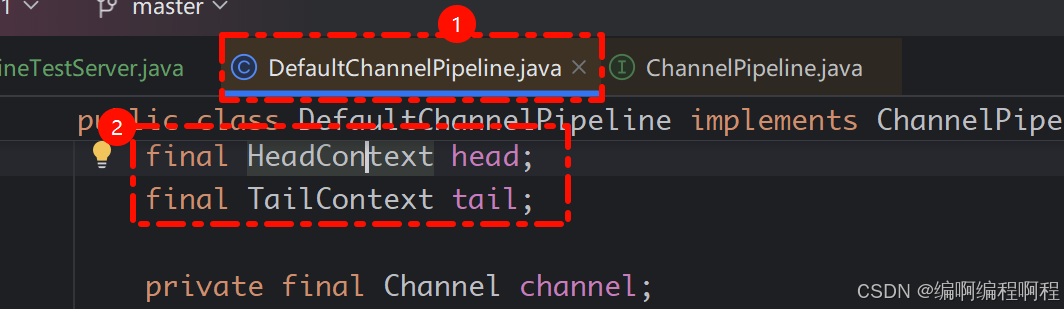
protected DefaultChannelPipeline(Channel channel) {
    this.channel = ObjectUtil.checkNotNull(channel, "channel");
    succeededFuture = new SucceededChannelFuture(channel, null);
    voidPromise =  new VoidChannelPromise(channel, true);

    tail = new TailContext(this);
    head = new HeadContext(this);

    head.next = tail;
    tail.prev = head;
}
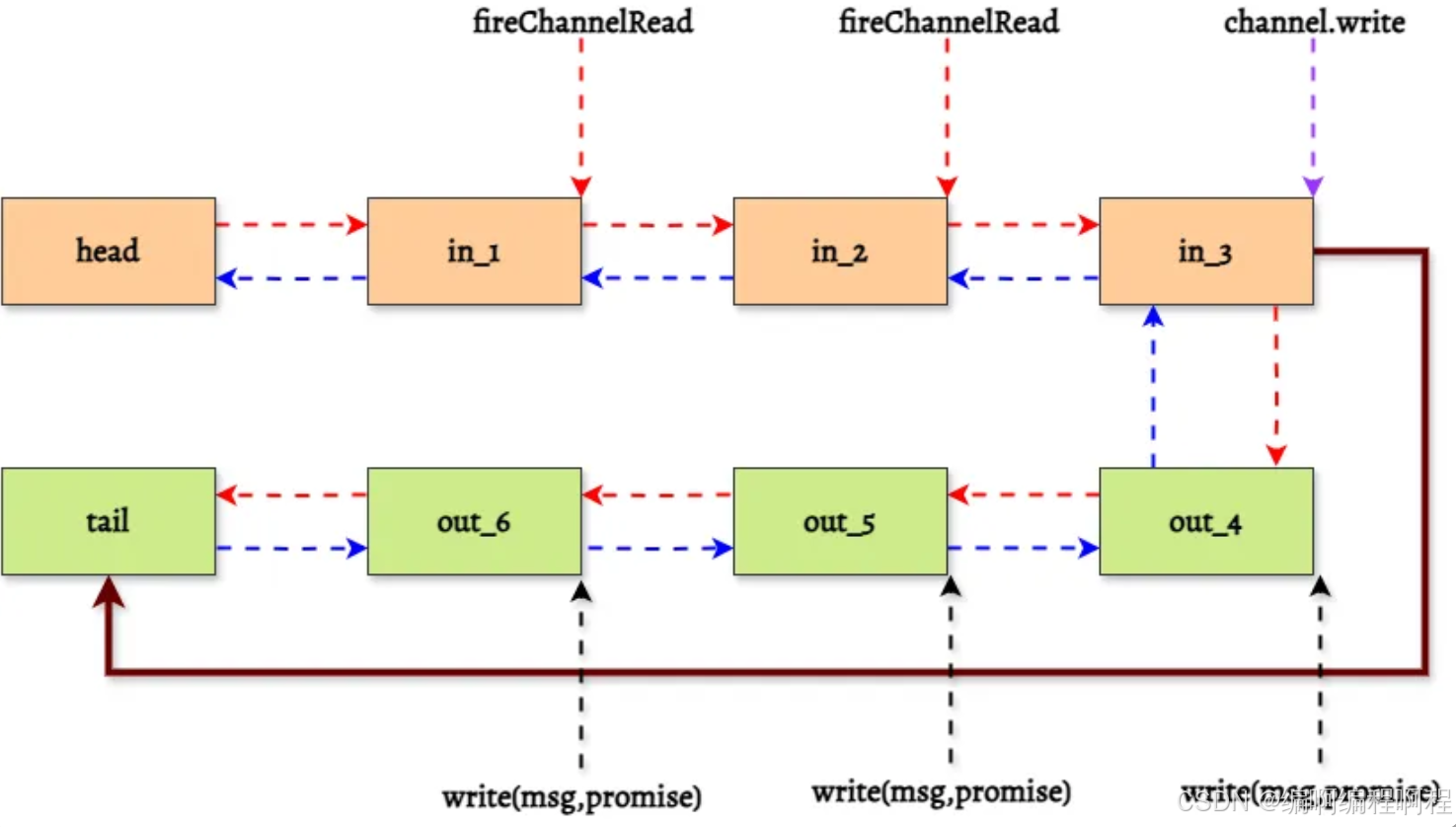
- ctx.channel.write(msg)和ctx.write(msg,promise), 触发写操作的时候, 则会进行【出站】操作
- ctx.channel.write(msg)是从
tail开始查找,按照出站顺序执行- ctx.write(msg) / ctx.write(msg, promise), 从当前的handler向前查找, 依次执行
ch.pipeline()
    .addLast("handler3", new ChannelInboundHandlerAdapter() {
        @Override
        public void channelRead(ChannelHandlerContext ctx, Object msg) throws Exception {
            System.out.println("[" + Thread.currentThread().getName() + "]" + " ---  \t\t: " + "handler3 读取到消息: " + msg);
            // 从链表尾部,找出站处理器,依次从后往前执行
            // ctx.channel().write(msg);
            // System.out.println(ctx.pipeline().names());
            //
            ctx.write(msg);
        }
    });
[main] ---  		: channel: AbstractBootstrap$PendingRegistrationPromise@1de76cc7(incomplete)
[main] ---  		: 服务端启动成功 ~~~~ listening port : 8080
[nioEventLoopGroup-3-1] --- handler1 读取到消息: PooledUnsafeDirectByteBuf(ridx: 0, widx: 6, cap: 2048)
[nioEventLoopGroup-3-1] --- handler2 读取到消息: PooledUnsafeDirectByteBuf(ridx: 0, widx: 6, cap: 2048)
[nioEventLoopGroup-3-1] --- handler3 读取到消息: PooledUnsafeDirectByteBuf(ridx: 0, widx: 6, cap: 2048)
1.9 Pipeline操作API总结
| 操作 | 方法 | 说明 |
|---|---|---|
| 添加 | addFirst(), addLast(), addBefore(), addAfter() | 动态添加 Handler |
| 删除 | remove(handler) | 移除指定 Handler |
| 替换 | replace(oldHandler, newName, newHandler) | 替换 Handler |
| 查找 | get(name) | 获取 Handler |
| 遍历 | names() | 获取所有 Handler 名称 |
1.10 最佳实践与常见陷阱
1.10.1 ✅ 推荐实践
| 实践 | 说明 |
|---|---|
| 合理组织 Handler 顺序 | 解码 → 认证 → 业务 → 编码 |
无状态 Handler 标记 @Sharable | 提高性能 |
使用 SimpleChannelInboundHandler | 自动释放资源 |
在 exceptionCaught 中关闭连接 | 防止资源泄漏 |
| 避免阻塞 Handler | 如 Thread.sleep() |
1.10.2 ⚠️ 常见错误
// ❌ 错误:忘记 fireChannelRead,事件中断
@Override
public void channelRead(ChannelHandlerContext ctx, Object msg) {
    // 处理后忘记继续传播
    // 后续 Handler 将收不到事件
}

// ✅ 正确:调用 fire 或 write
ctx.fireChannelRead(msg); // 入站
ctx.write(msg);           // 出站
1.11 Pipeline的优缺点总结
1.11.1 ✅ 优点
| 优点 | 说明 |
|---|---|
| 高度解耦 | 业务与网络层分离 |
| 可扩展性强 | 灵活组合、动态修改 |
| 支持编解码 | 内置丰富编解码器 |
| 线程安全 | 事件串行执行,无锁 |
| 内存高效 | 零拷贝 + 自动释放 |
1.11.2 ❌ 缺点
| 缺点 | 说明 |
|---|---|
| 学习成本高 | 需理解事件传播方向 |
| 调试复杂 | 事件在多个节点间流动 |
| 内存泄漏风险 | 忘记释放 ByteBuf |
| 过度设计风险 | 简单场景可能过于复杂 |
1.12 总结: Pipeline的核心价值
| 维度 | 说明 |
|---|---|
| 核心角色 | Netty 的“事件调度中心” |
| 设计模式 | 责任链 + 事件驱动 |
| 核心能力 | 组织处理器、传播事件、管理资源 |
| 适用场景 | 所有网络通信:HTTP、WebSocket、RPC、MQTT |
| Netty 地位 | 与 EventLoop、Future 并列为三大基石 |
1.13 一句话总结
ChannelPipeline是 Netty 的“神经中枢”- 它通过双向链表组织
Handler,驱动事件在入站与出站路径上高效流动 - 实现了高性能、可扩展、易维护的异步网络处理架构,是构建现代高并发网络应用的核心引擎。
- 它通过双向链表组织






 扫一扫
扫一扫


 6235
6235

 被折叠的 条评论
为什么被折叠?
被折叠的 条评论
为什么被折叠?
 到【灌水乐园】发言





