


 本文介绍了一种计算在第一象限中从原点可见的格点数量的方法。通过使用欧拉函数来确定与原点连线不会穿过其他格点的坐标(x, y),实现了对POJ3090问题的有效解决。
http://poj.org/problem?id=3090
| Time Limit:1000MS | Memory Limit:65536K |
Description
A lattice point (x,y) in the first quadrant (xandyare integers greater than or equal to 0), other than the origin, is visible from the origin if the line from (0, 0) to (x,y) does not pass through any other lattice point. For example, the point (4, 2) is not visible since the line from the origin passes through (2, 1). The figure below shows the points (x,y) with 0 ≤x,y≤ 5 with lines from the origin to the visible points.
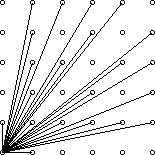
Write a program which, given a value for the size,N, computes the number of visible points (x,y) with 0 ≤x,y≤N.
Input
The first line of input contains a single integerC(1 ≤C≤ 1000) which is the number of datasets that follow.
Each dataset consists of a single line of input containing a single integerN(1 ≤N≤ 1000), which is the size.
Output
For each dataset, there is to be one line of output consisting of: the dataset number starting at 1, a single space, the size, a single space and the number of visible points for that size.
Sample Input
4
2
4
5
231
Sample Output
1 2 5
2 4 13
3 5 21
4 231 32549
牛人做法:
先画一条(0, 0)到(n, n)的线,把图分成两部分,两部分是对称的,只需算一部分就好。
取右下半,这一半里的点(x, y)满足x >= y
可以通过欧拉函数计算第k列有多少点能够连到(0, 0)
若x与k的最大公约数d > 1,则(0, 0)与(x, k)点的连线必定会通过(x/d, k/d),就被挡住了
所以能连的线的数目就是比k小的、和k互质的数的个数,然后就是欧拉函数。
/* Author : yan
 * Question : POJ 3090 Visible Lattice Points
 * Date && Time : Wednesday, January 12 2011 12:01 AM
 * Compiler : gcc (Ubuntu 4.4.3-4ubuntu5) 4.4.3
*/
#include<stdio.h>
unsigned euler(unsigned x)
{// 就是公式
    unsigned i, res=x,tmp;
    tmp= (int)sqrt(x * 1.0) + 1;
    for (i = 2; i <tmp; i++)
        if(x%i==0)
        {
            res = res / i * (i - 1);
            while (x % i == 0) x /= i; // 保证i一定是素数
        }
        if (x > 1) res = res / x * (x - 1);
	return res;
}

int main()
{
	freopen("input","r",stdin);
	int test;
	int n;
	int i;
	int ans;
	int _case=1;
	scanf("%d",&test);
	while(test--)
	{
		ans=0;
		scanf("%d",&n);
		for(i=2;i<=n;i++)
		{
			ans+=euler(i);
		}
		printf("%d %d %d/n",_case++,n,ans*2+3);
	}
	return 0;
}






 扫一扫
扫一扫


 303
303

 被折叠的 条评论
为什么被折叠?
被折叠的 条评论
为什么被折叠?
 到【灌水乐园】发言





