


TRIE is an interesting data-structure used mainly for manipulating with Words in a language. This word is got from the word retrieve. TRIE (pronounced as 'try') has a wide variety of applications in
- Spell checking
- Data compression
- Computational biology
- Routing table for IP addresses
- Storing/Querying XML documents etc.,
A TRIE tree would typically look like the following

The above TRIE is constructed by inserting the words ball, bat, doll, dork, do, dorm, send, sense. The markers are denoted on the Node using a red star( * ). We shall look into more about the TRIE data structure in depth in the next post .
In this section we shall see how the insert() method on the TRIE data structure works. We shall take a specific case and analyze it with pictorial representation.
Before we begin, assume we already have an existing TRIE as shown below.

Lets see the steps on how to insert a word "bate". Any insertion would ideally be following the below algorithm.
- If the input string length is zero, then set the marker for the root node to be true.
- If the input string length is greater than zero, repeat steps 3 and 4 for each character
- If the character is present in the child node of the current node, set the current node point to the child node.
- If the character is not present in the child node, then insert a new node and set the current node to that newly inserted node.
- Set the marker flag to true when the end character is reached.
- See whether "b" is present in the current node's children (which is root). Yes its present, so set the current node to the child node which is having the character "b".
- See whether "a" is present in the current node's children. Yes its present, so set the current node to the child node which is having the character "a".
- See whether "t" is present in the current node's children. Yes its present, so set the current node to the child node which is having the character "t".
- See whether "e" is present in the current node's children. No, its not present, so create a new node with character set to "e". Since "e" is the end of the word, set the marker flag to true.

The above picture shows how the word "bate" is inserted into the existing TRIE data structure. This example clearly shows how the insertion in a TRIE happens.
Consider the following TRIE as usual.
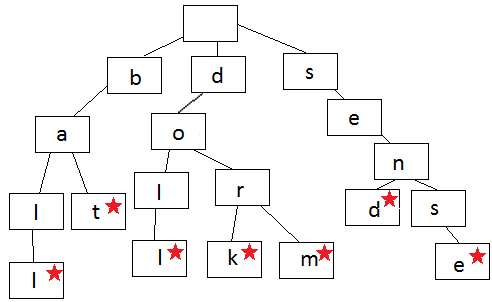
The search alogirthm involves the following steps
- For each character in the string, see if there is a child node with that character as the content.
- If that character does not exist, return false
- If that character exist, repeat step 1.
- Do the above steps until the end of string is reached.
- When end of string is reached and if the marker of the current Node is set to true, return true, else return false.
- See whether "d" is present in the current node's children. Yes its present, so set the current node to child node which is having character "d".
- See whether "o" is present in the current node's children. Yes its present, so set the current node to child node which is having character "o".
- Since "o" is the end of the word, see whether marker is set to true or false. Marker is set to false which means that "do" is not registered as a word in the TRIE. So, return false.
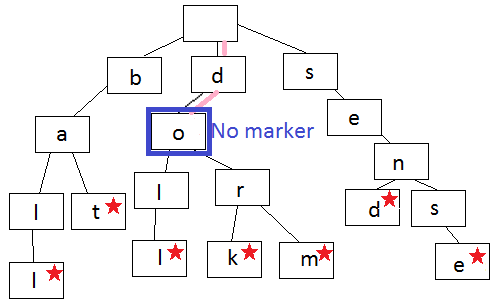
Using the same algorithm, lets perform a search for the key "ball"
- See whether "b" is present in the current node's children. Yes its present, so set the current node to child node which is having character "b".
- See whether "a" is present in the current node's children. Yes its present, so set the current node to child node which is having character "a".
- See whether "l" is present in the current node's children. Yes its present, so set the current node to child node which is having character "l".
- See whether "l" is present in the current node's children. Yes its present, so set the current node to child node which is having character "l".
- Since "l" is the end of the word, see whether marker is set to true or false. Marker is set to true which means that "ball" is registered as a word in the TRIE. So, return true

Now that we've seen the basic operations on how to work with a TRIE, we shall now see the space and time complexities in order to get a real feel of how good a TRIE data structure is. Lets take the two important operations INSERT and SEARCH to measure the complexity.
INSERT operation first. Lets always take into account the worst case timing first and later convince ourselves of the practical timings. For every Node in the TRIE we had something called as Collection where the Collection can be either a Set or a List. If we choose Set, the order of whatever operation we perform over that will be in O(1) time, whereas if we use a LinkedList the number of comparisons at worst will be 26 (the number of alphabets). So for moving from one node to another, there will be at least 26 comparisons will be required at each step.
Having these in mind, for inserting a word of length 'k' we need (k * 26) comparisons. By Applying the Big O notation it becomes O(k) which will be again O(1). Thus insert operations are performed in constant time irrespective of the length of the input string (this might look lik an understatement, but if we make the length of the input string a worst case maximum, this sentence holds true).
Same holds true for the search operation as well. The search operation exactly performs the way the insert does and its order is O(k*26) = O(1)
public class Trie {

	private TrieNode root;			// Root node in trie

	/**
	 * Constructor for Trie class
	 */
	public Trie(){
		root = new TrieNode((char) 0);
	}

	/**
	 * A method to insert a word into the trie
	 * @param word The word to be inserted
	 */
	public void insert(String word){
		TrieNode cur = root;
		for(int i=0; i<word.length(); i++){
			Map<Character, TrieNode> children = cur.getChildren();
			char c = word.charAt(i);
			if(children.containsKey(c)){	// If the character is in trie, continue searching
				cur = children.get(c);
			}else{								// Otherwise, create a new trie node
				TrieNode newNode = new TrieNode(c);
				children.put(c, newNode);
				cur = newNode;
			}
		}
		cur.setEnd(true);					// Markup for the end of word
	}

	/**
	 * A method used to determine if a word is stored in trie or not
	 * @param word The word to be checked
	 * @return	 True if the word is stored in trie, false otherwise
	 */
	public boolean contains(String word){
		TrieNode cur = root;
		for(int i=0; i<word.length(); i++){
			char c = word.charAt(i);
			if(!cur.children.containsKey(c)){		// Some letter is not in trie, return false
				return false;
			}
			cur = cur.children.get(c);
		}
		return cur.isEnd;								// When reaches the end of word, return value is based on if the markup is set or not
	}

	/**
	 * Inner class for Trie Node
	 * @author Bin Feng
	 *
	 */
	class TrieNode{
		private char letter;										// Letter associate with the node
		private Map<Character, TrieNode> children;		// Children of current node
		private boolean isEnd;								// Markup for end of word

		/**
		 * Constructor for TrieNode class
		 * @param letter The letter associate with node
		 */
		public TrieNode(char letter) {
			this.letter = letter;
			children = new HashMap<Character, Trie.TrieNode>();
			isEnd = false;
		}

		/**
		 * Getters and Setters
		 */
		public char getLetter() {
			return letter;
		}

		public void setLetter(char letter) {
			this.letter = letter;
		}

		public Map<Character, TrieNode> getChildren() {
			return children;
		}

		public void setChildren(Map<Character, TrieNode> children) {
			this.children = children;
		}

		public boolean isEnd() {
			return isEnd;
		}

		public void setEnd(boolean isEnd) {
			this.isEnd = isEnd;
		}

	}
}
http://www.technicalypto.com/2010/04/trie-in-java.html
// =====================================================================================================================
另一个完整版的Trie的实现,其中的search方法可用于解决如同:Google搜索找autocomplete字符串的问题。
TrieNode:
package Trie;

import java.util.HashMap;
import java.util.Map;

public class TrieNode<T> {
	private Character nodeKey;
	private T nodeValue;
	private boolean terminal;
	private Map<Character, TrieNode<T>> children = new HashMap<Character, TrieNode<T>>();

	public Character getNodeKey() {
		return nodeKey;
	}

	public void setNodeKey(Character nodeKey) {
		this.nodeKey = nodeKey;
	}

	public T getNodeValue() {
		return nodeValue;
	}

	public void setNodeValue(T nodeValue) {
		this.nodeValue = nodeValue;
	}

	public boolean isTerminal() {
		return terminal;
	}

	public void setTerminal(boolean terminal) {
		this.terminal = terminal;
	}

	public Map<Character, TrieNode<T>> getChildren() {
		return children;
	}

	public void setChildren(Map<Character, TrieNode<T>> children) {
		this.children = children;
	}
}
Trie:
package Trie;

import java.util.ArrayList;
import java.util.HashSet;
import java.util.Iterator;
import java.util.List;
import java.util.Map;
import java.util.Set;

public class Trie<T> {

	private TrieNode<T> rootNode = new TrieNode<T>();

	public void add(String key, T value) {
		addNode(rootNode, key, 0, value);
	}

	public T find(String key) {
		return findKey(rootNode, key);
	}

	public List<T> search(String prefix) {
		List<T> list = new ArrayList<T>();

		char[] ch = prefix.toCharArray();
		TrieNode<T> node = rootNode;
		for (int i = 0; i < ch.length; i++) {
			node = node.getChildren().get(ch[i]);
			if (node == null) {
				break;
			}
		}

		if (node != null) {
			getValuesFromNode(node, list);
		}

		return list;
	}

	public boolean contains(String key) {
		return hasKey(rootNode, key);
	}

	public Set<String> getAllKeys() {
		Set<String> keySet = new HashSet<String>();
		getKeysFromNode(rootNode, "", keySet);

		return keySet;
	}

	public int size() {
		return getAllKeys().size();
	}

	private void getValuesFromNode(TrieNode<T> currNode, List<T> valueList) {
		if (currNode.isTerminal()) {
			valueList.add(currNode.getNodeValue());
		}

		Map<Character, TrieNode<T>> children = currNode.getChildren();
		Iterator childIter = children.keySet().iterator();
		while (childIter.hasNext()) {
			Character ch = (Character) childIter.next();
			TrieNode<T> nextNode = children.get(ch);
			getValuesFromNode(nextNode, valueList);
		}
	}

	private void getKeysFromNode(TrieNode<T> currNode, String key, Set keySet) {
		if (currNode.isTerminal()) {
			keySet.add(key);
		}

		Map<Character, TrieNode<T>> children = currNode.getChildren();
		Iterator childIter = children.keySet().iterator();
		while (childIter.hasNext()) {
			Character ch = (Character) childIter.next();
			TrieNode<T> nextNode = children.get(ch);
			String s = key + nextNode.getNodeKey();
			getKeysFromNode(nextNode, s, keySet);
		}
	}

	private T findKey(TrieNode<T> currNode, String key) {
		Character c = key.charAt(0);
		if (currNode.getChildren().containsKey(c)) {
			TrieNode<T> nextNode = currNode.getChildren().get(c);
			if (key.length() == 1) {
				if (nextNode.isTerminal()) {
					return nextNode.getNodeValue();
				}
			} else {
				return findKey(nextNode, key.substring(1));
			}
		}

		return null;
	}

	private boolean hasKey(TrieNode<T> currNode, String key) {
		Character c = key.charAt(0);
		if (currNode.getChildren().containsKey(c)) {
			TrieNode<T> nextNode = currNode.getChildren().get(c);
			if (key.length() == 1) {
				if (nextNode.isTerminal()) {
					return true;
				}
			} else {
				return hasKey(nextNode, key.substring(1));
			}
		}

		return false;
	}

	private void addNode(TrieNode<T> currNode, String key, int pos, T value) {
		Character c = key.charAt(pos);
		TrieNode<T> nextNode = currNode.getChildren().get(c);

		if (nextNode == null) {
			nextNode = new TrieNode<T>();
			nextNode.setNodeKey(c);
			if (pos < key.length() - 1) {
				addNode(nextNode, key, pos + 1, value);
			} else {
				nextNode.setNodeValue(value);
				nextNode.setTerminal(true);
			}
			currNode.getChildren().put(c, nextNode);
		} else {
			if (pos < key.length() - 1) {
				addNode(nextNode, key, pos + 1, value);
			} else {
				nextNode.setNodeValue(value);
				nextNode.setTerminal(true);
			}
		}
	}
}
TrieTest:
package Trie;

import static org.junit.Assert.*;

import org.junit.Test;

public class TrieTest {

	Trie<Product> productTrie = new Trie<Product>();

    public void setUp() throws Exception {
        productTrie.add("ham", new Product(1, "ham"));
        productTrie.add("hammer", new Product(2, "hammer"));
        productTrie.add("hammock", new Product(3, "hammock"));
        productTrie.add("ipod", new Product(4, "ipod"));
        productTrie.add("iphone", new Product(5, "iphone"));
    }

    public void testAdd() {
        assertEquals(5, productTrie.size());
    }

    public void testFind() {
        assertNotNull(productTrie.find("ham"));
    }

    public void testSearch() {
        assertEquals(3, productTrie.search("ha").size());
    }

    public void testContains() {
        assertEquals(true, productTrie.contains("ipod"));
    }

    public void testGetAllKeys() {
        assertEquals(5, productTrie.getAllKeys().size());
    }

    class Product {
        private int productId;
        private String productDesc;

        public Product(int productId, String productDesc) {
            this.productId = productId;
            this.productDesc = productDesc;
        }

        public int getProductId() {
            return productId;
        }
        public void setProductId(int productId) {
            this.productId = productId;
        }
        public String getProductDesc() {
            return productDesc;
        }
        public void setProductDesc(String productDesc) {
            this.productDesc = productDesc;
        }

    }

}
http://stevedaskam.wordpress.com/2009/05/28/trie-structures/
http://stevedaskam.wordpress.com/2009/05/17/autocomplete-data-structures/


 1184


 扫一扫


 被折叠的 条评论
为什么被折叠?
 到【灌水乐园】发言


