


序
本文主要研究一下langchain4j的Advanced RAG
核心流程
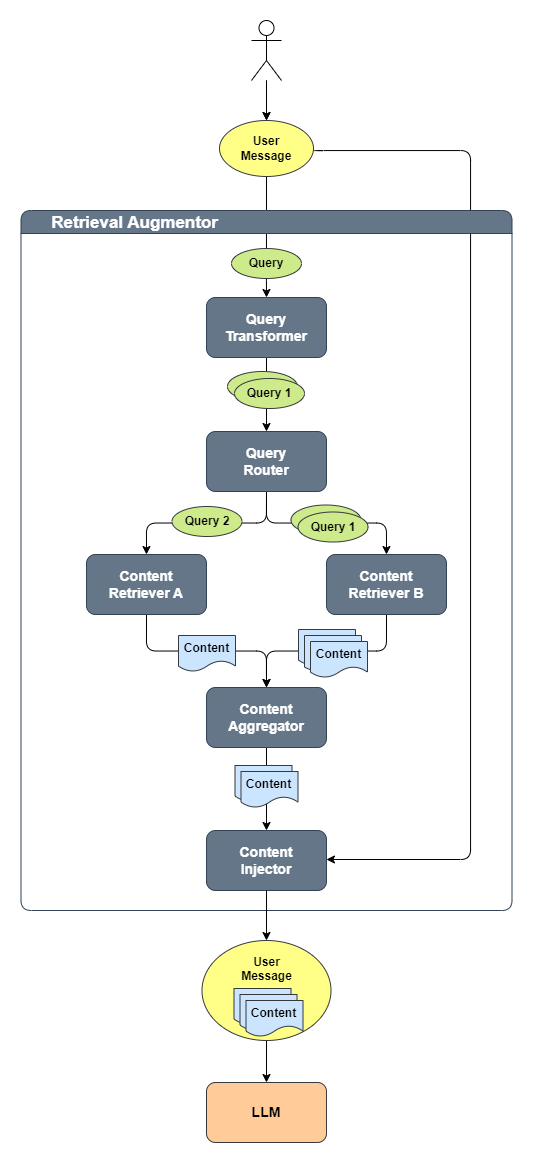
- 将UserMessage转换为一个原始的Query
- QueryTransformer将原始的Query转换为多个Query
- 每个Query通过QueryRouter被路由到一个或多个ContentRetriever
- 每个ContentRetriever检索对应Query相关的Content
- ContentAggregator将所有检索到的Content合并成一个最终排序的列表
- 这个内容列表被注入到原始的UserMessage中
- 最后包含原始查询以及注入的相关内容的UserMessage被发送到LLM
示例
public class _02_Advanced_RAG_with_Query_Routing_Example {

    /**
     * Please refer to {@link Naive_RAG_Example} for a basic context.
     * <p>
     * Advanced RAG in LangChain4j is described here: https://github.com/langchain4j/langchain4j/pull/538
     * <p>
     * This example showcases the implementation of a more advanced RAG application
     * using a technique known as "query routing".
     * <p>
     * Often, private data is spread across multiple sources and formats.
     * This might include internal company documentation on Confluence, your project's code in a Git repository,
     * a relational database with user data, or a search engine with the products you sell, among others.
     * In a RAG flow that utilizes data from multiple sources, you will likely have multiple
     * {@link EmbeddingStore}s or {@link ContentRetriever}s.
     * While you could route each user query to all available {@link ContentRetriever}s,
     * this approach might be inefficient and counterproductive.
     * <p>
     * "Query routing" is the solution to this challenge. It involves directing a query to the most appropriate
     * {@link ContentRetriever} (or several). Routing can be implemented in various ways:
     * - Using rules (e.g., depending on the user's privileges, location, etc.).
     * - Using keywords (e.g., if a query contains words X1, X2, X3, route it to {@link ContentRetriever} X, etc.).
     * - Using semantic similarity (see EmbeddingModelTextClassifierExample in this repository).
     * - Using an LLM to make a routing decision.
     * <p>
     * For scenarios 1, 2, and 3, you can implement a custom {@link QueryRouter}.
     * For scenario 4, this example will demonstrate how to use a {@link LanguageModelQueryRouter}.
     */

    public static void main(String[] args) {

        Assistant assistant = createAssistant();

        // First, ask "What is the legacy of John Doe?"
        // Then, ask "Can I cancel my reservation?"
        // Now, see the logs to observe how the queries are routed to different retrievers.
        startConversationWith(assistant);
    }

    private static Assistant createAssistant() {

        EmbeddingModel embeddingModel = new BgeSmallEnV15QuantizedEmbeddingModel();

        // Let's create a separate embedding store specifically for biographies.
        EmbeddingStore<TextSegment> biographyEmbeddingStore =
                embed(toPath("documents/biography-of-john-doe.txt"), embeddingModel);
        ContentRetriever biographyContentRetriever = EmbeddingStoreContentRetriever.builder()
                .embeddingStore(biographyEmbeddingStore)
                .embeddingModel(embeddingModel)
                .maxResults(2)
                .minScore(0.6)
                .build();

        // Additionally, let's create a separate embedding store dedicated to terms of use.
        EmbeddingStore<TextSegment> termsOfUseEmbeddingStore =
                embed(toPath("documents/miles-of-smiles-terms-of-use.txt"), embeddingModel);
        ContentRetriever termsOfUseContentRetriever = EmbeddingStoreContentRetriever.builder()
                .embeddingStore(termsOfUseEmbeddingStore)
                .embeddingModel(embeddingModel)
                .maxResults(2)
                .minScore(0.6)
                .build();

        ChatLanguageModel chatLanguageModel = OpenAiChatModel.builder()
                .apiKey(OPENAI_API_KEY)
                .modelName(GPT_4_O_MINI)
                .build();

        // Let's create a query router.
        Map<ContentRetriever, String> retrieverToDescription = new HashMap<>();
        retrieverToDescription.put(biographyContentRetriever, "biography of John Doe");
        retrieverToDescription.put(termsOfUseContentRetriever, "terms of use of car rental company");
        QueryRouter queryRouter = new LanguageModelQueryRouter(chatLanguageModel, retrieverToDescription);

        RetrievalAugmentor retrievalAugmentor = DefaultRetrievalAugmentor.builder()
                .queryRouter(queryRouter)
                .build();

        return AiServices.builder(Assistant.class)
                .chatLanguageModel(chatLanguageModel)
                .retrievalAugmentor(retrievalAugmentor)
                .chatMemory(MessageWindowChatMemory.withMaxMessages(10))
                .build();
    }

    private static EmbeddingStore<TextSegment> embed(Path documentPath, EmbeddingModel embeddingModel) {
        DocumentParser documentParser = new TextDocumentParser();
        Document document = loadDocument(documentPath, documentParser);

        DocumentSplitter splitter = DocumentSplitters.recursive(300, 0);
        List<TextSegment> segments = splitter.split(document);

        List<Embedding> embeddings = embeddingModel.embedAll(segments).content();

        EmbeddingStore<TextSegment> embeddingStore = new InMemoryEmbeddingStore<>();
        embeddingStore.addAll(embeddings, segments);
        return embeddingStore;
    }
}
这里使用了DefaultRetrievalAugmentor来设置了LanguageModelQueryRouter,这里设置了biographyContentRetriever、termsOfUseContentRetriever两个ContentRetriever。
源码解析
RetrievalAugmentor
dev/langchain4j/rag/RetrievalAugmentor.java
@Experimental
public interface RetrievalAugmentor {

    /**
     * Augments the {@link ChatMessage} provided in the {@link AugmentationRequest} with retrieved {@link Content}s.
     * <br>
     * This method has a default implementation in order to <b>temporarily</b> support
     * current custom implementations of {@code RetrievalAugmentor}. The default implementation will be removed soon.
     *
     * @param augmentationRequest The {@code AugmentationRequest} containing the {@code ChatMessage} to augment.
     * @return The {@link AugmentationResult} containing the augmented {@code ChatMessage}.
     */
    default AugmentationResult augment(AugmentationRequest augmentationRequest) {

        if (!(augmentationRequest.chatMessage() instanceof UserMessage)) {
            throw runtime("Please implement 'AugmentationResult augment(AugmentationRequest)' method " +
                    "in order to augment " + augmentationRequest.chatMessage().getClass());
        }

        UserMessage augmented = augment((UserMessage) augmentationRequest.chatMessage(), augmentationRequest.metadata());

        return AugmentationResult.builder()
                .chatMessage(augmented)
                .build();
    }

    /**
     * Augments the provided {@link UserMessage} with retrieved content.
     *
     * @param userMessage The {@link UserMessage} to be augmented.
     * @param metadata    The {@link Metadata} that may be useful or necessary for retrieval and augmentation.
     * @return The augmented {@link UserMessage}.
     * @deprecated Use/implement {@link #augment(AugmentationRequest)} instead.
     */
    @Deprecated
    UserMessage augment(UserMessage userMessage, Metadata metadata);
}
RetrievalAugmentor接口定义了augment(AugmentationRequest augmentationRequest)方法,它作为langchain4j的RAG入口,负责根据AugmentationRequest来检索相关Content,它提供了默认实现主要是适配废弃的
augment(UserMessage userMessage, Metadata metadata)方法
DefaultRetrievalAugmentor
dev/langchain4j/rag/DefaultRetrievalAugmentor.java
public class DefaultRetrievalAugmentor implements RetrievalAugmentor {
private static final Logger log = LoggerFactory.getLogger(DefaultRetrievalAugmentor.class);
private final QueryTransformer queryTransformer;
private final QueryRouter queryRouter;
private final ContentAggregator contentAggregator;
private final ContentInjector contentInjector;
private final Executor executor;
public DefaultRetrievalAugmentor(QueryTransformer queryTransformer,
QueryRouter queryRouter,
ContentAggregator contentAggregator,
ContentInjector contentInjector,
Executor executor) {
this.queryTransformer = getOrDefault(queryTransformer, DefaultQueryTransformer::new);
this.queryRouter = ensureNotNull(queryRouter, "queryRouter");
this.contentAggregator = getOrDefault(contentAggregator, DefaultContentAggregator::new);
this.contentInjector = getOrDefault(contentInjector, DefaultContentInjector::new);
this.executor = getOrDefa 最低0.47元/天 解锁文章






 扫一扫
扫一扫


 935
935

 被折叠的 条评论
为什么被折叠?
被折叠的 条评论
为什么被折叠?
 到【灌水乐园】发言





