


HC32L130单片机PID电机驱动,先写出PID驱动程序如下:
#include "pid.h"


/* 初始化PID控制器 */
PID_Controller PID_Init(float Kp, float Ki, float Kd,
                       float integral_limit, float output_limit)
{
    PID_Controller pid;
    memset(&pid, 0, sizeof(pid));

    pid.Kp = Kp;
    pid.Ki = Ki;
    pid.Kd = Kd;
    pid.integral_limit = integral_limit;
    pid.output_limit = output_limit;
    return pid;
}


void PID_Initset(PID_Controller *pid,
              float Kp, float Ki, float Kd,
              float integral_limit, float output_limit) {
    pid->Kp = Kp;
    pid->Ki = Ki;
    pid->Kd = Kd;
    pid->integral_limit = integral_limit;
    pid->output_limit = output_limit;
    pid->integral = 0.0f;
    pid->error = 0.0f;
    pid->last_error = 0.0f;
}

/* 重置PID控制器 */
void PID_Reset(PID_Controller *pid) {
    pid->integral = 0;
    pid->last_error = 0;
}

/* 计算PID输出 (位置式算法) */
float PID_Calculate(PID_Controller *pid, int target, int feedback)
{

	 float output1;


    // 计算误差
    pid->error = target - feedback;


    // 积分项(带限幅)
    pid->integral += pid->error;

    if(pid->integral > pid->integral_limit) pid->integral = pid->integral_limit;
    else if(pid->integral < -pid->integral_limit) pid->integral = -pid->integral_limit;


    // 计算总输出
    output1 =(pid->Kp * pid->error)+ (pid->Ki * pid->integral)+ (pid->Kd * (pid->error - pid->last_error));       //P_out + I_out + D_out;

		pid->last_error = pid->error;


    // 输出限幅
//    if(output1 > pid->output_limit) output1 = pid->output_limit;
//    else if(output1 < -pid->output_limit) output1 = -pid->output_limit;
//
//    // 抗积分饱和处理:当输出饱和时,冻结积分项
//    if(output >= pid->output_limit || output <= -pid->output_limit) {
//        pid->integral -= pid->error; // 撤销本次积分
//    }

    return output1;
}

/**************************************************************************
函数功能:增量PID控制器
入口参数:实际值,目标值
返回  值:电机PWM
根据增量式离散PID公式
pwm+=Kp[e(k)-e(k-1)]+Ki*e(k)+Kd[e(k)-2e(k-1)+e(k-2)]
e(k)代表本次偏差
e(k-1)代表上一次的偏差  以此类推
pwm代表增量输出
**************************************************************************/
float Incremental_PID(PID_Controller *pid,int target,int reality)
{
	 static float Bias,Pwm,Last_bias=0,Prev_bias=0;

	 Bias=target-reality;                                   /* 计算偏差 */

	if(pid->integral > pid->integral_limit) pid->integral = pid->integral_limit;
    else if(pid->integral < -pid->integral_limit) pid->integral = -pid->integral_limit;

	 Pwm += (pid->Kp*(Bias-Last_bias))               /* 比例环节 */
           +(pid->Ki*Bias)                           /* 积分环节 */
           +(pid->Kd*(Bias-2*Last_bias+Prev_bias));  /* 微分环节 */

     Prev_bias=Last_bias;                                   /* 保存上上次偏差 */
	 Last_bias=Bias;	                                    /* 保存上一次偏差 */


	 // 输出限幅
    if(Pwm > pid->output_limit) Pwm = pid->output_limit;
    else if(Pwm < -pid->output_limit) Pwm = -pid->output_limit;

	 return Pwm;                                            /* 输出结果 */
}
头文件
#include "stdio.h"
#include "string.h"


/* PID控制结构体 */
typedef struct {
    float Kp;               // 比例系数
    float Ki;               // 积分系数
    float Kd;               // 微分系数

    float integral_limit;   // 积分项限幅
    float output_limit;     // 输出限幅

    float integral;         // 积分累加值
	  float error;
    float last_error;       // 上一次误差
} PID_Controller;
extern PID_Controller wz_pid;
extern PID_Controller Inc_pid;
PID_Controller PID_Init(float Kp, float Ki, float Kd, float integral_limit, float output_limit);
void PID_Initset(PID_Controller *pid,
              float Kp, float Ki, float Kd,
              float integral_limit, float output_limit);
void PID_Reset(PID_Controller *pid);
float PID_Calculate(PID_Controller *pid, int target, int feedback);
float Incremental_PID(PID_Controller *pid,int target,int reality);
电机驱动板驱动PWM方式:
#include "MOTOR_con.h"
#include "pid.h"
#include "gpio.h"
//#include "adt.h"
#include "pcnt.h"
#include "stdio.h"
#include "stdlib.h"
#include "math.h"
//#include "ddl.h"
#include "adc.h"


static uint32_t u32AdcResultAcc;
uint32_t  u32BtTestFlag = 0;
uint32_t  u32InitCntData = 0x0;
uint16_t u16AdcResult;
int  cntadd=0;
int  cntadd1=0;
uint32_t  cntadd1_last=0;
PID_Controller wz_pid;
PID_Controller Inc_pid;
int Last_AdcResult;
int setpoint = 1400;  // 目标值
//float setspeed = 10.0;  // 目标值
//float feedback = 0.0;    // 反馈值
float output;            // 控制器输出
int moto1,moto2,porzt;
float Target_Velocity=0,Reality_Velocity=0;/* 实际速度,目标速度 */
uint16_t u16CaptureA,u16CaptureB;

void Moto_Stop(void)
{
  Set_Pwm(0);
	Adt_SwBrake(TRUE);  //软件刹车
	Gpio_SetIO(GpioPortC, GpioPin0);
}

void Moto_Star(float out)
{

  Adt_SwBrake(FALSE);  //软件刹车解除,恢复PWM输出
	Gpio_ClrIO(GpioPortC, GpioPin0);
	Set_Pwm(out);

}

void Moto_Cont(void)
{

  Gpio_SetIO(GpioPortC, GpioPin0);
	delay1ms(1);
////	delay100us(5);
	Gpio_ClrIO(GpioPortC, GpioPin0);
}

int Xianfu(int data,int max)
{
    if(data<-max) data=-max;
    if(data> max) data= max;
    return data;
}

  void Set_Pwm(float moto)
{
	if(moto>0)      /* 正转 */
    {
        Gpio_SetIO(GpioPortD, GpioPin6);
			porzt=1;
    }
    else           /* 反转 */
    {
         Gpio_ClrIO(GpioPortD, GpioPin6);

			porzt=0;
    }


	if(moto)        /* 控制器有输出 */
    {

        moto =((unsigned short int)(fabs(moto)) + Dead_Voltage);/* 取绝对值 + 死区电压*/
//        moto = Xianfu_Pwm(moto);         /* 限幅 */
//			  moto =pid.output_limit-moto;
//			  if(moto<(pid.output_limit/2.0))  //1.1
//					moto=pid.output_limit/2.0;
			moto2=moto;
			Adt_SetCompareValue(M0P_ADTIM5, enAdtCompareA, moto);
			Adt_StartCount(M0P_ADTIM5); //开启TIM5,输出pwm

    }
    else            /* 无输出,直接关闭驱动 */
    {
			  Adt_SetCompareValue(M0P_ADTIM5, enAdtCompareA, 0);
			Adt_StartCount(M0P_ADTIM5); //开启TIM5,输出pwm

    }

	moto1=moto;
}


void Get_pwm(void)
{
	   u16AdcResult = Adc_GetSglResult();   ///< 获取采样值
			 ///< 启动单次转换采样
       Adc_SGL_Start();
       cntadd1=u16AdcResult;

			u16CaptureA=Pcnt_GetCnt();//脉冲计数值

//			Adt_GetCaptureBuf(M0P_ADTIM4, AdtCHxA, &u16CaptureA);    //脉冲高电平计数值
//			Adt_GetCaptureValue(M0P_ADTIM4, AdtCHxA, &u16CaptureA);
//			u16CaptureA=Adt_GetCount(M0P_ADTIM4);
//			  Reality_Velocity=u16CaptureA;    //脉冲高电平计数值

			if(setpoint>4030)
				setpoint=4030;
			if(setpoint<20)
				setpoint=20;

			 output =PID_Calculate(&wz_pid, setpoint, cntadd1);   /* 位置PID控制器 */
			 output= Xianfu(output,320);                    /* 位置环输出限幅 */


			if(abs(setpoint-cntadd1)<30)
        {
                                                    /* 停止输出 */
            Moto_Stop();

					 Last_AdcResult=cntadd1;
        }
       if(abs(setpoint-cntadd1)>=40)
        {

//					Moto_Cont();


					  Reality_Velocity=output;


					  output = Incremental_PID(&Inc_pid,Reality_Velocity,u16CaptureA);      /* 增量式速度控制 */


			//位置限速
			if(fabs(output)>500)
			{

				if(abs(Last_AdcResult-setpoint)>=2000 && abs(Last_AdcResult-setpoint)<5000)
				{
					Target_Velocity=abs(Last_AdcResult-setpoint)/6;

				}

				if(abs(Last_AdcResult-setpoint)>=1000 && abs(Last_AdcResult-setpoint)<2000)
				{
					Target_Velocity=abs(Last_AdcResult-setpoint)/4;

				}

				if(abs(Last_AdcResult-setpoint)>=500 && abs(Last_AdcResult-setpoint)<1000)
				{
					Target_Velocity=abs(Last_AdcResult-setpoint)/3;

				}

					if(abs(Last_AdcResult-setpoint)>=100 && abs(Last_AdcResult-setpoint)<500)
				{
					Target_Velocity=abs(Last_AdcResult-setpoint)/2;

				}

					if(abs(Last_AdcResult-setpoint)>=0 && abs(Last_AdcResult-setpoint)<100)
				{
					Target_Velocity=abs(Last_AdcResult-setpoint)/1;

				}

			 if(abs(setpoint-cntadd1)<Target_Velocity) //到临近位置后输出低速
						{
							output= Xianfu(output,320);   //输出低速
						}

			}
                                                  /* 赋值 */
					   Moto_Star(output);

        }

         printf("speed:%d,%d,%d,%d,%d,%d\r\n",cntadd1,(int)setpoint,moto1,porzt,u16CaptureA,(int)Reality_Velocity);
//printf("speed:%d,%d\r\n",cntadd1,(int)setpoint);
//				printf("speed:%d,%d,%d,%d\r\n",u16CaptureA,(int)Reality_Velocity,moto1,(int)Target_Velocity);
				u16CaptureA=0;
        Pcnt_SetB2C(0);
}
头文件
#include "adt.h"
#include "ddl.h"

#define Dead_Voltage 0     /* 死区电压 */
#define Set_con      1
extern  en_adt_compare_t         enAdtCompareA;
extern uint16_t u16CaptureA,u16CaptureB;

void Get_pwm(void);
void Set_Pwm(float moto);
void Moto_Stop(void);
void Moto_Star(float out);
int Xianfu(int data,int max);
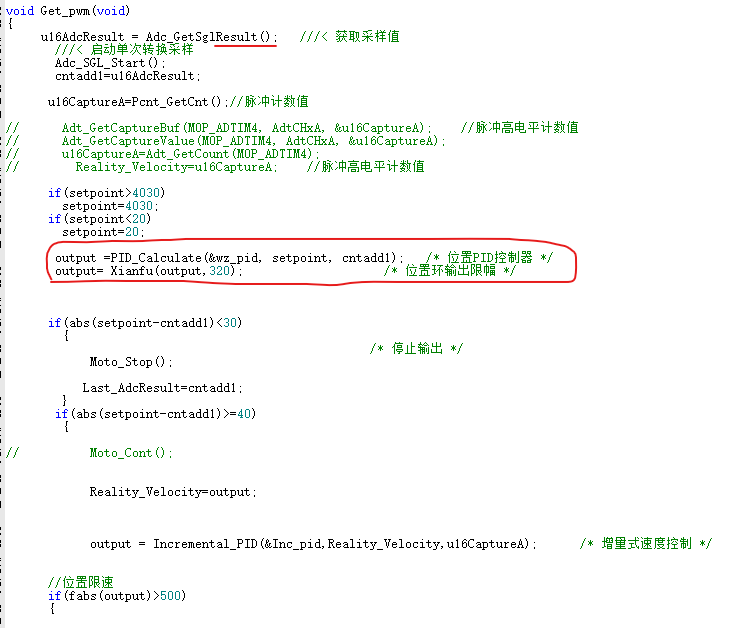
位置环PID反馈ADC获取
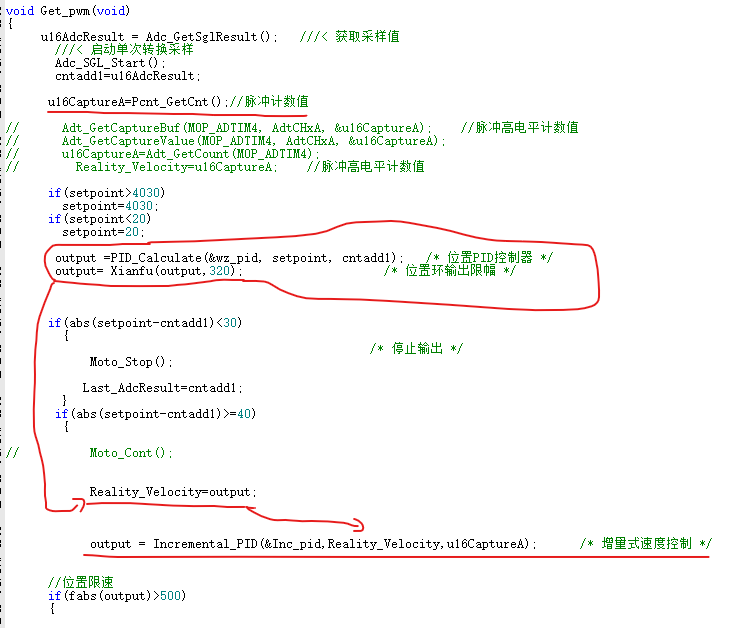
速度环PID反馈为脉冲计数,输入值为位置环的输出。
main.c
/******************************************************************************
* Copyright (C) 2017, Xiaohua Semiconductor Co.,Ltd All rights reserved.
*
* This software is owned and published by:
* Xiaohua Semiconductor Co.,Ltd ("XHSC").
*
* BY DOWNLOADING, INSTALLING OR USING THIS SOFTWARE, YOU AGREE TO BE BOUND
* BY ALL THE TERMS AND CONDITIONS OF THIS AGREEMENT.
*
* This software contains source code for use with XHSC
* components. This software is licensed by XHSC to be adapted only
* for use in systems utilizing XHSC components. XHSC shall not be
* responsible for misuse or illegal use of this software for devices not
* supported herein. XHSC is providing this software "AS IS" and will
* not be responsible for issues arising from incorrect user implementation
* of the software.
*
* Disclaimer:
* XHSC MAKES NO WARRANTY, EXPRESS OR IMPLIED, ARISING BY LAW OR OTHERWISE,
* REGARDING THE SOFTWARE (INCLUDING ANY ACOOMPANYING WRITTEN MATERIALS),
* ITS PERFORMANCE OR SUITABILITY FOR YOUR INTENDED USE, INCLUDING,
* WITHOUT LIMITATION, THE IMPLIED WARRANTY OF MERCHANTABILITY, THE IMPLIED
* WARRANTY OF FITNESS FOR A PARTICULAR PURPOSE OR USE, AND THE IMPLIED
* WARRANTY OF NONINFRINGEMENT.
* XHSC SHALL HAVE NO LIABILITY (WHETHER IN CONTRACT, WARRANTY, TORT,
* NEGLIGENCE OR OTHERWISE) FOR ANY DAMAGES WHATSOEVER (INCLUDING, WITHOUT
* LIMITATION, DAMAGES FOR LOSS OF BUSINESS PROFITS, BUSINESS INTERRUPTION,
* LOSS OF BUSINESS INFORMATION, OR OTHER PECUNIARY LOSS) ARISING FROM USE OR
* INABILITY TO USE THE SOFTWARE, INCLUDING, WITHOUT LIMITATION, ANY DIRECT,
* INDIRECT, INCIDENTAL, SPECIAL OR CONSEQUENTIAL DAMAGES OR LOSS OF DATA,
* SAVINGS OR PROFITS,
* EVEN IF Disclaimer HAS BEEN ADVISED OF THE POSSIBILITY OF SUCH DAMAGES.
* YOU ASSUME ALL RESPONSIBILITIES FOR SELECTION OF THE SOFTWARE TO ACHIEVE YOUR
* INTENDED RESULTS, AND FOR THE INSTALLATION OF, USE OF, AND RESULTS OBTAINED
* FROM, THE SOFTWARE.
*
* This software may be replicated in part or whole for the licensed use,
* with the restriction that this Disclaimer and Copyright notice must be
* included with each copy of this software, whether used in part or whole,
* at all times.
*/
/******************************************************************************/
/** \file main.c
 **
 ** A detailed description is available at
 ** @link Sample Group Some description @endlink
 **
 **   - 2019-04-22 Husj    First Version
 **
 ******************************************************************************/

/******************************************************************************
 * Include files
 ******************************************************************************/
#include "adt.h"
#include "gpio.h"
#include "flash.h"
#include "bt.h"
#include "adc.h"
#include "bgr.h"
#include "pid.h"
#include "stdio.h"
#include "stdlib.h"
#include "math.h"
#include "ddl.h"
#include "uart.h"
#include "vc.h"
#include "pcnt.h"
#include "MOTOR_con.h"
#include "gpio_control.h"
/******************************************************************************
 * Local pre-processor symbols/macros ('#define')
 ******************************************************************************/


/******************************************************************************
 * Global variable definitions (declared in header file with 'extern')
 ******************************************************************************/

/******************************************************************************
 * Local type definitions ('typedef')
 ******************************************************************************/

/******************************************************************************
 * Local function prototypes ('static')
 ******************************************************************************/

/******************************************************************************
 * Local variable definitions ('static')                                      *
 ******************************************************************************/


/*****************************************************************************
 * Function implementation - global ('extern') and local ('static')
 ******************************************************************************/


 en_adt_compare_t         enAdtCompareA;
 en_adt_compare_t          enAdtCompareB;


///< 时钟初始化
void App_ClockInit(void)
{
    en_flash_waitcycle_t      enFlashWait;
    stc_sysctrl_pll_cfg_t     stcPLLCfg;


    DDL_ZERO_STRUCT(stcPLLCfg);

    enFlashWait = FlashWaitCycle1;                      //读等待周期设置为1(当HCLK大于24MHz时必须至少为1)
    Flash_WaitCycle(enFlashWait);                       // Flash 等待1个周期

    stcPLLCfg.enInFreq    = SysctrlPllInFreq4_6MHz;     //RCH 4MHz
    stcPLLCfg.enOutFreq   = SysctrlPllOutFreq36_48MHz;  //PLL 输出48MHz
    stcPLLCfg.enPllClkSrc = SysctrlPllRch;              //输入时钟源选择RCH
    stcPLLCfg.enPllMul    = SysctrlPllMul12;            //4MHz x 12 = 48MHz
    Sysctrl_SetPLLFreq(&stcPLLCfg);
    Sysctrl_SetPLLStableTime(SysctrlPllStableCycle16384);
    Sysctrl_ClkSourceEnable(SysctrlClkPLL, TRUE);

	Sysctrl_SysClkSwitch(SysctrlClkPLL);   ///< 时钟切换为PLL锁相环时钟
}

///< AdvTimer端口初始化
void App_AdvTimerPortInit(void)
{
    stc_gpio_cfg_t        stcTIM5Port;
    stc_gpio_cfg_t        stcBrakePort;
    stc_gpio_cfg_t        stcBKTestPort;

	 stc_gpio_cfg_t         stcGpioCfg;

   stc_gpio_cfg_t stcUartGpioCfg;

	stc_gpio_cfg_t           stcTIM4Port;

	stc_gpio_cfg_t GpioInitStruct;

    DDL_ZERO_STRUCT(GpioInitStruct);

    DDL_ZERO_STRUCT(stcGpioCfg);


    DDL_ZERO_STRUCT(stcTIM4Port);

    DDL_ZERO_STRUCT(stcTIM5Port);
    DDL_ZERO_STRUCT(stcBrakePort);
    DDL_ZERO_STRUCT(stcBKTestPort);

    Sysctrl_SetPeripheralGate(SysctrlPeripheralGpio, TRUE); //端口外设时钟使能

    stcTIM5Port.enDir  = GpioDirIn;
    //PA04设置为TIM50_CHA
    Gpio_Init(GpioPortA, GpioPin4, &stcTIM5Port);
    Gpio_SetAfMode(GpioPortA,GpioPin4,GpioAf5);

    //ADC采样IO口
    Gpio_SetAnalogMode(GpioPortA, GpioPin0);        //PA00 (AIN0)


//换向端口、控制端口设置
    stcGpioCfg.enDir = GpioDirOut;
    ///< 端口上下拉配置->下拉
//    stcGpioCfg.enPu =GpioPuEnable ;
//    stcGpioCfg.enPd =GpioPdDisable ;
//    Gpio_SetIO(GpioPortD, GpioPin6);
    Gpio_Init(GpioPortD, GpioPin6, &stcGpioCfg);  //换向端口
		stcGpioCfg.enPu =GpioPuEnable ;
		Gpio_Init(GpioPortC, GpioPin0, &stcGpioCfg);  //控制端口刹车

//串口端口配置
    stcUartGpioCfg.enDir = GpioDirOut;
    Gpio_Init(GpioPortB,GpioPin6,&stcUartGpioCfg);
    Gpio_SetAfMode(GpioPortB,GpioPin6,GpioAf2); //配置PB06 为UART0 TX
    stcUartGpioCfg.enDir = GpioDirIn;
    Gpio_Init(GpioPortB,GpioPin7,&stcUartGpioCfg);
    Gpio_SetAfMode(GpioPortB,GpioPin7,GpioAf2);//配置PB07 为UART0 RX

	 stcTIM4Port.enDir  = GpioDirIn;
	 //PA08设置为TIM4_CHA
    Gpio_Init(GpioPortA, GpioPin8, &stcTIM4Port);
    Gpio_SetAfMode(GpioPortA,GpioPin8,GpioAf6);
    //PD01设置为TIM4_CHB
//    Gpio_Init(GpioPortA, GpioPin7, &stcTIM4Port);
//    Gpio_SetAfMode(GpioPortA,GpioPin7,GpioAf7);


		GpioInitStruct.enDrv = GpioDrvH;
    GpioInitStruct.enDir = GpioDirOut;
    Gpio_Init(GpioPortA,GpioPin6,&GpioInitStruct);
    Gpio_SetAfMode(GpioPortA,GpioPin6,GpioAf5);              //PA06作为比较器VC0_OUT

		GpioInitStruct.enDrv = GpioDrvH;
    GpioInitStruct.enDir = GpioDirIn;
    Gpio_Init(GpioPortB,GpioPin5,&GpioInitStruct);
    Gpio_SetAfMode(GpioPortB,GpioPin5,GpioAf6);              //PB05作为PCNT_S0

		GpioInitStruct.enDrv = GpioDrvH;
    GpioInitStruct.enDir = GpioDirIn;
		GpioInitStruct.enPu = GpioPuDisable;
		GpioInitStruct.enPd = GpioPdEnable;
    Gpio_Init(GpioPortD,GpioPin4,&GpioInitStruct);
    Gpio_Init(GpioPortD,GpioPin5,&GpioInitStruct);
		Gpio_Init(GpioPortD,GpioPin7,&GpioInitStruct);
		Gpio_Init(GpioPortB,GpioPin8,&GpioInitStruct);
		Gpio_Init(GpioPortC,GpioPin6,&GpioInitStruct);
		Gpio_Init(GpioPortB,GpioPin13,&GpioInitStruct);
}


//串口模块配置
void App_UartCfg(void)
{
    stc_uart_cfg_t  stcCfg;
    stc_uart_multimode_t stcMulti;
    stc_uart_baud_t stcBaud;

    DDL_ZERO_STRUCT(stcCfg);
    DDL_ZERO_STRUCT(stcMulti);
    DDL_ZERO_STRUCT(stcBaud);

    Sysctrl_SetPeripheralGate(SysctrlPeripheralUart0,TRUE);//UART0外设模块时钟使能

    stcCfg.enRunMode = UartMskMode3;     //模式3
    stcCfg.enStopBit = UartMsk1bit;      //1位停止位
    stcCfg.enMmdorCk = UartMskEven;      //偶校验
    stcCfg.stcBaud.u32Baud = 9600;       //波特率9600
    stcCfg.stcBaud.enClkDiv = UartMsk8Or16Div;         //通道采样分频配置
    stcCfg.stcBaud.u32Pclk = Sysctrl_GetPClkFreq();    //获得外设时钟(PCLK)频率值
    Uart_Init(M0P_UART0, &stcCfg);       //串口初始化

//    Uart_ClrStatus(M0P_UART0,UartRC);    //清接收请求
//    Uart_ClrStatus(M0P_UART0,UartTC);    //清发送请求
//    Uart_EnableIrq(M0P_UART0,UartRxIrq); //使能串口接收中断
//    Uart_EnableIrq(M0P_UART0,UartTxIrq); //使能串口发送中断

}

//void Tim4_IRQHandler(void)
//{
//    //AdvTimer4 捕获中断A
//    if(TRUE == Adt_GetIrqFlag(M0P_ADTIM4, AdtCMAIrq))
//    {
////        Adt_GetCaptureValue(M0P_ADTIM4, AdtCHxA, &u16Capture);  //读取捕获值A
////        Adt_GetCaptureBuf(M0P_ADTIM4, AdtCHxA, &u16CaptureBuf);  //读取捕获值A的缓存值
////        Adt_GetCaptureValue(M0P_ADTIM4, AdtCHxA, &u16CaptureA);    //脉冲高电平计数值
////        if(1 == Gpio_GetInputIO(GpioPortA, GpioPin8))      //PA08为高电平时
////        {
////            u16CapDuty = (u16CaptureBuf*100) / u16Capture;      //计算占空比
////        }
//        u16CaptureA++;
//        Adt_ClearIrqFlag(M0P_ADTIM4, AdtCMAIrq);    //清除捕获中断A的标志
//    }
//}


///< AdvTimer端口初始化
//void App_AdtPortInit1(void)
//{
//    stc_gpio_cfg_t           stcTIM4Port;
//
//    DDL_ZERO_STRUCT(stcTIM4Port);
//
//    Sysctrl_SetPeripheralGate(SysctrlPeripheralGpio, TRUE);  //端口外设时钟使能
//
//    stcTIM4Port.enDir  = GpioDirIn;
//    //PA08设置为TIM4_CHA
//    Gpio_Init(GpioPortA, GpioPin8, &stcTIM4Port);
//    Gpio_SetAfMode(GpioPortA,GpioPin8,GpioAf6);

//    //PA07设置为TIM4_CHB
////    Gpio_Init(GpioPortA, GpioPin7, &stcTIM4Port);
////    Gpio_SetAfMode(GpioPortA,GpioPin7,GpioAf7);
//
//}


///< AdvTimer初始化
void App_AdvTimer4Init(void)
{
    uint16_t                 u16Period;
    stc_adt_basecnt_cfg_t    stcAdtBaseCntCfg;
    stc_adt_CHxX_port_cfg_t  stcAdtTIM4ACfg;
    stc_adt_CHxX_port_cfg_t  stcAdtTIM4BCfg;

    DDL_ZERO_STRUCT(stcAdtBaseCntCfg);
    DDL_ZERO_STRUCT(stcAdtTIM4ACfg);
    DDL_ZERO_STRUCT(stcAdtTIM4BCfg);

    Sysctrl_SetPeripheralGate(SysctrlPeripheralAdvTim, TRUE); //ADT外设时钟使能


     stcAdtBaseCntCfg.enCntMode = AdtSawtoothMode;            //Sawtooth Mode
    stcAdtBaseCntCfg.enCntDir = AdtCntUp;                    // Cnt up
    stcAdtBaseCntCfg.enCntClkDiv = AdtClkPClk0Div4;          // PCLK0/4
    Adt_Init(M0P_ADTIM4, &stcAdtBaseCntCfg);                 //ADT载波、计数模式、时钟配置

    Adt_SetPeriod(M0P_ADTIM4, 0xFFFF);                       //周期设置

    stcAdtTIM4ACfg.enCap = AdtCHxCompareInput;               //ChannelA 捕获输入
    stcAdtTIM4ACfg.bFltEn = TRUE;
    stcAdtTIM4ACfg.enFltClk = AdtFltClkPclk0Div16;
    Adt_CHxXPortCfg(M0P_ADTIM4, AdtCHxA, &stcAdtTIM4ACfg);  //ChannelA配置捕获输入 & GPIO CHA 输入滤波使能

    Adt_EnableValueBuf(M0P_ADTIM4, AdtCHxA, TRUE);          //缓存传送功能打开


    Adt_CfgHwCaptureA(M0P_ADTIM4, AdtHwTrigCHxARise);  //硬件捕获A条件配置:
    Adt_CfgHwCaptureA(M0P_ADTIM4, AdtHwTrigCHxAFall);  //硬件捕获A条件配置:

    Adt_CfgHwClear(M0P_ADTIM4, AdtHwTrigCHxARise);     //硬件清零条件:CHA 端口采样到上升沿
    Adt_EnableHwClear(M0P_ADTIM4);

//		Adt_ClearAllIrqFlag(M0P_ADTIM4);
//    Adt_CfgIrq(M0P_ADTIM4, AdtCMAIrq, TRUE);           //捕获输入A中断配置
//    EnableNvic(ADTIM4_IRQn, IrqLevel3, TRUE);          //AdvTimer4中断使能

		 Adt_StartCount(M0P_ADTIM4);   //AdvTimer4 运行
}
///< AdvTimer初始化
void App_AdvTimerInit(uint16_t u16Period, uint16_t u16CHA_PWMDuty, uint16_t u16CHB_PWMDuty)
{

    stc_adt_basecnt_cfg_t    stcAdtBaseCntCfg;
    stc_adt_CHxX_port_cfg_t  stcAdtTIM5ACfg;
    stc_adt_CHxX_port_cfg_t   stcAdtTIM5BCfg;

    DDL_ZERO_STRUCT(stcAdtBaseCntCfg);
    DDL_ZERO_STRUCT(stcAdtTIM5ACfg);
    DDL_ZERO_STRUCT(stcAdtTIM5BCfg);

    Sysctrl_SetPeripheralGate(SysctrlPeripheralAdvTim, TRUE);//ADT外设时钟使能

    stcAdtBaseCntCfg.enCntMode = AdtSawtoothMode;
    stcAdtBaseCntCfg.enCntDir = AdtCntUp;
    stcAdtBaseCntCfg.enCntClkDiv = AdtClkPClk0;
    Adt_Init(M0P_ADTIM5, &stcAdtBaseCntCfg);                      //ADT载波、计数模式、时钟配置

    Adt_SetPeriod(M0P_ADTIM5, u16Period);                         //周期值

    enAdtCompareA = AdtCompareA;
    Adt_SetCompareValue(M0P_ADTIM5, enAdtCompareA, u16CHA_PWMDuty);    //通用比较基准值寄存器A设置

    enAdtCompareB = AdtCompareB;
    Adt_SetCompareValue(M0P_ADTIM5, enAdtCompareB, u16CHB_PWMDuty);  //通用比较基准值寄存器B设置

    stcAdtTIM5ACfg.enCap = AdtCHxCompareOutput;            //比较输出
    stcAdtTIM5ACfg.bOutEn = TRUE;                          //CHA输出使能

    stcAdtTIM5ACfg.enPerc = AdtCHxPeriodHigh;//AdtCHxPeriodLow;              //计数值与周期匹配时CHA电平保持不变
    stcAdtTIM5ACfg.enCmpc = AdtCHxCompareLow;//AdtCHxCompareHigh;              //计数值与比较值A匹配时,CHA电平翻转

//		stcAdtTIM5ACfg.enPerc = AdtCHxPeriodLow;              //计数值与周期匹配时CHA电平保持不变
//    stcAdtTIM5ACfg.enCmpc = AdtCHxCompareHigh;              //计数值与比较值A匹配时,CHA电平翻转

    stcAdtTIM5ACfg.enStaStp = AdtCHxStateSelSS;            //CHA起始结束电平由STACA与STPCA控制
    stcAdtTIM5ACfg.enStaOut = AdtCHxPortOutLow;            //CHA起始电平为低AdtCHxPortOutHigh   AdtCHxPortOutLow
    stcAdtTIM5ACfg.enStpOut = AdtCHxPortOutLow;            //CHA结束电平为低
    stcAdtTIM5ACfg.enDisSel = AdtCHxDisSel3;               //选择强制输出无效条件3(刹车条件3)
    stcAdtTIM5ACfg.enDisVal =AdtTIMxDisValLow; //AdtTIMxDisValHigh   ,  AdtTIMxDisValLow;            //刹车时CHA端口输出低电平
    Adt_CHxXPortCfg(M0P_ADTIM5, AdtCHxA, &stcAdtTIM5ACfg);   //CHA端口配置

    stcAdtTIM5BCfg.enCap = AdtCHxCompareOutput;
    stcAdtTIM5BCfg.bOutEn = TRUE;
    stcAdtTIM5BCfg.enPerc = AdtCHxPeriodInv;
    stcAdtTIM5BCfg.enCmpc = AdtCHxCompareInv;
    stcAdtTIM5BCfg.enStaStp = AdtCHxStateSelSS;
    stcAdtTIM5BCfg.enStaOut = AdtCHxPortOutLow;
    stcAdtTIM5BCfg.enStpOut = AdtCHxPortOutLow;
    Adt_CHxXPortCfg(M0P_ADTIM5, AdtCHxB, &stcAdtTIM5BCfg);    //端口CHB配置


    Adt_StartCount(M0P_ADTIM5); //开启TIM5,输出pwm
}


//Timer0配置初始化
void App_Timer0Cfg(uint16_t u16Period)
{
    uint16_t                  u16ArrValue;
    uint16_t                  u16CntValue;
    stc_bt_mode0_cfg_t     stcBtBaseCfg;

    DDL_ZERO_STRUCT(stcBtBaseCfg);

    Sysctrl_SetPeripheralGate(SysctrlPeripheralBaseTim, TRUE); //Base Timer外设时钟使能

    stcBtBaseCfg.enWorkMode = BtWorkMode0;                  //定时器模式
    stcBtBaseCfg.enCT       = BtTimer;                      //定时器功能,计数时钟为内部PCLK
    stcBtBaseCfg.enPRS      = BtPCLKDiv16;                 //PCLK/16
    stcBtBaseCfg.enCntMode  = Bt16bitArrMode;               //自动重载16位计数器/定时器
    stcBtBaseCfg.bEnTog     = FALSE;
    stcBtBaseCfg.bEnGate    = FALSE;
    stcBtBaseCfg.enGateP    = BtGatePositive;
    Bt_Mode0_Init(TIM0, &stcBtBaseCfg);                     //TIM0 的模式0功能初始化

    u16ArrValue = u16Period;
    Bt_M0_ARRSet(TIM0, u16ArrValue);                        //设置重载值(ARR = 周期)

    u16CntValue = u16Period;
    Bt_M0_Cnt16Set(TIM0, u16CntValue);                      //设置计数初值

    Bt_ClearIntFlag(TIM0,BtUevIrq);                         //清中断标志
    Bt_Mode0_EnableIrq(TIM0);                               //使能TIM0中断(模式0时只有一个中断)
    EnableNvic(TIM0_IRQn, IrqLevel0, TRUE);                 //TIM0中断使能


		Bt_M0_Run(TIM0);        //TIM0 运行。
}

///< ADC模块 初始化
void App_AdcInit(void)
{
    stc_adc_cfg_t              stcAdcCfg;

    DDL_ZERO_STRUCT(stcAdcCfg);

    ///< 开启ADC/BGR 外设时钟
    Sysctrl_SetPeripheralGate(SysctrlPeripheralAdcBgr, TRUE);

    Bgr_BgrEnable();        ///< 开启BGR

    ///< ADC 初始化配置
    stcAdcCfg.enAdcMode         = AdcSglMode;               ///<采样模式-单次
    stcAdcCfg.enAdcClkDiv       = AdcMskClkDiv1;            ///<采样分频-1
    stcAdcCfg.enAdcSampCycleSel = AdcMskSampCycle4Clk;     ///<采样周期数-4
    stcAdcCfg.enAdcRefVolSel    = AdcMskRefVolSelAVDD;  ///<参考电压选择-电源电压AVDD
    stcAdcCfg.enAdcOpBuf        = AdcMskBufDisable;         ///<OP BUF配置-关
    stcAdcCfg.enInRef           = AdcMskInRefDisable;        ///<内部参考电压关
    stcAdcCfg.enAdcAlign        = AdcAlignRight;            ///<转换结果对齐方式-右
    Adc_Init(&stcAdcCfg);

	   ///< ADC 采样通道配置
    Adc_CfgSglChannel(AdcExInputCH0);

		///< 启动单次转换采样
    Adc_SGL_Start();
}

static void App_VC0Init(void)
{
    stc_vc_channel_cfg_t VcInitStruct;
    DDL_ZERO_STRUCT(VcInitStruct);

    stc_vc_dac_cfg_t VcInitdac;
	  DDL_ZERO_STRUCT(VcInitdac);

    Sysctrl_SetPeripheralGate(SysctrlPeripheralVcLvd, TRUE); //开LVD时钟
    Sysctrl_SetPeripheralGate(SysctrlPeripheralAdcBgr, TRUE);//开adc时钟

    Bgr_BgrEnable();                                         //BGR必须使能

    VcInitStruct.enVcChannel = VcChannel0;
    VcInitStruct.enVcCmpDly  = VcDelay10mv;          //VC0迟滞电压约为10mV
    VcInitStruct.enVcBiasCurrent = VcBias10ua;       //VC0功耗为10uA
    VcInitStruct.enVcFilterTime  = VcFilter28us;     //VC输出滤波时间约为28us
    VcInitStruct.enVcInPin_P     = VcInPCh5;         //VC0_CH的P端连接PA01
    VcInitStruct.enVcInPin_N     = ResDivOut;//AiBg1p2;          //VC0_CH的N端连接内核1.2V
    VcInitStruct.enVcOutCfg   = VcOutDisable;     //不输出给配置寄存器所定义的外设
    VcInitStruct.bFlten          = TRUE;             //是能滤波
    Vc_Init(&VcInitStruct);

	VcInitdac.bDivEn=TRUE;
	VcInitdac.u8DivVal=5;
	VcInitdac.enDivVref=VcDivVrefAvcc;

	Vc_DacInit(&VcInitdac);
  Vc_Cmd(VcChannel0, TRUE);
    ///< VC0 中断配置
//    Vc_CfgItType(VcChannel0, VcIrqFall);          //配置VC0为上升沿中断
//    Vc_ClearItStatus(Vc0_Intf);
//    Vc_ItCfg(VcChannel0, TRUE);
//    EnableNvic(VC0_IRQn, IrqLevel3, TRUE);
}

/**
 ******************************************************************************
 ** \brief  配置PCNT脉冲计数
 **
 ** \return 无
 ******************************************************************************/
static void App_PcntInit(void)
{
    stc_pcnt_initstruct_t PcntInitStruct;
    DDL_ZERO_STRUCT(PcntInitStruct);

    Sysctrl_SetPeripheralGate(SysctrlPeripheralPcnt, TRUE);

    PcntInitStruct.Pcnt_S0Sel = PcntS0PNoinvert;  //S0输入极性不取反
    PcntInitStruct.Pcnt_Clk   = PcntCLKPclk;      //采样时钟
    PcntInitStruct.Pcnt_Mode  = PcntSingleMode; //单通道脉冲计数模式
    PcntInitStruct.Pcnt_FltEn = TRUE;          //滤波使能
    PcntInitStruct.Pcnt_DebTop = 5;            //滤波计数器阈值
    PcntInitStruct.Pcnt_ClkDiv = 1;            //滤波时钟分频系数
    PcntInitStruct.Pcnt_TocrEn = FALSE;        //超时控制使能
    PcntInitStruct.Pcnt_Dir    = PcntDirUp;   //向上计数
    Pcnt_Init(&PcntInitStruct);

    Pcnt_SetB2T(65535);
    Pcnt_ClrItStatus(PcntOV);
    Pcnt_ItCfg(PcntOV, TRUE);
    EnableNvic(PCNT_IRQn, IrqLevel3, TRUE);

    Pcnt_Cmd(TRUE);                                      //使能PCNT
}


 /*******************************************************************************
 * TIM0中断服务函数
 ******************************************************************************/
void Tim0_IRQHandler(void)
{


    //Timer0 模式0 溢出中断
    if(TRUE == Bt_GetIntFlag(TIM0, BtUevIrq))
    {

//        Get_pwm();
			  Handle_Buttons();
        Bt_ClearIntFlag(TIM0,BtUevIrq); //中断标志清零

    }
}


/**
 ******************************************************************************
 ** \brief  Main function of project
 **
 ** \return uint32_t return value, if needed
 **
 ** This sample
 **
 ******************************************************************************/
int32_t main(void)
{
    stc_adt_disable_3_cfg_t  stcAdtDisable3;

    DDL_ZERO_STRUCT(stcAdtDisable3);

    App_ClockInit();     //时钟初始化

	  App_AdvTimerPortInit();    //端口初始化

    App_AdvTimerInit(2000, 1000,1000);  //AdvTimer5初始化pwm//配置为三角波模式: 初始化周期4000, CHA占空比设置2000


//	App_AdvTimer4Init(); //TIM4


	App_Timer0Cfg(30000); //10ms一次定时中断定时

	  App_AdcInit(); //开启ADC

   ///< VC0 比较器初始化
    App_VC0Init();

		App_PcntInit(); //脉冲计数初始化

	  App_UartCfg(); //串口

//pid = PID_Init(10, 0.0002, 5, 500000.0, 2000.0);
        PID_Initset(&wz_pid,20, 0, 0, 500000.0, 2000.0);
	      PID_Initset(&Inc_pid,6, 0, 0, 500000.0, 2000.0);


	u16CaptureA=0;
    while(1)
		{

//			Adt_SetCompareValue(M0P_ADTIM5, enAdtCompareA, 1000);

		}
}
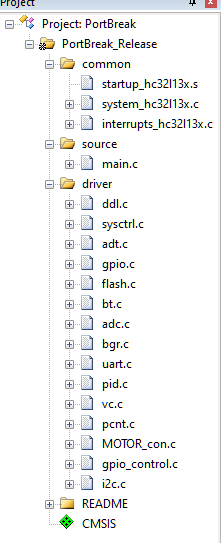
需要的库
PID值调试使用VOFA程序,单片机串口输出值,VOFA程序查看波形慢慢调试PID值
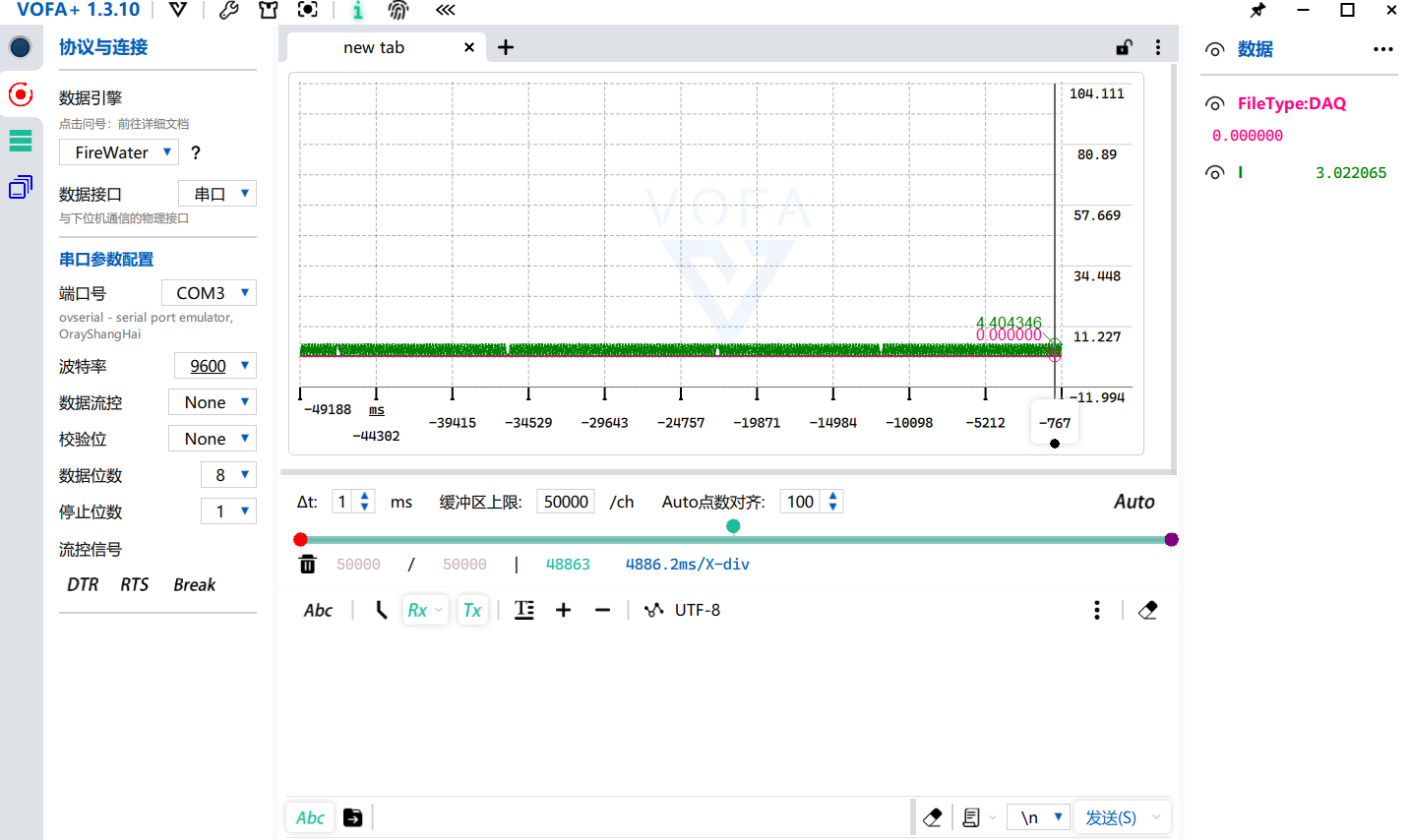
 最后得到PID值

位置环和速度环的PID值






 扫一扫
扫一扫


 705
705

 被折叠的 条评论
为什么被折叠?
被折叠的 条评论
为什么被折叠?
 到【灌水乐园】发言





