



 这篇文章描述了一种基于有限状态机(FSM)的方法来模拟lemmings的行为,包括行走、挖掘、碰撞和落地后的反应。关键逻辑在于计数落地次数和判断是否发生溅射,当lemming连续落下超过20次时,会停止活动。
See also: Lemmings1, Lemmings2, and Lemmings3.
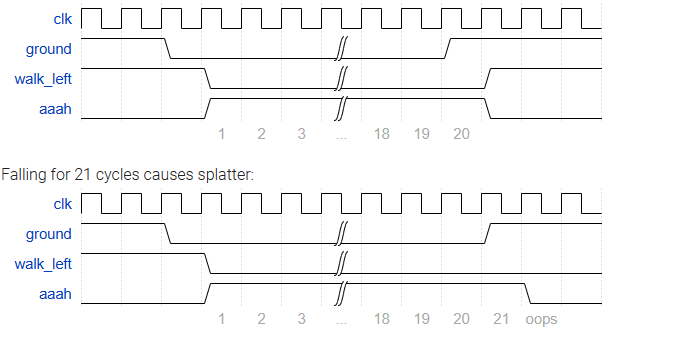
Although Lemmings can walk, fall, and dig, Lemmings aren't invulnerable. If a Lemming falls for too long then hits the ground, it can splatter. In particular, if a Lemming falls for more than 20 clock cycles then hits the ground, it will splatter and cease walking, falling, or digging (all 4 outputs become 0), forever (Or until the FSM gets reset). There is no upper limit on how far a Lemming can fall before hitting the ground. Lemmings only splatter when hitting the ground; they do not splatter in mid-air.
Extend your finite state machine to model this behaviour.
module top_module(
    input clk,
    input areset,    // Freshly brainwashed Lemmings walk left.
    input bump_left,
    input bump_right,
    input ground,
    input dig,
    output walk_left,
    output walk_right,
    output aaah,
    output digging );

    parameter LEFT = 3'b000,
    		DIG_L = 3'b110,
    		FALL_L = 3'b111,
    		SPLAT = 3'b101,
    		 RIGHT = 3'b001,
    		DIG_R = 3'b010,
    		FALL_R = 3'b011;

    reg [2:0] state;
    reg [2:0] next_state;
    reg [4:0] cnt_fall;
    reg fall_flag;

    always@(posedge clk or posedge areset)
        if(areset)
            cnt_fall <= 5'd0;
    else if(next_state == FALL_L || next_state == FALL_R)
        cnt_fall <= cnt_fall + 1;
	else
        cnt_fall <= 0;

    always@(posedge clk or posedge areset)
        if(areset)
            fall_flag <=  0;
    else if(cnt_fall == 20)
          fall_flag <= 1;
	else
        fall_flag <= fall_flag;

    always@ (posedge clk or posedge areset)
        if(areset)
            state <= LEFT;
    	else
            state <= next_state;

    always@(*)
        case (state)
            LEFT:
                if(ground == 0)
                    next_state <= FALL_L;
            	else if(dig)
                	next_state <= DIG_L;
            	else if(bump_left)
                	next_state <= RIGHT;
            	else
                	next_state <= LEFT;
            DIG_L:
                if(ground == 0)
                    next_state <= FALL_L;
            	else
                	next_state <= DIG_L;
            FALL_L:
                if(ground) begin
                   if(fall_flag)
                	next_state <= SPLAT;
                    else
                    next_state <= LEFT;
                end
            	else
                	next_state <= FALL_L;
            SPLAT:
                next_state <= SPLAT;
            RIGHT:
                 if(ground == 0)
                    next_state <= FALL_R;
            	else if(dig)
                	next_state <= DIG_R;
            else if(bump_right)
                	next_state <= LEFT;
            	else
                	next_state <= RIGHT;
            DIG_R:
                if(ground == 0)
                    next_state <= FALL_R;
            	else
                	next_state <= DIG_R;
            FALL_R:
              if(ground) begin
                   if(fall_flag)
                	next_state <= SPLAT;
                    else
                    next_state <= RIGHT;
                end
            	else
                	next_state <= FALL_R;
            default:
                next_state <= LEFT;
        endcase

    assign walk_left = (state == LEFT);
    assign walk_right = (state == RIGHT);
    assign aaah = (state == FALL_R || state == FALL_L);
    assign digging = ((state == DIG_R || state == DIG_L ));

endmodule





 扫一扫
扫一扫


 1376
1376

 被折叠的 条评论
为什么被折叠?
被折叠的 条评论
为什么被折叠?
 到【灌水乐园】发言





