
论文阅读:LLift. Enhancing static analysis for practical bug detection: An llm-integrated approach.

主要看的 oral

本文针对 linux kernel 源码中存在的 UBI(use before init) 漏洞。作者基于前人的静态分析工具 UBITect 进行改进,UBITect 使用静态分析-符号执行两个阶段检测 UBI 漏洞,但由于静态分析在效率和准确度之间的取舍产生了 95% 的 FP,并且受限于符号执行存在 40% 的超时失败案例,UbiText 会 discard 很多可能的 case。因此本文作者提出用 LLM
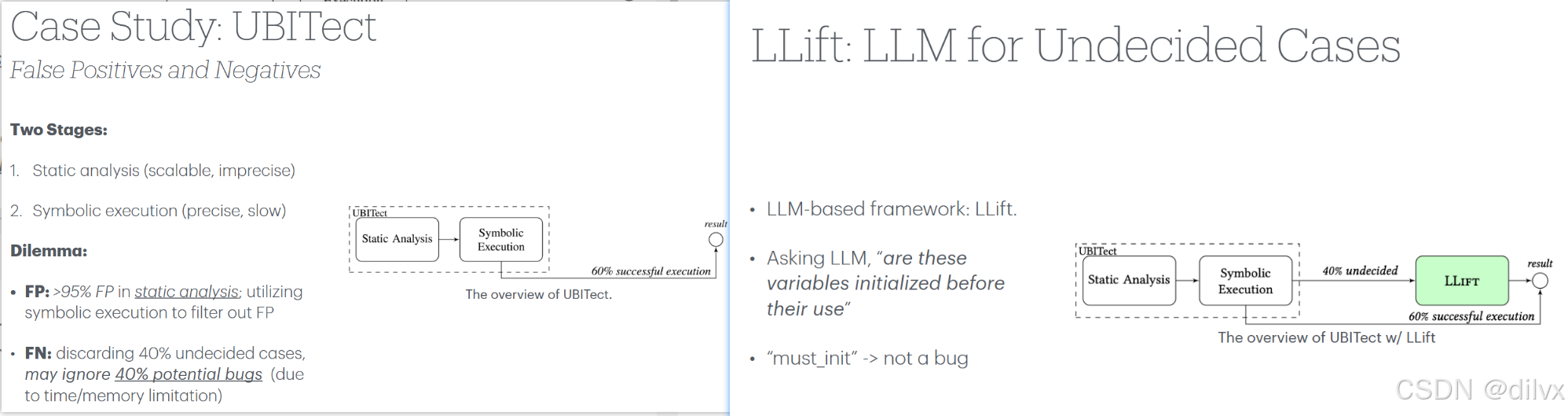
在这里插入图片描述

authors

这篇 paper 在 23 年挂到 arxiv 上,24 年发表在 OOPSLA 上。预印本的 title 是 The Hitchhiker’s Guide to Program Analysis: A Journey with Large Language Models. 发表的时候赶上热点了,不到一年两篇各 cite 50,加起来 cite 破百。

这是篇 oral. YOUTUBE | SLICES | MAINPAGE

Authors:

  • 一作:Haonan Li. UC Riverside。Links: blog |
### Java Project Lombok Library Usage and Configuration In the context of enhancing productivity by reducing boilerplate code, developers often turn towards libraries like Lombok. This library allows programmers to add annotations that automatically generate commonly used methods such as getters, setters, constructors, equals, hashcode, toString, etc., thus simplifying class definitions. To integrate Lombok into a Maven-based project, one must include it within `pom.xml`: ```xml <dependency> <groupId>org.projectlombok</groupId> <artifactId>lombok</artifactId> <version>1.18.20</version> <scope>provided</scope> </dependency> ``` After adding this dependency, ensure an IDE plugin is installed for proper annotation processing support since some editors might not recognize generated elements without additional setup[^1]. For instance, when using IntelliJ IDEA or Eclipse, specific plugins need installation from their respective marketplaces or update sites. Once configured correctly, these tools will provide real-time recognition of Lombok's features during development. With Lombok integrated successfully, consider applying its powerful annotations directly on classes where repetitive coding patterns exist. A simple example would be creating data transfer objects (DTOs): ```java import lombok.Data; @Data public class UserDto { private String name; private int age; } ``` This snippet demonstrates how effortlessly fields can gain accessors/mutators along with other utility functions through just declaring them once at the top level via `@Data`. Moreover, there are numerous specialized tags available depending upon requirements ranging from logging (`@Slf4j`) over builder pattern implementation (`@Builder`) up until thread safety aspects covered under `@Synchronized`. Each serves unique purposes aimed at streamlining daily tasks faced while crafting robust applications efficiently[^2]. --related questions-- 1. How does integrating Lombok affect compile times compared to traditional approaches? 2. What alternatives exist besides Lombok for minimizing boilerplate in Java projects? 3. Can you explain potential issues encountered after adopting Lombok in large-scale enterprise environments? 4. Is it possible to customize the behavior of auto-generated methods provided by Lombok annotations?
评论
成就一亿技术人!
拼手气红包6.0元
还能输入1000个字符
 
红包 添加红包
表情包 插入表情
 条评论被折叠 查看
添加红包

请填写红包祝福语或标题

红包个数最小为10个

红包金额最低5元

当前余额3.43前往充值 >
需支付:10.00
成就一亿技术人!
领取后你会自动成为博主和红包主的粉丝 规则
hope_wisdom
发出的红包
实付
使用余额支付
点击重新获取
扫码支付
钱包余额 0

抵扣说明:

1.余额是钱包充值的虚拟货币,按照1:1的比例进行支付金额的抵扣。
2.余额无法直接购买下载,可以购买VIP、付费专栏及课程。

余额充值



