


 本文深入探讨了Java编译器中的Attr类及其方法在语义合法性检查和逻辑判断中的应用,包括变量类型匹配、初始化状态验证及泛型方法参数类型的推导。同时,介绍了Attr类如何通过检查变量类型、方法访问合法性以及常量折叠等功能,确保代码的正确性和效率。
.
标记类为Attr,这个类中将对第一和第二阶段未标记的如Statement和Expression进行标记,作用如下:
进行语义合法性的检查和进行逻辑判断,如:
(1)变量的类型是否匹配
(2)变量在使用前是否已经初始化
(3)能够推导出泛型方法的参数类型
(4)字符串常量的合并
其中还有其它的一些辅助类来完成一些检查:
(1)Check 检查变量类型是否正确,如二元操作符两边的操作数的类型是否匹配,方法返回的类型是否与接收的引用值类型匹配等
(2)Resolve 主要检查变量、方法或者类的访问是否合法、变量是否有静态变量、变量是否已经初始化等
(3)ConstanceFold 常量折叠。
了解下Attr中的方法。
Type attribTree(JCTree jcTree, Environment<AttrContext> environment, int protoKind, Type protoType, String errKey) {
        // 保存之前的环境
		Environment<AttrContext> prevEnv = this.env;
		int prevPkind = this.protoKind;
		Type prevPt = this.protoType;
		String prevErrKey = this.errorKey;

		try {
            // 创造自己的环境
			this.env = environment;
			this.protoKind = protoKind;
			this.protoType = protoType;
			this.errorKey = errKey;

			jcTree.accept(this);
			if (jcTree == breakTree){
                throw new BreakAttr(environment);
            }
			return result;
		} catch (CompletionFailure ex) {
			jcTree.type = symbolTable.errType;
			return check.completionError(jcTree.position(), ex);
		} finally {
            // 还原之前的环境
			this.env = prevEnv;
			this.protoKind = prevPkind;
			this.protoType = prevPt;
			this.errorKey = prevErrKey;
		}
    }
替换Attr中的几个属性,如下:
/** Visitor argument: the current env.
     */
    Environment<AttrContext> env;

    /** Visitor argument: the currently expected proto-kind.
     */
    int protoKind;

    /** Visitor argument: the currently expected proto-type.
     */
    Type protoType;

    /** Visitor argument: the error key to be generated when a type error occurs
     */
    String errorKey;

    /** Visitor result: the computed type.
     */
    Type result;
这个方法主要由以下的两个方法调用,如下:
/** Visitor method: attribute a tree, catching any completion failure
     *  exceptions. Return the tree's type.
     *
     *  @param jcTree    The tree to be visited.
     *  @param environment     The environment visitor argument.
     *  @param protoKind   The protokind visitor argument. protoKind 为Symbol的类型Kinds
     *  @param protoType   The prototype visitor argument. prototype为Type的类型TypeTags
     */
    Type attribTree(JCTree jcTree, Environment<AttrContext> environment, int protoKind, Type protoType) {
        return attribTree(jcTree, environment, protoKind, protoType, "incompatible.types"); // 不兼容的类型
    }

    public Type attribExpression(JCTree jcTree, Environment<AttrContext> environment, Type protoType, String key) {
        Type temp = null;
        if(protoType.typeTag != ERROR){
            temp = protoType;
        }else{
            temp = Type.noType;
        }
        return attribTree(jcTree, environment, _VAL_12, temp , key);
    }
如上两个方法由下面这几个方法调用,主要是attribStatement(),attribType()与attribExpression(),如下:
    /** Derived visitor method: attribute an expression tree.
     */
    public Type attribExpression(JCTree jcTree, Environment<AttrContext> environment, Type protoType) {
        Type temp = null;
        if(protoType.typeTag != ERROR){
            temp = protoType;
        }else{
            temp = Type.noType;
        }
        return attribTree(jcTree, environment, _VAL_12, temp);  // String a = "a".toString()
    }

    /** Derived visitor method: attribute an expression tree with
     *  no constraints on the computed type.
     */
    Type attribExpression(JCTree jcTree, Environment<AttrContext> environment) {
        return attribTree(jcTree, environment, _VAL_12, Type.noType); // "a".toString();
    }

    /** Derived visitor method: attribute a type tree.
     */
    Type attribType(JCTree jcTree, Environment<AttrContext> environment) {
    	Type result = attribTree(jcTree, environment, _TYP_2, Type.noType); // 类型参数相关
    	return result;
    }

    /** Derived visitor method: attribute a statement or definition tree.
     */
    public Type attribStatement(JCTree jcTree, Environment<AttrContext> environment) {
        return attribTree(jcTree, environment, _NIL_0, Type.noType); // "a".toString()
    }
重点关注调用方法时为方法参数protoKind与protoType指定的值。
举例来说变量的类型是否匹配是如何检查的,如下:
package m20170409;

public class TestA<T> {

	public Integer x(){
		return new Integer(2);
	}

	public void test(int a){
		Integer x = x().toString();  // 声明与初始化类型不匹配
	}
}
主要看代码Integer x = x().toString();的JCVariableDeclaration语法节点。
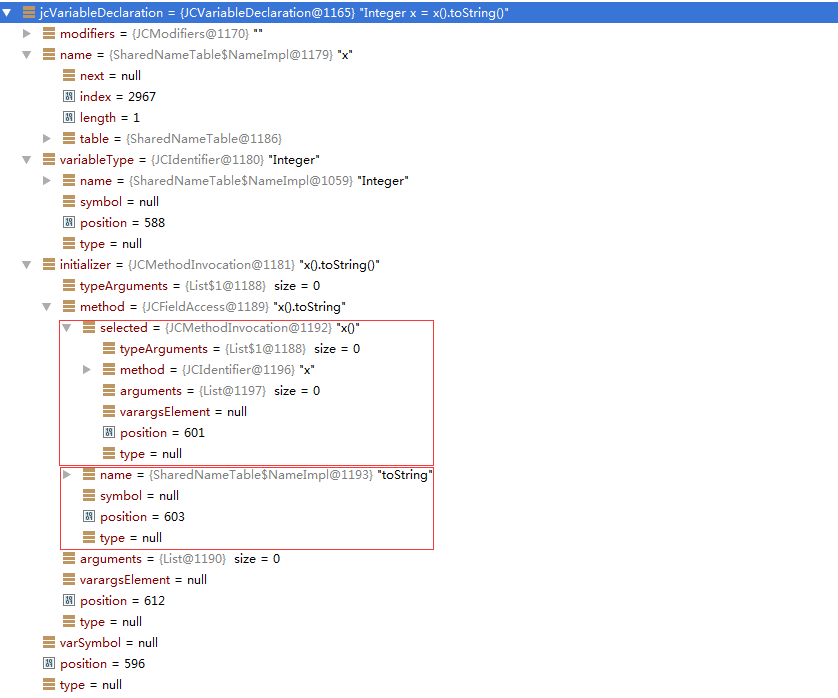
首先看对variableType属性的处理,这个节点是JCIdentifier类型,调用如下方法来标记:
attribTree(jcTree, environment, _TYP_2, Type.noType);
进一步调用了visitIdentifier()方法来处理,如下:





 扫一扫
扫一扫


 2万+
2万+

 被折叠的 条评论
为什么被折叠?
被折叠的 条评论
为什么被折叠?
 到【灌水乐园】发言





