<think>我们参考了用户提供的三个引用,其中引用[1]和引用[2]都提供了计算某一天是该年第几天的方法,引用[3]使用了time模块的方法。用户明确要求使用Python实现计算年月日是该年的第几天。
我们将提供两种方法:
1. 常规方法(不使用标准库):通过判断闰年来计算,类似于引用[1]和[2]。
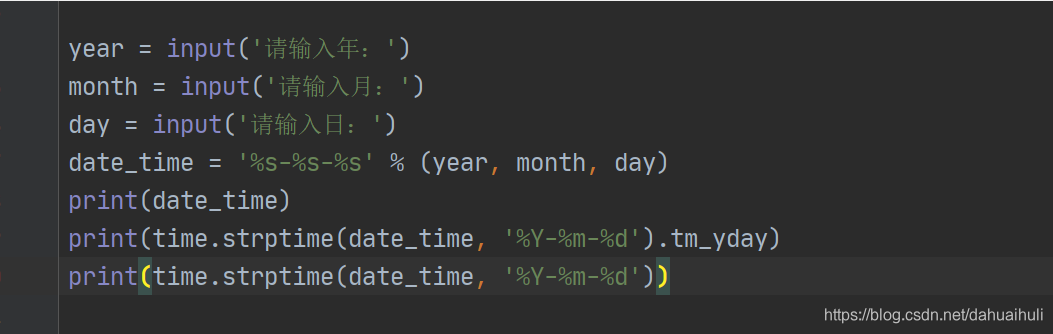
2. 使用time模块(标准库方法):类似于引用[3],但需注意引用[3]中要求年份在1970-2038之间(因为是基于时间戳,实际上Python的time模块可以处理更广的年份,但不同系统可能有限制)。
考虑到用户可能希望有一个通用的解决方案,我们将重点放在常规方法上,因为它不受年份限制。
### 常规方法思路:
1. 判断输入年份是否为闰年,以确定2月的天数。
2. 将每个月的天数存储在一个列表中(注意闰年和平年)。
3. 计算输入月份之前的所有月份的天数之和,然后加上当前月的日期。
### 代码实现(常规方法):
```python
def is_leap_year(year):
"""判断是否为闰年"""
return (year % 4 == 0 and year % 100 != 0) or (year % 400 == 0)
def day_of_year(year, month, day):
"""计算某一天是该年的第几天"""
# 定义每个月的天数,闰年2月有29天,平年28天
# 这里使用两个列表的列表,通过判断闰年来选择第二个列表(闰年)
# 也可以用一个列表,然后根据闰年修改2月的天数
months_days = [
[31, 28, 31, 30, 31, 30, 31, 31, 30, 31, 30, 31], # 平年
[31, 29, 31, 30, 31, 30, 31, 31, 30, 31, 30, 31] # 闰年
]
# 判断闰年,如果是闰年则取下标1,否则0
days_list = months_days[1] if is_leap_year(year) else months_days[0]
# 检查输入月份和日期是否有效
if month < 1 or month > 12:
raise ValueError("月份必须在1~12之间")
if day < 1 or day > days_list[month-1]:
raise ValueError(f"日期必须在1~{days_list[month-1]}之间")
# 计算该月之前的所有月份的天数总和
total_days = 0
for i in range(month - 1):
total_days += days_list[i]
total_days += day
return total_days
# 测试
print(day_of_year(2020, 3, 1)) # 2020是闰年,3月1日应该是第61天
print(day_of_year(2021, 3, 1)) # 2021非闰年,3月1日应该是第60天
```
### 使用time模块的方法(注意年份范围限制通常为1970-2038,但实际取决于系统):
```python
import time
def day_of_year_using_time(year, month, day):
# 构建时间字符串
date_str = f"{year}-{month}-{day}"
# 尝试解析日期
try:
struct_time = time.strptime(date_str, "%Y-%m-%d")
return struct_time.tm_yday
except ValueError as e:
# 如果日期不合法,抛出异常
raise ValueError("输入的日期不合法") from e
# 测试
print(day_of_year_using_time(2020, 3, 1)) # 61
```
### 说明:
1. 常规方法更通用,不受年份限制,但需要自己处理闰年逻辑。
2. time模块方法简洁,但可能受系统时间范围限制(如Unix时间戳是从1970年开始的,最大年份也可能有限制)。
### 相关问题
1. 如何判断一个年份是否为闰年?
2. Python中如何处理日期时间数据?
3. 除了上述方法,还有哪些Python库可以用于日期计算?
[^1]: 引用用户提供的引用[1]中的代码示例。
[^2]: 引用用户提供的引用[2]中的代码示例。
[^3]: 引用用户提供的引用[3]中的代码示例。
</think>### Python计算年月日是该年第几天的方法
计算指定日期是该年的第几天是常见的日期处理需求,主要涉及闰年判断和月份天数累加。以下是两种常用实现方法:
#### 方法1:常规计算(推荐)
```python
def is_leap_year(year):
"""判断是否为闰年"""
return (year % 4 == 0 and year % 100 != 0) or (year % 400 == 0)
def day_of_year(year, month, day):
"""计算指定日期是该年的第几天"""
# 每月天数表(二维数组,索引0为平年,1为闰年)
days_in_month = [
[31, 28, 31, 30, 31, 30, 31, 31, 30, 31, 30, 31], # 平年
[31, 29, 31, 30, 31, 30, 31, 31, 30, 31, 30, 31] # 闰年
]
# 获取对应年份的天数表
month_days = days_in_month[1] if is_leap_year(year) else days_in_month[0]
# 计算天数:前(month-1)个月的天数 + 当前月天数
return sum(month_days[:month-1]) + day
# 测试用例
print(day_of_year(2023, 2, 15)) # 输出:46 (2023年是非闰年)
print(day_of_year(2024, 3, 1)) # 输出:61 (2024年是闰年)
```
#### 方法2:使用time模块(需1970-2038年内)
```python
import time
def calc_day_with_time():
year = int(input("输入年份(1970-2038): "))
month = int(input("输入月份(1-12): "))
day = int(input("输入日期(1-31): "))
date_str = f"{year}-{month}-{day}"
day_of_year = time.strptime(date_str, "%Y-%m-%d").tm_yday
print(f"{year}年{month}月{day}日是当年的第{day_of_year}天")
calc_day_with_time()
```
#### 关键逻辑说明:
1. **闰年判断**:满足 `(year % 4 == 0 and year % 100 != 0) or (year % 400 == 0)` 即为闰年[^1]
2. **月份天数处理**:
- 通过二维列表存储平年/闰年的月份天数
- 使用切片 `month_days[:month-1]` 获取前N个月的天数[^2]
3. **日期有效性检查**:
- 月份范围:1-12
- 日期范围:需校验当月实际天数(可在函数中添加验证逻辑)
#### 注意事项:
1. 方法2的 `time.strptime()` 有年份范围限制(通常1970-2038)
2. 实际使用中建议添加日期有效性验证(如2月30日为非法日期)
3. 如需更大年份范围,推荐使用方法1
### 相关问题
1. 如何在Python中验证用户输入的日期是否合法?
2. 除了上述方法,还有哪些Python库可以处理日期计算(如datetime)?
3. 如何计算两个日期之间相差的天数?
4. 闰年判断规则的历史演变和特殊年份处理?
[^1]: 参考引用[1]中的闰年判断逻辑
[^2]: 基于引用[2]的月份天数累加思路优化
[^3]: 引用[3]提供的time模块实现方法