


 本文深入介绍了机器学习中的各种概念和技术,包括Sklearn库的常用操作,如OneHotEncoder、GridSearch、SDGClassifier、混淆矩阵等。进一步探讨了TensorFlow中的神经网络构建,如激活函数、复杂模型、优化器和RNN(LSTM)。内容涵盖从线性回归到深度学习的多个方面,是理解机器学习和深度学习的宝贵资源。
文章目录
- SKlearn
- Tensorflow
SKlearn
common符号
m is the number of instance
x
(
i
)
x^{(i)}
x(i)a vector of all feature value of the
i
t
h
i^{th}
ith instance
X is a matrix containing all feature values(excluding labels)
(
(
x
(
1
)
)
T
(
x
(
2
)
)
T
.
.
.
(
x
(
2000
)
)
T
)
\left(\begin{array}{c} \left( x^{(1)} \right) ^T\\ \left( x^{(2)} \right) ^T\\ ...\\ \left( x^{(2000)} \right) ^T\\ \end{array}\right)
⎝⎜⎜⎜⎛(x(1))T(x(2))T...(x(2000))T⎠⎟⎟⎟⎞
h is prediciton function, also called hypothesis
y
^
=
h
(
x
(
1
)
)
=
158
,
300
\hat y = h(x^{(1)}) = 158,300
y^=h(x(1))=158,300
ONneHotEncoder p67
p67
假设一个n行column有m个不同categorical 元素,那么会将其转换成n
×
\times
× m 的稀疏矩阵,对应 元素为1,其他元素为0.
Grid Search p76
Try all permutation of hyper parameters with a chosen estimator, return the best one.
代码如下
from sklearn.model_selection import GridSearchCV
param_grid = [
   {'n_estimators': [3,10,30], 'max_features': [2,4,6,8]}
   {'bootstrap': [False],  'n_estimators': [3, 10], 'max_features': [2,3,4]},
   ]
forest_reg = RandomForestRegressor()
grid_search = GridSearchCV(forest_reg, param_grid, cv=5,
   							scoring='neg_mean_squared_error',
   							return_train_score=True)
grid_search.fit(housing_prepared, housing_labels)
GridSearchCV.best_params_ 返回dict类型的params
GridSearchCV.best_estimator_ 返回最优estimator
For more randomness, try from sklearn.model_selection import RandomizedSearchCV on page #78.
如何测试结果 p79
1.pipeline.transform(X_test)
2. pipeline.transform(Y_test) //X,Y来自test_set
3. final_predictions = final_model.predict(X_test_prepared)
4. final_mse = mean_squared_error(y_test, final_predictions)
5. final_rmse = np.sqrt(final_mse)
SDGClassifier p88
Stochastic Gradient Descent (一个linear model)
from sklearn.linear_model import SDGClassifier
sgd_clf = SDGClassifier(random_state=42)
sgd_clf.fit(X_train, y_train)
- 计算loss function随意选择一个sample,而不是计算对于所有的loss的和。
- 比普通gradient更快
cross_va_predict p90
代码如下
from sklearn.model_selection import cross_val_predict
y_train_pred = cross_val_predict(<estimator>, X_train, y_train_5, cv = 3)
这里estimator不用被fit, 所有的prediction都是‘clean'的(没有被用到train set)
confusion_matrix p90
( 53057 , 1522 1325 , 4096 ) \begin{pmatrix} 53057, & 1522\\ 1325, &4096\end{pmatrix} (53057,1325,15224096) = ( T r u e N e g a t i v e ( T N ) , F a l s e P o s i t i v e ( F P ) F a l s e N e g a t i v e ( F N ) , T r u e P o s i t i v e ( T P ) ) \begin{pmatrix} True~Negative(TN), & False~Positive(FP)\\ False~Negative(FN), &True~Positive(TP)\end{pmatrix} (True Negative(TN),False Negative(FN),False Positive(FP)True Positive(TP))
− − − − − − − − − − − − − − − − − − − − − − − − − − − − − − − ------------------------------- −−−−−−−−−−−−−−−−−−−−−−−−−−−−−−−
Precision = T P T P + F P \displaystyle \frac{TP}{TP + FP} TP+FPTP, 接近于1说明”留下的都是好人“
Recall = T P T P + F N \displaystyle \frac{TP}{TP + FN} TP+FNTP, 接近于1说明”好人都被留下了”
代码如下
from sklearn.metrics import confusion_matrix
confusion_matrix(actural, predicted)
#precision and recall
from sklearn.metrics import precision_score, recall_score
precision_score(y_train_5, y_train_pred)
recall_score(y_train_5, y_train_pred)
receiver operating characteristic (ROC) curve p97
plot true positive rate (recall) against false positive rate
True positive rate = recall = T P T P + F P \displaystyle \frac{TP}{TP + FP} TP+FPTP,
false positive rate (FPR) = F P F P + T N \displaystyle \frac{FP}{FP + TN} FP+TNFP,
from sklearn.metrics import roc_curve
fpr, tpr, thresholds = roc_curve(y_train_5, y_scores)
plt.plot(fpr, tpr, linewidth=2, label=label)
OvR, OvO p100
OvR: one-versus the rest
- run n 次,看哪个class得分最高
OvO: one-versus-one
- run N ∗ ( N − 1 ) 2 \frac{N*(N-1)}{2} 2N∗(N−1)次,看那个类赢的duel次数最多
from sklearn.multiclass import OneVsRestClassifier #或者OneVsOneClassfier
ovr_clf = OneVsRestClassifier(SVC())
ovr_clf.fit(X_train, y_train)
Linear Regression
y
^
=
θ
0
+
θ
1
x
1
+
.
.
.
+
θ
n
x
n
\hat y = \theta_0 + \theta_1x_1 + ... + \theta_nx_n
y^=θ0+θ1x1+...+θnxn
注意
θ
0
\theta_0
θ0是bias, 再与x相乘的时候要 add x0 = 1 to each instance
X_b = np.c_[np.ones((100,1)), X]
Normal Equation:
theta_best = np.linalg.inv(X_b.T.dot(X_b)).dot(X_b.T).dot(y)
support vector machine
Binary classifier
如果结果不是binary, sklearn自动run OvO
from sklearn.svm import SVC
svm_clf = SVC()
svm_clf.fit(X_train, y_train)
svm_clf.predict([some_digit])
#或者SGD也可以
TF embedding layer
吧一个categorical data转换为(64) demensional vector. 越接近的category的vector角度之间越小
import tensorflow as tf
from tensorflow import keras
import numpy as np
model = keras.Sequential()
model.add(tf.keras.layers.Embedding(1000, 64, batch_input_shape=[32, None]))
y = model.predict([5])
y.shape
#(1,1,64)
softmax
s o f t m a x ( x i ) = exp ( x i ) ∑ j = 1 n exp ( x j ) softmax(x_i) = \frac{\exp(x^i )}{\sum^n_{j=1}\exp(x^j)} softmax(xi)=∑j=1nexp(xj)exp(xi)
PCA p225
project to low dimensional space, keeping the maximum variance
SVD: Singular Value Decomposition, 一个theorem that 任何matrix A m n A_{mn} Amn都可以转换成 U m m S m n V n n T U_{mm}S_{mn}V_{nn}^T UmmSmnVnnT,
SVD详细介绍以及算法
V就是我们的principal ccomponent.
这里
U
,
V
T
U, V^T
U,VT是orthogonal matrix, aka
U
T
U
=
I
U^TU = I
UTU=I, S 是diagonal matrix 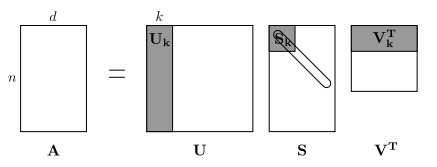
Incremental PCA (IPCA)
split the training set into mini-batches.
Kernel PCA (KPCA)
uses the kernel trick, RBF kernel for example.
use gridSearch to selsect the kernel and hyperparaeters.
LLE
Manifold learning technique
First measuring how each training instance linearly relates to its cloest neighbors
then looking for a low-dimentsional representation of the training set where theses local relationsips are best preserved.
W
^
=
a
r
g
m
i
n
w
(
x
(
i
)
∑
j
−
1
m
w
i
,
j
x
(
j
)
)
subject to
{
w
i
,
j
=
1
i
f
x
(
j
)
is not one of the k c.n. of
x
(
i
)
∑
j
=
1
m
w
i
,
j
=
1
f
o
r
i
=
1
,
2
,
.
.
.
,
m
\hat W = \underset{w}{argmin} (x^{(i)} \sum^m_{j-1} w_{i,j} x^{(j)})\\ \text{subject to} \begin{cases} w_{i,j} = 1 & if x^{(j)} \text{is not one of the k c.n. of }x{(i)} \\ \sum_{j = 1}^m w_{i,j} = 1 & for i = 1,2,...,m \end{cases}
W^=wargmin(x(i)j−1∑mwi,jx(j))subject to{wi,j=1∑j=1mwi,j=1ifx(j)is not one of the k c.n. of x(i)fori=1,2,...,m
W是一个m x m的矩阵,W_i 的sum为1,
w
i
.
j
w_{i.j}
wi.j越大代表
x
(
i
)
,
x
(
j
)
x^{(i)}, x^{(j)}
x(i),x(j)越接近
然后我们寻咋
z
^
\hat z
z^
Z
^
=
a
r
g
m
i
n
Z
∑
i
=
1
m
(
z
(
i
)
−
∑
j
=
1
m
w
^
i
,
j
z
(
j
)
)
2
\hat Z = \underset{Z}{argmin} \sum_{i=1}^m (z^{(i)} - \sum_{j = 1}^m \hat w _{i,j} z ^{(j)} ) ^2
Z^=Zargmini=1∑m(z(i)−j=1∑mw^i,jz(j))2
complexity:
O
(
m
log
(
m
)
n
log
(
k
)
)
O(m \log (m) n \log (k))
O(mlog(m)nlog(k)) for knn,
O
(
m
n
k
3
)
O(mnk^3)
O(mnk3) for optimizing the wieght, and
O
(
d
m
2
)
O(dm^2)
O(dm2) for constructing z
K-Means p239
unsupervised learning,找到k个centroid
inertia是 mean squared distance betwee neach instance and its closest centroid.
k越大ineratia越小
怎么选k?plot inertia下降曲线,选转折点(coarse approach)
silhouette score
mean silhouette coefficient over all the instances.
silhouette coefficient is equal to (b-1) / max(a, b)
a is the mean distance to the other instances
from sklearn.cluster import KMeans
k = 5
kmeans = KMeans(N_cluster=k)
y_pred = kmeans.fit_predict(X)
>>> y_pred
>array([4,0,1, ... , 2, 1 0], dtype=int32
>>>kmeans.cluster_centers_
array([[-2.8, 1.8],
[0.2, 2.2],
[-2.7, 2,7],
[-1.4, 2.2],
[-2.8, 1.3]])
Process
- start by placing the centroids randomly
- lavel the instances
- update the centroids
- repeat 2 and 3
we can avvoid unluckiness by
good_init = np.array([[-3,3],[-3,2], [-3,1], [-1,2], [0,2]])
kmeans = KMeans(n_clusters=5, init=good_init, n_init - 1)
Or trying more
or
K_Means++
- Take one random centroid c ( 1 ) c^{(1)} c(1)
- chosse an instand x ( i ) x{(i)} x(i) with probability D ( x ( i ) ) 2 / ∑ j = 1 m D ( x ( j ) ) 2 D(x{(i)})^2 / \sum^m_{j = 1} D (x^{(j)})^2 D(x(i))2/∑j=1mD(x(j))2
Accelerated K-Means – by Charles Elkan
use triangle inequality
MiniBatchKMeans
as title, use mini batches
speeds up by three or four
Gaussian Mixtures
假设每个clusture都是高斯分布
If z ( i ) = j z^{(i)}=j z(i)=j,then x ( i ) . ~ N ( u ( j ) , σ ( j ) ) . x^{(i)} \tilde . N(u^{(j)}, \sigma^{(j)}). x(i).~N(u(j),σ(j)).
其他类型Kmeans
BIRCH
处理大数据
Mean-Shift
Tensorflow
Perceptron
和neuron差不多(应该?) 每个perceptron有一个z,
z
=
w
T
w
z = w^Tw
z=wTw, 然后有一个threshold。
h
e
a
v
i
s
i
d
e
(
z
)
=
{
0
z
<
0
1
z
≥
0
heaviside (z) = \begin{cases} 0 & z < 0 \\ 1 & z \geq 0 \end{cases}
heaviside(z)={01z<0z≥0
每一层都会有bias,有额外的neuron来表示。这个neuron没有input edge只有output edge
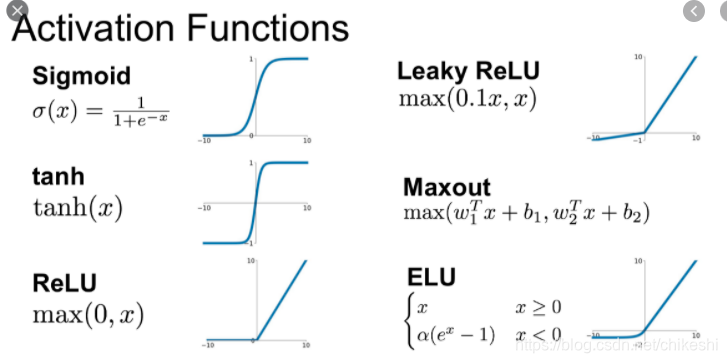
Activation functions p292
没有non linearity的话MLP(mult layer perceptions)就只是一个single layer
Leaky Relu
L R e L U ( x ) = m a x ( α x , x ) LReLU(x) = max(\alpha x, x) LReLU(x)=max(αx,x)
Parametric leaky ReLU
P R e L U ( x ) = m a x ( α x , x ) , a is trainable PReLU(x) = max(\alpha x, x), \text{a is trainable} PReLU(x)=max(αx,x),a is trainable
Scaled ELU (SELU)
S
E
L
U
(
x
)
=
λ
{
x
x
≥
0
a
(
e
x
−
1
)
x
<
0
SELU(x) = \lambda \begin{cases} x & x \geq 0 \\ a(e^x - 1) & x < 0 \end{cases}
SELU(x)=λ{xa(ex−1)x≥0x<0
比ELU多了个lambda, 貌似是最好用的
Complex Models
Wide & Deep nn p309
吧input层和最后的hidden layer直接拼在一起然后通过output layer
- 可以使模型capture最基础的特征
Keras多种用法
Subclassing API to build dynamic models p313
keras.Model可以被继承
Save a model p314
Using Callbacks p315
在model.fit里加上 callbacks=[f1,f2...], 这里f1,f2是keras.callbacks里的方法
TensorBoard p317
一个interactive visualization tool to view the leanrning curves during tranning.
Grid Search p321
RandomizedSearchCV(keras_reg, param_distribs, n_iter=10, cv=3)
zooming
when a region of parameter space is good, search more in it``
Vanishing/Exploding Gradient problem p332
Q; 不太懂为什么会梯度消失,既然每neuron都是下一层的总和
- 下一层有正有负,所以当做每层只有一个neuron就好
Xavier/Glorot initialization
fan_in: the number of inputs of a layer
fan_out: the number neurons of a layer
fan_avg = (fan_in + fan_out)/2
两种方式:normal distribution with mean 0 and variance
σ
=
1
f
a
n
a
v
g
\sigma = \frac{1}{fan_{avg}}
σ=fanavg1
或者 uniform idstribution between -r and +r, with
r
=
3
f
a
n
a
v
g
r = \sqrt{\frac{3}{fan_{avg}}}
r=fanavg3
| Initialization | Activation functions | variance |
|---|---|---|
| Glorot | None, tanh, logistic, softmax | 1/fan_avg |
| He | ReLU and variants | 2/fan_in |
| LeCun | SELU | 1/fan_in |
Mean是0非常重要,否则有可能explode
Nonsaturating Activation Functions:
Nonsaturating activation function指的是𝑓 is non-saturating iff (|lim𝑧→−∞𝑓(𝑧)|=+∞)∨(|lim𝑧→+∞𝑓(𝑧)|=+∞)
saturating 有左右边界
Batch Normalization
let the model learn the optimal scale and mean of eacho f the layer’s inputs
B指的是mini-batch B
u
B
=
1
m
B
∑
i
=
1
B
x
(
i
)
σ
B
2
=
1
m
B
∑
i
=
1
B
(
x
(
i
)
−
u
B
)
2
x
^
(
i
)
=
x
−
u
B
σ
B
2
+
ϵ
z
^
(
i
)
=
γ
⊗
x
(
i
)
+
β
u_B = \frac{1}{m_B} \sum_{i=1}^B x^{(i)}\\ \sigma_B^2 =\frac{1}{m_B}\sum_{i=1}^B (x^{(i)} - u_B)^2\\ \hat{x}^{(i)} = \frac{x-u_B}{\sqrt{\sigma_B^2+\epsilon}}\\ \hat z^{(i)} = \gamma \otimes x^{(i)} + \beta
uB=mB1i=1∑Bx(i)σB2=mB1i=1∑B(x(i)−uB)2x^(i)=σB2+ϵx−uBz^(i)=γ⊗x(i)+β
γ
,
β
\gamma, \beta
γ,β 是我们要训练的
train的时间增加,但runtime的速度一样,因为原本的
X
W
+
b
→
γ
⊗
(
X
W
+
b
)
+
β
XW + b \rightarrow \gamma \otimes (XW + b) + \beta
XW+b→γ⊗(XW+b)+β
Gradient Clipping
如果gradient 大于1 / 小于 -1, 那么限制他在[1,-1]之内
Transfer Learning p348
reuse pretrained layer
迁移学习在low level feature相似的情况下效果最好
lower layer 对应 low level feature
upper layer 对应 upper level feature
所以我们要去掉深的层,留下浅的并把它锁住。
lower level feature例子: first order image gradients
Pretraining on an Auxiliary Task
如果transfer learning没有类似model怎么办?
- 自己训练一个
比如我想训练识别猫头鹰,但没有很多照片
如果我有很多鸟类照片,可以先训练个识别鸟类的model
锁住model,加上几层继续训练
Optimizer
Momentum Optimizer
m ← β 1 m − η ∇ θ J ( θ ) θ ← θ − m m \leftarrow \beta_1 m - \eta \nabla_\theta J(\theta)\\ \theta \leftarrow \theta - m m←β1m−η∇θJ(θ)θ←θ−m
Nesterov Accelerated Gradient
m
←
β
m
−
η
∇
θ
J
(
θ
+
β
m
)
θ
←
θ
+
m
(
η
=
0.001
,
β
=
0.9
by default
)
m \leftarrow \beta m - \eta \nabla_\theta J(\theta + \beta m)\\ \theta \leftarrow \theta + m ( \eta = 0.001, \beta = 0.9 \text{ by default})
m←βm−η∇θJ(θ+βm)θ←θ+m(η=0.001,β=0.9 by default)
吧正常的
θ
\theta
θ 变成了
θ
+
β
m
\theta + \beta m
θ+βm, 计算了稍稍往前一点地方的gradient
AdaGrad
scale down the gradient vector along the steepest dimensions.
减少梯度高的梯度,为了更好的朝中心下降。
会让training变慢,但下的比较快
s
←
s
+
∇
θ
J
(
θ
)
⊗
∇
θ
J
(
θ
)
θ
←
θ
−
η
∇
θ
J
(
θ
)
⊘
s
+
ϵ
s \leftarrow s + \nabla_\theta J(\theta) \otimes \nabla_\theta J(\theta) \\ \theta \leftarrow \theta - \eta \nabla_\theta J(\theta) \oslash \sqrt{s+\epsilon}
s←s+∇θJ(θ)⊗∇θJ(θ)θ←θ−η∇θJ(θ)⊘s+ϵ
不要用在DNN里,会过早停下训练。(在最低点周围的gradient很小,square一下几乎就没有了)
RMSProp
s ← β s + ( 1 − β ) ∇ θ J ( θ ) ⊗ ∇ θ J ( θ ) θ ← θ − η ∇ θ J ( θ ) ⊘ s + ϵ s \leftarrow \beta s +(1-\beta) \nabla_\theta J(\theta) \otimes \nabla_\theta J(\theta) \\ \theta \leftarrow \theta - \eta \nabla_\theta J(\theta) \oslash \sqrt{s+\epsilon} s←βs+(1−β)∇θJ(θ)⊗∇θJ(θ)θ←θ−η∇θJ(θ)⊘s+ϵ
这会让s小一点,于是 θ \theta θ就大一点 芜湖~
Adam and Nadam
芜湖,最常见的出现了
$$ m \leftarrow \beta_2 m - \eta \nabla_\theta J(\theta)\
s \leftarrow \beta_1 s +(1-\beta_1) \nabla_\theta J(\theta) \otimes \nabla_\theta J(\theta) \
\hat m \leftarrow \frac{m}{1-a^n}\
\theta \leftarrow \theta - m\
\theta \leftarrow \theta - \eta \nabla_\theta J(\theta) \oslash \sqrt{s+\epsilon}
$$
RNN(LSTM)
sigmoid表示gate,0-1的probalility
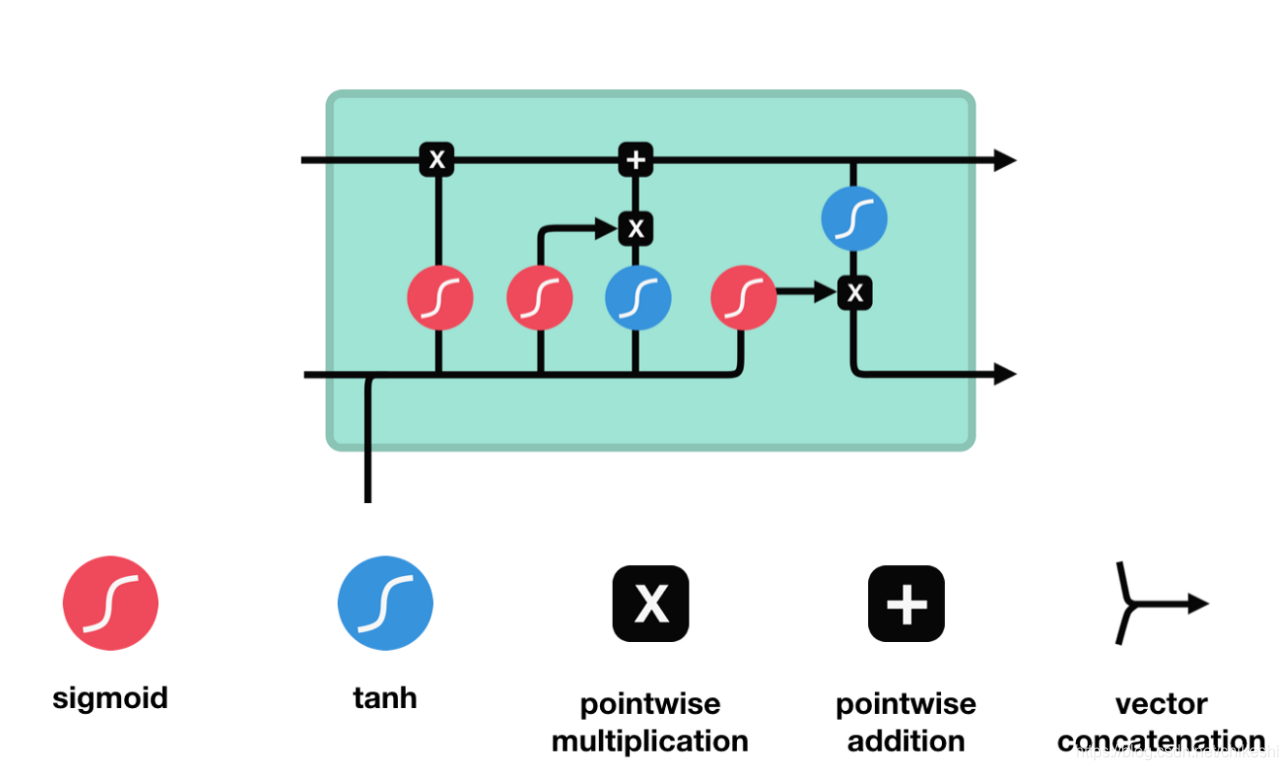
从左往右,第一个sigmoid,
f
t
f_t
ft表示forget gate :
f
t
=
σ
(
W
f
x
t
+
U
f
h
t
−
1
+
b
f
)
f_t = \sigma (W_fx_t + U_fh_{t-1} + b_f)
ft=σ(Wfxt+Ufht−1+bf)
- Wf: input weight for the forget gate
- Uf: recurrent weight for the forget gate
- bf: bias weight for the forget gate
从左往右,第二个sigmoid, i t i_t it 表示 update gate: i t = σ ( W i x t + U i h t − 1 + b i ) i_t = \sigma(W_ix_t + U_ih_{t-1} + b_i) it=σ(Wixt+Uiht−1+bi)
- Wi: input weight for the update gate
- Ui: recurrent weight for the update gate
- bi: bias weight for the update gate.
从左往右,第一个tanh, c t ~ \tilde{c_t} ct~ 表示 update candidate value.(注意这里是 σ h ) \sigma_h) σh) c t ~ = σ h ( W c x T + U c h t − 1 + b c ) \tilde{c_t} = \sigma_h(W_cx_T + U_ch_{t-1} + b_c) ct~=σh(WcxT+Ucht−1+bc)
- Wc: input weight for the candidate value
- Uc: recurrent weight for the candidate value
- bi: bias weight for the candidate value
新的state
C
t
C_t
Ct:
C
t
=
f
t
∗
C
t
−
1
+
i
t
∗
C
~
t
C_t = f_t * C_{t-1} + i_t * \tilde{C}_t
Ct=ft∗Ct−1+it∗C~t
注意这里左右两个乘号分别对应图中两个乘号,加号对应图中的加号
从左往右,第三个sigmoid, o t o_t ot 表示 output gate. o t = σ g ( W o x t + U o h t − 1 + b o ) o_t = \sigma_g(W_ox_t + U_oh_{t-1} + b_o) ot=σg(Woxt+Uoht−1+bo)
- Wo: input weight for the output gate
- Uo: recurrent weight for the output gate
- bo: bias weight for the output gate
从左往右,第二个tanh 表示final output
h
t
=
o
t
∗
t
a
n
h
(
C
t
)
h_t = o_t * tanh(C_t)
ht=ot∗tanh(Ct)
W f W_f Wf: input weight for the forget gate
U f U_f Uf: recurrent weight for the forget gate
b f b_f bf: bias weight for the forget gate
W i W_i Wi: input weight for the update gate
U i U_i Ui: recurrent weight for the update gate
b i b_i bi: bias weight for the update gate.
W c W_c Wc: input weight for the candidate value
U c U_c Uc: recurrent weight for the candidate value
b i b_i bi: bias weight for the candidate value
W o W_o Wo: input weight for the output gate
U o U_o Uo: recurrent weight for the output gate
b o b_o bo: bias weight for the output gate
So there you have it, there are 12 weights that can largely be divided into three camps:
input weight that multiplies with the input timestep
recurrent weight that multiplies with the previous output
bias weight
Q&A
- tanh 的值是是[-1,1], o t o_t ot的值是[0,1], 那最后 h t h_t ht的output不就是[0,1]?
- sigmoid是处理forget的概率,tanh是处理值
- 这里貌似并没有DNN,只有matrix multiplicaiton。一个matmul代表不了DNN因为没有non-linarity
code level of LTSM
原文地址
pre-knowledge: Keras Layer class
Three important functions: __init()__, __build()__ , __call()__
可以在init里面设置weight(w)和bias(b), 推荐在build里面
init会在被创建的时候运行,build会在第一次run的时候运行
def build(self, input_shape):
	input_dim = input_shape[-1]
	...
	self.kernel = self.add_weight(shape=(input_dim, self.units * 4), ...)
这里4*self.units是因为i(update) f(forget) c(update candidate) o(output)各需要一个
def call(self, inputs, states, training=None):
	...
	 h_tm1 = states[0]  # previous memory state
     c_tm1 = states[1]  # previous carry state
	i = self.recurrent_activation(x_i + K.dot(h_tm1_i,
	                                       self.recurrent_kernel_i))
	f = self.recurrent_activation(x_f + K.dot(h_tm1_f,
	                                       self.recurrent_kernel_f))
	c = f * c_tm1 + i * self.activation(x_c + K.dot(h_tm1_c,
	                                             self.recurrent_kernel_c))
	o = self.recurrent_activation(x_o + K.dot(h_tm1_o,
	                                       self.recurrent_kernel_o)
	...
	h = o * self.activation(c)
这几行分别对应上面几个式子。
注意self.recurrent_activation和self_activation是不同的。一般recurrent_activation是Sigmoid,activation是tanh,不过可以自己设定
GRU
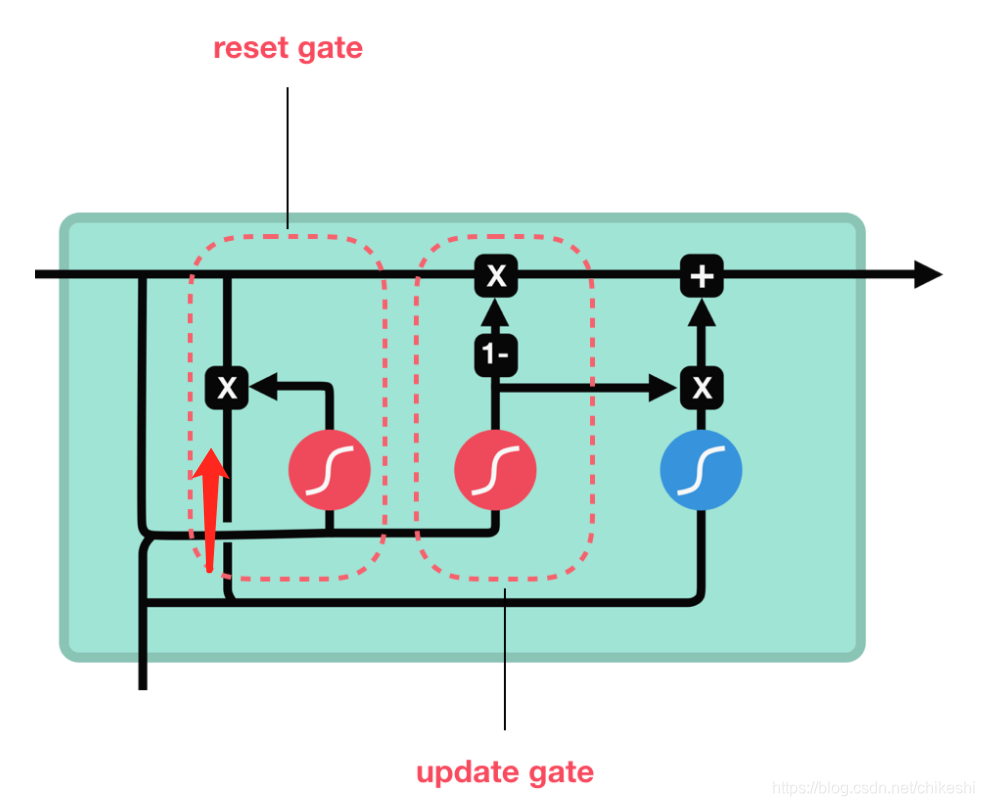
Update gate:
U
t
=
σ
(
W
u
h
t
−
1
+
U
u
x
t
b
u
)
U_t = \sigma (W_uh_{t-1} + U_ux_t b_u)
Ut=σ(Wuht−1+Uuxtbu)
Reset gate:
r
t
=
σ
(
W
r
h
t
−
1
+
U
t
x
t
+
b
r
)
r_t = \sigma (W_rh_{t-1} + U_tx_t + b_r)
rt=σ(Wrht−1+Utxt+br)
New hidden state content:
h
~
t
=
tanh
(
W
h
(
r
t
⊗
h
t
−
1
+
U
h
x
t
+
b
h
)
\tilde h_t = \tanh (W_h(r_t \otimes h_{t-1} + U_hx_t + b_h)
h~t=tanh(Wh(rt⊗ht−1+Uhxt+bh)
Hidden State:
h
t
=
(
1
−
u
t
)
⊗
h
t
−
1
+
u
t
⊗
h
~
t
h_t = (1-u_t) \otimes h_{t-1} + u_t \otimes \tilde h_t
ht=(1−ut)⊗ht−1+ut⊗h~t





 扫一扫
扫一扫


 1662
1662

 被折叠的 条评论
为什么被折叠?
被折叠的 条评论
为什么被折叠?
 到【灌水乐园】发言





