


 该文介绍了一个用于多传感器BEV感知的模型Simple-BEV,它结合了摄像头和雷达数据。模型首先通过ResNet提取特征,然后通过上采样和卷积层压缩特征。接着,将不同传感器的数据融合并压缩到BEV表示。在nuScenes数据集上进行训练,适用于自动驾驶场景的理解。
论文地址:Simple-BEV: What Really Matters for Multi-Sensor BEV Perception?
项目地址:https://github.com/aharley/simple_bev
阅读代码前的准备
1.环境搭建
# 虚拟环境中安装pytorch1.12+cuda11.3
conda install pytorch=1.12.0 torchvision=0.13.0 cudatoolkit=11.3 -c pytorch

# 下载相关依赖包
pip install -r requirements.txt
2.预训练模型下载
# 下载camera-only的预训练模型
sh get_rgb_model.sh

# 下载camera-plus-radar的预训练模型
sh get_rad_model.sh
3.准备nuScenes数据集
nuScenes
|---trainval
  |---maps
  |---samples
  |---sweeps
  |---v1.0-trainval
数据集的一些参数:
translation和rotation就是对应的平移和旋转关系
模型搭建与前向传播
先看一下README.md
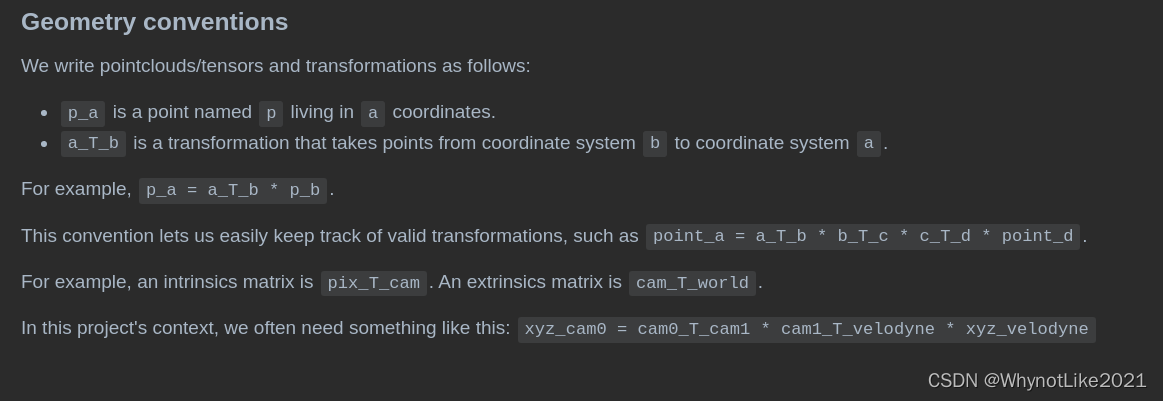
规定了一些变量命名标准, (最开始没看, 都有点看不懂一些变量的含义)
注意: pix_T_cam是内参矩阵(自车坐标系, 一般是以后轴中心为原点, 车头朝向为X轴)
顺便温习一下转置矩阵和逆矩阵
Segnet类初始化:
class Segnet(nn.Module):
    def __init__(self, Z, Y, X, vox_util=None,
                 use_radar=False,
                 use_lidar=False,
                 use_metaradar=False,
                 do_rgbcompress=True,
                 rand_flip=False,
                 latent_dim=128,
                 encoder_type="res101"):
        super(Segnet, self).__init__()
        assert (encoder_type in ["res101", "res50", "effb0", "effb4"])

        self.Z, self.Y, self.X = Z, Y, X
        self.use_radar = use_radar
        self.use_lidar = use_lidar
        self.use_metaradar = use_metaradar
        self.do_rgbcompress = do_rgbcompress
        self.rand_flip = rand_flip
        self.latent_dim = latent_dim
        self.encoder_type = encoder_type

        self.mean = torch.as_tensor([0.485, 0.456, 0.406]).reshape(1,3,1,1).float().cuda()
        self.std = torch.as_tensor([0.229, 0.224, 0.225]).reshape(1,3,1,1).float().cuda()

        # Encoder
        self.feat2d_dim = feat2d_dim = latent_dim
        if encoder_type == "res101":
            self.encoder = Encoder_res101(feat2d_dim)
        elif encoder_type == "res50":
            self.encoder = Encoder_res50(feat2d_dim)
        elif encoder_type == "effb0":
            self.encoder = Encoder_eff(feat2d_dim, version='b0')
        else:
            # effb4
            self.encoder = Encoder_eff(feat2d_dim, version='b4')

        # BEV compressor
        if self.use_radar:
            if self.use_metaradar:
                self.bev_compressor = nn.Sequential(
                    nn.Conv2d(feat2d_dim*Y + 16*Y, feat2d_dim, kernel_size=3, padding=1, stride=1, bias=False),
                    nn.InstanceNorm2d(latent_dim),
                    nn.GELU(),
                )
            else:
                self.bev_compressor = nn.Sequential(
                    nn.Conv2d(feat2d_dim*Y+1, feat2d_dim, kernel_size=3, padding=1, stride=1, bias=False),
                    nn.InstanceNorm2d(latent_dim),
                    nn.GELU(),
                )
        elif self.use_lidar:
            self.bev_compressor = nn.Sequential(
                nn.Conv2d(feat2d_dim*Y+Y, feat2d_dim, kernel_size=3, padding=1, stride=1, bias=False),
                nn.InstanceNorm2d(latent_dim),
                nn.GELU(),
            )
        else:
            if self.do_rgbcompress:
                self.bev_compressor = nn.Sequential(
                    nn.Conv2d(feat2d_dim*Y, feat2d_dim, kernel_size=3, padding=1, stride=1, bias=False),
                    nn.InstanceNorm2d(latent_dim),
                    nn.GELU(),
                )
            else:
                # use simple sum
                pass

        # Decoder
        self.decoder = Decoder(
            in_channels=latent_dim,
            n_classes=1,
            predict_future_flow=False
        )

        # Weights
        self.ce_weight = nn.Parameter(torch.tensor(0.0), requires_grad=True)
        self.center_weight = nn.Parameter(torch.tensor(0.0), requires_grad=True)
        self.offset_weight = nn.Parameter(torch.tensor(0.0), requires_grad=True)

        # set_bn_momentum(self, 0.1)

        if vox_util is not None:
            self.xyz_memA = utils.basic.gridcloud3d(1, Z, Y, X, norm=False)
            self.xyz_camA = vox_util.Mem2Ref(self.xyz_memA, Z, Y, X, assert_cube=False)
        else:
            self.xyz_camA = None
Segnet类的前向传播过程:
关键部分进行了注释
主要涉及unproject_image_to_mem()函数方法, 下面根据论文的Architecture部分进行细读
    def forward(self, rgb_camXs, pix_T_cams, cam0_T_camXs, vox_util, rad_occ_mem0=None):
        '''
        B = batch size, S = number of cameras, C = 3, H = img height, W = img width
        rgb_camXs: (B,S,C,H,W)
        pix_T_cams: (B,S,4,4)
        cam0_T_camXs: (B,S,4,4)
        vox_util: vox util object
        rad_occ_mem0:
            - None when use_radar = False, use_lidar = False
            - (B, 1, Z, Y, X) when use_radar = True, use_metaradar = False
            - (B, 16, Z, Y, X) when use_radar = True, use_metaradar = True
            - (B, 1, Z, Y, X) when use_lidar = True
        '''
        B, S, C, H, W = rgb_camXs.shape  # 输出是(1, 6, 3, 448, 800)
        assert(C==3)
        # reshape tensors
        __p = lambda x: utils.basic.pack_seqdim(x, B)
        __u = lambda x: utils.basic.unpack_seqdim(x, B)
        rgb_camXs_ = __p(rgb_camXs)  # 输出是(6, 3, 448, 800)
        pix_T_cams_ = __p(pix_T_cams)  # 输出是(6, 4, 4)
        cam0_T_camXs_ = __p(cam0_T_camXs)  # 输出是(6, 4, 4)
        # 对cam0_T_camXs_求逆,形状不变
        camXs_T_cam0_ = utils.geom.safe_inverse(cam0_T_camXs_)

        # rgb encoder
        device = rgb_camXs_.device
        rgb_camXs_ = (rgb_camXs_ + 0.5 - self.mean.to(device)) / self.std.to(device)
        if self.rand_flip:
            B0, _, _, _ = rgb_camXs_.shape
            self.rgb_flip_index = np.random.choice([0,1], B0).astype(bool)
            rgb_camXs_[self.rgb_flip_index] = torch.flip(rgb_camXs_[self.rgb_flip_index], [-1])
        feat_camXs_ = self.encoder(rgb_camXs_)  # 输出是(6, 128, 56, 100)
        if self.rand_flip:
            feat_camXs_[self.rgb_flip_index] = torch.flip(feat_camXs_[self.rgb_flip_index], [-1])
        _, C, Hf, Wf = feat_camXs_.shape

        sy = Hf/float(H)
        sx = Wf/float(W)
        Z, Y, X = self.Z, self.Y, self.X

        # unproject image feature to 3d grid
        featpix_T_cams_ = utils.geom.scale_intrinsics(pix_T_cams_, sx, sy)  # 输出是(6, 4, 4)
        if self.xyz_camA is not None:
            xyz_camA = self.xyz_camA.to(feat_camXs_.device).repeat(B*S,1,1)  # 输出是(6, 320000, 3)
        else:
            xyz_camA = None
        feat_mems_ = vox_util.unproject_image_to_mem(
            feat_camXs_,
            utils.basic.matmul2(featpix_T_cams_, camXs_T_cam0_),
            camXs_T_cam0_, Z, Y, X,
            xyz_camA=xyz_camA)  # 输出是(6, 128, 200, 8, 200)
        feat_mems = __u(feat_mems_)  # B, S, C, Z, Y, X  (1, 6, 128, 200, 8, 200)

        mask_mems = (torch.abs(feat_mems) > 0).float()
        feat_mem = utils.basic.reduce_masked_mean(feat_mems, mask_mems, dim=1) # B, C, Z, Y, X

        if self.rand_flip:
            self.bev_flip1_index = np.random.choice([0,1], B).astype(bool)
            self.bev_flip2_index = np.random.choice([0,1], B).astype(bool)
            feat_mem[self.bev_flip1_index] = torch.flip(feat_mem[self.bev_flip1_index], [-1])
            feat_mem[self.bev_flip2_index] = torch.flip(feat_mem[self.bev_flip2_index], [-3])

            if rad_occ_mem0 is not None:
                rad_occ_mem0[self.bev_flip1_index] = torch.flip(rad_occ_mem0[self.bev_flip1_index], [-1])
                rad_occ_mem0[self.bev_flip2_index] = torch.flip(rad_occ_mem0[self.bev_flip2_index], [-3])

        # bev compressing
        if self.use_radar:
            assert(rad_occ_mem0 is not None)
            if not self.use_metaradar:
                feat_bev_ = feat_mem.permute(0, 1, 3, 2, 4).reshape(B, self.feat2d_dim*Y, Z, X)
                rad_bev = torch.sum(rad_occ_mem0, 3).clamp(0,1) # squish the vertical dim
                feat_bev_ = torch.cat([feat_bev_, rad_bev], dim=1)
                feat_bev = self.bev_compressor(feat_bev_)
            else:
                feat_bev_ = feat_mem.permute(0, 1, 3, 2, 4).reshape(B, self.feat2d_dim*Y, Z, X)
                rad_bev_ = rad_occ_mem0.permute(0, 1, 3, 2, 4).reshape(B, 16*Y, Z, X)
                feat_bev_ = torch.cat([feat_bev_, rad_bev_], dim=1)
                feat_bev = self.bev_compressor(feat_bev_)
        elif self.use_lidar:
            assert(rad_occ_mem0 is not None)
            feat_bev_ = feat_mem.permute(0, 1, 3, 2, 4).reshape(B, self.feat2d_dim*Y, Z, X)
            rad_bev_ = rad_occ_mem0.permute(0, 1, 3, 2, 4).reshape(B, Y, Z, X)
            feat_bev_ = torch.cat([feat_bev_, rad_bev_], dim=1)
            feat_bev = self.bev_compressor(feat_bev_)
        else: # rgb only
            if self.do_rgbcompress:
                feat_bev_ = feat_mem.permute(0, 1, 3, 2, 4).reshape(B, self.feat2d_dim*Y, Z, X)  # 输出是(1, 1024, 200, 200)
                feat_bev = self.bev_compressor(feat_bev_)  # 输出是(1, 128, 200, 200)
            else:
                feat_bev = torch.sum(feat_mem, dim=3)

        # bev decoder
        # 得到{dict:6}
        out_dict = self.decoder(feat_bev, (self.bev_flip1_index, self.bev_flip2_index) if self.rand_flip else None)

        raw_e = out_dict['raw_feat']
        feat_e = out_dict['feat']
        seg_e = out_dict['segmentation']
        center_e = out_dict['instance_center']
        offset_e = out_dict['instance_offset']

return raw_e, feat_e, seg_e, center_e, offset_e论文Architecture部分:
1. 利用ResNet-101骨干网提取特征, 输入(H, W)=(448, 800)
2. 对最后一层输出进行上采样, 并将其与第三层输出连接起来, 并应用两个具有实例归一化和ReLU激活的卷积层, 得到特征图, 形状为C*(H/8)*(W/8)
class Encoder_res101(nn.Module):
    def __init__(self, C):
        super().__init__()
        self.C = C  # self.C=128,在Segnet类中初始化定义
        resnet = torchvision.models.resnet101(pretrained=True)

        # 这里应该是拿出resnet101的前三层, 作为self.backbone
        self.backbone = nn.Sequential(*list(resnet.children())[:-4])

        # 这里是resnet101的最后一层
        self.layer3 = resnet.layer3

        self.depth_layer = nn.Conv2d(512, self.C, kernel_size=1, padding=0)

        # 这里的1536是x1与x2拼接起来,1024+512=1536
        self.upsampling_layer = UpsamplingConcat(1536, 512)

    def forward(self, x):

        # 传入self.backbone得到第三层的输出
        x1 = self.backbone(x)  # 输出是(6, 512, 56, 100)
        # 将x1传入self.layer3得到最后一层的输出
        x2 = self.layer3(x1)  # 输出是(6, 1024, 28, 50)
        x = self.upsampling_layer(x2, x1)  # 输出是(6, 512, 56, 100)
        x = self.depth_layer(x)  # 输出是(6, 128, 56, 100)

        return x


class UpsamplingConcat(nn.Module):
    def __init__(self, in_channels, out_channels, scale_factor=2):
        super().__init__()

        self.upsample = nn.Upsample(scale_factor=scale_factor, mode='bilinear', align_corners=False)
        # 两个具有实例归一化和ReLU激活的卷积层
        self.conv = nn.Sequential(
            nn.Conv2d(in_channels, out_channels, kernel_size=3, padding=1, bias=False),
            nn.InstanceNorm2d(out_channels),
            nn.ReLU(inplace=True),
            nn.Conv2d(out_channels, out_channels, kernel_size=3, padding=1, bias=False),
            nn.InstanceNorm2d(out_channels),
            nn.ReLU(inplace=True),
        )

    def forward(self, x_to_upsample, x):
        x_to_upsample = self.upsample(x_to_upsample)
        # 上采样之后的拼接操作
        x_to_upsample = torch.cat([x, x_to_upsample], dim=1)  # 输出是(6, 1536, 56, 100)
        return self.conv(x_to_upsample)
3. 将预定义的3D坐标volume投影到所有特征图中, 并对特征进行双线性采样, 从而从每个相机中生成3D特征volume, 然后通过判断3D坐标是否落在相机视锥内, 来同时计算每个相机的二进制"有效"volume
    def unproject_image_to_mem(self, rgb_camB, pixB_T_camA, camB_T_camA, Z, Y, X, assert_cube=False, xyz_camA=None):
        # rgb_camB is B x C x H x W
        # pixB_T_camA is B x 4 x 4

        # rgb lives in B pixel coords
        # we want everything in A memory coords

        # this puts each C-dim pixel in the rgb_camB
        # along a ray in the voxelgrid
        B, C, H, W = list(rgb_camB.shape)

        if xyz_camA is None:
            xyz_memA = utils.basic.gridcloud3d(B, Z, Y, X, norm=False, device=pixB_T_camA.device)
            xyz_camA = self.Mem2Ref(xyz_memA, Z, Y, X, assert_cube=assert_cube)

        xyz_camB = utils.geom.apply_4x4(camB_T_camA, xyz_camA)  # 输出是(6, 320000, 3)
        z = xyz_camB[:,:,2]

        xyz_pixB = utils.geom.apply_4x4(pixB_T_camA, xyz_camA)  # 输出是(6, 320000, 3)
        normalizer = torch.unsqueeze(xyz_pixB[:,:,2], 2)  # 输出是(6, 320000, 1)
        EPS=1e-6
        # z = xyz_pixB[:,:,2]
        xy_pixB = xyz_pixB[:,:,:2]/torch.clamp(normalizer, min=EPS)  # 输出是(6, 320000, 2)
        # this is B x N x 2
        # this is the (floating point) pixel coordinate of each voxel
        x, y = xy_pixB[:,:,0], xy_pixB[:,:,1]
        # these are B x N

        x_valid = (x>-0.5).bool() & (x<float(W-0.5)).bool()
        y_valid = (y>-0.5).bool() & (y<float(H-0.5)).bool()
        z_valid = (z>0.0).bool()
        valid_mem = (x_valid & y_valid & z_valid).reshape(B, 1, Z, Y, X).float()  # 输出是(6, 1, 200, 8, 200)

        if (0):
            # handwritten version
            values = torch.zeros([B, C, Z*Y*X], dtype=torch.float32)
            for b in list(range(B)):
                values[b] = utils.samp.bilinear_sample_single(rgb_camB[b], x_pixB[b], y_pixB[b])
        else:
            # native pytorch version
            y_pixB, x_pixB = utils.basic.normalize_grid2d(y, x, H, W)
            # since we want a 3d output, we need 5d tensors
            z_pixB = torch.zeros_like(x)
            xyz_pixB = torch.stack([x_pixB, y_pixB, z_pixB], axis=2)  # 输出是(6, 320000, 3)
            rgb_camB = rgb_camB.unsqueeze(2)
            xyz_pixB = torch.reshape(xyz_pixB, [B, Z, Y, X, 3])  # 输出是(6, 200, 8, 200, 3)
            values = F.grid_sample(rgb_camB, xyz_pixB, align_corners=False)  # 输出是(6, 128, 200, 8, 200)

        values = torch.reshape(values, (B, C, Z, Y, X))  # 输出是(6, 128, 200, 8, 200)
        values = values * valid_mem
        return values
4. 在volume集合上取一个有效的加权平均值, 将表示简化为单个3Dvolume的特征, 形状为C*Z*Y*X
def reduce_masked_mean(x, mask, dim=None, keepdim=False):
    # x and mask are the same shape, or at least broadcastably so < actually it's safer if you disallow broadcasting
    # returns shape-1
    # axis can be a list of axes
    for (a,b) in zip(x.size(), mask.size()):
        # if not b==1:
        assert(a==b) # some shape mismatch!
    # assert(x.size() == mask.size())
    prod = x*mask  # 输出是(1, 6, 128, 200, 8, 200)
    if dim is None:  # dim=1
        numer = torch.sum(prod)
        denom = EPS+torch.sum(mask)
    else:
        numer = torch.sum(prod, dim=dim, keepdim=keepdim)  # 输出是(1, 128, 200, 8, 200)
        denom = EPS+torch.sum(mask, dim=dim, keepdim=keepdim)  # 输出是(1, 128, 200, 8, 200)

    mean = numer/denom  # 输出是(1, 128, 200, 8, 200)
    return mean
5. 重新排列3D特征volume尺寸, C*X*Y*X -> (CxY)*Z*X, 生成高维BEV特征图, 将RGB特征和雷达特征连接, 并应用3*3卷积核压缩CxY维
self.bev_compressor = nn.Sequential(
    nn.Conv2d(feat2d_dim*Y, feat2d_dim, kernel_size=3, padding=1, stride=1, bias=False),
    nn.InstanceNorm2d(latent_dim),
    nn.GELU(),
)


feat_bev_ = feat_mem.permute(0, 1, 3, 2, 4).reshape(B, self.feat2d_dim*Y, Z, X)  # 输出是(1, 1024, 200, 200)
feat_bev = self.bev_compressor(feat_bev_)  # 输出是(1, 128, 200, 200)
6. 使用Resnet-18的三个模块处理BEV特征, 生成三个特征图, 然后使用具有双线性上采样的加性跳跃连接, 最后应用特征任务的头
class Decoder(nn.Module):
    def __init__(self, in_channels, n_classes, predict_future_flow):
        super().__init__()
        backbone = resnet18(pretrained=False, zero_init_residual=True)
        self.first_conv = nn.Conv2d(in_channels, 64, kernel_size=7, stride=2, padding=3, bias=False)
        self.bn1 = backbone.bn1
        self.relu = backbone.relu

        self.layer1 = backbone.layer1
        self.layer2 = backbone.layer2
        self.layer3 = backbone.layer3
        self.predict_future_flow = predict_future_flow

        shared_out_channels = in_channels
        self.up3_skip = UpsamplingAdd(256, 128, scale_factor=2)
        self.up2_skip = UpsamplingAdd(128, 64, scale_factor=2)
        self.up1_skip = UpsamplingAdd(64, shared_out_channels, scale_factor=2)

        self.feat_head = nn.Sequential(
            nn.Conv2d(shared_out_channels, shared_out_channels, kernel_size=3, padding=1, bias=False),
            nn.InstanceNorm2d(shared_out_channels),
            nn.ReLU(inplace=True),
            nn.Conv2d(shared_out_channels, shared_out_channels, kernel_size=1, padding=0),
        )
        self.segmentation_head = nn.Sequential(
            nn.Conv2d(shared_out_channels, shared_out_channels, kernel_size=3, padding=1, bias=False),
            nn.InstanceNorm2d(shared_out_channels),
            nn.ReLU(inplace=True),
            nn.Conv2d(shared_out_channels, n_classes, kernel_size=1, padding=0),
        )
        self.instance_offset_head = nn.Sequential(
            nn.Conv2d(shared_out_channels, shared_out_channels, kernel_size=3, padding=1, bias=False),
            nn.InstanceNorm2d(shared_out_channels),
            nn.ReLU(inplace=True),
            nn.Conv2d(shared_out_channels, 2, kernel_size=1, padding=0),
        )
        self.instance_center_head = nn.Sequential(
            nn.Conv2d(shared_out_channels, shared_out_channels, kernel_size=3, padding=1, bias=False),
            nn.InstanceNorm2d(shared_out_channels),
            nn.ReLU(inplace=True),
            nn.Conv2d(shared_out_channels, 1, kernel_size=1, padding=0),
            nn.Sigmoid(),
        )

        if self.predict_future_flow:
            self.instance_future_head = nn.Sequential(
                nn.Conv2d(shared_out_channels, shared_out_channels, kernel_size=3, padding=1, bias=False),
                nn.InstanceNorm2d(shared_out_channels),
                nn.ReLU(inplace=True),
                nn.Conv2d(shared_out_channels, 2, kernel_size=1, padding=0),
            )

    def forward(self, x, bev_flip_indices=None):
        b, c, h, w = x.shape

        # (H, W)
        skip_x = {'1': x}
        x = self.first_conv(x)  # 输出是(1, 64, 100, 100)
        x = self.bn1(x)
        x = self.relu(x)

        # (H/4, W/4)
        x = self.layer1(x)  # 输出是(1, 64, 100, 100)
        skip_x['2'] = x
        x = self.layer2(x)  # 输出是(1, 128, 50, 50)
        skip_x['3'] = x

        # (H/8, W/8)
        x = self.layer3(x)  # 输出是(1, 256, 25, 25)

        # First upsample to (H/4, W/4)
        x = self.up3_skip(x, skip_x['3'])  # 输出是(1, 128, 50, 50)

        # Second upsample to (H/2, W/2)
        x = self.up2_skip(x, skip_x['2'])  # 输出是(1, 64, 100, 100)

        # Third upsample to (H, W)
        x = self.up1_skip(x, skip_x['1'])  # 输出是(1, 128, 200, 200)

        if bev_flip_indices is not None:
            bev_flip1_index, bev_flip2_index = bev_flip_indices
            x[bev_flip2_index] = torch.flip(x[bev_flip2_index], [-2]) # note [-2] instead of [-3], since Y is gone now
            x[bev_flip1_index] = torch.flip(x[bev_flip1_index], [-1])

        feat_output = self.feat_head(x)  # 输出是(1, 128, 200, 200)
        segmentation_output = self.segmentation_head(x)  # 输出是(1, 1, 200, 200)
        instance_center_output = self.instance_center_head(x)  # 输出是(1, 1, 200, 200)
        instance_offset_output = self.instance_offset_head(x)  # 输出是(1, 2, 200, 200)
        instance_future_output = self.instance_future_head(x) if self.predict_future_flow else None

        return {
            'raw_feat': x,
            'feat': feat_output.view(b, *feat_output.shape[1:]),
            'segmentation': segmentation_output.view(b, *segmentation_output.shape[1:]),
            'instance_center': instance_center_output.view(b, *instance_center_output.shape[1:]),
            'instance_offset': instance_offset_output.view(b, *instance_offset_output.shape[1:]),
            'instance_flow': instance_future_output.view(b, *instance_future_output.shape[1:])
            if instance_future_output is not None else None,
        }


class UpsamplingAdd(nn.Module):
    def __init__(self, in_channels, out_channels, scale_factor=2):
        super().__init__()
        self.upsample_layer = nn.Sequential(
            nn.Upsample(scale_factor=scale_factor, mode='bilinear', align_corners=False),
            nn.Conv2d(in_channels, out_channels, kernel_size=1, padding=0, bias=False),
            nn.InstanceNorm2d(out_channels),
        )

    def forward(self, x, x_skip):
        x = self.upsample_layer(x)
        return x + x_skip





 扫一扫
扫一扫


 2090
2090


 到【灌水乐园】发言



