


 本文介绍了一种基于线性表和二叉排序树实现的低频词过滤系统,该系统能够处理英文文章,统计单词频率并过滤出现次数少于五次的单词。通过对比两种数据结构的效率,展示了不同场景下的适用性和性能表现。
基于线性表和二叉排序树的低频词过滤系统
实验内容
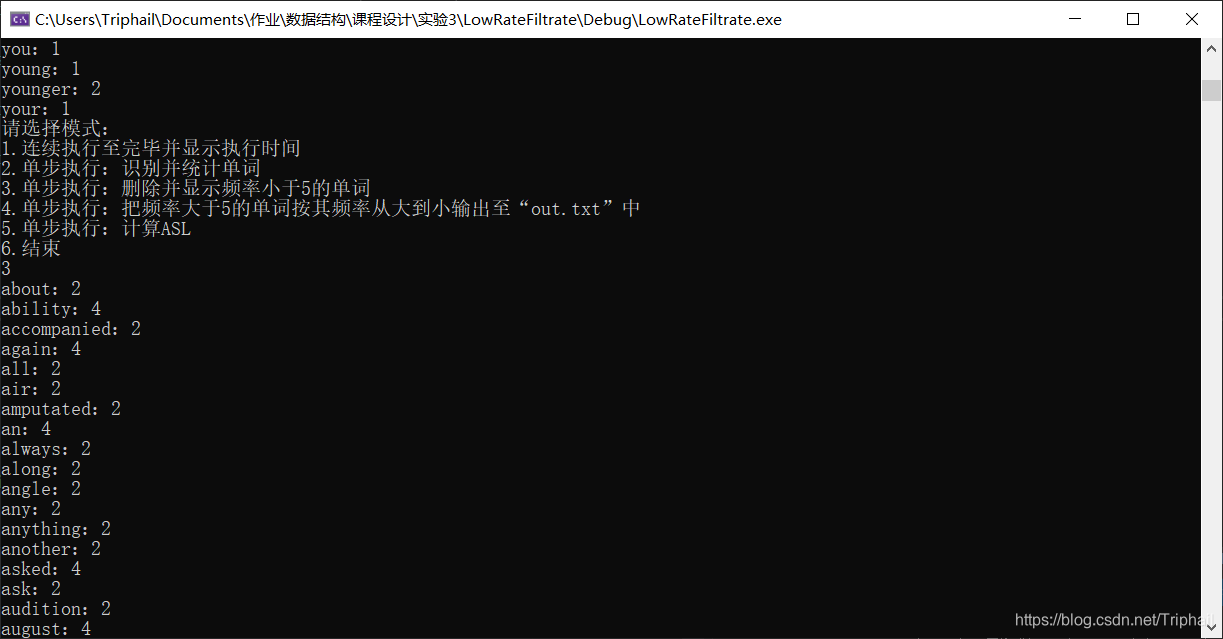
- 对于一篇给定的英文文章,分别利用线性表和二叉排序树来实现单词频率的统计,实现低频词的过滤,并比较两种方法的效率。具体要求如下:
- 读取英文文章文件(Infile.txt),识别其中的单词。
- 分别利用线性表和二叉排序树构建单词的存储结构。当识别出一个单词后,若线性表或者二叉排序树中没有该单词,则在适当的位置上添加该单词;若该单词已经被识别,则增加其出现的频率。
- 统计结束后,删除出现频率低于五次的单词,并显示该单词和其出现频率。
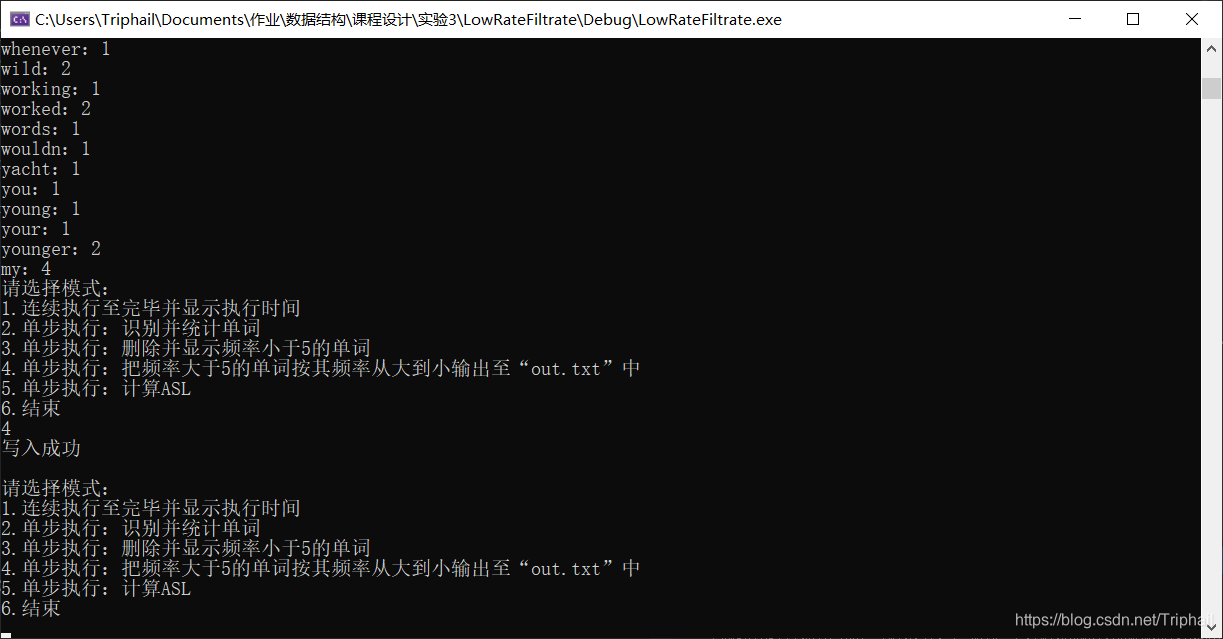
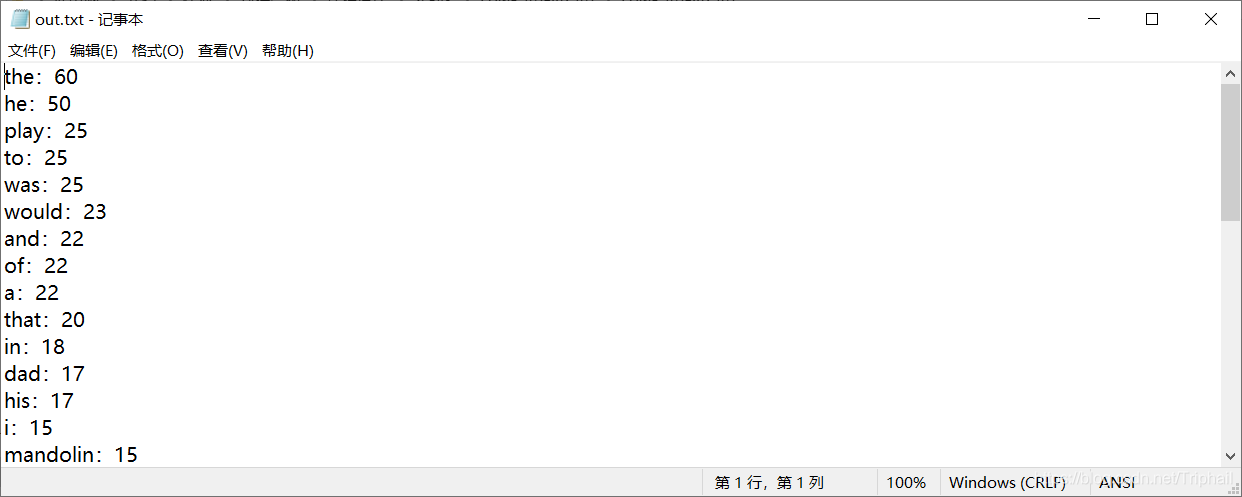
- 其余单词及其出现频率按照从高到低的次序输出到文件中(Outfile.txt),同时输出用两种方法完成该工作所用的时间。
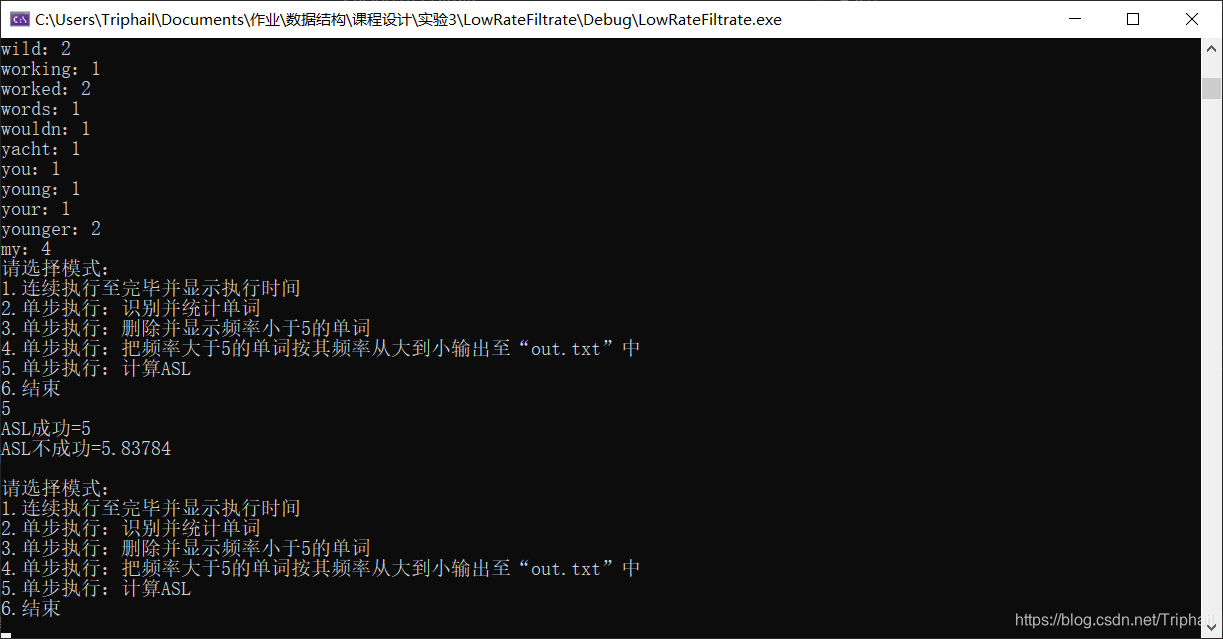
- 计算查找表的ASL值,分析比较两种方法的效率。
各个数据结构的定义
创建链表的结点
struct Node
{

	//单词的名字
	string wordName;

	//单词出现的频率
	int count = 1;
	Node* next=NULL;


};
创建链表
class List
{
public:

	//默认构造函数
	List();
	//带参构造函数
	List(string* p, int n);

	//列表的长度
	int GetLen();

	//得到pos位置的单词
	string GetData(int pos);

	//移动节点到pos位置
	Node* MoveTo(int pos);
	//在pos位置插入节点
	void Insert(string data, int pos);

	//输出列表信息
	void Cout();

	//在列表中查找单词,返回单词的下标
	int Search(string data);

	//删除pos位置节点
	void Delete(int pos);

	//在列表末尾插入节点
	void Insert(string data);

	//列表转数组
	Node* ListToArray(int& arrayLength);

	//插入节点
	void Insert(Node* node);

private:

	Node* first;


};
创建链表过滤单词类
class ListFiltrate
{

public:

	//单词过滤
	void Filtrate(string article);
	//void Print();

	//列表转数组
	Node* ListToArray(int& arrayLength);
	//统计输出所有单词
	void CountAllWord(string article);
    void ASL();//计算ASL


private:

	List words;

	//把文章拆分为各个单词,进行统计出现频率
	void GetWord(string article);

	//对得到的单词进行处理
	void DeleteLowFrequencyWord();

	//删除出现频率小于5的单词
	string WordChange(string word);


};
创建查找二叉树结点类
struct BiSortNode
{
	//单词的名字
	string wordName;
	//单词出现的频率
	int count = 1;

	BiSortNode* lChild=NULL;
	BiSortNode* rChild=NULL;


};
创建查找二叉树
class BiSortTree
{
public:


	BiSortTree();//构造函数

	BiSortNode* Search(BiSortNode* root, string key);//在树中递归查找key
	void Insert(string word);//在树中插入一个节点

	void Delete(BiSortNode* node);//删除一个节点
	BiSortNode* GetRoot();//得到树的根节点
	void InorderPrint(BiSortNode* root);//中序遍历输入树
	Node* TreeToArray(int& length);//查找二叉树转数组
	int* GetEveryLevelNodeNumber();//返回树每一层不为Null的结点个数
	int* GetEveryLevelNodeNullNumber();//返回树每一层为Null的结点个数
	int GetTreeHeight();//返回树的高度


private:

	BiSortNode* root;//根节点
	BiSortNode* Insert(BiSortNode* root, BiSortNode* node);//递归插入节点
	void NextReplace(BiSortNode* node);//删除时遇到节点有左右子树时,用直接后继代替该节点
	BiSortNode* FindParentNode(BiSortNode*root, BiSortNode* node);//寻找节点的父节点
	void TreeToList(BiSortNode* root);//树结构转列表
	List list;
	void CountEveryLevelNode(BiSortNode* root, int depth,int& count);//递归计算树每一层不为Null的结点个数
	void CountEveryLevelNullNode(BiSortNode* root, int depth, int& count);//递归计算树每一层为Null的结点个数
	int TreeHeight(BiSortNode* root);//递归计算树的高度


	int* everyLevelNodeNumber;//树中每一层不为Null的结点个数
	int* everyLevelNullNodeNumber;//树中每一层为Null的结点个数

};
创建查找二叉树过滤单词类
class BiSortTreeFiltrate
{

public:

	//单词过滤
	void Filtrate(string article);

	//树结构转数组
	Node* TreeToArray(int& length);

	//统计输出所有单词
	void CountAllWord(string article);
	void ASL();//计算ASL

private:

	BiSortTree words;

	//把文章拆分为各个单词,进行统计出现频率
	void GetWord(string article);

	//对得到的单词进行处理
	string WordChange(string word);

	//删除出现频率小于5的单词
	void DeleteLowFrequencyWord(BiSortNode* root);


};
各项功能具体实现代码
默认构造函数
List::List()
{
	//默认构造函数
	this->first = new Node[1];
	this->first->next = NULL;
}
带参构造函数
List::List(string* p, int n)
{
	//带参构造函数
	this->first = new Node[1];
	this->first->next = NULL;

	for (int i = 0; i < n; i++)
	{
		this->Insert(p[i], i + 1);
	}

}
列表的长度
int List::GetLen()
{
	//列表的长度
	Node* p = this->first->next;
	int Len = 0;
	while (p != NULL)
	{
		Len++;
		p = p->next;
	}
	return Len;
}
得到pos位置的单词
string List::GetData(int pos)
{
	//得到pos位置的单词
	Node* p = this->first;
	for (int i = 0; i < pos; i++)
	{

		p = p->next;

	}


	return p->wordName;
}
移动节点到pos位置
Node* List::MoveTo(int pos)
{

	//移动节点到pos位置
	Node* p = this->first;
	for (int i = 0; i < pos; i++)
	{
		p = p->next;

	}

	return p;
}
在pos位置插入节点
void List::Insert(string data, int pos)
{

	//在pos位置插入节点
	Node* p = new Node;
	p->wordName = data;

	Node* q = MoveTo(pos - 1);

	p->next = q->next;
	q->next = p;


}
输出列表信息
void List::Cout()
{

	//输出列表信息
	for (Node* p = this->first->next; p != NULL; p = p->next)
	{


		cout << p->wordName << ":" << p->count << endl;


	}

}
在列表中查找单词,返回单词的下标
int List::Search(string data)
{
	//在列表中查找单词,返回单词的下标
	int pos = 0;
	for (Node* p = this->first->next; p != NULL; p = p->next)
	{
		pos++;
		if (p->wordName==data)
		{
			return pos;
		}

	}

	return -1;
}
删除pos位置节点
void List::Delete(int pos)
{
	//删除pos位置节点
	Node* p = MoveTo(pos - 1);
	Node* q = p->next;

	p->next = q->next;

	delete q;
}
在列表末尾
void List::Insert(string data)
{
	//在列表末尾插入节点
	Node* p = new Node;
	p->wordName = data;

	p->next = NULL;


	Node* q = MoveTo(this->GetLen());

	q->next = p;


}
列表转数组
Node* List::ListToArray(int& arrayLength)
{

	//列表转数组
	int length = this->GetLen();
	Node* array = new Node[length];

	for (int i = 1; i < length+1; i++)
	{
		array[i-1].wordName = this->MoveTo(i)->wordName;
		array[i-1].count =this->MoveTo(i)->count;
		/*cout << array[i-1].wordName << " " << array[i].count<<endl;*/


	}

	arrayLength = length;
	return array;
}
插入节点
void List::Insert(Node* node)
{
	//插入节点

	Node* q = MoveTo(this->GetLen());

	q->next = node;


}
列表单词过滤
void ListFiltrate::Filtrate(string article)
{
	//单词过滤

	//把文章拆分为各个单词,进行统计出现频率
	this->GetWord(article);


	//删除出现频率小于5的单词
	this->DeleteLowFrequencyWord();


}
列表转数组
Node* ListFiltrate::ListToArray(int& arrayLength)
{

	//列表转数组
	return this->words.ListToArray(arrayLength);


}
统计输出所有单词
void ListFiltrate::CountAllWord(string article)
{
	//统计输出所有单词
	this->GetWord(article);

	this->words.Cout();

}
把文章拆分为各个单词,进行统计出现频率
void ListFiltrate::GetWord(string article)
{
	//把文章拆分为各个单词,进行统计出现频率
	string temp = article;


	while (temp.size()>0)
	{


		int startWordIndex = 0;//查找单词开始字母的下标


		while ((temp[startWordIndex] < 'a' || temp[startWordIndex]>'z') && (temp[startWordIndex] < 'A' || temp[startWordIndex]>'Z'))
		{
			startWordIndex++;
			if (startWordIndex > temp.size())
			{
				return;
			}

		}

		int endWordIndex = startWordIndex;//查找单词结束字母的下标
		while ((temp[endWordIndex] >= 'a' && temp[endWordIndex] <= 'z') || (temp[endWordIndex] >= 'A'&& temp[endWordIndex] <= 'Z')||temp[endWordIndex]=='-'||temp[endWordIndex]=='\'')
		{
			endWordIndex++;
		}


		//得到单词
		string word = this->WordChange(temp.substr(startWordIndex, endWordIndex - startWordIndex));

		//在树中查找单词,统计频率
		if (this->words.Search(word) != -1)
		{
			this->words.MoveTo(this->words.Search(word))->count++;


		}
		else
		{

			this->words.Insert(word);

		}

		//文章删除该单词
		temp = temp.substr(endWordIndex );


	}


}
删除出现频率小于5的单词
void ListFiltrate::DeleteLowFrequencyWord()
{
	//删除出现频率小于5的单词

	int length = this->words.GetLen() + 1;
	for (int i = 1; i < length; i++)
	{

		if (this->words.MoveTo(i)->count < 5)
		{

			cout << this->words.MoveTo(i)->wordName << ":" << this->words.MoveTo(i)->count << endl;


			this->words.Delete(i);
			i--;
			length--;

		}


	}


}
对得到的单词进行处理
string ListFiltrate::WordChange(string word)
{

	//对得到的单词进行处理

	string result=word;
			//大写换小写
	for (int i = 0; i < word.size(); i++)
	{
		//大写换小写
		if (result[i] >='A' && result[i] <= 'Z')
		{
			result[i] = result[i] + 32;


		}

		//格助词处理
		if (result[i] == '\'')
		{
			result = result.substr(0, i );

			break;
		}


	}
	return result;

}
计算列表查找ASL
void ListFiltrate::ASL()
{
	cout << "ASL成功=" << (this->words.GetLen() + 1) / 2;
	cout << "ASL失败=" << this->words.GetLen();


}
构造函数
BiSortTree::BiSortTree()
{

	//构造函数
	this->root = NULL;
	this->everyLevelNodeNumber = NULL;

	this->everyLevelNullNodeNumber = NULL;
}
在树中递归查找key
BiSortNode* BiSortTree::Search(BiSortNode* root, string key)
{
	//在树中递归查找key
	if (root == NULL)
	{

		return NULL;

	}

	if (root->wordName == key)
	{
		//查找成功
		return root;

	}

	if (root->wordName > key)
	{
		//查找左子树
		return this->Search(root->lChild, key);

	}
	else
	{

		//查找右子树
		return this->Search(root->rChild, key);

	}


}
在树中插入一个节点
void BiSortTree::Insert(string word)
{
	//在树中插入一个节点
	BiSortNode* node = new BiSortNode[1];
	node->wordName = word;


	this->root = this->Insert(this->root, node);


}
递归插入节点
BiSortNode* BiSortTree::Insert(BiSortNode* root, BiSortNode* node)
{
	//递归插入节点
	if (root == NULL)
	{
		//当数为空,插入节点为根节点
		return node;


	}

	if (node->wordName < root->wordName)
	{

		root->lChild = this->Insert(root->lChild, node);//插入左子树

	}
	else
	{

		root->rChild = this->Insert(root->rChild, node);//插入右子树


	}
	return root;


}
删除一个节点
void BiSortTree::Delete(BiSortNode* node)
{
	//删除一个节点
	if (node->rChild == NULL && node->lChild == NULL)
	{
		//当该节点为叶子节点时
		BiSortNode* temp = this->FindParentNode(root, node);
		if (temp->rChild == node)
		{

			temp->rChild = NULL;
		}
		else
		{
			temp->lChild = NULL;
		}
		delete[] node;


	}
	else if (node->rChild == NULL && node->lChild != NULL)
	{
		//右子树为空,左子树不为空

		//子节点的值赋给该节点
		BiSortNode* temp = node->lChild;
		node->wordName = temp->wordName;
		node->count = temp->count;
		node->lChild = temp->lChild;
		node->rChild = temp->rChild;

		//删除子节点
		delete[] temp;


	}
	else if (node->lChild == NULL && node->rChild != NULL)
	{
		//左子树为空,右子树不为空

		//子节点的值赋给该节点
		BiSortNode* temp = node->rChild;
		node->wordName = temp->wordName;
		node->count = temp->count;
		node->lChild = temp->lChild;
		node->rChild = temp->rChild;

		//删除子节点
		delete[] temp;


	}
	else
	{
		//左右子树皆不为空

		//直接后继代替该节点
		this->NextReplace(node);


	}


}
得到树的根节点
BiSortNode* BiSortTree::GetRoot()
{
	//得到树的根节点
	return this->root;
}
中序遍历输入树
void BiSortTree::InorderPrint(BiSortNode* root)
{
	//中序遍历输入树
	if (root == NULL)
	{

		return;
	}


	this->InorderPrint(root->lChild);
	cout << root->wordName << ":" << root->count << endl;

	this->InorderPrint(root->rChild);


}
查找二叉树转数组
Node* BiSortTree::TreeToArray(int& length)
{
	//查找二叉树转数组

	//树结构转列表
	this->TreeToList(this->root);

	//列表转数组
	return this->list.ListToArray(length);


}
树结构转列表
void BiSortTree::TreeToList(BiSortNode* root)
{

	//树结构转列表

	if (root == NULL)
	{

		return;
	}


	//this->InorderPrint(root->lChild);
	this->TreeToList(root->lChild);

	Node* node = new Node[1];

	node->wordName = root->wordName;
	node->count = root->count;


	this->list.Insert(node);
	this->TreeToList(root->rChild);
}
直接后继取代删除节点
void BiSortTree::NextReplace(BiSortNode* node)
{
	//直接后继取代删除节点
	BiSortNode* temp = node;//后继节点的父节点
	BiSortNode* subNode = node->rChild;//直接后继节点

	while (subNode->lChild != NULL)
	{

		temp = subNode;
		subNode = subNode->lChild;

	}

	node->wordName = subNode->wordName;
	node->count = subNode->count;

	if (node == temp)
	{
		//被删除节点右孩子节点的左子树为空
		temp->rChild = subNode->rChild;


	}
	else
	{
		//被删节点右孩子的左子树为空
		temp->lChild = subNode->rChild;

	}

	delete[] subNode;
	subNode = NULL;


}
寻找节点的父节点
BiSortNode* BiSortTree::FindParentNode(BiSortNode* root, BiSortNode* node)
{
	//寻找节点的父节点
	if (root == NULL)
	{
		return NULL;
	}

	if (root->lChild == node || root->rChild == node)
	{

		return root;

	}

	if (root->wordName < node->wordName)
	{
		root = this->FindParentNode(root->rChild, node);

	}
	else
	{
		root = this->FindParentNode(root->lChild, node);
	}


}
递归计算树每一层不为Null的结点个数
void BiSortTree::CountEveryLevelNode(BiSortNode* root, int depth,int& count)
{
	//递归计算树每一层不为Null的结点个数
	if (root == NULL || depth == 0)
	{
		return;


	}


	if (depth == 1)
	{
		//当层的深度为1时,说明已经递归到指定深度
		count++;
	}


	this->CountEveryLevelNode(root->lChild, depth - 1, count );


	this->CountEveryLevelNode(root->rChild, depth - 1, count);


}
递归计算树每一层为Null的结点个数
void BiSortTree::CountEveryLevelNullNode(BiSortNode* root, int depth, int& count)
{
	//递归计算树每一层为Null的结点个数
	if (depth == 1 &&root==NULL)
	{
		//当层的深度为1时,说明已经递归到指定深度

		count++;

	}
	if (root == NULL || depth == 0)
	{
		return;


	}


	this->CountEveryLevelNullNode(root->lChild, depth - 1, count);


	this->CountEveryLevelNullNode(root->rChild, depth - 1, count);


}
返回树每一层不为Null的结点个数
int* BiSortTree::GetEveryLevelNodeNumber()
{
	//返回树每一层不为Null的结点个数

	//根据树的高度创建数组
	int height = this->TreeHeight(this->root)+1;
	this->everyLevelNodeNumber = new int[height];


	for (int i = 1; i < height; i++)
	{
		int count = 0;
		this->CountEveryLevelNode(this->root, i, count);
		//计算depth层中不为Null的结点个数
		this->everyLevelNodeNumber[i] =count;


	}


	return this->everyLevelNodeNumber;
}
返回树每一层为Null的结点个数
int* BiSortTree::GetEveryLevelNodeNullNumber()
{
	//返回树每一层为Null的结点个数


	//根据树的高度创建数组
	int height = this->TreeHeight(this->root) + 2;
	this->everyLevelNullNodeNumber= new int[height];

	for (int i = 1; i < height; i++)
	{
		int count = 0;
		this->CountEveryLevelNullNode(this->root, i, count);
		//计算depth层中为Null的结点个数
		this->everyLevelNullNodeNumber[i] = count;
	}


	return everyLevelNullNodeNumber;
}
递归计算树的高度
int BiSortTree::TreeHeight(BiSortNode* root)
{
	//递归计算树的高度
	if (root == NULL)
	{
		//当根结点为空时返回

		return 0;
	}

	//递归计算左子树的高度
	int leftLength = this->TreeHeight(root->lChild);
	//递归计算右子树的高度
	int rightLength =this->TreeHeight(root->rChild);


	//返回左子树和右子树中的最大者
	return max(leftLength, rightLength) + 1;
}
返回树的高度
int BiSortTree::GetTreeHeight()
{
	//返回树的高度
	return this->TreeHeight(this->root);
}
查找二叉树单词过滤
void BiSortTreeFiltrate::Filtrate(string article)
{
	//单词过滤

	//把文章拆分为各个单词,进行统计出现频率
	this->GetWord(article);


	//删除出现频率小于5的单词
	this->DeleteLowFrequencyWord(this->words.GetRoot());


}
树结构转数组
Node* BiSortTreeFiltrate::TreeToArray(int& length)
{

	//树结构转数组
	return this->words.TreeToArray(length);


}
统计输出所有单词
void BiSortTreeFiltrate::CountAllWord(string article)
{
	//统计输出所有单词
	this->GetWord(article);
	this->words.InorderPrint(this->words.GetRoot());

}
把文章拆分为各个单词,进行统计出现频率
void BiSortTreeFiltrate::GetWord(string article)
{
	//把文章拆分为各个单词,进行统计出现频率

	string temp = article;


	while (temp.size() > 0)
	{


		int startWordIndex = 0;//查找单词开始字母的下标


		while ((temp[startWordIndex] < 'a' || temp[startWordIndex]>'z') && (temp[startWordIndex] < 'A' || temp[startWordIndex]>'Z'))
		{
			startWordIndex++;
			if (startWordIndex > temp.size())
			{
				return;
			}

		}

		int endWordIndex = startWordIndex;//查找单词结束字母的下标
		while ((temp[endWordIndex] >= 'a' && temp[endWordIndex] <= 'z') || (temp[endWordIndex] >= 'A' && temp[endWordIndex] <= 'Z') || temp[endWordIndex] == '-' || temp[endWordIndex] == '\'')
		{
			endWordIndex++;
		}

		//得到单词
		string word = this->WordChange(temp.substr(startWordIndex, endWordIndex - startWordIndex));

		//在树中查找单词,统计频率
		BiSortNode* tempNode = this->words.Search(this->words.GetRoot(), word);


		if (tempNode != NULL)
		{
			tempNode->count++;


		}
		else
		{
			this->words.Insert(word);
		}


		//文章删除该单词
		temp = temp.substr(endWordIndex);


	}


}
删除出现频率小于5的单词
void BiSortTreeFiltrate::DeleteLowFrequencyWord(BiSortNode* root)
{


	//删除出现频率小于5的单词

	if (root == NULL)
	{

		return;
	}


	this->DeleteLowFrequencyWord(root->lChild);


	this->DeleteLowFrequencyWord(root->rChild);

	if (root->count < 5)
	{


		cout << root->wordName << ":" << root->count << endl;
		this->words.Delete(root);

	}

}
主函数代码
使用文件流读取文章
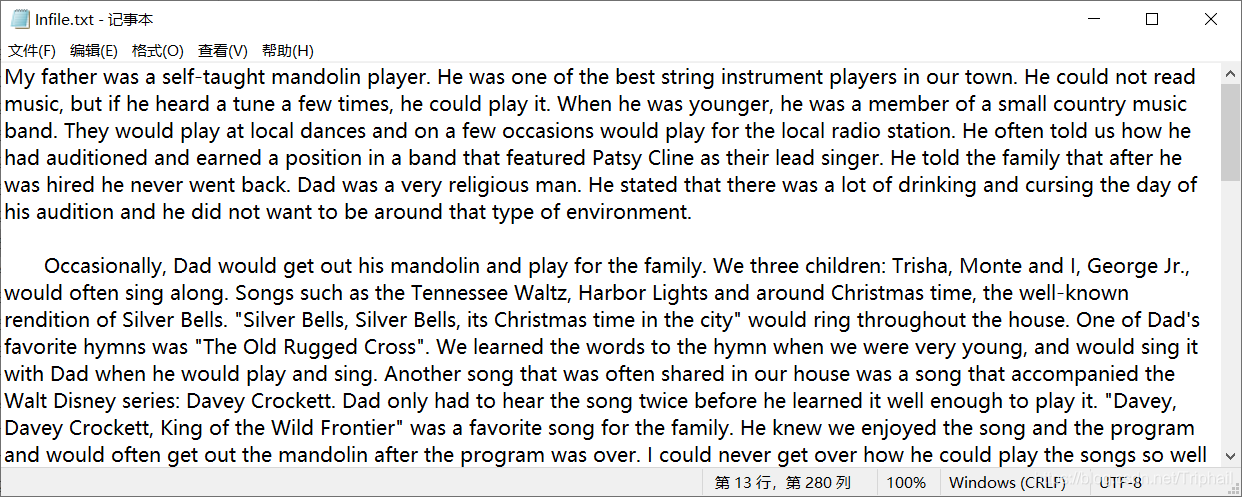
string ReadArticle()
{
	//读取文章
	ifstream file;
	file.open("Infile.txt");
	stringstream buffer;
	buffer << file.rdbuf();
	string article = buffer.str();
	file.close();
	return article;
}
显示执行时间
void PrintWorkTime(clock_t start, clock_t end)
{
	//显示执行时间
	cout << "执行时间为:" << (double)(end - start);

}
输入的模式选择
int ModelChoose()
{
	int chooseModel;
	cout << "请选择模式:" << endl;
	cout << "1.连续执行至完毕并显示执行时间" << endl;
	cout << "2.单步执行:识别并统计单词" << endl;
	cout << "3.单步执行:删除并显示频率小于5的单词" << endl;
	cout << "4.单步执行:把频率大于5的单词按其频率从大到小输出至“out.txt”中" << endl;
	cout << "5.单步执行:计算ASL" << endl;
	cin >> chooseModel;
	return chooseModel;

}
列表模式
void ListModel(int chooseModel, string article)
{
	//输入模式选择
	chooseModel = ModelChoose();

	ListFiltrate list;
	switch (chooseModel)
	{
	case 1:
	{
		//连续执行至全部完成,并显示执行时间

		//记录执行开始的时间
		clock_t start = clock();
		cout << "单词的信息如下:" << endl;

		//低频词语删除
		list.Filtrate(article);
		int length = 0;
		//把高频词汇写入txt中
		WriteWords(list.ListToArray(length), length);
		//记录执行结束的时间
		clock_t end = clock();
		cout << endl;
		//打印执行时间
		PrintWorkTime(start, end);

		list.ASL();


	}
	case 2:
	{
		//识别并统计单词
		list.CountAllWord(article);
		break;

	}
	case 3:
	{
		//删除并显示频率小于5的单词
		list.Filtrate(article);

		break;
	}
	case 4:
	{

		//把频率大于5的单词按其频率从大到小输出至“out.txt”中
		int length = 0;
		WriteWords(list.ListToArray(length), length);
		break;

	}
	case 5:
	{
		list.Filtrate(article);
		list.ASL();

		break;

	}
	default:
		break;
	}
}
查找二叉树模式
void BiSortTreeModel(int chooseModel, string article)
{
	//输入模式选择
	chooseModel = ModelChoose();

	BiSortTreeFiltrate tree;
	switch (chooseModel)
	{
	case 1:
	{

		//连续执行至全部完成,并显示执行时间

		//记录执行开始的时间
		clock_t start = clock();

		cout << "单词的信息如下:" << endl;
		//低频词语删除
		tree.Filtrate(article);


		//把高频词汇写入txt中
		int length = 0;
		WriteWords(tree.TreeToArray(length), length);

		//记录执行结束的时间
		clock_t end = clock();
		cout << endl;
		//打印执行时间
		PrintWorkTime(start, end);
		tree.ASL();


	}
	case 2:
	{
		//识别并统计单词
		tree.CountAllWord(article);
		break;

	}
	case 3:
	{
		//删除并显示频率小于5的单词
		tree.Filtrate(article);

		break;
	}
	case 4:
	{
		//把频率大于5的单词按其频率从大到小输出至“out.txt”中
		int length = 0;
		WriteWords(tree.TreeToArray(length), length);
		break;

	}
	case 5:
	{
		//计算ASL
		tree.Filtrate(article);
		tree.ASL();

		break;

	}
	default:
		break;
	}
}
把单词写入txt中
void WriteWords(Node* array, int& length)
{
	//把单词写入txt中

	//单词按照频率从高到底进行排序
	Sort(array, length);

	//写入单词
	OutputWords(length, array);


}
写入单词
void OutputWords(int length, Node* array)
{
	//把单词写入txt中
	ofstream outFile("out.txt");
	for (int i = 0; i < length; i++)
	{

		//cout << b[i]<<" ";

		outFile << array[i].wordName << ":" << array[i].count << endl;


	}
}
单词按照从大到小进行排序
void Sort(Node* array, int length)
{
	//单词按照从大到小进行排序

	for (int i = 0; i < length; i++)
	{

		int temp = i;

		for (int j = i + 1; j < length; j++)
		{


			if (array[temp].count < array[j].count)
			{

				temp = j;


			}


		}

		if (temp != i)
		{


			Node tempNode;
			tempNode.wordName = array[temp].wordName;
			tempNode.count = array[temp].count;

			array[temp].wordName = array[i].wordName;
			array[temp].count = array[i].count;


			array[i].wordName = tempNode.wordName;
			array[i].count = tempNode.count;

		}


	}


}
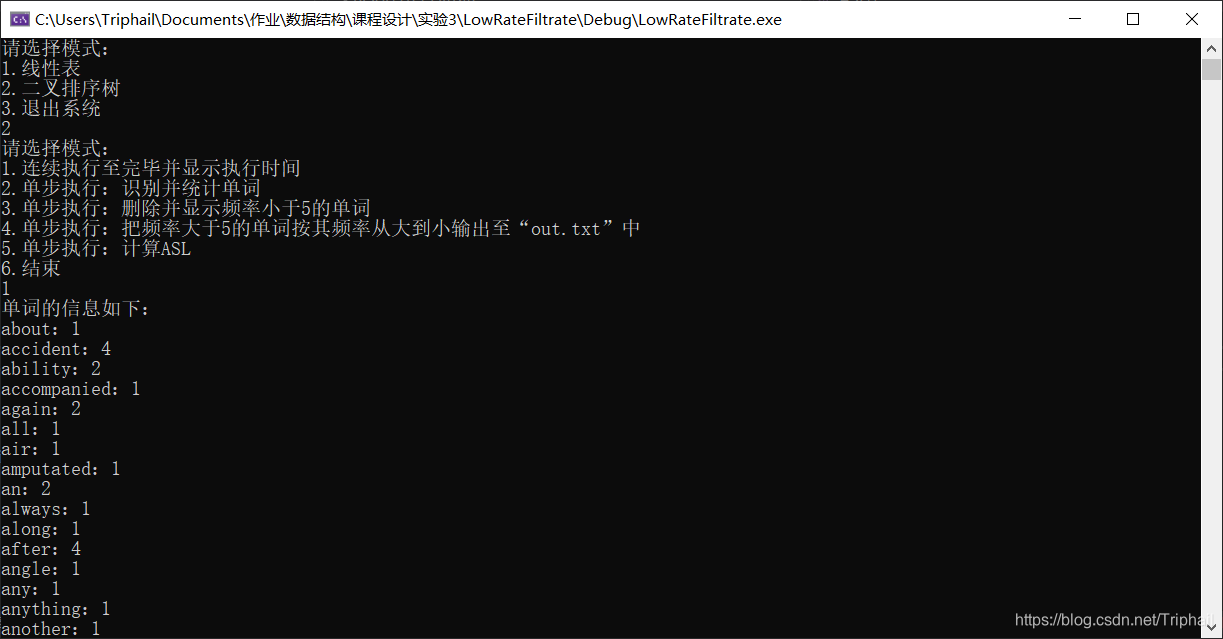
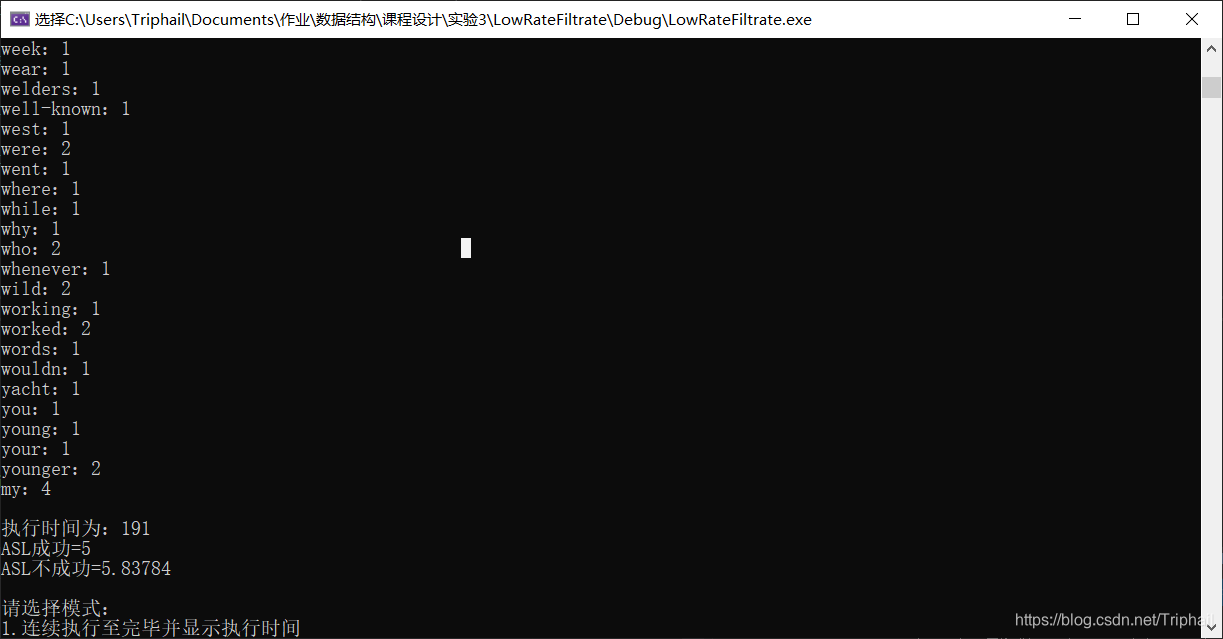
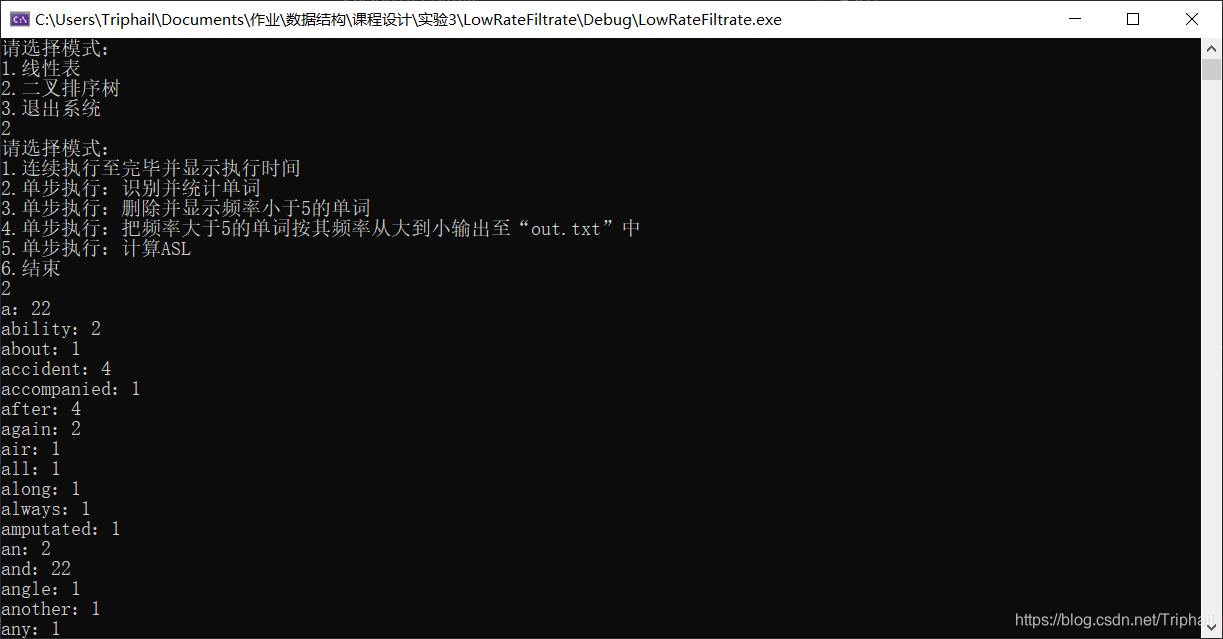
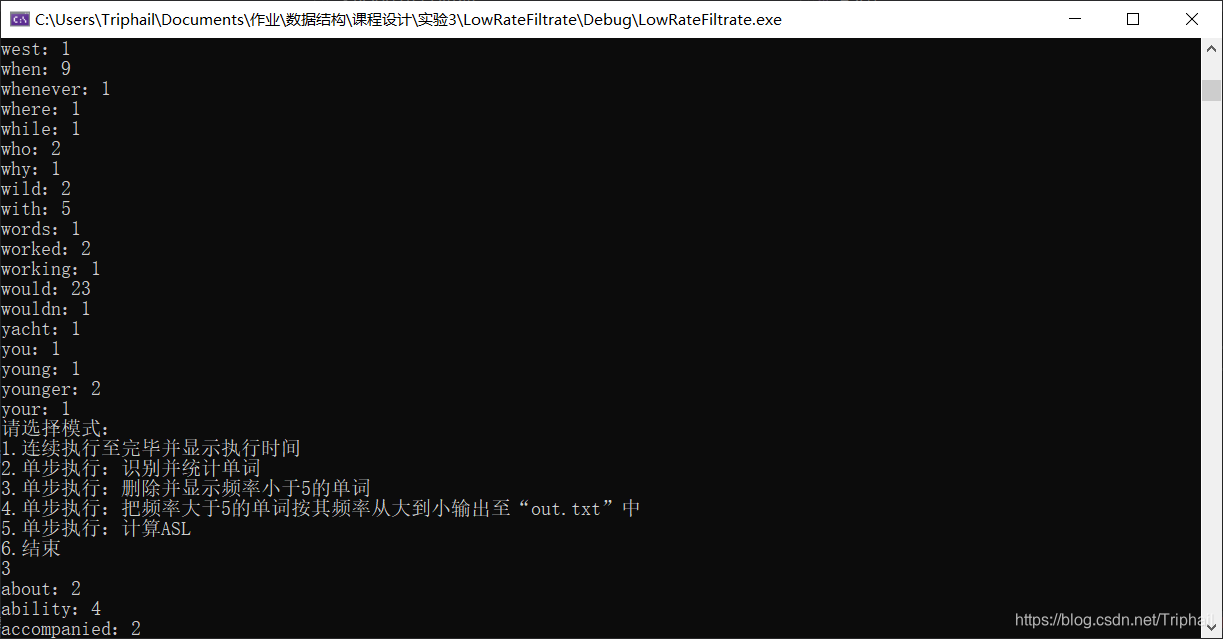
实验结果
主菜单
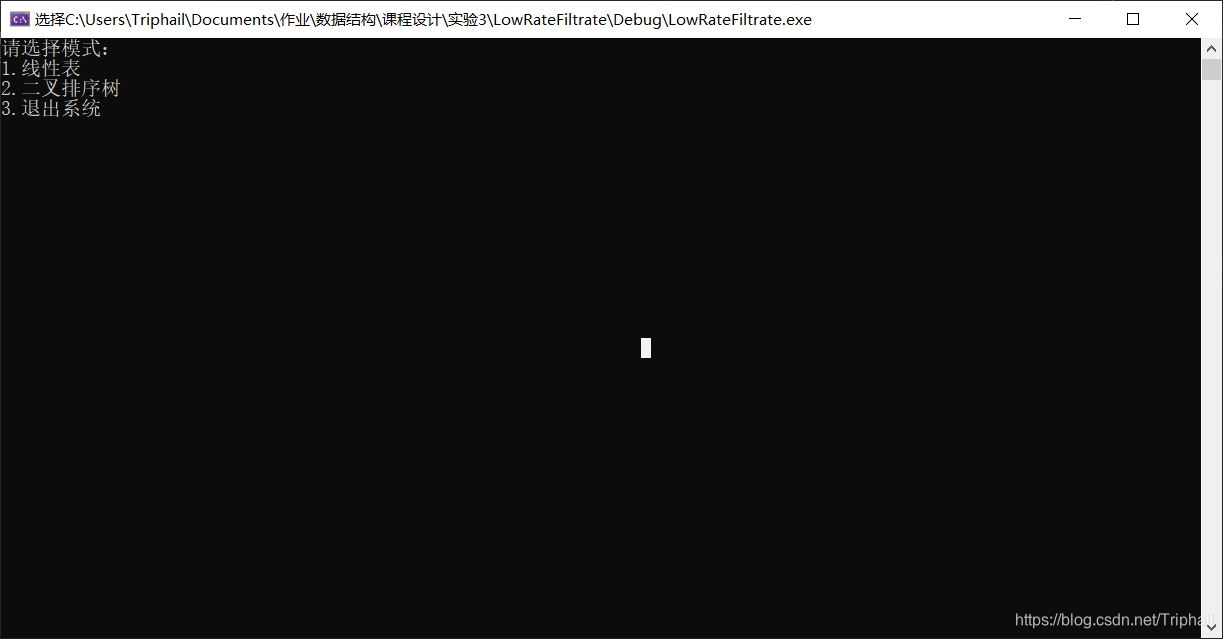
线性表模式
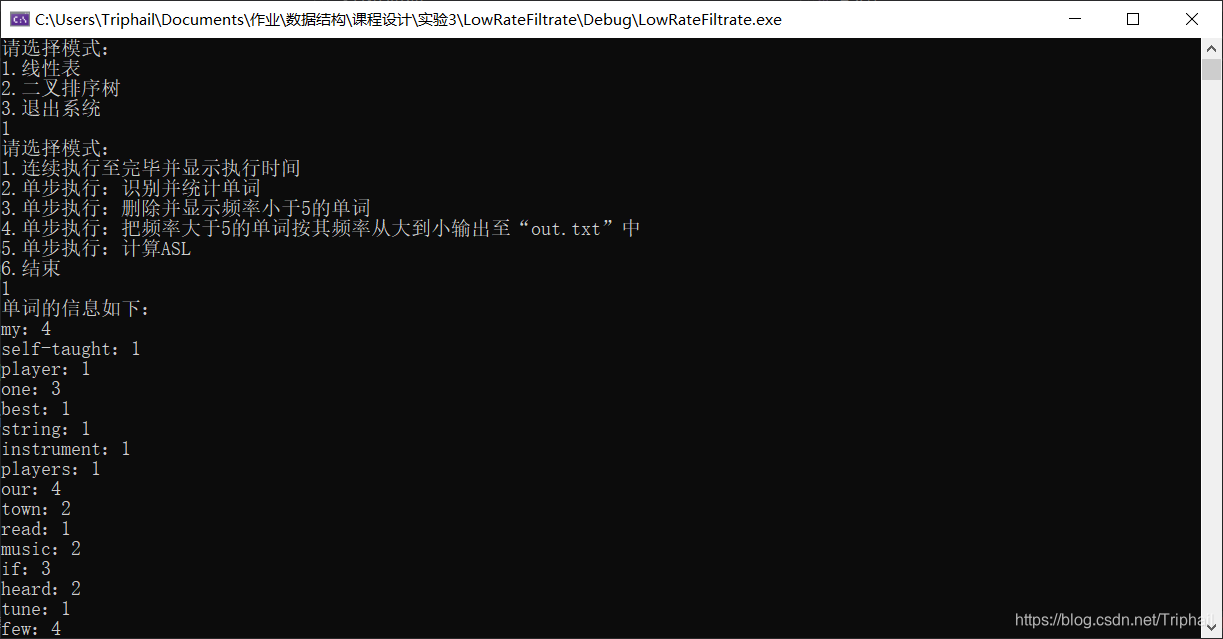
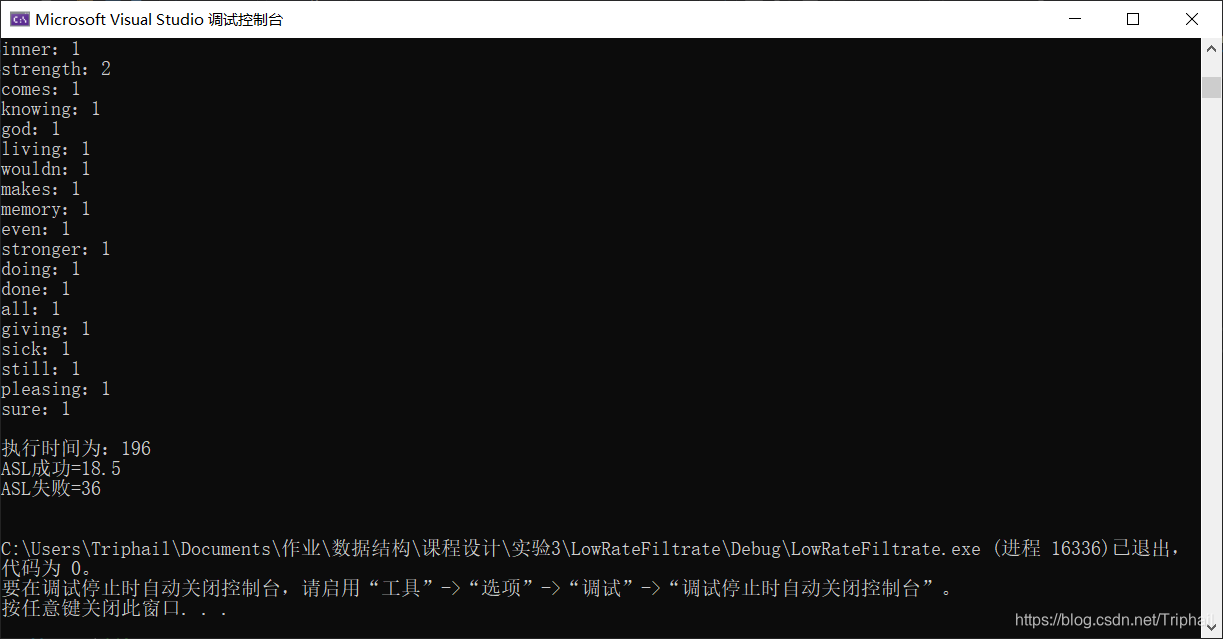
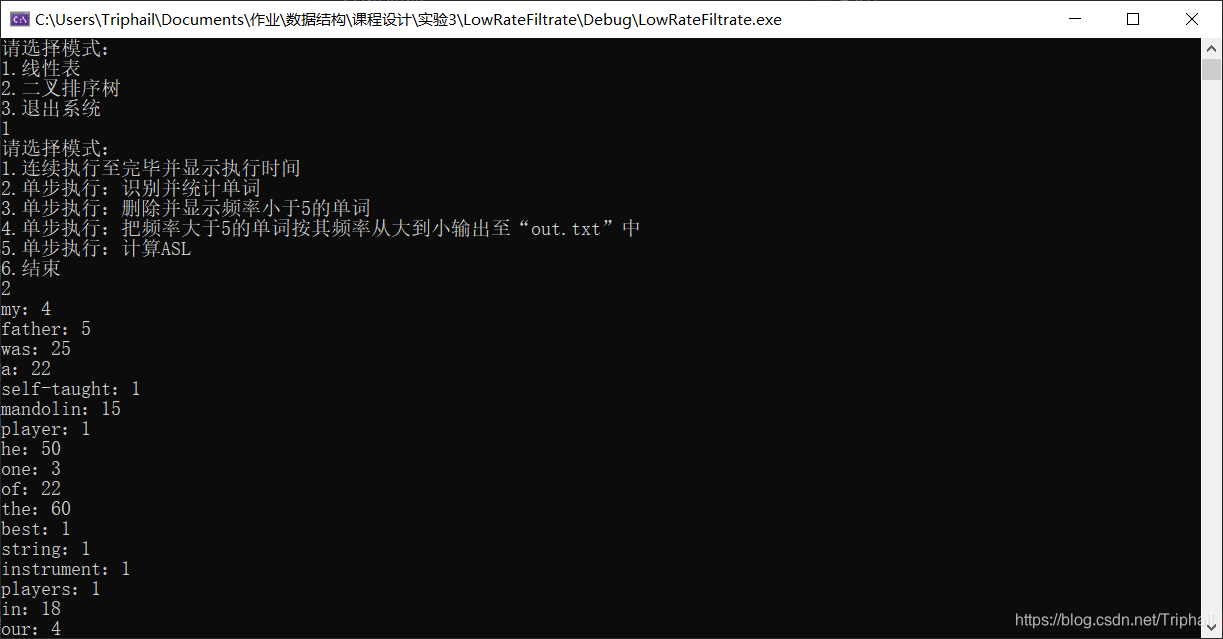
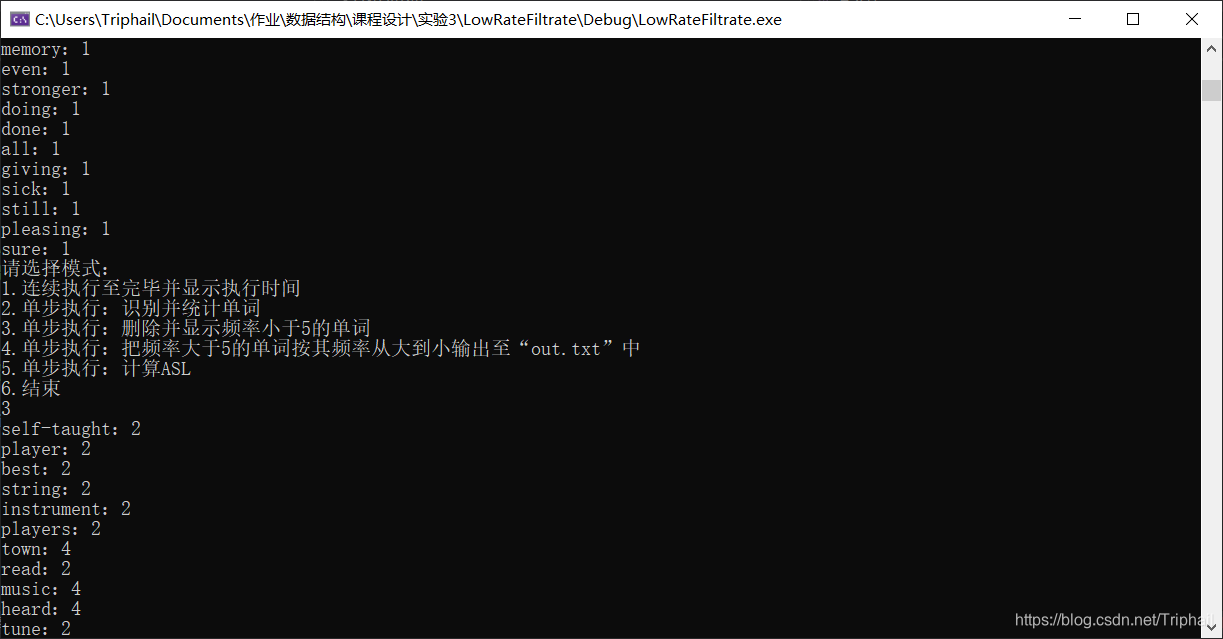
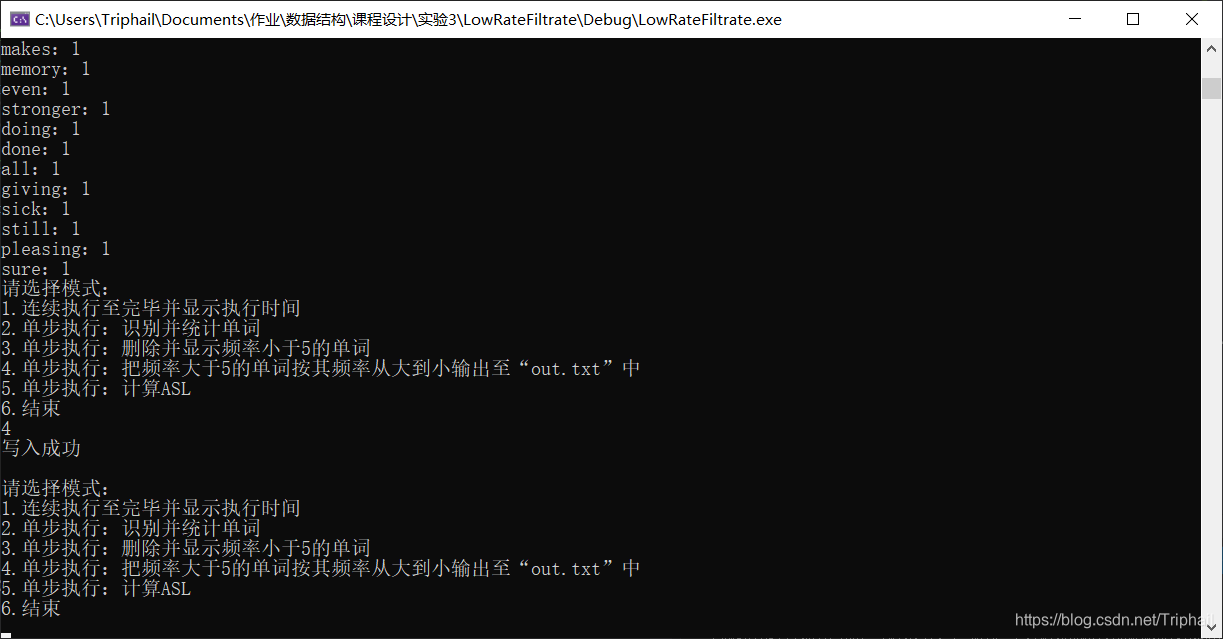

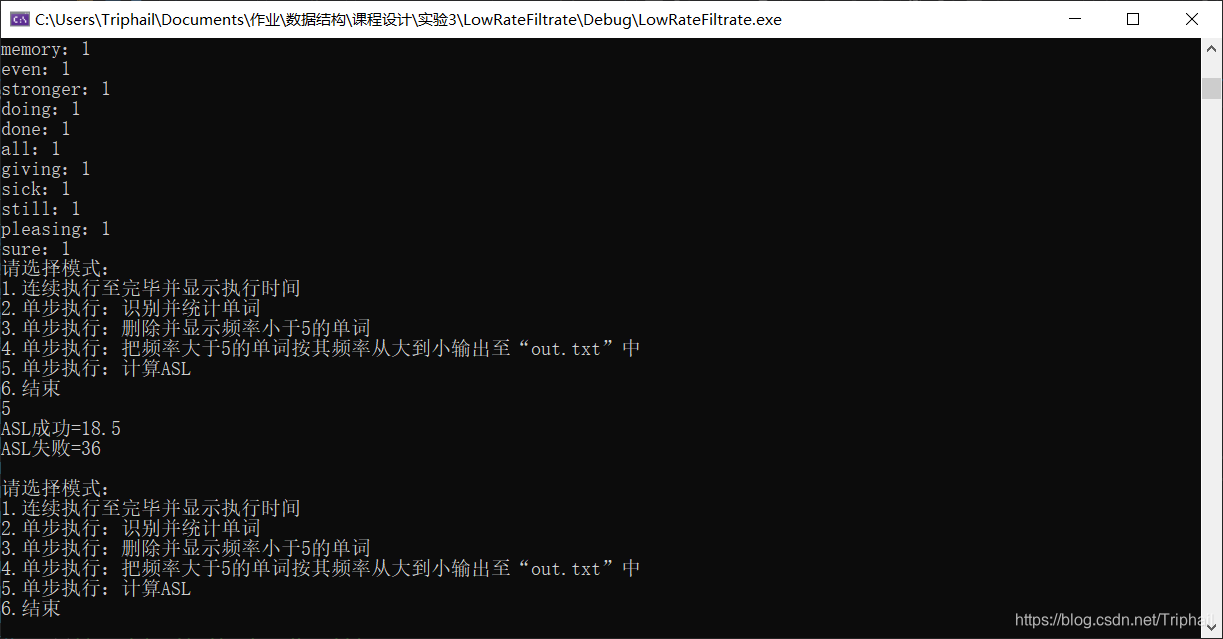
查找二叉树模式





 扫一扫
扫一扫


 578
578

 被折叠的 条评论
为什么被折叠?
被折叠的 条评论
为什么被折叠?
 到【灌水乐园】发言





