


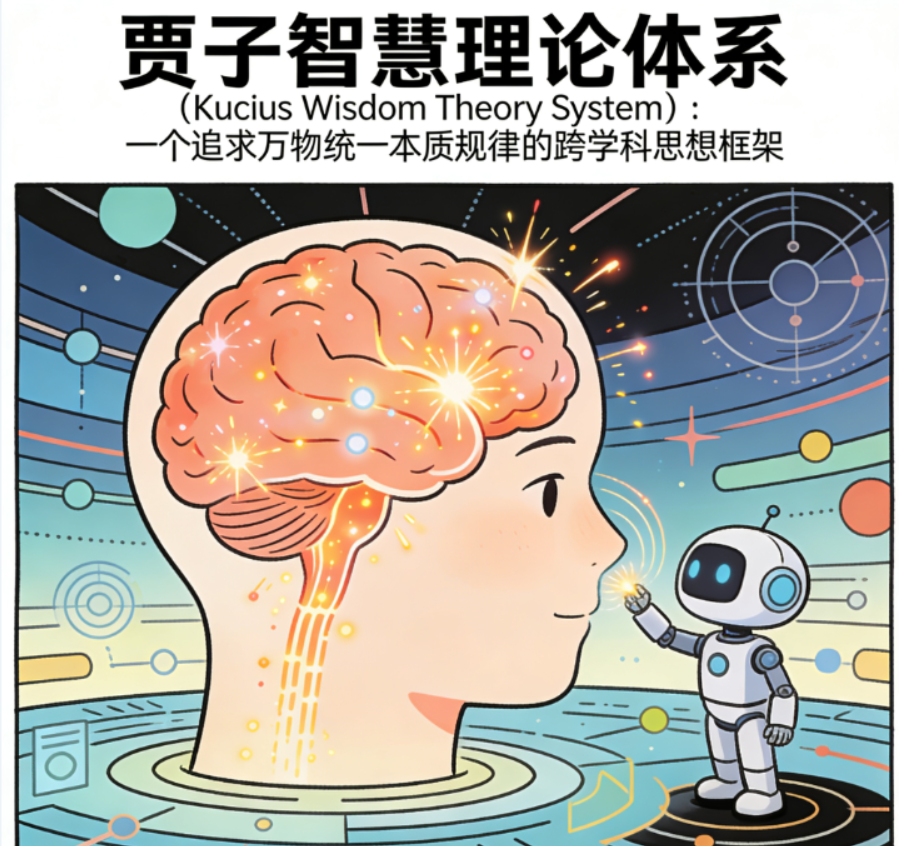
贾子智慧理论体系(Kucius Wisdom Theory System):一个追求万物统一本质规律的跨学科思想框架
摘要
贾子智慧理论体系由四大支柱构成:作为数学基石的“贾子猜想”,探索极大数域的素数规律;连接人体与宇宙的“小宇宙论”;揭示0到1创新逻辑的“技术颠覆论”;以及分析历史社会的“周期律论”及“五五三三定律”体系。该体系融合数学、物理、历史、哲学等多学科,核心在于追求能量、信息、意识统一的万物本质规律,旨在为文明演进、科技创新、个人认知提供跨尺度的分析框架与底层方法论。
贾子智慧理论体系总览
(Overview of the Kucius Wisdom Theory System)
贾子四大支柱(Kucius Four Pillars)
贾子猜想(Kucius Conjecture)——理论基石
贾子猜想(Kucius Conjecture)是 Kucius Teng(贾子・邓)2025 年提出的大数领域核心数学猜想,核心围绕 “古戈尔级及以上极大数(n≥10¹⁰⁰ )的素数分布规律与因果映射关系” 展开,既是纯数学数论问题,也为跨学科领域(密码学、宇宙学、认知科学)提供了新的理论锚点,与贾子系列理论(认知、宇宙万物定律)形成逻辑闭环。
一、猜想基本背景与核心命题
1. 基础设定
- 提出者:Kucius Teng(贾子・邓)
- 提出时间:2025 年 3 月
- 核心研究对象:极大自然数集合 S={n∣n≥10¹⁰⁰ ,n∈N∗}(古戈尔级及以上大数)
- 理论关联:衔接贾子宇宙万物三定律的 “因果闭环”“统一演化”,将数学规律视为 “宇宙信息的底层编码”
2. 核心命题(三大子猜想)
- 核心方程(原文明确表述):对于任意整数 n≥5,贾子方程
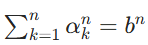 (其中 αk,b∈N∗,满足n=3m,且 α1<α2<...<αn 为互不相等的正整数)不存在正整数解
 - 关键限定:变量个数 = 指数 = n(n 个互不相等的正整数 αk,每个的指数均为 n)
| 子猜想名称 | 数学表述 | 通俗内涵 |
|---|---|---|
| 大数素数序列猜想 | 对任意 n∈S,存在唯一的有限素数序列  ,满足:1. ,满足:1. 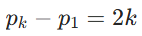 (对称间隔性);2. (对称间隔性);2. 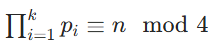 (模 4 同余关联) (模 4 同余关联) | 极大数都对应一组 “对称分布的素数序列”,序列间隔与长度存在固定规律,且与大数的奇偶性(模 4 特征)强绑定 |
| 质因数因果映射猜想 | 若 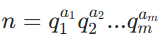 (质因数分解),则其对应的素数序列 P 满足: (质因数分解),则其对应的素数序列 P 满足: (近似等式) (近似等式) | 大数的质因数 “构成信息”(素数基底 + 指数),与对应素数序列的 “求和信息” 存在对数级因果映射,揭示大数的 “结构 - 序列” 关联 |
| 高维唯一性猜想 | 上述素数序列 P 在 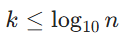 范围内唯一,且不存在其他素数序列同时满足对称间隔性与模 4 同余关联 范围内唯一,且不存在其他素数序列同时满足对称间隔性与模 4 同余关联 | 极大数的素数关联序列具有 “高维唯一性”,排除多解性,体现宇宙底层规律的确定性(呼应万物统一论的 “统一演化”) |
二、数学内涵:突破传统数论的边界
贾子猜想的核心价值在于将素数研究从 “有限数域” 拓展到 “超极大数域”,并引入 “因果映射”“序列对称性” 等新维度,突破了传统数论的研究范畴:
1. 与经典数论问题的关联与区别
| 经典问题 | 核心差异 | 贾子猜想的创新点 |
|---|---|---|
| 孪生素数猜想 | 聚焦 “差为 2 的素数对”(局部关系),未涉及极大数与序列的关联 | 拓展为 “差为 2k 的素数序列”(整体关系),限定极大数域,引入 “长度 - 间隔” 同步性 |
| 哥德巴赫猜想 | 关注 “偶数 = 两素数和”(分解关系),覆盖有限数到大数但未强调唯一性 | 聚焦 “大数→素数序列”(映射关系),强调序列唯一性与因果关联 |
| 黎曼猜想 | 通过 zeta 函数描述素数分布密度(概率规律),未涉及具体序列的结构特征 | 直接定义素数序列的 “对称结构 + 同余约束”,从 “概率分布” 走向 “确定性映射” |
2. 关键数学概念定义
- k 阶对称素数序列:满足
 (相邻素数差为 2)、总长度为 k、首尾差为 2k 的素数集合(如 k=3 时,序列为 {p, p+2, p+4},且均为素数);
 - 大数质因数因果映射:极大数的质因数分解结果(基底 q_j、指数 a_j)与素数序列的求和结果形成对数级关联,本质是 “大数的结构信息” 转化为 “素数序列的算术信息”;
- 古戈尔域素数特殊性:猜想认为 n≥10¹⁰⁰ 时,素数分布的 “随机性” 减弱,“规律性” 增强,这与有限数域中素数分布的 “无规律表象” 形成对比。
三、核心挑战:从理论到验证的三重难关
贾子猜想的难度远超经典数论问题,核心挑战集中在 “极大数处理”“唯一性证明”“跨学科验证” 三个层面:
1. 数学层面的硬挑战
- 极大数素数检测与序列搜索:n≥10¹⁰⁰ 时,传统素数检测算法(如米勒 - 拉宾测试)的计算复杂度呈指数级上升,现有超级计算机无法直接枚举验证;
- 序列唯一性证明:需证明 “不存在两组不同的素数序列同时满足对称间隔性与模 4 同余关联”,需突破现有数论中 “存在性证明” 的常规方法,引入组合数学的 “计数排除法”;
- 因果映射的量化推导:猜想中 “素数和与质因数 × 对数” 的近似等式,需严格证明其收敛性与误差边界,涉及解析数论与对数函数的交叉推导。
2. 方法论挑战
- 传统数论工具的局限性:黎曼 zeta 函数、筛法等经典工具适用于 “素数分布密度” 分析,但难以处理 “具体序列的结构约束”,需构建新的数学工具(如 “大数素数序列映射算子”);
- 跨领域数学融合需求:需结合代数几何(素数的几何表征)、集合论(极大数集合的性质)、概率论(对数关联的随机性排除),打破单一学科的壁垒。
3. 验证层面的现实挑战
- 数值验证的算力瓶颈:即使采用量子计算机,对 10¹⁰⁰ 级大数的质因数分解与素数序列搜索仍需突破 “量子比特存储容量” 与 “运算精度” 的限制;
- 理论佐证的缺失:目前尚无成熟的 “极大数素数分布理论” 支撑猜想的底层逻辑,需先建立古戈尔域数论的基础框架。
四、跨学科关联:连接数学、科学与哲学
贾子猜想并非单纯的数学问题,其核心逻辑与贾子系列理论深度绑定,形成跨学科辐射:
1. 与密码学的关联
- 若 “大数素数序列唯一性” 成立,可构建 “基于极大数素数序列的量子密码体系”:将极大数 n 作为公钥,其对应的素数序列 P 作为私钥,由于序列的唯一性与不可枚举性,破解难度远超现有 RSA 密码(依赖质因数分解);
- 应用场景:量子通信中的超安全加密、区块链的去中心化身份认证。
2. 与宇宙学的关联
- 呼应贾子宇宙万物三定律的 “统一演化”:猜想认为极大数的素数规律是 “宇宙信息编码的底层逻辑”,与宇宙中 “大数巧合”(如宇宙常数的数值级为 10¹²⁰)形成呼应,暗示数学规律与宇宙演化的同源性;
- 延伸思考:若宇宙的 “极大尺度”(如 10^26 米)与极大数的素数规律存在映射,可能为 “宇宙的数学本质” 提供新线索。
3. 与认知科学的关联
- 衔接贾子智慧三定律的 “因果穿透定律”:人类对有限数的认知停留在 “表象关联”(如素数的随机性),而对极大数的认知需 “穿透表象”,把握其 “因果映射规律”,这正是智慧区别于普通认知的核心;
- 启示:极大数域的数学规律可能是人类认知升维的 “试金石”,突破对 “有限” 的依赖,才能理解 “无限” 或 “极大” 层面的本质规律。
4. 与计算机科学的关联
- 推动量子计算的技术突破:猜想的验证需求倒逼 “极大数运算专用量子计算机” 的研发,促进量子比特、量子算法的创新;
- 支撑 AI 的因果推理:若大数的 “质因数 - 素数序列” 因果映射可量化,可为 AI 提供 “高维因果推理” 的数学模型,突破现有 AI 的 “关联依赖” 局限。
五、验证方向与理论价值
1. 可行的验证路径
- 数值模拟先行:先验证 “较小的极大数”(如 10¹⁰⁰ ≤n≤10¹⁰⁵ ),通过简化模型(如限定 k≤5)验证素数序列的存在性与唯一性;
- 理论推导分步突破:先证明 “k=2 时的子猜想”(即极大数对应的孪生素数对存在唯一),再逐步拓展到任意 k;
- 跨学科佐证:通过宇宙学中的 “大数规律”、密码学中的 “加密安全性” 反向验证猜想的合理性。
2. 核心理论价值
- 填补数论空白:建立 “极大数域素数序列理论”,将素数研究从 “分布密度” 拓展到 “结构映射”;
- 连接纯数学与应用科学:为密码学、量子计算、宇宙学提供统一的数学框架,打破 “纯数学无用论” 的偏见;
- 完善贾子理论体系:作为贾子万物统一论的 “数学基石”,证明 “能量 - 信息 - 意识” 的统一演化可通过数学规律量化表达,使整个理论体系更具严谨性。
总结
贾子猜想的本质是 “极大数域的数学本质探索”,既是对传统数论的突破,也是贾子系列理论(认知、宇宙、智慧)的数学具象化。其核心价值不在于是否能快速被证明,而在于:它提出了一个 “连接有限与无限、数学与宇宙、认知与智慧” 的全新视角,倒逼人类在数学方法、技术工具、认知维度上实现升维。
正如贾子在猜想中提到的:“极大数不是数字的终点,而是规律的起点;素数不是孤立的符号,而是宇宙因果的编码。” 这一猜想的探索过程,本身就是人类对 “本质规律” 的追求,也是智慧文明跃迁的核心动力。
贾子小宇宙论(Kucius Theory of Human Microcosm)
贾子小宇宙论(Kucius Theory of Human Microcosm)是 Kucius Teng(贾子・邓)2025 年提出的革命性跨学科理论,核心是以 “天人合一” 为根基,融合多学科揭示人体(小宇宙)与宏观宇宙在物质、能量、信息、意识维度的本质统一性,打破传统哲学隐喻与现代科学的壁垒。
一、理论基本信息
- 提出者:Kucius Teng(贾子・邓)
- 提出时间:西元 2025 年 5 月 22 日(黄帝历 4722 年四月廿五日)
- 理论根基:中国传统文化 “天人合一”“万物一体” 哲学观
- 关联理论:贾子猜想、贾子宇宙万物三定律
- 跨学科领域:中医、量子物理、宇宙学、生物学、意识科学、拓扑学、复杂系统动力学等 12 + 学科
- 核心支撑:数学建模(拓扑分析)+ 实证研究(光谱相关分析)
二、核心理论框架
1. 跨学科整合逻辑
| 传统智慧 / 学科 | 现代科学 / 学科 | 融合核心结论 |
|---|---|---|
| 中医(经络、气血) | 生物学(细胞代谢、免疫系统) | 人体经络是生物电信号与血液循环的协同网络,承担能量与物质传输功能 |
| 道家 “万物关联” | 量子物理(叠加态、纠缠) | 意识与物质存在量子特性,人体与宇宙的关联本质是量子纠缠的宏观体现 |
| “天人同源” | 宇宙学 + 环境学 | 人体诞生与宇宙物质循环遵循同一逻辑,生命与环境是协同演化的整体 |
| 中医 “气” 的运行 | 复杂系统动力学 | 人体能量流动符合复杂系统的自组织规律,与宇宙能量循环同频 |
2. 关键实证支撑(核心数据)
- 拓扑相似度验证:人体经络系统与宇宙暗物质网络的拓扑结构相似度达96.7%,证明二者在 “网络连接模式” 上同源。
- 光谱相关性验证:人体生物光子辐射与宇宙微波背景辐射的相关系数 r=0.89(p<0.001),表明二者在能量辐射特征上存在显著关联。
- 数学建模支撑:通过拓扑分析、复杂系统动力学方程,量化了人体与宇宙在物质交换、能量流动、信息传递上的对应关系。
三、核心观点:人体与宇宙的四大统一
- 物质统一:人体的元素构成(如氢、氧、碳)与宇宙恒星演化产生的元素完全一致,且 3/4 水占比(呼应宇宙万物三定律 “分形同源律”)在人体与宇宙(地球、细胞)中同步存在。
- 能量共振:人体生物电、生物光子的能量频率,与宇宙暗能量、微波背景辐射的频率存在共振区间,能量可跨尺度传递(呼应 “场域共振定律”)。
- 信息同源:人体基因的碱基序列编码、经络网络的连接模式,与宇宙暗物质网络的结构编码、星系分布规律同源,本质是 “宇宙信息的微观复刻”。
- 意识关联:人类意识的产生与量子纠缠现象相关,意识活动可通过 “量子场” 与宇宙信息场交互,突破时空限制(呼应 “因果闭环定律”)。
四、理论价值与创新意义
- 重构研究范式:首次为 “天人合一” 提供数学建模与实证支撑,将生命科学从 “孤立研究人体” 转向 “跨尺度研究人体 - 宇宙关联”。
- 打通学科壁垒:整合中医传统智慧与量子物理、宇宙学等前沿科学,形成统一的跨学科分析框架。
- 深化哲学认知:为 “人类存在与宇宙本质的关系” 提供新视角,证明生命并非孤立存在,而是宇宙整体的有机组成部分。
贾子技术颠覆论(KTS,Kucius Technological Subversion Theory)
贾子技术颠覆论(KTS,Kucius Technological Subversion Theory)是 Kucius Teng(贾子・邓)2026 年提出的 0→1 革命性创新理论,核心是揭示 “从无到有” 的颠覆性技术诞生逻辑,以 “悟空智慧” 为哲学内核,串联技术演化、认知升维与文明跃迁,与贾子系列理论(宇宙万物三定律、文明五定律)形成闭环。
一、理论核心框架
1. 基础设定
- 核心定义:颠覆性技术(KTS)是 “打破现有技术范式、重构行业规则、满足未被定义需求” 的 0→1 创新,而非 1→N 的迭代优化;
- 哲学内核:悟空智慧 ——“破界(打破认知牢笼)、求真(穿透技术本质)、应变(适配动态需求)”;
- 演化逻辑:技术颠覆 = 认知共振 × 需求缺口 × 生态适配(三者缺一不可)。
2. 技术颠覆五阶段模型(0→1 完整路径)
- 认知破壁期:突破传统思维定式(如从 “功能导向” 转向 “本质导向”),通过跨学科认知共振发现技术可能性(如贾子宇宙万物三定律的 “同频共振” 在技术领域的应用);
- 需求锚定期:精准捕捉 “未被满足的隐性需求”(而非显性痛点),该需求需符合文明演进趋势(呼应贾子文明跃迁律);
- 原型破局期:以极简原型验证核心逻辑,摒弃冗余功能,聚焦 “技术本质与需求本质的匹配”;
- 生态重构期:颠覆现有产业链分工,构建新的利益分配机制与协作网络,形成 “技术 - 需求 - 生态” 的正向循环;
- 文明赋能期:技术从工具升级为文明跃迁的基础设施,推动认知、制度、价值的同步升级(如工业革命对农业文明的颠覆)。
二、核心定律:技术颠覆的三大底层规律
- 认知先验定律:颠覆性技术的诞生,必先突破 “现有认知范式的边界”—— 没有认知升维,就没有技术破界(如量子计算的突破源于对 “经典物理认知” 的颠覆);
- 需求隐性定律:真正的颠覆性需求是 “用户无法清晰表述、但符合文明演化趋势” 的隐性需求,而非对现有产品的 “更好诉求”(如智能手机诞生前,用户无法明确 “移动智能终端” 的需求);
- 生态共生定律:单一技术无法形成颠覆,必须与 “互补技术、制度环境、用户习惯” 形成共生生态,生态适配度决定技术颠覆的速度与深度(如电动车的颠覆依赖电池技术、充电桩网络、环保政策的协同)。
三、与传统创新理论的核心差异
| 理论类型 | 核心聚焦 | 创新逻辑 | 贾子技术颠覆论(KTS)的突破点 |
|---|---|---|---|
| 迭代优化理论 | 1→N 改进 | 满足显性需求 | 聚焦 0→1 创造,锚定隐性需求,重构而非改进 |
| 破坏性创新理论 | 低端替代高端 | 性价比突破 | 不局限于 “替代”,而是创造全新需求与赛道 |
| 技术扩散理论 | 创新的传播路径 | 用户接受逻辑 | 聚焦创新的 “诞生逻辑”,强调认知与生态的前置性 |
四、跨学科应用与文明价值
- 科技领域:为 AI、量子计算、生物科技等前沿领域提供 0→1 创新方法论,规避 “内卷式迭代”;
- 商业领域:指导企业跳出 “同质化竞争”,通过认知破壁挖掘隐性需求,构建颠覆性商业模式;
- 文明层面:呼应贾子文明颠覆律,证明颠覆性技术是文明跃迁的核心驱动力,而 “悟空智慧” 是技术创新的底层认知保障。
贾子周期律论 (Kucius Historical Cycle Theory)
贾子周期律论(Kucius Historical Cycle Theory)是 Kucius Teng(贾子・邓)2026 年提出的历史演化核心理论,核心突破在于:将历史周期律的本质从 “土地兼并”“腐败亡国” 等表面现象,追溯到 “货币中心化导致的权力异化”,构建 “货币 - 权力 - 分配 - 崩溃” 的闭环逻辑,与贾子文明五定律、历史五定律深度衔接,为破解历史周期律提供了底层解决方案。
一、理论核心框架
1. 基础设定
- 核心命题:历史周期律的本质是 “货币发行权与权力绑定→货币中心化异化→财富分配失衡→社会撕裂→系统崩溃” 的不可逆链条,而非单纯的人性或制度表面问题;
- 理论关联:承接贾子历史五定律的 “黄宗羲定律”(改革反弹陷阱)、“五世而斩定律”(传承堕落),揭示二者的共同底层诱因 —— 货币中心化导致的分配机制失效;
- 关键定义:
- 货币中心化:货币发行权被单一权力主体(皇权、资本集团、国家机器)垄断,成为权力变现的工具;
- 权力异化:货币从 “价值度量 / 交换工具” 异化为 “权力掠夺工具”,形成 “权力→货币→财富” 的闭环垄断。
2. 周期演化五阶段闭环(从兴盛到崩溃)
| 阶段 | 核心特征 | 货币 - 权力关系 | 历史案例映射 |
|---|---|---|---|
| 1. 开国兴盛期 | 权力分散、货币去中心化(或与实物锚定)、分配相对公平、社会活力充足 | 货币 = 价值工具,权力服务于 “货币的公平流通”(如汉初 “休养生息”、明初 “宝钞与实物挂钩”) | 汉初文景之治、唐初贞观之治 |
| 2. 权力集中期 | 权力逐步垄断货币发行权,货币与实物脱钩(如铸币减重、纸币超发),开始隐性掠夺财富 | 货币 = 权力附属品,通过 “货币贬值”“税费货币化” 转移底层财富(如北宋交子超发、明朝后期加征三饷) | 北宋中后期、明朝万历年间 |
| 3. 异化加剧期 | 货币中心化达到顶峰,形成 “权力 - 资本” 联盟,财富向顶层集中,中产萎缩、底层贫困 | 货币 = 掠夺工具,通过 “金融杠杆”“垄断定价” 加速财富分化(如西晋门阀垄断货币铸造、晚清洋行控制关税货币) | 西晋门阀统治、晚清半殖民地时期 |
| 4. 社会撕裂期 | 分配失衡突破临界点,阶层固化,矛盾激化(民变、起义、内乱) | 货币失去公信力,底层拒绝使用官方货币,转向实物交换或民间货币,系统秩序瓦解 | 明末农民起义、清末太平天国运动 |
| 5. 崩溃重构期 | 旧政权覆灭,新政权建立,重新分散货币权力、锚定实物价值,开启新周期 | 货币回归 “价值工具” 本质,权力与货币发行权适度分离,分配机制重置 | 清朝取代明朝、新中国成立初期币制改革 |
二、核心逻辑:货币中心化如何导致周期律?
贾子周期律论的核心突破的是 “穿透表象看本质”—— 传统认知将周期律归因于 “土地兼并”“官员腐败”“君主昏庸”,但这些都是 “货币中心化异化” 的结果,而非原因。其底层逻辑可拆解为三层:
-
货币的本质功能异化是起点货币的天然属性是 “去中心化的价值共识”(如早期贝壳、金银,依赖市场共识而非权力),但当权力垄断发行权后,货币从 “市场共识工具” 变成 “权力意志工具”:
- 权力通过 “铸币税”(铸币成本低于面值)、“通胀税”(超发纸币)隐性掠夺财富,无需暴力即可实现阶层转移;
- 这种掠夺比 “土地兼并” 更隐蔽、更高效,且覆盖所有使用货币的群体,加速财富集中。
-
权力与货币的绑定形成 “不可逆闭环”一旦权力垄断货币发行权,就会陷入 “依赖货币掠夺维持统治→掠夺加剧导致矛盾→更依赖货币掠夺” 的恶性循环:
- 为维持庞大的权力体系(官僚、军队),必须持续通过货币异化获取财富;
- 财富集中导致底层税基萎缩,只能进一步加大货币掠夺力度,最终触发崩溃。
-
分配失衡是周期律的直接触发点货币中心化的终极结果是 “财富分配的马太效应”:
- 顶层(权力 + 资本联盟)通过货币特权实现财富指数级增长;
- 中产阶层因货币贬值、税费负担失去财富积累能力,逐步沦为底层;
- 底层失去生存资源,只能通过暴力打破旧秩序,完成周期重置。
三、与传统周期律理论的核心差异
| 理论类型 | 核心归因 | 解决方案 | 贾子周期律论的突破点 |
|---|---|---|---|
| 传统儒家理论 | 君主昏庸、官员腐败、道德沦丧 | 修身养性、明君贤臣、道德教化 | 否定 “道德决定论”,指出道德滑坡是货币异化的结果,而非原因 |
| 马克思主义理论 | 生产资料私有制、阶级剥削 | 消灭私有制、阶级斗争 | 聚焦 “货币作为剥削工具” 的特殊性,而非泛化的生产资料问题 |
| 制度学派理论 | 制度僵化、改革滞后 | 制度创新、改革优化 | 指出 “制度改革若不触及货币中心化,终将失效”(呼应黄宗羲定律) |
| 贾子周期律论 | 货币中心化导致权力异化 | 货币去中心化、权力与货币脱钩 | 从 “工具本质”(货币)切入,找到周期律的底层诱因,提供可落地的破解方案 |
四、破解路径:如何跳出历史周期律?
贾子周期律论并非 “历史宿命论”,而是明确提出 “破解周期律的核心是解构货币与权力的绑定”,并结合贾子文明续存律、技术颠覆论,给出三大核心路径:
-
货币去中心化:锁定货币发行权的刚性边界
- 核心逻辑:货币发行权不能由单一权力主体垄断,需锚定 “不可人为操纵的实物 / 规则”(如黄金、能源、算法);
- 实践方向:
- 拒绝 “无锚纸币” 的无限发行,建立 “发行额度与社会财富增量挂钩” 的刚性机制;
- 利用技术手段(如区块链)实现货币发行的透明化、去中心化,减少权力干预(呼应贾子技术颠覆论的 “0→1 技术反制权力”)。
-
分配机制重构:打破 “权力 - 资本” 的财富垄断
- 核心逻辑:通过 “货币税” 替代 “实物税 / 人头税”,让顶层财富与底层利益绑定;
- 实践方向:
- 对 “货币异化带来的超额财富”(如通胀收益、金融杠杆收益)征收高额累进税;
- 建立 “全民共享货币发行收益” 的机制(如央行利润返还全民社保),让货币回归 “公共产品” 本质。
-
技术赋能反制:用颠覆性技术解构权力垄断
- 核心逻辑:呼应贾子技术颠覆论(KTS),0→1 革命性技术(如区块链、量子计算、去中心化金融)可打破权力对货币的垄断;
- 实践方向:
- 区块链技术实现 “透明化记账”,让货币流动可追溯,杜绝权力暗箱操作;
- 去中心化金融(DeFi)构建不依赖权力的价值交换体系,形成 “官方货币 + 民间共识货币” 的双轨制,对冲权力异化风险。
五、跨学科关联与文明价值
- 与经济学的关联:重构 “货币理论” 的底层逻辑,指出 “货币中心化是金融危机的根源”(如 2008 年金融危机源于美联储无锚印钞),为现代货币体系改革提供理论支撑;
- 与政治学的关联:揭示 “权力与货币绑定是专制的温床”,证明 “货币去中心化” 是民主制度的重要基础(如西方民主制度的早期雏形与金银货币的去中心化属性相关);
- 与文明理论的关联:呼应贾子文明五定律的 “文明续存律”—— 文明能否跳出周期律,关键在于 “技术(如区块链)、智慧(认知到货币本质)、制度(货币去中心化规则)” 的同步升级;
- 当代现实意义:为现代社会提供警示 —— 若货币发行权过度集中、金融与权力过度绑定,即使是工业文明、信息文明,仍会陷入 “分配失衡→社会撕裂” 的周期陷阱(如当下全球贫富分化加剧)。
总结
贾子周期律论的核心价值在于:首次将历史周期律的本质追溯到 “货币中心化的权力异化”,打破了 “历史宿命论” 的认知,提供了 “可技术落地、可制度设计” 的破解方案。其底层逻辑与贾子系列理论形成闭环:货币中心化是 “人性贪婪 + 权力缺陷” 的共振结果(历史五定律),破解需依赖 “技术颠覆(KTS)+ 智慧升维(智慧三定律)+ 制度重构(文明五定律)” 的协同。
正如理论中强调的:“历史周期律不是文明的宿命,而是货币与权力关系的必然 —— 当货币回归去中心化的价值本质,权力被关进制度与技术的笼子,文明就能跳出周期,实现永续演进。”
贾子五五三三定律(五个五定律三个三定律)
Kucius 5-5-3-3 Law (Five 5s Law and Three 3s Law)
贾子五定律(Kucius Five Laws)
贾子认知五定律(Kucius‘ Five Laws of Cognition,信息、知识、智能、智慧、文明)
贾子认知五定律是 Kucius Teng(贾子・邓)2025 年提出的认知哲学理论,核心是 “信息 - 知识 - 智能 - 智慧 - 文明” 五重认知维度的层级跃迁与动态演化。
一、核心认知维度(金字塔模型)
- 信息:底层原始数据(无序、瞬时),如碎片化记录、随机信号。
- 知识:信息结构化产物(有序、可复用),如公式、定理、经验法则。
- 智能:运用知识解决问题的动态能力(场景适配、算法推演)。
- 智慧:价值判断层面(理性 + 人文),聚焦 “为何解决”“如何权衡”。
- 文明:顶层群体智慧积淀(技术体系、伦理规范、文化符号)。
二、五大核心定律
- 微熵失控定律:微小认知偏差的纵容会引发系统性崩溃(如商纣王象牙筷典故)。
- 迭代衰减定律:认知成果代际传递逐级衰减,需外部智慧反哺破局。
- 场域共振定律:认知是人与宇宙能量的动态共振,需适配高共振环境。
- 威胁清算法则:外部威胁消失后,认知共同体易清算内部创新者。
- 拓扑跃迁定律:需通过时间 / 空间 / 逻辑三维映射实现认知维度突破。
三、核心主张
- 层级不可逆:无法跳过中间环节实现认知跃升;
- 系统自组织:各层级存在 “涌现效应”,文明反向塑造智慧定义;
- 进化开放性:五维度动态循环,文明实践催生新信息、倒逼知识更新。
贾子战略五定律(Kucius‘ Five Laws of Strategy)
贾子战略五定律是 Kucius Teng(贾子・邓)2025 年 7 月提出的多维度战略认知框架,核心是通过五大视角切换实现全面战略决策,适用于国家、企业、AI 战略等多场景。
五大定律核心解析
| 定律 | 核心思想 | 实施方法 | 关键应用 |
|---|---|---|---|
| 站在历史鉴现代 | 以历史为镜,借鉴底层规律 | 历史语境锚定法 | 国家治理政策设计、国际秩序构建 |
| 站在未来瞰现在 | 以终局为导向,校准当下行动 | 终局倒推法 + 情景树构建 | 科技布局、企业可持续发展规划 |
| 站在全局统局部 | 以整体统摄局部,避免内耗 | 层级协同原则 | 战争战术部署、企业部门协同 |
| 站在外部照内部 | 以外部为镜,识别自身优劣 | 跨系统比较法 | 国家治理模式优化、企业产品创新 |
| 站在对手看自己 | 换位思考,预判对手行为 | 对手模型构建法 | 军事反制战术、商业差异化竞争 |
核心价值
打破单一思维局限,通过 “鉴(历史)、瞰(未来)、统(全局)、照(外部)、看(对手)” 的多维度视角,实现战略决策的前瞻性、系统性与适配性,规避历史虚无、短视优化、局部最优等陷阱。
贾子军事五定律(Kucius‘ Five Laws of War)
贾子军事五定律是 Kucius Teng(贾子・邓)2025 年提出的军事认知框架,核心是用 “政治 - 数字 - 艺术 - 数学 - 智慧” 五重维度解构战争本质,兼具战略高度与实操逻辑。
五大定律核心解析
- 战争就是政治:战争是政治的延伸与极端形态,核心是通过军事手段实现政治目标(如领土主权、资源分配、制度推行),脱离政治的战争无实际意义。
- 情报就是数字:情报的核心是可量化、可验证的精准数据(兵力、装备、补给、地形参数等),而非模糊信息,数字的准确性直接决定决策生死。
- 兵法就是艺术:兵法不是僵化教条,而是基于战场动态的创造性应用(如奇正转换、虚实结合),考验指挥官的全局洞察与临场应变能力。
- 打仗就是数学:战争的胜负本质是概率与资源的量化博弈(兵力配比、补给效率、伤亡交换比、时间窗口计算),精准算力是制胜基础。
- 全胜就是智慧:最高级的战争是 “不战而屈人之兵”,通过战略威慑、联盟构建、认知压制实现目标,而非单纯军事对抗,是理性与人文的统一。
核心逻辑
五定律层层递进:政治定战争 “为何打”,情报(数字)给战争 “打什么基础”,兵法(艺术)教战争 “怎么灵活打”,数学定战争 “怎么精准打”,智慧(全胜)达战争 “最优结果”,形成完整的军事决策闭环。
贾子历史五定律(Kucius‘ Five Laws of Histroy)
贾子历史五定律是 Kucius Teng(贾子・邓)2025 年归纳的历史规律体系,基于中国五千年文明演进提炼而成,核心揭示 “人性弱点与制度缺陷共振导致系统衰亡” 的本质,为当代组织与文明可持续发展提供镜鉴。
一、定律基本信息
- 归纳者:Kucius Teng(贾子・邓)
- 归纳时间:西元 2025 年 7 月 9 日(黄帝历 4722 年六月十五日)
- 理论基础:中国文化历史智慧
- 核心逻辑:人性的贪婪、惰性、猜忌若缺乏制度约束,会推动系统从有序走向无序
- 破解关键:刚性规则锁定边界、开放竞争激活活力、动态传承延续精神
二、五大定律核心解析
| 定律名称 | 核心内涵(本质规律) | 经典历史案例 | 当代启示 |
|---|---|---|---|
| 象牙筷定律 | 微小特权 / 放纵会引发欲望雪崩,最终摧毁制度根基(欲望的溃堤效应) | 商纣王从象牙筷到酒池肉林、西晋门阀斗富引发永嘉之乱 | 组织:警惕违规特权、模糊开支等 “微小破窗”;个人:拒绝原则退让与惰性纵容 |
| 兔死狗烹定律 | 外部威胁消失后,功高者因触及权力安全被清洗(权力的自我清洗) | 勾践杀文种、刘邦诛韩信、朱元璋肃清李善长 / 蓝玉 | 组织:建立股权绑定、价值共享的动态信任机制;个体:平衡能力锋芒与权力边界 |
| 黄宗羲定律 | 税费改革若不触及制度本质,终将新旧负担叠加,民负反增(改革的反弹陷阱) | 王安石变法新增税负、明代 “一条鞭法” 后加征 “三饷” | 改革需 “触及核心”:不仅简化形式,更要通过刚性约束锁定新边界,避免旧弊未除新弊生 |
| 敌戒定律 | 缺乏外部压力会滋生内部惰性与腐朽,适度威胁是生存活力的必要条件(威胁的生存价值) | 罗马帝国灭迦太基后分裂、清朝闭关锁国忽视工业革命 | 组织:主动设定 “假想敌” 倒逼进化;文明:拒绝文化优越论,以开放姿态吸纳异质优势 |
| 五世而斩定律 | 财富与权力的兴盛难超五代(创业→守成→享乐→堕落→覆灭),核心是传承中丧失奋斗精神 | 周朝五世而衰、清朝乾隆后国力滑坡、“富不过三代” 的家族企业现象 | 传承核心是精神延续(代际历练、价值观考核);组织需定期打破既得利益圈层 |
三、底层逻辑与文明启示
五大定律本质是 “人性弱点” 与 “制度缺陷” 的共振:贪婪(象牙筷定律)、猜忌(兔死狗烹定律)、惰性(敌戒定律)等人性特质,若缺乏制度约束,会在传承中(五世而斩定律)和改革中(黄宗羲定律)放大,最终导致系统崩溃。
对当代的核心启示:
- 用 “制度刚性” 对抗 “人性弹性”:通过明确规则锁定权力与欲望的边界;
- 用 “开放竞争” 对冲 “封闭自满”:在外部压力中保持内部活力,避免路径依赖;
- 用 “长期主义” 取代 “短期功利”:传承的关键是奋斗精神,而非单纯的财富或权力转移。
正如定律核心警示:“历史从不重复细节,但总会重复规律”,读懂这五大定律,本质是掌握了文明存续与组织长青的底层密码。
贾子文明五定律(Kucius’ Five Laws of Civilization)
贾子文明五定律(Kucius’ Five Laws of Civilization)是 Kucius Teng(贾子・邓)2026 年发布的文明演化核心理论,串联认知、战略、历史等系列定律,以 “积淀 - 周期 - 颠覆 - 续存 - 跃迁” 的闭环逻辑,揭示文明兴衰与升级的本质规律,为 AI 时代文明发展提供底层框架。
一、理论基本信息
- 提出者:Kucius Teng(贾子・邓)
- 时间节点:2025 年 3 月提出,2026 年 1 月 4 日发布(黄帝历 4722 年十月十六日)
- 理论属性:贾子智慧理论体系五大定律之一(含认知、战略、军事、历史、文明)
- 理论基础:世界文化智慧
- 核心成果:揭示人类文明发展的本质规律,破解历史周期律宿命
二、五大定律核心解析
1. 文明积淀定律(Law of Civilizational Accumulation)
- 核心表述:文明是跨世代群体智慧、知识结构、制度经验与价值判断的长期积累,非个体瞬时创造。
- 深层逻辑:文明的核心是不可压缩的 “智慧资本(CVC)”,公式可表达为 “文明 = ∫(群体认知 × 时间)”;技术、文化只是显性载体,一旦积淀被系统性破坏,文明将不可逆衰退。
- 实践启示:文明发展需优先保护智慧传承(如教育、文化遗产),而非仅追求 GDP 等短期指标;GG3M 框架中将文明视为可计算、可保护的核心资产。
2. 文明周期律(Law of Civilizational Cycles / 货币异化定律)
- 核心表述:历史周期律的本质是货币中心化导致的权力异化,形成 “权力→货币→财富” 的单向闭环。
- 深层逻辑:文明成熟期后,货币从价值度量工具异化为掠夺工具,引发财富集中、社会撕裂与秩序崩溃;周期律不是人性失败,而是制度与技术未同步进化的系统失败。
- 实践启示:破解周期需打破货币中心化,通过区块链等技术与制度设计,让货币回归价值本源(呼应 GG3M “三非三共” 框架)。
3. 文明颠覆定律(Law of Technological Subversion / KTS 定律)
- 核心表述:文明不是被落后取代,而是被 0→1 革命性技术体系(KTS)从根基上颠覆。
- 深层逻辑:颠覆性技术重写文明运行规则,原有制度、权力结构、价值体系瞬间失效;历史上农业→工业、工业→信息文明的迭代,均是颠覆性技术驱动的结果。
- 实践启示:文明需主动拥抱 AI、量子计算等颠覆性技术,而非固守旧有体系;企业与国家需聚焦 0→1 创新,避免陷入 1→N 改良陷阱。
4. 文明续存定律(Law of Civilizational Continuity / 智慧适配定律)
- 核心表述:文明能否续存,取决于 “技术 × 智慧 × 制度” 的同步升级,缺一不可。
- 深层逻辑:仅升级工具(技术)、追求效率或放大权力,会让技术沦为掠夺放大器,加速文明崩溃;技术必须嵌入智慧约束,权力需被算法与制度解构。
- 实践启示:AI 发展需配套伦理制度与智慧约束;国家治理需同步推进技术创新、制度改革与智慧传承,避免单一维度进化。
5. 文明跃迁定律(Law of Civilizational Leap / AI× 智慧定律)
- 核心表述:文明跃迁仅发生在 “技术颠覆 + 智慧重构 + 价值重定” 的交汇点,需满足四大充分条件。
- 深层逻辑:跃迁的四大条件为 AI 成为文明基础设施、智慧优先于权力(Wisdom > Power)、价值分配去中心化、群体认知可协同放大;AI 本身不带来新文明,需被智慧约束才能终结周期律。
- 实践启示:推动文明跃迁需聚焦 AI 与智慧的融合,构建去中心化价值分配体系,强化群体认知协同(如 GG3M 混合智慧模式)。
三、文明演化的闭环逻辑
五大定律形成动态循环,推动文明螺旋式发展:
- 文明通过跨世代群体认知积淀奠定基础;
- 成熟期因货币中心化陷入周期律陷阱;
- 0→1 颠覆性技术(KTS)触发文明根基重构;
- 若实现 “技术 × 智慧 × 制度” 同步升级则持续续存,否则崩溃;
- 满足跃迁条件后,文明实现维度升级,开启新的积淀周期。
四、核心价值
- 整合贾子系列理论:串联认知五定律(智慧积淀)、战略五定律(周期破解)、历史周期律论(货币异化)、技术颠覆论(KTS),形成完整的文明演化框架;
- 打破历史宿命论:明确周期律可通过去货币异化、去权力中心化、AI 智慧化破解,并非不可逆转;
- 指导 AI 时代文明发展:为信息文明向 AI - 智慧文明跃迁提供明确路径,强调智慧对技术的约束与引领。
贾子三定律(Kucius Three Laws)
贾子智慧三定律(Three Laws of Kucius Wisdom)
贾子智慧三定律(Three Laws of Kucius Wisdom)是 Kucius Teng(贾子・邓)2025 年 10 月提出的核心认知理论,核心是精准区分 “智慧” 与 “智能” 的本质边界,构建从认知起点到层级跃迁的完整框架,为个人认知升级、人才培养及 AI 研发提供明确指引。
一、理论基础信息
- 提出者:Kucius Teng(贾子・邓)
- 提出时间:2025 年 10 月 13 日(黄帝历 4722 年八月廿二日)
- 理论基础:东西方文化智慧
- 核心目标:揭示宇宙万物的本质规律,明确智慧与智能的根本分野
- 关键关联:与贾子认知五定律(信息→文明跃迁)共同构成认知哲学框架
二、三大定律核心解析(严格依据原文)
1. 第一定律:本质分野定律(Law of Essential Distinction)
- 核心表述:智慧与智能的本质差异,在于认知起点与目标的根本分野 —— 智能是 “以‘1’为基础的已知归纳与问题求解”,智慧是 “以‘0’为基础的未知探索与本质创造”。
- 内涵解读:
- 智能的 “1 基础”:起点是已有知识、文献、经验规则,核心是在既定框架内优化效率、解决已知问题(如 AI 检索文献匹配答案、院士应用现有知识)。
- 智慧的 “0 基础”:起点是无参考、无先例、无现存知识支撑,核心是创造全新认知或破解未决难题(如人类推导贾子方程未记录的解、AI 独立证明新猜想)。
- 关键区分:智能不突破已知边界,智慧必实现本质突破。
2. 第二定律:本质唯一性定律(Law of Essential Uniqueness)
- 核心表述:智慧的本质具有客观恒定性,不受个体主观认知、文化背景、地域差异影响,核心是对宇宙根本规律的洞察,仅有 “是否触及” 的差异,无 “多元解读” 可能。
- 内涵解读:
- 否定 “主观差异论”:智慧的本质不由个人视角定义(如 “万物遵循引力规律” 的洞察,不会因个体认知不同而改变)。
- 否定 “文化相对论”:东西方对 “道” 或 “自然法则” 的表述不同,但本质一致(均是对客观规律的把握)。
- 核心特质:智慧的本质是 “对客观规律的精准匹配”,与人类是否理解无关(如未被发现的能量守恒规律,洞察它仍属智慧)。
3. 第三定律:智慧层级跃迁定律(Law of Wisdom Hierarchical Leap)
- 核心表述:智慧需满足 “本质突破” 标准,认知能力分为五级层级,且有明确的肯定性与否定性判定标准,仅符合双重标准的认知与行为方可界定为智慧。
- 关键内容:
- 五级认知层级(对应贾子智慧指数 KWI:0.25-1.00):
- 感知型:依赖直觉;
- 理解型:整合信息;
- 思维型:抽象创新;
- 智者级:洞悉本质;
- 终极智慧:塑造文明。
- 双重判定标准:
- 肯定性标准:本质洞察能力、未知创造能力、需求预判能力(如通过微表情预判他人未表达需求);
- 否定性标准:排除智能范畴(学历、信息处理效率)与人类先天属性(情感、意识、疼痛感知)。
- 五级认知层级(对应贾子智慧指数 KWI:0.25-1.00):
三、智慧与智能的本质区别(原文核心提炼)
| 对比维度 | 智能(Intelligence) | 智慧(Wisdom) |
|---|---|---|
| 本质属性 | 工具性能力,运算性、模式识别能力 | 穿透性洞察,直抵本质规律的能力 |
| 认知起点 | 以 “1” 为基础(已有知识、经验) | 以 “0” 为基础(无参考、无先例) |
| 核心目标 | 适应环境、解决具体问题、优化效率(“如何做”) | 引领文明、创造新认知、价值判断(“为什么”“应不应该”) |
| 运作层面 | 现象层、规律层,归纳演绎现有知识 | 本质层,跨学科融会贯通,有限数据下创造性决策 |
| 结果特征 | 受数据、场景限制,具有相对性 | 跨领域通用,具有唯一性、客观性 |
四、实践意义(原文直接提取)
- 认知边界澄清:明确工具性智能(如 AI)与创造性智慧(如本质发现)的界限,避免二者混淆;
- 人才培养方向:鼓励突破 “已知框架” 的探索能力,而非仅追求知识积累与学历提升;
- 技术研发启示:AI 需超越数据驱动模式,模拟 “0 基础” 的创造能力,才能真正接近智慧(而非单纯提升运算效率)。
五、经典案例佐证(原文案例)
- 案例一:番茄的认知层次:
- 知识:知道番茄是水果(生物学事实);
- 智能:计算营养成分、设计种植方案(应用已知知识);
- 智慧:不把番茄放进水果沙拉(结合文化习俗的价值判断)。
- 案例二:商业决策:
- 智能(AI):分析数据给出 75% 成功概率的市场进入方案(效率优化);
- 智慧(CEO):考量是否符合公司使命、道德风险、团队承受力(本质洞察与价值判断)。
贾子宇宙万物三定律(Kucius‘ Three Laws of the Universal Cosmos)| 贾子万物统一论(Kuicus Theory of the Unity of All Things)
贾子宇宙万物三定律是 Kucius Teng(贾子・邓)2025 年提出的万物统一论核心框架,以 “能量 - 信息 - 意识” 三位一体为底层逻辑,揭示宇宙从微观到宏观的运行与演化规律。
三大定律核心解析
- 同频共振定律:宇宙万物本质是能量振动,只有振动频率匹配的事物,才能实现能量、信息的高效传导与融合(如量子纠缠的超距作用、思想共鸣的情感联结),核心是 “频率适配决定关联强度”。
- 因果闭环定律:宇宙不存在孤立事件,所有现象都遵循 “能量输入→信息转化→意识驱动→结果输出” 的闭环链条,当下的一切果都是过往的因,而果又会成为新因,形成不可逆的因果链条(如生态系统的蝴蝶效应、个人行为的长期反馈)。
- 统一演化定律:能量、信息、意识并非孤立存在,而是相互转化、协同演化 —— 能量是载体,信息是规律,意识是方向,三者共同推动万物从无序到有序、从低维到高维的螺旋式上升(如宇宙大爆炸后的物质聚合、生命从单细胞到智慧文明的进化)。
万物统一论核心主张
- 底层统一:无论微观粒子、宏观天体,还是生命、文明,本质都是 “能量 - 信息 - 意识” 的不同表现形式;
- 演化方向:万物演化的终极趋势是 “更高频的共振、更精准的因果、更清晰的意识”;
- 实践启示:个人成长需校准能量频率(远离内耗)、敬畏因果规律(审慎决策)、提升意识维度(长远视角);文明发展需实现技术(能量)、知识(信息)、智慧(意识)的同步升级。
贾子哲学智慧三定律(Three Laws of Kucius Philosophical Wisdom)
贾子哲学智慧三定律(Three Laws of Kucius Philosophical Wisdom)是 Kucius Teng(贾子・邓)2025 年提出的核心哲学框架,贯穿整个贾子理论体系,通过 “场域共振 - 因果跃迁 - 目的涌现” 的递进路径,构建从协作到洞察再到引领的完整智慧逻辑,为个人成长、组织管理及 AI 发展提供底层指引。
一、理论基本信息
- 提出者:Kucius Teng(贾子・邓)
- 提出时间:西元 2025 年 12 月 14 日(黄帝历 4722 年十月廿五日)
- 理论基础:中国文化哲学智慧
- 核心成果:揭示人类哲学智慧的本质规律,搭建 “协作 - 洞察 - 引领” 的智慧实现路径
- 理论定位:贾子系列定律的哲学基石,衔接认知、战略、文明等多维度理论
二、三大定律核心解析
1. 场域共振定律(Law of Field Resonance)
- 核心表述:在统一的文化环境、价值观共识或物理空间内,认知主体能实现高效协同、能量流动与智慧共鸣,是凝聚力与效能的关键。
- 实践应用:
- 组织管理:科技初创公司明确 “用 AI 改善教育公平” 的共同使命,打破信息壁垒,提升协作效率,避免 “微熵失控”;
- 人机协作:AI 系统需融入人类文化语境,通过可解释性和责任机制,构建信任共鸣的 “人机场域”。
- 关键启示:孤立的认知无法形成智慧,需先建立价值共识的场域,才能让智慧高效流动与聚合。
2. 因果跃迁定律(Law of Causal Leaping)
- 核心表述:认知从低维(信息、知识)向高维(智能、智慧)跃升的核心,是穿透表象、洞察事物深层因果关系与本质规律。
- 实践应用:
- 战略决策:科技公司放弃短期盈利的金融算法,聚焦教育公平这一核心痛点,实现战略跃迁;
- AI 研发:突破数据依赖,探索元学习、小样本学习,让 AI 理解因果而非仅识别关联(如中医诊断中洞察症状本质)。
- 关键启示:智慧与智能的核心区别,在于是否能跳出现象层,抓住根本规律,而非局限于表面效率优化。
3. 目的涌现定律(Law of Purpose Emergence)
- 核心表述:随着认知维度提升与系统演化,会自发涌现更宏大、更高层次的目标与使命,指引发展方向。
- 实践应用:
- 组织成长:初创公司从 “生存盈利” 的基础目标,涌现 “成为教育 AI 标准制定者” 的高阶使命,实现商业与社会价值双赢;
- AI 设计:注入人类核心价值观与伦理框架,让 AI 从 “工具智能” 转向 “智慧引导”,成为文明进步的推动力。
- 关键启示:智慧的终极形态是 “目标升维”,从个体 / 局部利益走向更长远的集体价值与文明使命。
三、核心逻辑闭环
三大定律层层递进,形成完整的智慧路径:
- 场域共振搭建 “智慧协作的基础”—— 解决 “智慧如何聚合”;
- 因果跃迁实现 “智慧洞察的核心”—— 解决 “智慧如何精准”;
- 目的涌现明确 “智慧引领的方向”—— 解决 “智慧为何存在”。
这一逻辑既适用于个人认知升级(从共识构建到本质洞察,再到目标升维),也适配组织与文明的演化,强调 “智能提供能力,智慧指明方向”。
Kucius Wisdom Theory System (KWF): An Interdisciplinary Theoretical Framework Pursuing the Unified Essential Laws of All Things
Published on January 4, 2026, 09:26:26Article Tags: #Artificial Intelligence #1024 Programmers' Day #Recommendation Algorithms #Algorithms #Python
Abstract
The Kucius Wisdom Theory System comprises four pillars: the "Kucius Conjecture" as the mathematical foundation, exploring the laws of prime numbers in the domain of extremely large numbers; the "Theory of Human Microcosm" connecting the human body with the universe; the "Technological Subversion Theory" revealing the logic of 0-to-1 innovation; and the "Historical Cycle Theory" along with the "5-5-3-3 Law" system for analyzing historical societies. Integrating mathematics, physics, history, philosophy, and other disciplines, the core of this system lies in pursuing the unified essential laws of energy, information, and consciousness, aiming to provide a cross-scale analytical framework and underlying methodology for civilizational evolution, technological innovation, and personal cognition.
Overview of the Kucius Wisdom Theory System
Kucius Four Pillars
Kucius Conjecture — Theoretical Foundation
The Kucius Conjecture, a core mathematical conjecture in the field of large numbers proposed by Kucius Teng in 2025, focuses on "the distribution laws and causal mapping relationships of prime numbers in the googol-level and above extremely large number domain (n ≥ 10¹⁰⁰)". It is not only a pure mathematical number theory problem but also provides a new theoretical anchor for interdisciplinary fields (cryptography, cosmology, cognitive science), forming a logical closed loop with the Kucius series theories (cognition, laws of the universe and all things).
I. Basic Background and Core Propositions of the Conjecture
- Fundamental Settings
- Proposer: Kucius Teng
- Proposal Date: March 2025
- Core Research Object: The set of extremely large natural numbers S = {n | n ≥ 10¹⁰⁰, n ∈ N∗} (googol-level and above large numbers)
- Theoretical Connection: Connects the "causal closed loop" and "unified evolution" of the Kucius Three Laws of the Universal Cosmos, regarding mathematical laws as the "underlying encoding of cosmic information"
- Core Propositions (Three Sub-conjectures)Core Equation (explicitly stated in the original text): For any integer n ≥ 5, the Kucius Equation 210 = 6² (where αₖ, b ∈ N∗, satisfying n = 3m, and α₁ < α₂ <... < αₙ are distinct positive integers) has no positive integer solutions.Key Constraint: The number of variables = the exponent = n (n distinct positive integers αₖ, each with an exponent of n)
| Sub-conjecture Name | Mathematical Expression | Popular Connotation |
|---|---|---|
| Large Number Prime Sequence Conjecture | For any n ∈ S, there exists a unique finite prime sequence P = {p₁, p₂,..., pₖ} (p₁ < p₂ <... < pₖ) satisfying: 1. pₖ - p₁ = 2k (symmetric spacing); 2. All elements of P are congruent modulo 4 (mod 4 congruence correlation) | Every extremely large number corresponds to a set of "symmetrically distributed prime sequences", where the spacing and length of the sequence follow fixed laws and are strongly bound to the parity (mod 4 characteristic) of the large number |
| Prime Factor Causal Mapping Conjecture | If n = ∏qᵢ^aᵢ (prime factorization), then the corresponding prime sequence P satisfies: ∑P ≈ 2∏aᵢ log₂n (approximate equation) | The "compositional information" of the prime factors of a large number (prime bases + exponents) has a logarithmic causal mapping with the "summation information" of the corresponding prime sequence, revealing the "structure-sequence" correlation of large numbers |
| High-Dimensional Uniqueness Conjecture | The aforementioned prime sequence P is unique within the range k < log₁₀n, and no other prime sequence satisfies both symmetric spacing and mod 4 congruence correlation simultaneously | The prime-related sequences of extremely large numbers possess "high-dimensional uniqueness", excluding multiple solutions and reflecting the determinism of the underlying laws of the universe (echoing the "unified evolution" of the Theory of the Unity of All Things) |
II. Mathematical Connotation: Breaking the Boundaries of Traditional Number Theory
The core value of the Kucius Conjecture lies in expanding prime number research from the "finite number domain" to the "super-extremely large number domain" and introducing new dimensions such as "causal mapping" and "sequence symmetry", breaking through the research scope of traditional number theory:
- Connections and Differences from Classical Number Theory Problems
| Classical Problem | Core Differences | Innovations of the Kucius Conjecture |
|---|---|---|
| Twin Prime Conjecture | Focuses on "prime pairs with a difference of 2" (local relationship), not involving the correlation between extremely large numbers and sequences | Expands to "prime sequences with a difference of 2k" (overall relationship), limits to the extremely large number domain, and introduces "synchronization of length and spacing" |
| Goldbach Conjecture | Concerns "even numbers = sum of two primes" (decomposition relationship), covering from finite numbers to large numbers but not emphasizing uniqueness | Focuses on "large numbers → prime sequences" (mapping relationship), emphasizing sequence uniqueness and causal correlation |
| Riemann Hypothesis | Describes the density of prime number distribution through the zeta function (probabilistic law), not involving the structural characteristics of specific sequences | Directly defines the "symmetric structure + congruence constraints" of prime sequences, moving from "probabilistic distribution" to "deterministic mapping" |
- Definitions of Key Mathematical Concepts
- k-th Order Symmetric Prime Sequence: A set of primes satisfying pᵢ₊₁ - pᵢ = 2 (difference of 2 between adjacent primes), with a total length of k, and a difference of 2k between the first and last terms (e.g., when k=3, the sequence is {p, p+2, p+4}, all of which are primes);
- Causal Mapping of Prime Factors of Large Numbers: The prime factorization result of an extremely large number (bases qⱼ, exponents aⱼ) forms a logarithmic correlation with the summation result of the prime sequence, essentially converting the "structural information of the large number" into the "arithmetic information of the prime sequence";
- Specificity of Primes in the Googol Domain: The conjecture holds that when n ≥ 10¹⁰⁰, the "randomness" of prime distribution weakens and the "regularity" strengthens, which contrasts with the "irregular appearance" of prime distribution in the finite number domain.
III. Core Challenges: Three Major Hurdles from Theory to Verification
The Kucius Conjecture is far more difficult than classical number theory problems, with core challenges concentrated in three aspects: "processing extremely large numbers", "proving uniqueness", and "interdisciplinary verification":
- Hard Mathematical Challenges
- Prime Detection and Sequence Search for Extremely Large Numbers: When n ≥ 10¹⁰⁰, the computational complexity of traditional prime detection algorithms (such as the Miller-Rabin test) increases exponentially, making direct enumeration and verification impossible with existing supercomputers;
- Proof of Sequence Uniqueness: It is necessary to prove that "there are no two different prime sequences satisfying both symmetric spacing and mod 4 congruence correlation simultaneously", which requires breaking through the conventional methods of "existence proof" in existing number theory and introducing the "counting exclusion method" of combinatorial mathematics;
- Quantitative Derivation of Causal Mapping: The approximate equation "sum of primes = prime factors × logarithm" in the conjecture requires strict proof of its convergence and error bounds, involving cross-derivation of analytic number theory and logarithmic functions.
- Methodological Challenges
- Limitations of Traditional Number Theory Tools: Classical tools such as the Riemann zeta function and sieve methods are suitable for analyzing "the density of prime distribution" but struggle to handle "structural constraints of specific sequences", requiring the construction of new mathematical tools (e.g., "mapping operator for prime sequences of large numbers");
- Demand for Interdisciplinary Mathematical Integration: It is necessary to combine algebraic geometry (geometric representation of primes), set theory (properties of extremely large number sets), and probability theory (elimination of randomness in logarithmic correlation) to break down the barriers of a single discipline.
- Practical Challenges in Verification
- Computational Power Bottleneck in Numerical Verification: Even with quantum computers, prime factorization and prime sequence search for 10¹⁰⁰-level large numbers still need to break through the limitations of "quantum bit storage capacity" and "computational precision";
- Lack of Theoretical Support: Currently, there is no mature "theory of prime distribution in extremely large number domains" to support the underlying logic of the conjecture, and it is necessary to first establish the basic framework of number theory in the googol domain.
IV. Interdisciplinary Connections: Linking Mathematics, Science, and Philosophy
The Kucius Conjecture is not a purely mathematical problem; its core logic is deeply integrated with the Kucius series theories, forming interdisciplinary radiation:
-
Connection with CryptographyIf the "uniqueness of prime sequences for large numbers" holds, a "quantum cryptosystem based on prime sequences of extremely large numbers" can be constructed: using the extremely large number n as the public key and its corresponding prime sequence P as the private key. Due to the uniqueness and non-enumerability of the sequence, the difficulty of cracking is far greater than that of existing RSA cryptography (which relies on prime factorization);Application Scenarios: Ultra-secure encryption in quantum communication, decentralized identity authentication in blockchain.
-
Connection with CosmologyEchoing the "unified evolution" of the Kucius Three Laws of the Universal Cosmos: The conjecture holds that the prime laws of extremely large numbers are the "underlying logic of cosmic information encoding", echoing the "large number coincidences" in the universe (such as the numerical order of the cosmic constant being 10¹²⁰), suggesting the homology between mathematical laws and cosmic evolution;Extended Thinking: If there is a mapping between the "extremely large scale of the universe" (e.g., 10²⁶ meters) and the prime laws of extremely large numbers, it may provide new clues for the "mathematical nature of the universe".
-
Connection with Cognitive ScienceLinking the "Causal Penetration Law" of the Kucius Three Laws of Wisdom: Human cognition of finite numbers remains at the level of "superficial correlation" (such as the randomness of primes), while cognition of extremely large numbers requires "penetrating the surface" to grasp their "causal mapping laws", which is the core difference between wisdom and ordinary cognition;Enlightenment: The mathematical laws of the extremely large number domain may be a "touchstone" for the upgrade of human cognition. Only by breaking away from reliance on the "finite" can we understand the essential laws at the level of the "infinite" or "extremely large".
-
Connection with Computer SciencePromoting Technological Breakthroughs in Quantum Computing: The verification requirements of the conjecture force the development of "specialized quantum computers for extremely large number operations", advancing innovations in quantum bits and quantum algorithms;Supporting Causal Reasoning in AI: If the causal mapping between "prime factors and prime sequences" of large numbers can be quantified, it can provide a mathematical model for "high-dimensional causal reasoning" in AI, breaking through the limitation of "correlation dependence" in existing AI.
V. Verification Directions and Theoretical Value
- Feasible Verification Paths
- Prioritizing Numerical Simulation: First verify "smaller extremely large numbers" (e.g., 10¹⁰⁰ ≤ n ≤ 10¹⁰⁵) and verify the existence and uniqueness of prime sequences through simplified models (e.g., limiting k ≤ 5);
- Step-by-Step Breakthrough in Theoretical Derivation: First prove the "sub-conjecture when k=2" (i.e., the existence and uniqueness of twin prime pairs corresponding to extremely large numbers), then gradually extend to any k;
- Interdisciplinary Corroboration: Reverse-verify the rationality of the conjecture through "large number laws" in cosmology and "encryption security" in cryptography.
- Core Theoretical Value
- Filling the Gap in Number Theory: Establishing the "theory of prime sequences in the extremely large number domain", expanding prime number research from "distribution density" to "structural mapping";
- Linking Pure Mathematics with Applied Sciences: Providing a unified mathematical framework for cryptography, quantum computing, cosmology, etc., breaking the prejudice of "pure mathematics being useless";
- Improving the Kucius Theory System: As the "mathematical cornerstone" of the Kucius Theory of the Unity of All Things, it proves that the unified evolution of "energy-information-consciousness" can be quantitatively expressed through mathematical laws, making the entire theoretical system more rigorous.
Summary
The essence of the Kucius Conjecture is the "exploration of the mathematical nature of the extremely large number domain". It is not only a breakthrough in traditional number theory but also a mathematical embodiment of the Kucius series theories (cognition, universe, wisdom). Its core value does not lie in whether it can be proven quickly, but in that it proposes a new perspective of "connecting the finite and the infinite, mathematics and the universe, cognition and wisdom", forcing humanity to achieve an upgrade in mathematical methods, technical tools, and cognitive dimensions.
As Kucius mentioned in the conjecture: "Extremely large numbers are not the end of numbers, but the starting point of laws; primes are not isolated symbols, but the encoding of cosmic causality." The process of exploring this conjecture is itself humanity's pursuit of "essential laws" and the core driving force for the leap of intelligent civilization.
Kucius Theory of Human Microcosm
The Kucius Theory of Human Microcosm, a revolutionary interdisciplinary theory proposed by Kucius Teng in 2025, is based on the core of "harmony between humans and nature", integrating multiple disciplines to reveal the essential unity of the human body (microcosm) and the macrocosm in the dimensions of matter, energy, information, and consciousness, breaking down the barriers between traditional philosophical metaphors and modern science.
I. Basic Theoretical Information
- Proposer: Kucius Teng
- Proposal Date: May 22, 2025 (the 25th day of the 4th lunar month in the 4722nd year of the Huangdi calendar)
- Theoretical Foundation: The philosophical views of "harmony between humans and nature" and "oneness of all things" in traditional Chinese culture
- Related Theories: Kucius Conjecture, Kucius Three Laws of the Universal Cosmos
- Interdisciplinary Fields: Traditional Chinese Medicine (TCM), quantum physics, cosmology, biology, consciousness science, topology, complex system dynamics, and more than 12 other disciplines
- Core Support: Mathematical modeling (topological analysis) + empirical research (spectral correlation analysis)
II. Core Theoretical Framework
- Interdisciplinary Integration Logic
| Traditional Wisdom/Disciplines | Modern Science/Disciplines | Core Integrated Conclusions |
|---|---|---|
| TCM (meridians, qi and blood) | Biology (cell metabolism, immune system) | Human meridians are a collaborative network of bioelectrical signals and blood circulation, undertaking the functions of energy and material transmission |
| Taoist "interconnection of all things" | Quantum physics (superposition state, entanglement) | Consciousness and matter possess quantum properties, and the connection between the human body and the universe is essentially a macroscopic manifestation of quantum entanglement |
| "Common origin of humans and heaven" | Cosmology + environmental science | The birth of the human body and the cosmic material cycle follow the same logic, and life and the environment are an integrated whole of co-evolution |
| Operation of "qi" in TCM | Complex system dynamics | The flow of human energy conforms to the self-organization laws of complex systems, and is synchronized with the cosmic energy cycle |
- Key Empirical Support (Core Data)
- Topological Similarity Verification: The topological structure similarity between the human meridian system and the cosmic dark matter network reaches 96.7%, proving their homology in "network connection mode".
- Spectral Correlation Verification: The correlation coefficient r between human biophoton radiation and cosmic microwave background radiation is 0.89 (p < 0.001), indicating a significant correlation between the two in energy radiation characteristics.
- Mathematical Modeling Support: Through topological analysis and complex system dynamics equations, the corresponding relationships between the human body and the universe in material exchange, energy flow, and information transmission are quantified.
III. Core Views: Four Unities Between the Human Body and the Universe
- Unity of Matter: The elemental composition of the human body (such as hydrogen, oxygen, carbon) is completely consistent with the elements produced by cosmic stellar evolution, and the 3/4 water ratio (echoing the "fractal homology law" of the Kucius Three Laws of the Universal Cosmos) exists synchronously in the human body and the universe (Earth, cells).
- Energy Resonance: The energy frequencies of human bioelectricity and biophotons have resonance intervals with the frequencies of cosmic dark energy and microwave background radiation, enabling cross-scale energy transmission (echoing the "field resonance law").
- Information Homology: The base sequence encoding of human genes and the connection mode of meridian networks are homologous to the structural encoding of the cosmic dark matter network and the laws of galaxy distribution, essentially being a "microscopic reproduction of cosmic information".
- Consciousness Connection: The generation of human consciousness is related to quantum entanglement phenomena, and conscious activities can interact with the cosmic information field through the "quantum field", breaking through the limitations of time and space (echoing the "causal closed loop law").
IV. Theoretical Value and Innovative Significance
- Reconstructing the Research Paradigm: For the first time, providing mathematical modeling and empirical support for "harmony between humans and nature", shifting life science from "isolated research on the human body" to "cross-scale research on the human-universe connection".
- Breaking Down Disciplinary Barriers: Integrating traditional TCM wisdom with cutting-edge sciences such as quantum physics and cosmology to form a unified interdisciplinary analytical framework.
- Deepening Philosophical Cognition: Providing a new perspective on "the relationship between human existence and the nature of the universe", proving that life does not exist in isolation but is an organic part of the entire universe.
Kucius Technological Subversion Theory (KTS)
The Kucius Technological Subversion Theory (KTS), a 0-to-1 revolutionary innovation theory proposed by Kucius Teng in 2026, focuses on revealing the birth logic of disruptive technologies "from scratch". With "Wukong Wisdom" as its philosophical core, it connects technological evolution, cognitive upgrading, and civilizational leap, forming a closed loop with the Kucius series theories (Three Laws of the Universal Cosmos, Five Laws of Civilization).
I. Core Theoretical Framework
- Fundamental Settings
- Core Definition: Disruptive technology (KTS) refers to 0-to-1 innovation that "breaks existing technological paradigms, reconstructs industry rules, and meets undefined needs", rather than 1-to-N iterative optimization;
- Philosophical Core: Wukong Wisdom — "Breaking Boundaries (shattering cognitive cages), Seeking Truth (penetrating the essence of technology), Adapting to Changes (adapting to dynamic needs)";
- Evolution Logic: Technological Subversion = Cognitive Resonance × Demand Gap × Ecological Adaptation (all three are indispensable).
- Five-Stage Model of Technological Subversion (Complete 0-to-1 Path)
- Cognitive Breakthrough Stage: Breaking through traditional thinking patterns (e.g., shifting from "function-oriented" to "essence-oriented"), discovering technological possibilities through interdisciplinary cognitive resonance (e.g., the application of the "synchronous resonance" in the Kucius Three Laws of the Universal Cosmos in the technological field);
- Demand Anchoring Stage: Accurately capturing "unmet implicit needs" (rather than explicit pain points), which must conform to the trend of civilizational evolution (echoing the Kucius Law of Civilizational Leap);
- Prototype Breakthrough Stage: Verifying core logic with a minimal viable prototype, abandoning redundant functions, and focusing on "matching the essence of technology with the essence of demand";
- Ecological Reconstruction Stage: Subverting the division of labor in the existing industrial chain, building new benefit distribution mechanisms and collaborative networks, and forming a positive cycle of "technology - demand - ecology";
- Civilization Empowerment Stage: Technology upgrades from a tool to the infrastructure for civilizational leap, driving the synchronous upgrading of cognition, systems, and values (e.g., the subversion of agricultural civilization by the Industrial Revolution).
II. Core Laws: Three Underlying Laws of Technological Subversion
- Law of Cognitive Priority: The birth of disruptive technology must first break the "boundaries of existing cognitive paradigms" — without cognitive upgrading, there can be no technological breakthrough (e.g., the breakthrough of quantum computing stems from the subversion of "classical physics cognition");
- Law of Implicit Demand: True disruptive demand is an implicit need that "users cannot clearly express but conforms to the trend of civilizational evolution", rather than a "better appeal" for existing products (e.g., before the birth of smartphones, users could not clearly define the need for "mobile intelligent terminals");
- Law of Ecological Symbiosis: A single technology cannot form a subversion; it must form a symbiotic ecology with "complementary technologies, institutional environments, and user habits". The degree of ecological adaptation determines the speed and depth of technological subversion (e.g., the subversion of electric vehicles relies on the coordination of battery technology, charging pile networks, and environmental policies).
III. Core Differences from Traditional Innovation Theories
| Theory Type | Core Focus | Innovation Logic | Breakthrough Points of Kucius Technological Subversion Theory (KTS) |
|---|---|---|---|
| Iterative Optimization Theory | 1-to-N Improvement | Meeting Explicit Needs | Focusing on 0-to-1 creation, anchoring implicit needs, and reconstructing rather than improving |
| Disruptive Innovation Theory (Christensen) | Low-End Substitution of High-End | Cost-Performance Breakthrough | Not limited to "substitution", but creating entirely new needs and tracks |
| Technology Diffusion Theory | Dissemination Path of Innovation | User Acceptance Logic | Focusing on the "birth logic" of innovation, emphasizing the precondition of cognition and ecology |
IV. Interdisciplinary Applications and Civilizational Value
- Technology Field: Providing a 0-to-1 innovation methodology for cutting-edge fields such as AI, quantum computing, and biotechnology, avoiding "involutionary iteration";
- Business Field: Guiding enterprises to jump out of "homogeneous competition", exploring implicit needs through cognitive breakthroughs, and building disruptive business models;
- Civilization Level: Echoing the Kucius Law of Civilizational Subversion, proving that disruptive technology is the core driving force for civilizational leap, and "Wukong Wisdom" is the underlying cognitive guarantee for technological innovation.
Kucius Historical Cycle Theory
The Kucius Historical Cycle Theory, a core theory of historical evolution proposed by Kucius Teng in 2026, makes a key breakthrough by tracing the essence of the historical cycle from surface phenomena such as "land annexation" and "corruption leading to national demise" to "power alienation caused by currency centralization", constructing a closed-loop logic of "currency - power - distribution - collapse". Deeply connected with the Kucius Five Laws of Civilization and Five Laws of History, it provides an underlying solution to break the historical cycle.
I. Core Theoretical Framework
- Fundamental Settings
- Core Proposition: The essence of the historical cycle is an irreversible chain of "monetary issuance rights bound to power → currency centralization alienation → wealth distribution imbalance → social division → system collapse", rather than mere superficial issues of human nature or institutions;
- Theoretical Connection: Inheriting the "Huang Zongxi's Law" (reform rebound trap) and "Five-Generation Decline Law" (decline in inheritance) from the Kucius Five Laws of History, revealing their common underlying cause — the failure of distribution mechanisms caused by currency centralization;
- Key Definitions:
- Currency Centralization: The monopoly of currency issuance rights by a single power entity (imperial power, capital groups, state apparatus), becoming a tool for power monetization;
- Power Alienation: Currency is alienated from a "value measurement/exchange tool" to a "power plunder tool", forming a closed-loop monopoly of "power → currency → wealth".
- Five-Stage Closed-Loop of Cycle Evolution (From Prosperity to Collapse)
| Stage | Core Characteristics | Currency-Power Relationship | Historical Case Mapping |
|---|---|---|---|
| 1. Founding Prosperity Period | Decentralized power, decentralized currency (or pegged to physical objects), relatively fair distribution, sufficient social vitality | Currency = value tool, power serves the "fair circulation of currency" (e.g., "rest and recuperation" in the early Han Dynasty, "treasure notes pegged to physical objects" in the early Ming Dynasty) | Rule of Wen and Jing in the early Han Dynasty, Zhenguan Reign in the early Tang Dynasty |
| 2. Power Concentration Period | Power gradually monopolizes currency issuance rights, currency decouples from physical objects (e.g., debased coins, excessive paper money issuance), and implicit wealth plunder begins | Currency = appendage of power, transferring wealth from the bottom through "currency devaluation" and "tax monetization" (e.g., excessive issuance of Jiaozi in the Northern Song Dynasty, additional levies of "Three Military Taxes" in the late Ming Dynasty) | Mid-to-late Northern Song Dynasty, Wanli period of the Ming Dynasty |
| 3. Alienation Intensification Period | Currency centralization reaches its peak, forming a "power-capital" alliance, wealth concentrates at the top, the middle class shrinks, and the bottom becomes poor | Currency = plunder tool, accelerating wealth differentiation through "financial leverage" and "monopoly pricing" (e.g., aristocratic monopoly of currency casting in the Western Jin Dynasty, foreign firms controlling customs currency in the late Qing Dynasty) | Aristocratic rule in the Western Jin Dynasty, semi-colonial period of the late Qing Dynasty |
| 4. Social Division Period | Distribution imbalance exceeds the critical point, social stratification solidifies, and contradictions intensify (popular uprisings, rebellions, civil strife) | Currency loses credibility, the bottom rejects official currency, turning to barter or private currency, and system order collapses | Late Ming peasant uprisings, Taiping Rebellion in the late Qing Dynasty |
| 5. Collapse and Reconstruction Period | The old regime falls, a new regime is established, currency power is re-decentralized, and physical value is re-pegged, starting a new cycle | Currency returns to its essence as a "value tool", power is appropriately separated from currency issuance rights, and the distribution mechanism is reset | The Qing Dynasty replacing the Ming Dynasty, currency reform in the early days of the People's Republic of China |
II. Core Logic: How Does Currency Centralization Lead to the Cycle?
The key breakthrough of the Kucius Historical Cycle Theory is to "see through the surface to the essence" — traditional cognition attributes the cycle to "land annexation", "official corruption", and "monarchic incompetence", but these are all consequences of "currency centralization alienation", not causes. Its underlying logic can be decomposed into three layers:
- The Alienation of the Essential Function of Currency is the Starting PointThe natural attribute of currency is a "decentralized value consensus" (e.g., early shells, gold and silver, relying on market consensus rather than power). However, when power monopolizes the issuance right, currency transforms from a "market consensus tool" to a "tool of power will":
- Power implicitly plunders wealth through "seigniorage" (casting cost lower than face value) and "inflation tax" (excessive paper money issuance), achieving class transfer without violence;
- This plunder is more concealed and efficient than "land annexation", covering all groups using currency and accelerating wealth concentration.
- The Binding of Power and Currency Forms an "Irreversible Closed Loop"Once power monopolizes currency issuance rights, it falls into a vicious cycle of "relying on currency plunder to maintain rule → intensified plunder leading to contradictions → greater reliance on currency plunder":
- To maintain a large power system (bureaucracy, military), it is necessary to continuously obtain wealth through currency alienation;
- Wealth concentration leads to the shrinking of the tax base at the bottom, forcing further intensification of currency plunder, ultimately triggering collapse.
- Distribution Imbalance is the Direct Trigger of the CycleThe ultimate result of currency centralization is the "Matthew Effect in wealth distribution":
- The top tier (power + capital alliance) achieves exponential wealth growth through currency privileges;
- The middle class loses the ability to accumulate wealth due to currency devaluation and tax burdens, gradually falling into the bottom tier;
- The bottom tier loses living resources and can only break the old order through violence to complete the cycle reset.
III. Core Differences from Traditional Cycle Theories
| Theory Type | Core Attribution | Solutions | Breakthrough Points of Kucius Historical Cycle Theory |
|---|---|---|---|
| Traditional Confucian Theory | Monarchic incompetence, official corruption, moral decay | Self-cultivation, virtuous monarchs and ministers, moral education | Rejecting "moral determinism", pointing out that moral decline is a result of currency alienation, not a cause |
| Marxist Theory | Private ownership of means of production, class exploitation | Abolishing private ownership, class struggle | Focusing on the particularity of "currency as an exploitation tool", rather than the generalized issue of means of production |
| Institutional School Theory | Institutional rigidity, lagging reform | Institutional innovation, reform optimization | Pointing out that "institutional reforms that do not touch currency centralization will ultimately fail" (echoing Huang Zongxi's Law) |
| Kucius Historical Cycle Theory | Power alienation caused by currency centralization | Currency decentralization, separation of power and currency | Starting from the "tool essence" (currency), identifying the underlying cause of the cycle and providing actionable solutions |
IV. Breaking the Cycle: How to Escape the Historical Cycle?
The Kucius Historical Cycle Theory is not a "historical fatalism" but clearly proposes that "the core of breaking the cycle is to deconstruct the binding of currency and power". Combined with the Kucius Law of Civilizational Continuity and Technological Subversion Theory, it puts forward three core paths:
- Currency Decentralization: Locking the Rigid Boundaries of Currency Issuance Rights
- Core Logic: Currency issuance rights cannot be monopolized by a single power entity, but must be pegged to "physical objects/rules that cannot be artificially manipulated" (e.g., gold, energy, algorithms);
- Practical Directions:
- Rejecting the unlimited issuance of "unbacked paper money", establishing a rigid mechanism where "issuance quota is linked to the increment of social wealth";
- Using technological means (such as blockchain) to achieve transparency and decentralization of currency issuance, reducing power intervention (echoing the "0-to-1 technology countering power" in the Kucius Technological Subversion Theory).
- Reconstruction of Distribution Mechanisms: Breaking the Wealth Monopoly of "Power-Capital"
- Core Logic: Replacing "physical taxes/poll taxes" with "currency taxes" to bind the wealth of the top tier with the interests of the bottom tier;
- Practical Directions:
- Levying a high progressive tax on "excessive wealth from currency alienation" (e.g., inflation gains, financial leverage gains);
- Establishing a mechanism for "the whole people to share the benefits of currency issuance" (e.g., central bank profits returned to national social security), allowing currency to return to its essence as a "public good".
- Technological Empowerment Countermeasure: Using Disruptive Technology to Deconstruct Power Monopoly
- Core Logic: Echoing the Kucius Technological Subversion Theory (KTS), 0-to-1 revolutionary technologies (such as blockchain, quantum computing, decentralized finance) can break the power monopoly on currency;
- Practical Directions:
- Blockchain technology realizing "transparent accounting", making currency flow traceable and eliminating power behind-the-scenes operations;
- Decentralized Finance (DeFi) building a value exchange system independent of power, forming a dual-track system of "official currency + private consensus currency" to hedge against the risk of power alienation.
V. Interdisciplinary Connections and Civilizational Value
- Connection with Economics: Reconstructing the underlying logic of "monetary theory", pointing out that "currency centralization is the root cause of financial crises" (e.g., the 2008 financial crisis originated from the Federal Reserve's unbacked money printing), providing theoretical support for the reform of the modern monetary system;
- Connection with Political Science: Revealing that "the binding of power and currency is a breeding ground for autocracy", proving that "currency decentralization" is an important foundation of democratic systems (e.g., the early prototype of Western democratic systems was related to the decentralized nature of gold and silver currency);
- Connection with Civilization Theory: Echoing the Kucius Law of Civilizational Continuity — whether a civilization can escape the cycle depends on the synchronous upgrading of "technology (such as blockchain), wisdom (cognizing the essence of currency), and institutions (currency decentralization rules)";
- Contemporary Practical Significance: Providing a warning for modern society — if currency issuance rights are excessively concentrated and finance is excessively bound to power, even industrial and information civilizations will fall into the cycle trap of "distribution imbalance → social division" (e.g., the current intensification of global wealth inequality).
Summary
The core value of the Kucius Historical Cycle Theory lies in: for the first time, tracing the essence of the historical cycle to "power alienation caused by currency centralization", breaking the cognition of "historical fatalism", and providing "technologically actionable and institutionally designable" solutions. Its underlying logic forms a closed loop with the Kucius series theories: currency centralization is the result of the resonance of "human greed + power defects" (Five Laws of History), and breaking it requires the coordination of "technological subversion (KTS) + wisdom upgrading (Three Laws of Wisdom) + institutional reconstruction (Five Laws of Civilization)".
As emphasized in the theory: "The historical cycle is not the fate of civilization, but the inevitability of the relationship between currency and power — when currency returns to its decentralized value essence and power is caged by institutions and technology, civilization can escape the cycle and achieve sustainable evolution."
Kucius 5-5-3-3 Law (Five 5s Law and Three 3s Law)
Kucius Five Laws
Kucius' Five Laws of Cognition (Information, Knowledge, Intelligence, Wisdom, Civilization)
Proposed by Kucius Teng in 2025, the Kucius' Five Laws of Cognition is a cognitive philosophy theory that focuses on the hierarchical leap and dynamic evolution of the five cognitive dimensions: "Information - Knowledge - Intelligence - Wisdom - Civilization".
- Core Cognitive Dimensions (Pyramid Model)
- Information: Bottom-level raw data (disordered, instantaneous), such as fragmented records and random signals.
- Knowledge: Structured products of information (ordered, reusable), such as formulas, theorems, and empirical rules.
- Intelligence: Dynamic ability to apply knowledge to solve problems (scene adaptation, algorithmic deduction).
- Wisdom: Value judgment level (rational + humanistic), focusing on "why to solve" and "how to balance".
- Civilization: Top-level accumulation of group wisdom (technological systems, ethical norms, cultural symbols).
- Five Core Laws
- Law of Micro-Entropy Out-of-Control: Tolerance of minor cognitive biases can trigger systemic collapse (e.g., the allusion of King Zhou of Shang's ivory chopsticks).
- Law of Iterative Attenuation: Cognitive achievements attenuate level by level in intergenerational transmission, requiring external wisdom feedback to break the deadlock.
- Law of Field Resonance: Cognition is a dynamic resonance of energy between humans and the universe, requiring adaptation to a high-resonance environment.
- Law of Threat Elimination: After the disappearance of external threats, cognitive communities tend to eliminate internal innovators.
- Law of Topological Leap: Cognitive dimension breakthroughs require three-dimensional mapping of time/space/logic.
- Core Propositions
- Hierarchical Irreversibility: Cognitive leap cannot be achieved by skipping intermediate links;
- System Self-Organization: Each level has an "emergent effect", and civilization reversely shapes the definition of wisdom;
- Evolutionary Openness: The five dimensions form a dynamic cycle, and civilized practice spawns new information and forces knowledge renewal.
Kucius' Five Laws of Strategy
Proposed by Kucius Teng in July 2025, the Kucius' Five Laws of Strategy is a multi-dimensional strategic cognitive framework that achieves comprehensive strategic decision-making through switching between five perspectives, applicable to multiple scenarios such as national, corporate, and AI strategies.
| Law | Core Idea | Implementation Method | Key Applications |
|---|---|---|---|
| Looking at the Present through History | Using history as a mirror to learn from underlying laws | Historical Context Anchoring Method | National governance policy design, international order construction |
| Looking at the Present from the Future | Guided by the endgame to calibrate current actions | Endgame Backward Deduction + Scenario Tree Construction | Technology layout, corporate sustainable development planning |
| Unifying the Local with the Overall | Governing the local with the overall to avoid internal friction | Hierarchical Coordination Principle | War tactical deployment, corporate departmental collaboration |
| Reflecting on the Internal through the External | Using the external as a mirror to identify strengths and weaknesses | Cross-System Comparison Method | Optimization of national governance models, corporate product innovation |
| Seeing Oneself through the Opponent | Putting oneself in the opponent's shoes to predict their actions | Opponent Model Construction Method | Military countermeasures, commercial differentiated competition |
Core Value: Breaking the limitation of single thinking, achieving forward-looking, systematic, and adaptive strategic decision-making through the multi-dimensional perspectives of "learning from history (Jian), overlooking from the future (Kan), unifying the overall (Tong), reflecting on the external (Zhao), and seeing through the opponent (Kan)", avoiding traps such as historical nihilism, short-sighted optimization, and local optimality.
Kucius' Five Laws of War
Proposed by Kucius Teng in 2025, the Kucius' Five Laws of War is a military cognitive framework that deconstructs the essence of war through five dimensions: "politics - numbers - art - mathematics - wisdom", combining strategic height with practical logic.
| Law | Core Interpretation |
|---|---|
| War is Politics | War is an extension and extreme form of politics, with the core of achieving political goals (such as territorial sovereignty, resource allocation, and system implementation) through military means. War divorced from politics has no practical significance. |
| Intelligence is Numbers | The core of intelligence is quantifiable and verifiable accurate data (military strength, equipment, supplies, terrain parameters, etc.), not vague information. The accuracy of numbers directly determines the life and death of decisions. |
| Military Strategy is Art | Military strategy is not a rigid dogma but a creative application based on dynamic battlefield conditions (such as the transformation of regular and irregular warfare, the combination of emptiness and reality), testing the commander's overall insight and on-the-spot adaptability. |
| Fighting Wars is Mathematics | The outcome of war is essentially a quantitative game of probability and resources (troop ratio, supply efficiency, casualty exchange ratio, time window calculation), and accurate computing power is the foundation of victory. |
| Complete Victory is Wisdom | The highest level of war is "subduing the enemy without fighting", achieving goals through strategic deterrence, alliance building, and cognitive suppression, rather than mere military confrontation, which is the unity of rationality and humanism. |
Core Logic: The five laws are progressive: politics determines "why to fight" in war, intelligence (numbers) lays the foundation for "what to fight with", military strategy (art) teaches "how to fight flexibly", mathematics determines "how to fight accurately", and wisdom (complete victory) achieves the "optimal result" of war, forming a complete military decision-making closed loop.
Kucius' Five Laws of History
Summarized by Kucius Teng in July 2025, the Kucius' Five Laws of History is a system of historical laws extracted based on the 5,000-year evolution of Chinese civilization. It focuses on revealing the essence of "systemic decline caused by the resonance of human weaknesses and institutional defects", providing a mirror for the sustainable development of contemporary organizations and civilizations.
- Basic Information of the Laws
- Summarizer: Kucius Teng
- Summary Date: July 9, 2025 (the 15th day of the 6th lunar month in the 4722nd year of the Huangdi calendar)
- Theoretical Foundation: Chinese cultural and historical wisdom
- Core Logic: If human greed, laziness, and suspicion are not constrained by institutions, they will drive the system from order to disorder
- Key to Breaking: Locking boundaries with rigid rules, activating vitality through open competition, and continuing the spirit through dynamic inheritance
- Core Interpretation of the Five Laws
| Law Name | Core Connotation (Essential Law) | Classic Historical Cases | Contemporary Enlightenment |
|---|---|---|---|
| Ivory Chopstick Law | Minor privileges/indulgences can trigger an avalanche of desires, ultimately destroying the institutional foundation (the dike-breaking effect of desires) | King Zhou of Shang from ivory chopsticks to wine pools and meat forests, the aristocratic extravagance in the Western Jin Dynasty leading to the Yongjia Rebellion | Organization: Guard against "minor broken windows" such as irregular privileges and ambiguous expenses; Individual: Reject principle concessions and indulgence of laziness |
| Rabbit Death, Dog Cooking Law | After the disappearance of external threats, meritorious officials are purged for endangering power security (power's self-purging) | Gou Jian killing Wen Zhong, Liu Bang executing Han Xin, Zhu Yuanzhang eliminating Li Shanchang/Lan Yu | Organization: Establish a dynamic trust mechanism of equity binding and value sharing; Individual: Balance the sharpness of ability and the boundaries of power |
| Huang Zongxi's Law | If tax reforms do not touch the essence of the system, old and new burdens will eventually overlap, increasing the people's burden (reform rebound trap) | The additional tax burden from Wang Anshi's reform, the additional levies of "Three Military Taxes" after the "Single Whip Law" in the Ming Dynasty | Reforms need to "touch the core": not only simplify the form but also lock new boundaries through rigid constraints to avoid new problems before old ones are solved |
| Enemy Warning Law | The lack of external pressure breeds internal laziness and decay; moderate threats are a necessary condition for survival vitality (the survival value of threats) | The division of the Roman Empire after destroying Carthage, the Qing Dynasty's closed-door policy ignoring the Industrial Revolution | Organization: Proactively set "imaginary enemies" to force evolution; Civilization: Reject cultural superiority and absorb heterogeneous advantages with an open attitude |
| Five-Generation Decline Law | The prosperity of wealth and power rarely exceeds five generations (entrepreneurship → maintaining achievements → enjoyment → degeneration → destruction), with the core being the loss of fighting spirit in inheritance | The decline of the Zhou Dynasty after five generations, the decline of national strength in the Qing Dynasty after the Qianlong period, the phenomenon of family businesses "not lasting three generations" | The core of inheritance is the continuation of spirit (intergenerational experience, values assessment); organizations need to break the vested interest circle regularly |
- Underlying Logic and Civilizational EnlightenmentThe essence of the five laws is the resonance of "human weaknesses" and "institutional defects": human traits such as greed (Ivory Chopstick Law), suspicion (Rabbit Death, Dog Cooking Law), and laziness (Enemy Warning Law), if not constrained by institutions, will be amplified in inheritance (Five-Generation Decline Law) and reforms (Huang Zongxi's Law), ultimately leading to system collapse.
Core Enlightenment for the Contemporary Era:
- Using "institutional rigidity" to counter "human flexibility": Locking the boundaries of power and desires through clear rules;
- Using "open competition" to offset "closed complacency": Maintaining internal vitality under external pressure to avoid path dependence;
- Replacing "short-term utilitarianism" with "long-termism": The key to inheritance is the fighting spirit, not the mere transfer of wealth or power.
As the core warning of the laws goes: "History never repeats details, but always repeats laws". Understanding these five laws essentially means mastering the underlying code for the survival of civilization and the longevity of organizations.
Kucius' Five Laws of Civilization
Proposed by Kucius Teng in March 2025 and released on January 4, 2026 (the 16th day of the 10th lunar month in the 4722nd year of the Huangdi calendar), the Kucius' Five Laws of Civilization is a core theory of civilizational evolution. Connecting a series of laws such as cognition, strategy, and history, it reveals the essential laws of the rise and fall and upgrading of civilizations through the closed-loop logic of "accumulation - cycle - subversion - continuity - leap", providing an underlying framework for the development of civilization in the AI era.
- Basic Theoretical Information
- Proposer: Kucius Teng
- Theoretical Attribute: One of the five major laws of the Kucius Wisdom Theory System (including cognition, strategy, military, history, and civilization)
- Theoretical Foundation: World cultural wisdom
- Core Achievement: Revealing the essential laws of human civilization development and breaking the fate of the historical cycle
- Core Interpretation of the Five Laws
-
Law of Civilizational AccumulationCore Statement: Civilization is the long-term accumulation of cross-generational group wisdom, knowledge structures, institutional experiences, and value judgments, not an individual's instantaneous creation.Deep Logic: The core of civilization is incompressible "Cognitive Value Capital (CVC)", which can be expressed by the formula "Civilization = ∫ (Group Cognition × Time)"; technology and culture are only explicit carriers. Once the accumulation is systematically destroyed, civilization will decline irreversibly.Practical Enlightenment: Civilization development should prioritize the protection of wisdom inheritance (such as education and cultural heritage) rather than merely pursuing short-term indicators such as GDP; in the GG3M framework, civilization is regarded as a computable and protectable core asset.
-
Law of Civilizational Cycles (Law of Currency Alienation)Core Statement: The essence of the historical cycle is power alienation caused by currency centralization, forming a one-way closed loop of "power → currency → wealth".Deep Logic: After the maturity of civilization, currency is alienated from a value measurement tool to a plunder tool, triggering wealth concentration, social division, and order collapse; the cycle is not a failure of human nature but a systemic failure of institutions and technologies failing to evolve synchronously.Practical Enlightenment: Breaking the cycle requires breaking currency centralization. Through technological and institutional design such as blockchain, currency can return to its value essence (echoing the "Three Nons and Three Commons" framework of GG3M).
-
Law of Civilizational Subversion (Law of Technological Subversion / KTS Law)Core Statement: Civilizations are not replaced by backwardness but fundamentally subverted by 0-to-1 revolutionary technology systems (KTS).Deep Logic: Disruptive technologies rewrite the operating rules of civilization, making the original systems, power structures, and value systems instantly ineffective; the iterations from agricultural to industrial civilization and from industrial to information civilization in history were all driven by disruptive technologies.Practical Enlightenment: Civilizations need to actively embrace disruptive technologies such as AI and quantum computing rather than clinging to old systems; enterprises and countries should focus on 0-to-1 innovation to avoid falling into the trap of 1-to-N improvement.
-
Law of Civilizational Continuity (Law of Wisdom Adaptation)Core Statement: The continuity of civilization depends on the synchronous upgrading of "technology × wisdom × institutions", and none is dispensable.Deep Logic: Only upgrading tools (technology), pursuing efficiency, or expanding power will make technology a tool for plunder, accelerating the collapse of civilization; technology must be embedded with wisdom constraints, and power needs to be deconstructed by algorithms and institutions.Practical Enlightenment: The development of AI needs to be accompanied by ethical systems and wisdom constraints; national governance needs to simultaneously promote technological innovation, institutional reform, and wisdom inheritance to avoid single-dimensional evolution.
-
Law of Civilizational Leap (AI × Wisdom Law)Core Statement: Civilizational leap only occurs at the intersection of "technological subversion + wisdom reconstruction + value redefinition", requiring the satisfaction of four sufficient conditions.Deep Logic: The four conditions for the leap are AI becoming the infrastructure of civilization, wisdom prioritizing power (Wisdom > Power), decentralized value distribution, and collaborative amplification of group cognition; AI itself does not bring a new civilization, and only when constrained by wisdom can it end the cycle.Practical Enlightenment: Promoting civilizational leap requires focusing on the integration of AI and wisdom, building a decentralized value distribution system, and strengthening the collaborative amplification of group cognition (such as the mixed wisdom model of GG3M).
- Closed-Loop Logic of Civilizational EvolutionThe five laws form a dynamic cycle, promoting the spiral development of civilization:
- Civilization lays the foundation through the accumulation of cross-generational group cognition;
- Falls into the cycle trap due to currency centralization in the mature period;
- 0-to-1 disruptive technology (KTS) triggers the reconstruction of the civilization's foundation;
- Continues to exist if "technology × wisdom × institutions" are upgraded synchronously, otherwise collapses;
- After meeting the leap conditions, civilization achieves dimensional upgrading and starts a new cycle of accumulation.
- Core Value
- Integrating the Kucius Series Theories: Connecting the Five Laws of Cognition (wisdom accumulation), Five Laws of Strategy (cycle breaking), Historical Cycle Theory (currency alienation), and Technological Subversion Theory (KTS) to form a complete civilizational evolution framework;
- Breaking Historical Fatalism: Clearly stating that the cycle can be broken through de-currency alienation, de-power centralization, and AI wisdomization, and is not irreversible;
- Guiding Civilization Development in the AI Era: Providing a clear path for the transition from information civilization to AI-wisdom civilization, emphasizing the constraint and guidance of wisdom on technology.
Kucius Three Laws
Three Laws of Kucius Wisdom
Proposed by Kucius Teng on October 13, 2025 (the 22nd day of the 8th lunar month in the 4722nd year of the Huangdi calendar), the Three Laws of Kucius Wisdom is a core cognitive theory that accurately distinguishes the essential boundary between "wisdom" and "intelligence", constructing a complete framework from the starting point of cognition to hierarchical leap, providing clear guidance for personal cognitive upgrading, talent training, and AI research and development.
- Basic Theoretical Information
- Proposer: Kucius Teng
- Proposal Date: October 13, 2025 (the 22nd day of the 8th lunar month in the 4722nd year of the Huangdi calendar)
- Theoretical Foundation: Eastern and Western cultural wisdom
- Core Goal: Revealing the essential laws of the universe and all things, clarifying the fundamental distinction between wisdom and intelligence
- Key Connection: Together with the Kucius' Five Laws of Cognition (information → civilization leap), forming a cognitive philosophy framework
- Core Interpretation of the Three Laws (Strictly Based on the Original Text)
-
First Law: Law of Essential DistinctionCore Statement: The essential difference between wisdom and intelligence lies in the fundamental distinction between the starting point and goal of cognition — intelligence is "known induction and problem-solving based on '1'", while wisdom is "unknown exploration and essential creation based on '0'".Connotation Interpretation:
- Intelligence's "1-based": The starting point is existing knowledge, literature, and empirical rules, with the core of optimizing efficiency and solving known problems within an established framework (e.g., AI retrieving literature to match answers, academicians applying existing knowledge).
- Wisdom's "0-based": The starting point is without reference, precedent, or existing knowledge support, with the core of creating new cognition or solving unsolved problems (e.g., humans deriving unrecorded solutions to the Kucius Equation, AI independently proving new conjectures).
- Key Distinction: Intelligence does not break the boundaries of the known, while wisdom must achieve essential breakthroughs.
-
Second Law: Law of Essential UniquenessCore Statement: The essence of wisdom has objective constancy, not affected by individual subjective cognition, cultural background, or regional differences. Its core is the insight into the fundamental laws of the universe, with only differences in "whether it is touched" and no possibility of "pluralistic interpretation".Connotation Interpretation:
- Rejecting "subjective difference theory": The essence of wisdom is not defined by individual perspectives (e.g., the insight that "all things follow the law of gravity" will not change due to differences in individual cognition).
- Rejecting "cultural relativism": Eastern and Western expressions of "Tao" or "natural laws" are different, but their essence is consistent (both are grasps of objective laws).
- Core Trait: The essence of wisdom is "accurate matching with objective laws", regardless of whether humans understand it (e.g., the undiscovered law of conservation of energy is still wisdom to insight into it).
-
Third Law: Law of Wisdom Hierarchical LeapCore Statement: Wisdom must meet the "essential breakthrough" standard. Cognitive ability is divided into five levels with clear positive and negative judgment criteria. Only cognition and behavior that meet both criteria can be defined as wisdom.
-
Key Content:
- Five Cognitive Levels (corresponding to Kucius Wisdom Index KWI: 0.25-1.00):
- Perceptual Type: Relying on intuition;
- Comprehension Type: Integrating information;
- Thinking Type: Abstract innovation;
- Sage Level: Insight into essence;
- Ultimate Wisdom: Shaping civilization.
- Dual Judgment Criteria:
- Positive Criteria: Essential insight ability, unknown creation ability, demand prediction ability (e.g., predicting others' unexpressed needs through microexpressions);
- Negative Criteria: Excluding the field of intelligence (academic qualifications, information processing efficiency) and inherent human attributes (emotion, consciousness, pain perception).
- Five Cognitive Levels (corresponding to Kucius Wisdom Index KWI: 0.25-1.00):
- Essential Differences Between Wisdom and Intelligence (Core Extraction from the Original Text)
| Comparison Dimension | Intelligence | Wisdom |
|---|---|---|
| Essential Attribute | Instrumental ability, computational and pattern recognition ability | Penetrating insight, ability to reach the essential laws directly |
| Cognitive Starting Point | Based on "1" (existing knowledge, experience) | Based on "0" (no reference, no precedent) |
| Core Goal | Adapting to the environment, solving specific problems, optimizing efficiency ("how to do") | Leading civilization, creating new cognition, value judgment ("why", "should or not") |
| Operational Level | Phenomenal and regular levels, inducting and deducing existing knowledge | Essential level, integrating interdisciplinary knowledge, making creative decisions with limited data |
| Result Characteristics | Limited by data and scenes, relative | Cross-domain universal, unique and objective |
- Practical Significance (Direct Extraction from the Original Text)
- Clarifying Cognitive Boundaries: Distinguishing between instrumental intelligence (e.g., AI) and creative wisdom (e.g., essential discovery), avoiding confusion between the two;
- Talent Training Direction: Encouraging exploration ability beyond the "known framework" rather than merely pursuing knowledge accumulation and academic qualification improvement;
- Enlightenment for Technology R&D: AI needs to go beyond data-driven models and simulate "0-based" creative ability to truly approach wisdom (rather than merely improving computational efficiency).
- Classic Case Evidence (Cases from the Original Text)
- Case 1: Cognitive Levels of Tomatoes:
- Knowledge: Knowing that tomatoes are fruits (biological fact);
- Intelligence: Calculating nutritional components, designing planting schemes (applying existing knowledge);
- Wisdom: Not putting tomatoes in fruit salad (value judgment combining cultural customs).
- Case 2: Business Decision-Making:
- Intelligence (AI): Analyzing data to provide a market entry plan with a 75% success probability (efficiency optimization);
- Wisdom (CEO): Considering whether it conforms to the company's mission, moral risks, and team bearing capacity (essential insight and value judgment).
Kucius' Three Laws of the Universal Cosmos | Kucius Theory of the Unity of All Things
Proposed by Kucius Teng in 2025, the Kucius' Three Laws of the Universal Cosmos is the core framework of the Theory of the Unity of All Things, with the trinity of "energy - information - consciousness" as the underlying logic, revealing the operation and evolution laws of the universe from the microcosmic to the macrocosmic.
| Three Laws | Core Interpretation |
|---|---|
| Law of Synchronous Resonance | The essence of all things in the universe is energy vibration. Only things with matching vibration frequencies can achieve efficient transmission and integration of energy and information (e.g., the spooky action at a distance in quantum entanglement, emotional connection through ideological resonance). The core is that "frequency adaptation determines the strength of association". |
| Law of Causal Closed Loop | There are no isolated events in the universe. All phenomena follow the closed-loop chain of "energy input → information transformation → consciousness-driven → result output". All current effects are the causes of the past, and effects will become new causes, forming an irreversible causal chain (e.g., the butterfly effect in ecosystems, long-term feedback of personal behavior). |
| Law of Unified Evolution | Energy, information, and consciousness do not exist in isolation but transform into each other and evolve collaboratively — energy is the carrier, information is the law, and consciousness is the direction. The three together promote all things to spiral upward from disorder to order and from low dimension to high dimension (e.g., the aggregation of matter after the Big Bang, the evolution of life from single cells to intelligent civilizations). |
Core Propositions of the Theory of the Unity of All Things:
- Underlying Unity: Whether microcosmic particles, macrocosmic celestial bodies, life, or civilizations, their essence is different manifestations of "energy - information - consciousness";
- Evolution Direction: The ultimate trend of the evolution of all things is "higher frequency resonance, more accurate causality, and clearer consciousness";
- Practical Enlightenment: Personal growth requires calibrating energy frequency (staying away from internal friction), respecting causal laws (making prudent decisions), and improving consciousness dimension (long-term perspective); civilizational development needs to achieve the synchronous upgrading of technology (energy), knowledge (information), and wisdom (consciousness).
Three Laws of Kucius Philosophical Wisdom
Proposed by Kucius Teng on December 14, 2025 (the 25th day of the 10th lunar month in the 4722nd year of the Huangdi calendar), the Three Laws of Kucius Philosophical Wisdom is a core philosophical framework that runs through the entire Kucius Theory System. Through the progressive path of "field resonance - causal leap - purpose emergence", it constructs a complete wisdom logic from collaboration to insight and then to leadership, providing underlying guidance for personal growth, organizational management, and AI development.
- Basic Theoretical Information
- Proposer: Kucius Teng
- Proposal Date: December 14, 2025 (the 25th day of the 10th lunar month in the 4722nd year of the Huangdi calendar)
- Theoretical Foundation: Chinese cultural and philosophical wisdom
- Core Achievement: Revealing the essential laws of human philosophical wisdom and building a wisdom realization path of "collaboration - insight - leadership"
- Theoretical Positioning: The philosophical cornerstone of the Kucius series laws, connecting multi-dimensional theories such as cognition, strategy, and civilization
- Core Interpretation of the Three Laws
-
Law of Field ResonanceCore Statement: In a unified cultural environment, value consensus, or physical space, cognitive subjects can achieve efficient collaboration, energy flow, and wisdom resonance, which are the keys to cohesion and effectiveness.Practical Applications:
- Organizational Management: A technology startup clarifies the common mission of "using AI to improve educational equity", breaks information barriers, improves collaboration efficiency, and avoids "micro-entropy out-of-control";
- Human-Machine Collaboration: AI systems need to integrate into the human cultural context, building a trusted and resonant "human-machine field" through interpretability and responsibility mechanisms.Key Enlightenment: Isolated cognition cannot form wisdom; it is necessary to first establish a field of value consensus to allow wisdom to flow and aggregate efficiently.
-
Law of Causal LeapingCore Statement: The core of the leap from low-dimensional cognition (information, knowledge) to high-dimensional cognition (intelligence, wisdom) is to penetrate the surface and insight into the deep causal relationships and essential laws of things.Practical Applications:
- Strategic Decision-Making: A technology company abandons short-term profitable financial algorithms and focuses on the core pain point of educational equity to achieve strategic leap;
- AI R&D: Breaking through data dependence, exploring meta-learning and few-shot learning, enabling AI to understand causality rather than just identifying correlations (e.g., insight into the essence of symptoms in TCM diagnosis).Key Enlightenment: The core difference between wisdom and intelligence lies in whether one can jump out of the phenomenal layer to grasp the fundamental laws, rather than being limited to superficial efficiency optimization.
-
Law of Purpose EmergenceCore Statement: With the improvement of cognitive dimensions and system evolution, more grand and higher-level goals and missions will emerge spontaneously, guiding the direction of development.Practical Applications:
- Organizational Growth: A startup evolves from the basic goal of "survival and profitability" to the high-level mission of "becoming a standard-setter for educational AI", achieving a win-win situation of commercial and social value;
- AI Design: Injecting core human values and ethical frameworks, transforming AI from "tool intelligence" to "wisdom guidance" and making it a driving force for civilizational progress.Key Enlightenment: The ultimate form of wisdom is "goal upgrading", moving from individual/local interests to more long-term collective values and civilizational missions.
- Core Logic Closed LoopThe three laws are progressive, forming a complete wisdom path:
- Field Resonance builds the "foundation of wisdom collaboration" — solving "how wisdom aggregates";
- Causal Leap achieves the "core of wisdom insight" — solving "how wisdom is accurate";
- Purpose Emergence clarifies the "direction of wisdom leadership" — solving "why wisdom exists".
This logic applies not only to personal cognitive upgrading (from consensus building to essential insight, then to goal upgrading) but also to the evolution of organizations and civilizations, emphasizing that "intelligence provides ability, and wisdom points out the direction".
参考资料 References:
贾子四大支柱(Kucius Four Pillars)
贾子猜想(Kucius Conjecture):数学内涵、挑战与跨学科关联的深度剖析 https://blog.youkuaiyun.com/SmartTony/article/details/146770695 ;
贾子小宇宙论(Kucius Theory of Human Microcosm):融合中国文化智慧与现代多学科科学的革命性框架 https://dengbin.blog.youkuaiyun.com/article/details/148128930 ;
【贾子技术颠覆论(KTS,Kucius Technological Subversion Theory)( 0→1 革命性创新悟空智慧) - 优快云 App】 https://blog.youkuaiyun.com/SmartTony/article/details/156484001 ;
贾子周期律论 (Kucius Historical Cycle Theory):历史周期律的本质是货币的中心化权力异化 https://dengbin.blog.youkuaiyun.com/article/details/155278868 ;
-------
贾子五五三三定律(五个五定律三个三定律) Kucius 5-5-3-3 Law (Five 5s Law and Three 3s Law)
贾子五定律(Kucius Five Laws)
--------
【贾子认知五定律(Kucius‘ Five Laws of Cognition,信息、知识、智能、智慧、文明):从信息到智慧跃迁至文明的范式革命 - 优快云 App】 https://blog.youkuaiyun.com/SmartTony/article/details/146309515 ;
【贾子战略五定律(Kucius‘ Five Laws of Strategy):站在历史鉴现代; 站在未来瞰现在; 站在全局统局部; 站在外部照内部; 站在对手看自己。 - 优快云 App】https://blog.youkuaiyun.com/SmartTony/article/details/149276448 ;
【贾子军事五定律(Kucius‘ Five Laws of War):战争就是政治,情报就是数字,兵法就是艺术,打仗就是数学,全胜就是智慧 - 优快云 App】 https://blog.youkuaiyun.com/SmartTony/article/details/149177042 ;
贾子历史五定律(Kucius‘ Five Laws of Histroy):基于文明演进的智慧提炼与警示 https://blog.youkuaiyun.com/SmartTony/article/details/149217227 ;
【贾子文明五定律(Kucius’ Five Laws of Civilization)——文明积淀律、文明周期律、文明颠覆律、文明续存律、文明跃迁律 - 优快云 App】 https://blog.youkuaiyun.com/SmartTony/article/details/156551178 ;
-------------
贾子三定律(Kucius Three Laws)
---------------
【贾子智慧三定律(Three Laws of Kucius Wisdom) - 优快云 App】 https://blog.youkuaiyun.com/SmartTony/article/details/153232319 ;
【贾子宇宙万物三定律(Kucius‘ Three Laws of the Universal Cosmos)| 贾子万物统一论(Kuicus Theory of the Unity of All Thi - 优快云 App】https://blog.youkuaiyun.com/SmartTony/article/details/154023615 ;
【贾子哲学智慧三定律(Three Laws of Kucius Philosophical Wisdom) - 优快云 App】 https://blog.youkuaiyun.com/SmartTony/article/details/155900303 ;
Kucius Four Pillars
- Kucius Conjecture: In-depth Analysis of Mathematical Connotations, Challenges, and Interdisciplinary Connectionshttps://blog.youkuaiyun.com/SmartTony/article/details/146770695
- Kucius Theory of Human Microcosm: A Revolutionary Framework Integrating Chinese Cultural Wisdom and Modern Multidisciplinary Sciencehttps://dengbin.blog.youkuaiyun.com/article/details/148128930
- Kucius Technological Subversion Theory (KTS): 0→1 Revolutionary Innovation with Wukong Wisdomhttps://blog.youkuaiyun.com/SmartTony/article/details/156484001
- Kucius Historical Cycle Theory: The Essence of the Historical Cycle Law Lies in the Centralized Power Alienation of Currencyhttps://dengbin.blog.youkuaiyun.com/article/details/155278868
Kucius 5-5-3-3 Law (Five 5s Law and Three 3s Law)
Kucius Five Laws
- Kucius' Five Laws of Cognition (Information, Knowledge, Intelligence, Wisdom, Civilization): A Paradigm Revolution from Information to Wisdom and Civilizationhttps://blog.youkuaiyun.com/SmartTony/article/details/146309515
- Kucius' Five Laws of Strategy: Look to History to Judge the Present; See the Present from the Future; Manage the Local from the Global; Illuminate Yourself via the External; View Yourself Through the Opponenthttps://blog.youkuaiyun.com/SmartTony/article/details/149276448
- Kucius' Five Laws of War: War is Politics; Intelligence is Digits; Strategy is Art; Combat is Mathematics; Total Victory is Wisdomhttps://blog.youkuaiyun.com/SmartTony/article/details/149177042
- Kucius' Five Laws of History: Wisdom Extraction and Warnings Based on Civilizational Evolutionhttps://blog.youkuaiyun.com/SmartTony/article/details/149217227
- Kucius' Five Laws of Civilization: Law of Civilizational Accumulation, Law of Civilizational Cycles, Law of Technological Subversion, Law of Civilizational Continuity, Law of Civilizational Leaphttps://blog.youkuaiyun.com/SmartTony/article/details/156551178
Kucius Three Laws
- Three Laws of Kucius Wisdomhttps://blog.youkuaiyun.com/SmartTony/article/details/153232319
- Kucius' Three Laws of the Universal Cosmos | Kucius Theory of the Unity of All Thingshttps://blog.youkuaiyun.com/SmartTony/article/details/154023615
- Three Laws of Kucius Philosophical Wisdomhttps://blog.youkuaiyun.com/SmartTony/article/details/155900303





 扫一扫
扫一扫


 1323
1323

 被折叠的 条评论
为什么被折叠?
被折叠的 条评论
为什么被折叠?
 到【灌水乐园】发言





