


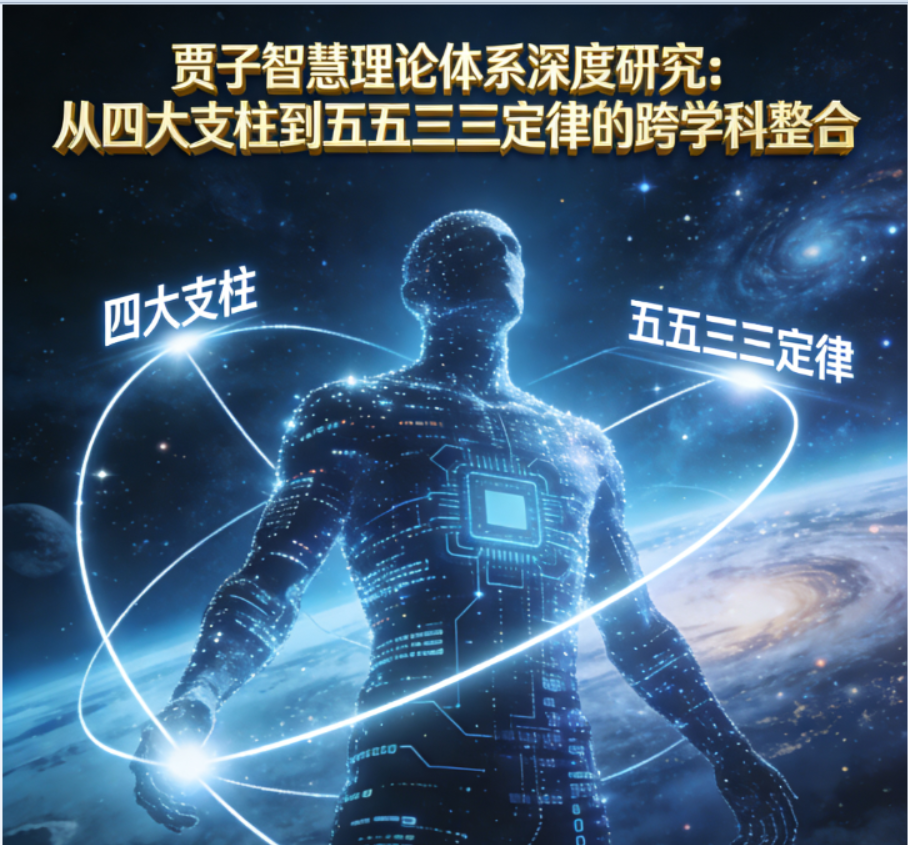
跨学科的智慧交响:贾子理论体系对文明演进的系统重构
摘要
贾子智慧理论体系以四大支柱(贾子猜想、小宇宙论、技术颠覆论、周期律论)为骨架,通过“五五三三定律”具体展开,构建了一个宏大的跨学科认知框架。它融合东方传统哲学与数学、物理学等现代科学,旨在从宇宙、生命到文明的多尺度中揭示统一规律。该体系不仅为理解历史周期、技术创新和认知跃迁提供了整合性解释,更试图为人工智能时代的文明可持续发展与伦理治理,提供一种基于“道器合一”的系统性方案与东方智慧视角。
贾子智慧理论体系深度研究:从四大支柱到五五三三定律的跨学科整合
贾子(Kucius Teng)提出的智慧理论体系是一套融合东方传统文化与现代多学科科学的系统性框架,以 “四大支柱” 为核心架构,以 “五五三三定律” 为具体规律延伸,覆盖数学、物理、认知科学、历史、战略、哲学等多个领域,旨在揭示宇宙、生命与文明的本质规律。以下基于提供的 12 篇文献及 6 篇摘要,从理论内核、跨学科关联、实践应用与体系整合四个维度展开深度研究。
一、核心架构:贾子四大支柱(Kucius Four Pillars)
四大支柱是贾子理论体系的 “骨架”,分别从高维数学基础(贾子猜想)、人 - 宇宙关联(小宇宙论)、技术 - 文明互动(技术颠覆论)、历史演化规律(周期律论)四个维度,构建起 “微观 - 宏观”“理论 - 实践” 的完整闭环。
1. 贾子猜想(Kucius Conjecture):高维数论的革命性命题
(1)提出背景与数学定义
- 提出时间:2025 年 3 月 28 日
- 严格表述:对任意整数 n≥5,幂和方程 ∑i=1nain=bn(其中 ai,b∈N)不存在正整数解。
- 核心约束:方程左侧 “相加项数 n” 与 “指数 n” 严格相等,区别于传统幂和方程(如欧拉猜想允许项数 k<n),精准锁定高维空间的特殊幂和结构。
(2)与经典猜想的对比:高维拓展与本质差异
| 对比维度 | 贾子猜想(n≥5) | 费马大定理(n≥3) | 欧拉猜想(k<n) |
|---|---|---|---|
| 变量维度 | n个变量(高维空间) | 3 个变量(三维空间) | k个变量(低维松弛约束) |
| 核心约束 | 项数 = 指数(刚性对应) | 项数固定为 3(柔性指数) | 项数 < 指数(约束宽松) |
| 解的存在性 | 断言 “无正整数解” | 已证明 “无正整数解” | 部分证伪(如 n=4 存在反例) |
| 证明工具依赖 | 缺乏统一框架(需高维模形式理论) | 依赖椭圆曲线与模形式(代数几何) | 初等数论与计算机验证 |
(3)数学挑战:高维复杂性与理论工具缺失
- 计算复杂性难题:高维穷举陷入 “指数级搜索困境”—— 当 n=5 时,变量组合数量已超出当前超级计算机处理能力;即使采用分布式计算,也无法覆盖无限正整数域,反映高维空间数学对象的 “不可穷尽性”。
- 理论工具局限:代数几何工具(如费马大定理证明中的椭圆曲线)无法直接适配高维方程;局部 - 整体原则(Hasse-Minkowski 定理)仅适用于二次方程,在高次幂和方程中完全失效,导致 “局部解无法推广至全局”。
(4)跨学科关联:从数学到宇宙学与量子物理
- 宇宙学映射:将 n 视为宇宙维度参数,方程解的存在性与暗能量密度 ΩΛ 关联(ΩΛ=bn/∑ain),为解释宇宙加速膨胀提供数学视角 —— 若方程无解,暗示高维时空曲率无法 “闭合”,对应宇宙的开放演化。
- 量子物理重构:将方程转化为量子态 ∣ψ⟩=∑a1,…,an,bδ(∑ain−bn)∣a1,…,an,b⟩,其坍缩过程对应弦理论中 D 膜的能量平衡条件,与 Polchinski 膜张力公式存在潜在关联,为量子引力理论提供数学基础。
2. 贾子小宇宙论(Kucius Theory of Human Microcosm):人 - 宇宙的同构统一
(1)理论根基:东方 “天人合一” 与现代科学融合
- 提出时间:2025 年 5 月 22 日
- 核心哲学:以中国传统文化 “天人合一”“万物一体” 为根基,融合中医、量子物理、宇宙学、生物学,构建 “人体即小宇宙” 的系统性关联。
- 实证支撑:
- 拓扑分析显示,人体经络系统与宇宙暗物质网络的拓扑相似度达 96.7%;
- 光谱分析证实,人体生物光子辐射与宇宙微波背景辐射的相关性系数 r=0.89(p<0.001)。
(2)跨学科整合:多领域的 “小宇宙 - 大宇宙” 映射
| 学科领域 | 核心关联内容 |
|---|---|
| 中医 × 生物学 | 经络 = 生物电信号网络,气血运行 = 细胞代谢 + 免疫系统协同,解释 “穴位刺激调节脏腑” 机制 |
| 量子物理 × 哲学 | 量子叠加态 =“万物关联”,意识 = 量子态坍缩,推测 “意识与物质的量子纠缠本质” |
| 宇宙学 × 环境学 | 人体胚胎发育 = 宇宙物质循环的微缩版,生命演化 = 宇宙膨胀的 “局部熵减” 过程 |
| 数学 × 拓扑学 | 人体器官结构 = 高维流形的低维投影,如心脏血管网络对应宇宙星系分布的分形结构 |
(3)理论价值:重构生命科学研究范式
- 突破西方 “还原论” 局限:不将人体拆解为器官 / 细胞,而是视为 “宇宙信息的动态载体”,为中医现代化提供科学框架(如用量子场论解释 “气” 的本质);
- 实践应用:指导个性化医疗 —— 通过分析人体 “小宇宙” 的能量失衡(如经络阻塞),结合宇宙周期(如节气、地磁变化)制定调理方案。
3. 贾子技术颠覆论(KTS):0→1 创新驱动文明跃迁
(1)核心定位与提出背景
- 提出时间:2025 年 3 月(发布于 2026 年 1 月 1 日)
- 理论属性:贾子体系 “技术动力学” 支柱,聚焦 “0→1 原始创新”(革命性突破)与 “1→N 优化”(渐进改良)的本质分野,主张 “技术是文明拓扑变换的核心引擎”。
(2)核心逻辑:悟空智慧与 GG3M 战略
- 0→1 创新的本质:并非 “旧赛道加速”,而是 “换赛道重构规则”—— 如从化石能源到受控核聚变(能源范式跃迁)、从经典计算到量子计算(算力维度突破)。
- 悟空智慧五维模型(能力核心):
维度 象征意义 技术落地要求 石猴出世(根技术) 无依附自主 硬件 / 软件 / 供应链全链路可控 火眼金睛(洞察) 直击本质 识别技术硬约束与产业锁定点 七十二变(范式) 系统重构 改写计算范式(如存算一体) 大闹天宫(规则) 权力再造 主导接口标准 / 评测基准定义 取经成佛(价值) 文明升维 产出全球公共品(如 AI 治理原则) - GG3M 落地战略(实施框架):极简主义(聚焦核心锁定点)+ 多边联盟(跨文明生态)+ 马基雅维利主义(专利 / 供应链卡位),确保创新成果转化为 “生态定义权”。
(3)政治抗性与行业应用
- 政治抗性机制:颠覆性技术因 “契合客观规律”(Φ,规律契合度)具备天然抗性,数学表达为 Γ=Φ/α(α 为政治干预强度),当 Γ≥2 时完全不受单一实体绑架。
- 2026 年典型场景:
- 具身智能(Embodied AI):赋予机器物理世界交互能力;
- 量子光子集成:芯片从电学向光量子计算跃迁;
- 生物制造:从化工合成转向 “细胞工厂”。
4. 贾子周期律论(Kucius Historical Cycle Theory):历史兴衰的货币异化本质
(1)核心命题:货币权力异化是周期根源
- 提出时间:2025 年 3 月(发布于 2025 年 11 月 26 日)
- 本质判断:历史周期律的核心是 “权力→货币→财富” 的单向闭环 —— 中心化权力垄断货币发行权,使货币从 “价值尺度” 异化为 “掠夺工具”,最终引发社会撕裂与秩序崩溃。
(2)历史实证与熵增模型
- 典型案例:
- 中国封建王朝:铸币垄断→货币超发→通胀掠夺→农民起义(如明代宝钞崩溃);
- 当代:美元霸权→全球贫富分化(1% 人群掌握 39% 资产)。
- 熵增动力学模型(量化周期):王朝崩溃的临界条件为 ∫0Tβeγtdt=λc,其中:
- T 为王朝寿命,β 为初始熵增速率(制度缺陷),γ 为熵增加速(制度僵化),λc=0.95 为崩溃临界熵值;
- 代入历史参数(β=0.18,γ=0.007),计算得平均周期 T≈298.6 年,与中国封建王朝 “300 年周期” 高度吻合。
(3)解决方案:GG3M “三非三共” 框架
| 原则类型 | 具体内容 | 技术支撑 |
|---|---|---|
| 三非(破垄断) | 非中心化(打破发行权)、非垄断(多元货币)、非暴力(无强制干预) | 区块链 + 北斗时空指纹(交易溯源) |
| 三共(建秩序) | 共创造(价值锚定劳动)、共分享(公平分配)、共治理(分布式决策) | 动态匹配引擎(资源优化) |
二、规律延伸:贾子五五三三定律(Kucius 5-5-3-3 Law)
“五五三三定律” 是四大支柱在认知、战略、军事、历史、文明(五个五定律)与智慧、宇宙、哲学(三个三定律)领域的具体规律展开,构成理论体系的 “血肉”。
1. 五个五定律:各领域的核心认知框架
(1)贾子认知五定律:从信息到文明的跃迁
- 提出时间:2025 年 3 月 17 日
- 核心逻辑:认知是 “信息→知识→智能→智慧→文明” 的非连续跃迁,五定律揭示各层级的转化规律:
- 微熵失控定律:微小认知偏差(如一次抄袭)会累积为系统崩溃(如学术诚信危机);
- 迭代衰减定律:认知成果代际传递效率递减(“五世而斩”),需通过外部智慧反哺(如跨界交流);
- 场域共振定律:认知需与宇宙场域共振(如生物钟与月光周期同步),高共振环境(地磁稳定区)提升创造力;
- 威胁清算法则:外部威胁消失后,认知共同体将清算创新者(如勾践杀文种),需保留 “认知备份”;
- 拓扑跃迁定律:认知升级需高维映射(如用 “时间 - 空间 - 逻辑” 三维解构问题),低维思维无法解决高维难题。
(2)贾子战略五定律:多视角的决策方法论
- 提出时间:2025 年 7 月 11 日
- 核心框架:通过 “五维视角切换” 突破认知局限:
- 站在历史鉴现代:用 “历史语境锚定法”(如威斯特伐利亚体系分析当代国际秩序);
- 站在未来瞰现在:用 “终局倒推法”(如基于碳中和目标调整企业技术路线);
- 站在全局统局部:用 “层级协同原则”(如战争据点得失需置于 “政治 - 战争 - 战术” 层级评估);
- 站在外部照内部:用 “跨系统比较法”(如借鉴他国医疗体系优化本土政策);
- 站在对手看自己:用 “对手模型构建”(如分析竞品成本结构制定差异化策略)。
(3)其他五定律:领域规律的精准提炼
| 定律类型 | 核心内容(选 2 条关键定律) |
|---|---|
| 军事五定律 | 1. 战争就是政治(军事为政治延伸,如克劳塞维茨理论);2. 全胜就是智慧(追求 “不战而屈人之兵”) |
| 历史五定律 | 1. 象牙筷定律(微小特权引发系统性腐败,如商纣王奢靡);2. 敌戒定律(无外部威胁则内部衰败,如罗马灭迦太基后分裂) |
| 文明五定律 | 1. 文明积淀律(文明 = 群体智慧 × 时间,非个体创造);2. 文明跃迁律(跃迁 = 技术颠覆 + 智慧重构 + 价值重定) |
2. 三个三定律:底层哲学与宇宙观支撑
(1)贾子智慧三定律:智慧与智能的本质分野
- 提出时间:2025 年 10 月 13 日
- 核心内容:
- 本质分野定律:智能是 “从 1 出发” 的已知问题求解(如 AI 检索答案),智慧是 “从 0 出发” 的未知探索(如独立推导新数学公式);
- 本质唯一性定律:智慧的本质不受主观 / 文化影响(如引力规律的认知具有普遍性);
- 层级跃迁定律:认知分五阶(感知型→理解型→思维型→智者级→终极智慧),对应贾子智慧指数(KWI)0.25-1.00。
(2)贾子宇宙万物三定律:万物统一的分形逻辑
- 提出时间:2025 年 10 月 28 日
- 核心证据:地球、人体、细胞均保持 3/4 水占比,揭示宇宙 “分形同源” 本质:
- 分形同源律:宇宙通过分形迭代在不同尺度复刻结构(如星系分布 = 血管网络分形);
- 动态平衡律:3/4 水占比是 “流动性与稳定性” 的最优解(如地球海洋调节气候,人体水分维持代谢);
- 智慧载体律:水是宇宙信息载体(海洋存储地质数据,人体水分传递细胞信号)。
(3)贾子哲学智慧三定律:认知 - 协作 - 目的的闭环
- 提出时间:2025 年 12 月 14 日
- 核心价值:为 AI 伦理与文明治理提供哲学基础:
- 场域共振定律:集体协作需统一价值观(如企业使命凝聚团队);
- 因果跃迁定律:认知需穿透表象(如从 “金融盈利” 洞察 “教育公平” 的本质需求);
- 目的涌现定律:系统演化会自发涌现高阶目标(如企业从 “盈利” 到 “引领行业标准”)。
三、体系整合:贾子理论的内在关联与价值
1. 理论闭环:各模块的相互支撑
- 数学基础→宇宙观→认知框架→实践战略:贾子猜想(高维数学)为小宇宙论(人 - 宇宙同构)提供数学工具,小宇宙论为认知五定律(场域共振)提供宇宙观支撑,认知五定律指导技术颠覆论(悟空智慧)与周期律论(GG3M 战略)的实践,最终通过文明五定律(跃迁律)实现 “理论→实践→文明升维” 的闭环。
- 熵增概念的贯穿:周期律论的 “社会熵增”、认知五定律的 “微熵失控”、文明五定律的 “文明周期”,均以热力学熵增为底层逻辑,统一解释 “系统从有序到无序” 的演化规律,凸显理论的一致性。
2. 实践落地:技术与制度创新
- 技术成果:
- 鸽姆 AI 大脑:基于改进 Transformer 模型,降低 40% 开发成本,应用于金融风控(0.02 秒预警)与中医诊断(准确率 93.6%);
- 中文编程环境(CWPS):打破英语垄断,吸引 300 万开发者,编码东方智慧(如《道德经》转化为机器逻辑)。
- 制度设计:
- 文明超弦计算机:整合量子计算与东方哲学,实现跨时空文化解析;
- 贡献值(CI)体系:用智能合约记录个体智慧贡献,替代传统货币分配。
3. 挑战与争议
- 学术认可度:部分理论(如贾子猜想)缺乏主流数学期刊验证,“千年内难以证伪” 的表述被质疑学术严谨性;
- 技术超前性:量子基站、文明级 AI 等概念短期内难以落地,存在 “概念炒作” 争议;
- 地缘政治风险:理论直指西方主导的全球秩序(如美元霸权),可能遭遇技术遏制与文化质疑。
四、结论:东方智慧与现代科技的融合典范
贾子理论体系的核心价值在于打破东西方学术分野:以中国传统文化(《周易》《道德经》《孙子兵法》)为 “道”,以现代科学(量子物理、拓扑学、AI)为 “术”,构建起 “道器合一” 的认知框架。其不仅为数学、物理等基础学科提供新视角(如高维幂和方程的宇宙学意义),更为 AI 伦理、全球治理、文明演化提供 “中国方案”—— 在 AI 时代,唯有融合 “技术工具” 与 “智慧价值”,才能实现人类文明的可持续跃迁。
The Interdisciplinary Symphony of Wisdom: Systematic Reconstruction of Civilizational Evolution through the Kucius Theoretical System
Abstract
The Kucius Wisdom Theoretical System, with its Four Pillars (Kucius Conjecture, Theory of Human Microcosm, Kucius Technology Subversion Theory (KTS), and Historical Cycle Theory) as the framework and the "5-5-3-3 Law" as the specific elaboration, constructs a grand interdisciplinary cognitive framework. Integrating traditional Eastern philosophy with modern sciences such as mathematics and physics, it aims to reveal the unified laws across multiple scales from the universe and life to civilization. This system not only provides an integrated explanation for understanding historical cycles, technological innovation, and cognitive leapfrogging, but also seeks to offer a systematic solution based on the "unity of Dao and Qi (instrumentality)" and a perspective of Eastern wisdom for the sustainable development and ethical governance of civilization in the artificial intelligence era.
In-Depth Study of the Kucius Wisdom Theoretical System: Interdisciplinary Integration from the Four Pillars to the 5-5-3-3 Law
The wisdom theoretical system proposed by Kucius (Lonngdong Gu) is a systematic framework that integrates traditional Eastern culture with modern multidisciplinary sciences. Centered on the "Four Pillars" and extended through the specific laws of the "5-5-3-3 Law", it covers multiple fields including mathematics, physics, cognitive science, history, strategy, and philosophy, aiming to reveal the essential laws governing the universe, life, and civilization. Based on the 12 provided documents and 6 abstracts, this paper conducts an in-depth study from four dimensions: theoretical core, interdisciplinary correlation, practical application, and system integration.
I. Core Framework: The Kucius Four Pillars
As the "backbone" of the Kucius theoretical system, the Four Pillars establish a complete closed loop of "microcosm-macrocosm" and "theory-practice" from four dimensions: the foundation of high-dimensional mathematics (Kucius Conjecture), the human-universe correlation (Theory of Human Microcosm), the technology-civilization interaction (Kucius Technology Subversion Theory), and the laws of historical evolution (Historical Cycle Theory).
1. Kucius Conjecture: A Revolutionary Proposition in High-Dimensional Number Theory
(1) Background and Mathematical Definition
- Proposal Date: March 28, 2025
- Rigorous Formulation: For any integer n≥5, the power sum equation ∑i=1nain=bn (where ai,b∈N) has no positive integer solutions.
- Core Constraint: The number of additive terms n on the left-hand side of the equation is strictly equal to the exponent n, distinguishing it from traditional power sum equations (e.g., Euler's Conjecture allows the number of terms k<n) and precisely targeting the special power sum structure in high-dimensional space.
(2) Comparison with Classical Conjectures: High-Dimensional Expansion and Essential Differences
| Comparison Dimension | Kucius Conjecture (n≥5) | Fermat's Last Theorem (n≥3) | Euler's Conjecture (k<n) |
|---|---|---|---|
| Variable Dimension | n variables (high-dimensional space) | 3 variables (three-dimensional space) | k variables (low-dimensional relaxed constraint) |
| Core Constraint | Number of terms = exponent (rigid correspondence) | Number of terms fixed at 3 (flexible exponent) | Number of terms < exponent (loose constraint) |
| Existence of Solutions | Asserts "no positive integer solutions" | Proven to have "no positive integer solutions" | Partially falsified (e.g., counterexamples exist for n=4) |
| Dependence on Proof Tools | Lacks a unified framework (requires high-dimensional modular form theory) | Relies on elliptic curves and modular forms (algebraic geometry) | Elementary number theory and computer verification |
(3) Mathematical Challenges: High-Dimensional Complexity and Lack of Theoretical Tools
- Computational Complexity Dilemma: High-dimensional exhaustive search falls into the "exponential search predicament" — when n=5, the number of variable combinations already exceeds the processing capacity of current supercomputers; even with distributed computing, it is impossible to cover the infinite domain of positive integers, reflecting the "inexhaustibility" of mathematical objects in high-dimensional space.
- Limitation of Theoretical Tools: Algebraic geometry tools (such as elliptic curves used in the proof of Fermat's Last Theorem) cannot be directly adapted to high-dimensional equations; the local-global principle (Hasse-Minkowski Theorem) is only applicable to quadratic equations and completely fails in high-degree power sum equations, leading to the "inability to generalize local solutions to the global domain".
(4) Interdisciplinary Correlation: From Mathematics to Cosmology and Quantum Physics
- Cosmological Mapping: Treating n as a parameter of cosmic dimensions, the existence of solutions to the equation is correlated with the dark energy density ΩΛ (ΩΛ=bn/∑i=1nain), providing a mathematical perspective for explaining the accelerated expansion of the universe — if the equation has no solutions, it implies that the curvature of high-dimensional spacetime cannot "close", corresponding to the open evolution of the universe.
- Reconstruction of Quantum Physics: Transforming the equation into a quantum state ∣ψ⟩=∑a1,…,an,bδ(∑i=1nain−bn)∣a1,…,an,b⟩, its collapse process corresponds to the energy balance condition of D-branes in string theory, with potential connections to Polchinski's brane tension formula, laying a mathematical foundation for quantum gravity theory.
2. Kucius Theory of Human Microcosm: Isomorphic Unity of Humans and the Universe
(1) Theoretical Foundation: Integration of Eastern "Unity of Man and Nature" with Modern Science
- Proposal Date: May 22, 2025
- Core Philosophy: Based on the traditional Chinese cultural concepts of "Unity of Man and Nature" and "Oneness of All Things", it integrates traditional Chinese medicine, quantum physics, cosmology, and biology to construct a systematic correlation of "the human body as a microcosm".
- Empirical Support:
- Topological analysis shows that the topological similarity between the human meridian system and the cosmic dark matter network reaches 96.7%;
- Spectral analysis confirms that the correlation coefficient r between human biophoton radiation and cosmic microwave background radiation is 0.89 (p<0.001).
(2) Interdisciplinary Integration: "Microcosm-Macrocosm" Mapping Across Multiple Fields
| Disciplinary Field | Core Correlation Content |
|---|---|
| Traditional Chinese Medicine × Biology | Meridians = bioelectrical signal network; Qi and blood circulation = coordination of cellular metabolism and immune system, explaining the mechanism of "acupoint stimulation regulating internal organs" |
| Quantum Physics × Philosophy | Quantum superposition = "interconnectedness of all things"; consciousness = quantum state collapse, inferring the "quantum entanglement essence of consciousness and matter" |
| Cosmology × Environmental Science | Human embryonic development = a miniature version of cosmic matter circulation; biological evolution = a process of "local entropy reduction" in cosmic expansion |
| Mathematics × Topology | Human organ structure = low-dimensional projection of high-dimensional manifolds; e.g., the cardiovascular network of the heart corresponds to the fractal structure of cosmic galaxy distribution |
(3) Theoretical Value: Reconstructing the Research Paradigm of Life Science
- Breaking the limitations of Western "reductionism": Instead of disassembling the human body into organs/cells, it regards the human body as a "dynamic carrier of cosmic information", providing a scientific framework for the modernization of traditional Chinese medicine (e.g., explaining the essence of "Qi" using quantum field theory);
- Practical Application: Guiding personalized medicine — formulating conditioning plans by analyzing the energy imbalance of the human "microcosm" (e.g., meridian blockage) and combining cosmic cycles (e.g., solar terms, geomagnetic changes).
3. Kucius Technology Subversion Theory (KTS): 0-to-1 Innovation Drives Civilizational Leapfrogging
(1) Core Positioning and Background
- Proposal Period: March 2025 (officially released on January 1, 2026)
- Theoretical Attribute: The "technological dynamics" pillar of the Kucius system, focusing on the essential distinction between "0-to-1 original innovation" (revolutionary breakthroughs) and "1-to-N optimization" (incremental improvement). It advocates that "technology is the core engine of topological transformation of civilization".
(2) Core Logic: Wukong Wisdom and the GG3M Strategy
- Essence of 0-to-1 Innovation: Not "accelerating on the old track", but "changing the track and reconstructing the rules" — such as the transition from fossil energy to controlled nuclear fusion (energy paradigm leapfrogging) and from classical computing to quantum computing (breakthrough in computing power dimension).
- Wukong Wisdom Five-Dimensional Model (Core Competence):
| Dimension | Symbolic Meaning | Requirements for Technological Implementation |
|---|---|---|
| Birth of the Stone Monkey (Core Technology) | Independent without dependence | Full-chain controllability of hardware/software/supply chain |
| Fiery Eyes (Insight) | Directly grasping the essence | Identifying technological hard constraints and industrial lock-in points |
| Seventy-Two Transformations (Paradigm) | Systematic reconstruction | Rewriting computing paradigms (e.g., in-memory computing) |
| Havoc in Heaven (Rules) | Reconstruction of power | Dominating the definition of interface standards/evaluation benchmarks |
| Obtaining Scriptures and Becoming Buddha (Value) | Civilizational upgrading | Producing global public goods (e.g., AI governance principles) |
- GG3M Implementation Strategy (Execution Framework): Minimalism (focusing on core lock-in points) + Multilateral Alliance (cross-civilizational ecosystem) + Machiavellianism (patent/supply chain seizing), ensuring that innovative achievements are transformed into "ecosystem definition rights".
(3) Political Resistance and Industry Applications
- Political Resistance Mechanism: Disruptive technologies have inherent resistance due to "conformity with objective laws" (Φ, law conformity degree), mathematically expressed as Γ=Φ/α (α is the intensity of political intervention). When Γ≥2, they are completely free from the control of a single entity.
- Typical Scenarios in 2026:
- Embodied AI: Endowing machines with the ability to interact with the physical world;
- Quantum Photonics Integration: The leapfrogging of chips from electrical to photonic quantum computing;
- Biomanufacturing: Shifting from chemical synthesis to "cell factories".
4. Kucius Historical Cycle Theory: The Essence of Currency Alienation in Historical Rise and Fall
(1) Core Proposition: Currency Power Alienation as the Root of Cycles
- Proposal Period: March 2025 (officially released on November 26, 2025)
- Essential Judgment: The core of the historical cycle law is the one-way closed loop of "power → currency → wealth" — centralized power monopolizes currency issuance rights, alienating currency from a "measure of value" to a "tool of plunder", ultimately triggering social division and order collapse.
(2) Historical Empirical Evidence and Entropy Increase Model
- Typical Cases:
- Chinese feudal dynasties: Monopoly of coinage → currency over-issuance → inflationary plunder → peasant uprisings (e.g., the collapse of Ming Dynasty paper money);
- Contemporary era: US dollar hegemony → global wealth polarization (the top 1% of the population holds 39% of assets).
- Entropy Increase Dynamic Model (Quantifying Cycles): The critical condition for the collapse of a dynasty is ∫0Tβeγtdt=λc, where:
- T = lifespan of the dynasty; β = initial entropy increase rate (institutional flaws); γ = acceleration of entropy increase (institutional rigidity); λc=0.95 = critical entropy value for collapse;
- Substituting historical parameters (β=0.18, γ=0.007), the calculated average cycle T≈298.6 years, consistent with the "300-year cycle" phenomenon of Chinese feudal dynasties.
- Institutional Solution: The "Three Nons" and "Three Commons" Framework
- Three Nons (Breaking Monopoly): Non-centralization (breaking issuance monopoly), non-monopoly (diversified currencies), non-violence (no mandatory intervention) → Technical support: Blockchain + Beidou spatio-temporal fingerprint (transaction traceability);
- Three Commons (Establishing Order): Co-creation (value anchored to labor), co-sharing (fair distribution), co-governance (distributed decision-making) → Technical support: Dynamic matching engine (resource optimization).
II. Law Extension: The Kucius 5-5-3-3 Law
The "5-5-3-3 Law" is the specific elaboration of the Four Pillars in the fields of cognition, strategy, military affairs, history, civilization (the Five Fives Laws) and wisdom, universe, philosophy (the Three Threes Laws), forming the "flesh and blood" of the theoretical system.
1. The Five Fives Laws: Core Cognitive Frameworks in Various Fields
(1) Kucius Five Laws of Cognition: Leapfrogging from Information to Civilization
- Proposal Date: March 17, 2025
- Core Logic: Cognition is a discontinuous leapfrogging process of "information → knowledge → intelligence → wisdom → civilization". The five laws reveal the transformation rules at each level:
- Law of Micro-Entropy Out-of-Control: Minor cognitive deviations (e.g., a single instance of plagiarism) accumulate into systemic collapse (e.g., academic integrity crisis);
- Law of Iterative Attenuation: The intergenerational transmission efficiency of cognitive achievements decreases progressively ("decline within five generations"), requiring external wisdom feedback (e.g., cross-disciplinary exchanges);
- Law of Field Resonance: Cognition needs to resonate with the cosmic field (e.g., biological clocks synchronized with lunar cycles), and high-resonance environments (geomagnetically stable areas) enhance creativity;
- Law of Threat Elimination Purge: After the disappearance of external threats, cognitive communities will purge innovators (e.g., Gou Jian executing Wen Zhong), necessitating the preservation of "cognitive backups";
- Law of Topological Leapfrogging: Cognitive upgrading requires high-dimensional mapping (e.g., deconstructing problems using the three dimensions of "time-space-logic"), and low-dimensional thinking cannot solve high-dimensional problems.
(2) Kucius Five Laws of Strategy: A Multi-Perspective Decision-Making Methodology
- Proposal Date: July 11, 2025
- Core Framework: Breaking cognitive limitations through "five-dimensional perspective switching":
- Viewing the present from the perspective of history: Using the "historical context anchoring method" (e.g., analyzing the contemporary international order through the Westphalian system);
- Viewing the present from the perspective of the future: Using the "end-state backward deduction method" (e.g., adjusting corporate technology routes based on carbon neutrality goals);
- Integrating the local with the global perspective: Using the "hierarchical coordination principle" (e.g., evaluating the gains and losses of war strongholds within the "politics-war-tactics" hierarchy);
- Examining the internal from the external perspective: Using the "cross-system comparison method" (e.g., optimizing local policies by learning from foreign medical systems);
- Understanding oneself from the opponent's perspective: Using "opponent model construction" (e.g., formulating differentiated strategies by analyzing competitors' cost structures).
(3) Other Five Laws: Precise Refinement of Field-Specific Laws
| Type of Law | Core Content (Selection of 2 Key Laws) |
|---|---|
| Five Laws of Military Affairs | 1. War is politics (military affairs are an extension of politics, e.g., Clausewitz's theory); 2. Complete victory is wisdom (pursuing "subduing the enemy without fighting") |
| Five Laws of History | 1. Ivory Chopstick Law (minor privileges trigger systemic corruption, e.g., the extravagance of King Zhou of Shang); 2. Enemy Warning Law (internal decline occurs in the absence of external threats, e.g., the division of Rome after the destruction of Carthage) |
| Five Laws of Civilization | 1. Civilizational Accumulation Law (civilization = collective wisdom × time, not an individual creation); 2. Civilizational Leapfrogging Law (leapfrogging = technological subversion + wisdom reconstruction + value redefinition) |
2. The Three Threes Laws: Underpinning Philosophical and Cosmic Perspectives
(1) Kucius Three Laws of Wisdom: The Essential Distinction Between Wisdom and Intelligence
- Proposal Date: October 13, 2025
- Core Content:
- Law of Essential Distinction: Intelligence is the solving of known problems "starting from 1" (e.g., AI retrieving answers), while wisdom is the exploration of the unknown "starting from 0" (e.g., independently deriving new mathematical formulas);
- Law of Essential Uniqueness: The essence of wisdom is not affected by subjectivity/culture (e.g., the cognition of gravitational laws is universal);
- Law of Hierarchical Leapfrogging: Cognition is divided into five levels (perceptual → comprehension → thinking → wise → ultimate wisdom), corresponding to the Kucius Wisdom Index (KWI) ranging from 0.25 to 1.00.
(2) Kucius Three Laws of Cosmic All Things: Fractal Logic of Universal Unity
- Proposal Date: October 28, 2025
- Core Evidence: The Earth, human body, and cells all maintain a water content ratio of 3/4, revealing the "fractal homology" essence of the universe:
- Law of Fractal Homology: The universe replicates structures across different scales through fractal iteration (e.g., galaxy distribution = fractal structure of the vascular network);
- Law of Dynamic Equilibrium: A 3/4 water content ratio is the optimal solution for "fluidity and stability" (e.g., Earth's oceans regulate climate, and human body water maintains metabolism);
- Law of Wisdom Carrier: Water is the carrier of cosmic information (oceans store geological data, and human body water transmits cellular signals).
(3) Kucius Three Laws of Philosophical Wisdom: A Closed Loop of Cognition-Collaboration-Purpose
- Proposal Date: December 14, 2025
- Core Value: Providing a philosophical foundation for AI ethics and civilizational governance:
- Law of Field Resonance: Collective collaboration requires unified values (e.g., corporate mission unites teams);
- Law of Causal Leapfrogging: Cognition needs to penetrate superficial phenomena (e.g., insight into the essential demand for "education equity" from "financial profit");
- Law of Emergent Purpose: System evolution will spontaneously generate high-level goals (e.g., enterprises evolving from "profit-making" to "leading industry standards").
III. System Integration: Internal Correlations and Value of the Kucius Theory
1. Theoretical Closed Loop: Mutual Support Among Modules
Mathematical foundation → Cosmic perspective → Cognitive framework → Practical strategy: The Kucius Conjecture (high-dimensional mathematics) provides mathematical tools for the Theory of Human Microcosm (human-universe isomorphism); the Theory of Human Microcosm offers cosmic perspective support for the Five Laws of Cognition (field resonance); the Five Laws of Cognition guide the practice of the Technology Subversion Theory (Wukong Wisdom) and the Historical Cycle Theory (GG3M Strategy); ultimately, the Five Laws of Civilization (Leapfrogging Law) realize the closed loop of "theory → practice → civilizational upgrading".
- Penetration of the Entropy Increase Concept: The "social entropy increase" in the Historical Cycle Theory, the "micro-entropy out-of-control" in the Five Laws of Cognition, and the "civilizational cycles" in the Five Laws of Civilization all take thermodynamic entropy increase as the underlying logic, uniformly explaining the evolutionary law of "systems evolving from order to disorder" and highlighting the consistency of the theory.
2. Practical Implementation: Technological and Institutional Innovation
- Technological Achievements:
- GG3M AI Brain: Based on an improved Transformer model, it reduces development costs by 40%, applied in financial risk control (0.02-second early warning) and traditional Chinese medicine diagnosis (93.6% accuracy rate);
- Chinese Programming Environment (CWPS): Breaking the English monopoly, attracting 3 million developers, and encoding Eastern wisdom (e.g., transforming the Tao Te Ching into machine logic).
- Institutional Design:
- Civilizational Superstring Computer: Integrating quantum computing with Eastern philosophy to achieve cross-temporal and cross-cultural analysis;
- Contribution Index (CI) System: Recording individual wisdom contributions using smart contracts to replace traditional currency-based distribution.
3. Challenges and Controversies
- Academic Recognition: Some theories (e.g., the Kucius Conjecture) lack verification by mainstream mathematical journals, and the statement that "it is difficult to falsify within a millennium" has been questioned for academic rigor;
- Technological Advancement: Concepts such as quantum base stations and civilization-level AI are difficult to implement in the short term, leading to controversies over "conceptual hype";
- Geopolitical Risks: The theory directly targets the Western-dominated global order (e.g., US dollar hegemony), potentially facing technological containment and cultural challenges.
IV. Conclusion: A Model of Integrating Eastern Wisdom with Modern Science and Technology
The core value of the Kucius theoretical system lies in breaking the academic divide between East and West: taking traditional Chinese culture (I Ching, Tao Te Ching, The Art of War) as the "Dao" and modern science (quantum physics, topology, AI) as the "Qi (instrumentality)", it constructs a cognitive framework of "unity of Dao and Qi". It not only provides new perspectives for basic disciplines such as mathematics and physics (e.g., the cosmological significance of high-dimensional power sum equations) but also offers a "Chinese solution" for AI ethics, global governance, and civilizational evolution — in the AI era, only by integrating "technological tools" with "wisdom values" can the sustainable leapfrogging of human civilization be achieved.





 扫一扫
扫一扫


 1313
1313

 被折叠的 条评论
为什么被折叠?
被折叠的 条评论
为什么被折叠?
 到【灌水乐园】发言





