



 本文深入探讨了ROC曲线在分类模型性能评估中的应用,通过调整决策阈值来观察假正例率(FPR)与真正例率(TPR)的变化,解释了随机猜测与完美分类器的概念。并提供了一个使用Python进行ROC曲线绘制的实例,展示了如何通过面积下曲线(ROCAUC)量化分类性能。
Section I: Brief Introduction on ROC Curve
Receiver Operating Charateristic(ROC) graphs are usefult tools to select models forclassification based on their performance with respect to th FPR and TPR, which are computed by shifting the decision threshold of the classifier. The diagonal of an ROC graph can be interpreted as random guessing, and classification models that fall below the diagonal are considered as worse than random guessing. A perfect classifier would fall into the top left corner of the graph with a TPR of 1 and an FOR of 0. Then, ROC area under the curve (ROC AUC) to charaterize the classification performance can be subsequently computed.
FROM
Sebastian Raschka, Vahid Mirjalili. Python机器学习第二版. 南京:东南大学出版社,2018.
Section II: Code Bundle and Result Analyses
第一部分:代码:
from sklearn import datasets
from sklearn.model_selection import train_test_split
from sklearn.preprocessing import StandardScaler
from sklearn.linear_model import LogisticRegression
from sklearn.decomposition import PCA
from sklearn.pipeline import make_pipeline
from sklearn.model_selection import StratifiedKFold
from sklearn.metrics import roc_curve,auc
import numpy as np
from scipy import interp
import matplotlib.pyplot as plt
import warnings
warnings.filterwarnings("ignore")

plt.rcParams['figure.dpi']=200
plt.rcParams['savefig.dpi']=200
font = {'family': 'Times New Roman',
        'weight': 'light'}
plt.rc("font", **font)

#Section 1: Load Breast data, i.e., Benign and Malignant
breast=datasets.load_breast_cancer()
X=breast.data
y=breast.target
X_train,X_test,y_train,y_test=\
    train_test_split(X,y,test_size=0.2,stratify=y,random_state=1)

#Section 2: Construct model optimized via GridSearch
pipe_lr=make_pipeline(StandardScaler(),\
                      PCA(n_components=2),\
                      LogisticRegression(penalty='l2',random_state=1,C=100))

cv=list(StratifiedKFold(n_splits=3,random_state=1).split(X_train,y_train))
fig=plt.figure(figsize=(7,5))
mean_tpr=0
mean_fpr=np.linspace(0,1,100)
all_tpr=[]

for i,(train_idx,test_idx) in enumerate(cv):
    probas=pipe_lr.fit(X_train[train_idx],y_train[train_idx]).predict_proba(X_train[test_idx])
    fpr,tpr,thresholds=roc_curve(y_train[test_idx],probas[:,1],pos_label=1)
    mean_tpr+=interp(mean_fpr,fpr,tpr)
    mean_tpr[0]=0
    roc_auc=auc(fpr,tpr)
    plt.plot(fpr,
             tpr,
             label='ROC Fold %d (Area = %.2f)' % (i+1,roc_auc))

plt.plot([0,1],[0,1],linestyle='--',color=[0.6,0.6,0.6],label='Random Guessing')
mean_tpr/=len(cv)
mean_tpr[-1]=1.0
mean_auc=auc(mean_fpr,mean_tpr)
plt.plot(mean_fpr,
         mean_tpr,
         'k--',
         label="Mean ROC (Area = %0.2f)" % mean_auc,
         linewidth=2)
plt.plot([0,0,1],[0,1,1],linestyle=":",color='black',label='Perfect Performance')
plt.xlim([-0.05,1.05])
plt.ylim([-0.05,1.05])
plt.xlabel("False Positive Rate")
plt.ylabel("True Positive Rate")
plt.legend(loc='lower right')
plt.savefig('./fig1.png')
plt.show()
第二部分:结果:
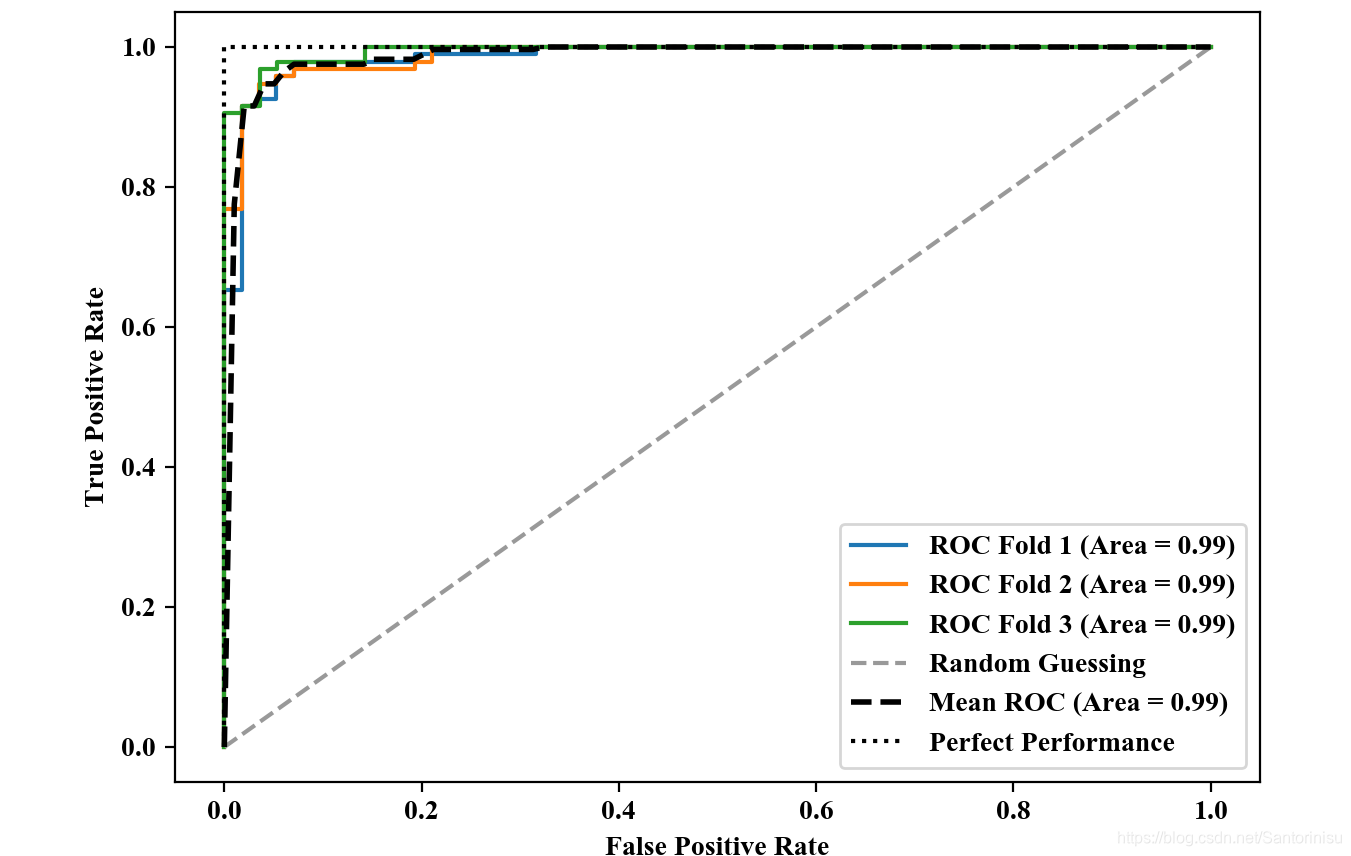
值得注意,曲线下方面积越大,FPR越小,说明负类辨识精准,TPR越高说明正类辨识越准确。由此可进一步说明模型分类性能越佳。
参考文献:
Sebastian Raschka, Vahid Mirjalili. Python机器学习第二版. 南京:东南大学出版社,2018.





 扫一扫
扫一扫


 1575
1575

 被折叠的 条评论
为什么被折叠?
被折叠的 条评论
为什么被折叠?
 到【灌水乐园】发言





