





 本文详细介绍了高中英语语法,包括主谓一致、动词的时态、语态、语气、助动词、情态动词、动词不定式、分词、动名词、形容词和副词以及代词等核心概念,每个章节都包含概念解析、知识点讲解、巩固练习和答案,适合学生系统学习和复习英语语法。
目录
词法
第 1 章 主谓一致
一.概念:

二.相关知识点精讲


三.巩固练习


四.答案

第 2 章 动词的时态
一.概念
时态是英语谓语动词的一种形式,表示动作发生的时间和所处的状态.英语中的时态是通过动词形式本身的变化来实现的.英语有 16 种时态,但中学阶段较常用的有十种:一般现在时,一般过去时,一般将来时,过去将来时,现在进行时,过去进行时,将来进行时,过去完成时,英在完成时和现在完成进行时.
二.相关知识点精讲


三.巩固练习


四.答案

第三章 动词的语态
一.概念:
动词的语态是动词的一种形式,表示主语和谓语之间语法或语义的关系.英语的语态有两种:主动语态和被动语态.主动语态用于主动句,表示主语是动作的执行者.被动语态用于被 动句,表示主语是动作的承受者.主动语态的构成方式与动词时态相同,而被动语态由 助动 词 be+过去分词 构成,有人称,数,时态的变化.
二. 相关知识点精讲
- let 的用法
1)当 let 后只有一个单音节动词,变被动语态时,可用不带 to 的不定式。
例如: They let the strange go.他们放陌生人走了。 —> The strange was let go.
2)当 let 后宾补较长时,let 通常不用被动语态,而用 allow 或 permit 代替。
例如: The nurse let me go to see my classmate in the hospital. 那护士让我去探望住 院的同学。
----> I was allowed / permitted to see my classmate in the hospital. - 短语动词的被动语态 短语动词是一个整体,不可丢掉后面的介词或副词。
例如: My sister will be taken care of by Grandma. 我妹妹由奶奶照顾。 Such a thing has never been heard of before. 这样的事闻所未闻。 - 表示"据说"或"相信" 的词组,基本上由 believe, consider, declare, expect, feel , report, say, see, suppose, think, understand 等组成。
例如: It is said that… 据说
It is reported that… 据报道
It is believed that… 大家相信
It is hoped that… 大家希望
It is well known that… 众所周知
It is thought that… 大家认为
It is suggested that… 据建议
It is taken granted that… 被视为当然
It has been decided that… 大家决定
It must be remember that… 务必记住的是 - 不用被动语态的情况
1) 不及物动词或不及物动词短语,如 appear, die disappear, end(vi. 结束), fail, happen, last, lie, remain, sit, spread, stand, break out, come true, fall asleep, keep silence, lose heart, take place 等没有无被动语态。
例如: After the fire, very little remained of my house. 大火过后,我家烧得所剩无几。
比较:rise, fall, happen 是不及物动词;raise, seat 是及物动词。 要想正确地使用被动语态,就须注意哪些动词是及物的,哪些是不及物的。特别是一词 多义的动词往往有两种用法。解决这一问题唯有在学习过程中多留意积累。
2) 不能用于被动语态的及物动词或动词短语,如 fit, have, hold, marry, own, wish, cost, notice, watch agree with, arrive at / in, shake hands with, succeed in, suffer from, happen to, take part in, walk into, belong to 等。
例如: This key just fits the lock. 这把钥匙只配这把锁。
Your story agrees with what had already been heard. 你说的与我们听说的一致。
3) 系动词无被动语态,如 appear, be become, fall, feel, get, grow, keep, look, remain, seem, smell, sound, stay, taste, turn 等。例如:It sounds good. 听 上去不错。
4) 带同源宾语的及物动词如 die/death, dream/dream, live/life 等,以及反身代词, 相互代词,不能用于被动语态。例如: She dreamed a bad dream last night. 她昨晚做了个恶梦。
5) 当宾语是不定式时,很少用于被动语态。例如: (对) She likes to swim. (错) To swim is liked by her. - 主动形式表示被动意义
1)wash, clean, cook, iron, look, cut, sell, read, wear, feel, draw, write, sell 等。例如: The book sells well. 这本书销路好。 This knife cuts easily. 这刀子很好用。
2)blame, let(出租), remain, keep, rent, build 等。例如: I was to blame for the accident. 事故发生了,我该受指责。 Much work remains. 还有许多活要干。
3) 在 need, require, want, worth (形容词), deserve 后的动名词必须用主动形式。 例如:The door needs repairing.= The door needs to be repaired. 门该修了。 This book is worth reading. 这本书值得一读。
4)特殊结构:make sb. heard / understood (使别人能听见/理解自己)等。
例如: Explain it clearly and make yourself understood. 解释清楚些,让别人理解你的 话。 - 被动形式表示主动意义,如 be determined, be pleased, be graduated (from), be prepared (for), be occupied (in), get married 等。
例如: He is graduated from a famous university. 他毕业于一所有名的大学。
注意:表示同某人结婚,用 marry sb. 或 get married to sb.均可。例如: He married a rich girl. 他与一个富妞结婚了。 He got married to a rich girl. - need/want/require/worth 当 need, want, require, be worth 后面接 doing 时,表示的是被动意义。
例如: Your hair wants cutting. 你的头发该理了。
The floor requires washing. 地板需要冲洗。
三.巩固练习
- I___________ (teach) here for ten years since I finished school.
- Would you mind me __________ (use) your bike?
- The students of Class Two___________ (sweep) their classroom now.
- The Whites____________ (not listen) to the radio at that time.
- It’s better to give than__________ (receive).
- How long you_ (live) in this town?
- You _______ (come) here last year, ______ you?
- ----When ______ you______ (see) him?
----I______ (see) him last Sunday. - She said that the car___________ (use) the next week.
- I didn’t know what __________ (happen) to China in a century.
- When I got to the station, the train ____ already ______ (leave).
- The stone bridge______________ (build) in our hometown for ten years.
- The desk must ______ (clean) once a day.
- The dog _________ (lie) on the floor when I came in.
- It _________(rain) heavily when I got home.
- Her mother____________ (cook) at this time yesterday.
- The students _____________ (do) their homework. __________ (not make) any noise!
- ----______ you ever_______ (be) to Beijing? ----Yes. I________ (go) there last week.
- He’ll telephone us as soon as he _________ (arrive) there.
- Jiefang trucks____________ (make) in Changchun.
- A pen is used for__________ (write).
- All that must ________ (do).
- My friend can’t decide which pair of trousers____________ (choose). So she asked me to go shopping with her.
- They find it useful__________ (learn) English.
- The old man often_________ (tell) the children a story in the evening. This evening he ________ (tell) two stories.
- The radio__________ (use) once in a week in our class. It____________ (not use) yesterday because there was something wrong with it.
- Would please tell us how___________ (make) the watch ________ (work)?
- She doesn’t know what_________ (do) and where__________ (go).
四.答案
- have taught
- using
- are sweeping
- weren ’ t listening
- toreceive
- have … lived
- came … didn’t
- did … see, saw
- would be used
- would happen
- had … left
- have been built
- becleaned
- was lying
- was raining
- was cooking
- are doing, Don ’ t make
- have … beeen, went
- arrives
- are made
- writing
- be done
- to choose
- to learn
- tells, will tell
第四章 动词的语气
一.概念语气有三种:
陈述语气,祈使语气和虚拟语气.语气表示说话人对劝词所示示的动作或所处的状态持有的态度或看 法.
二.相关知识点精讲
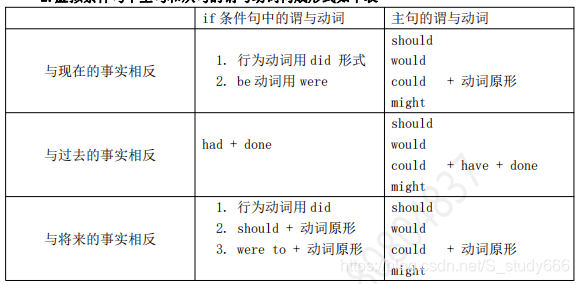
1.辨别 if 引导真实条件句和 if 引导的虚拟条件句的区别 If he has time, he will go with us.= Probably he has time and will go with us. If he had time, he would go with us.=But in fact he has no time.
2.虚拟条件句中主句和从句的谓与动词构成形式如下表
3.混合时间的虚拟语气
如果条件句中的动作和主句的动作不是同时发生,主句和从句的谓语动词的形式应分别根据各自所表示的时间加 以调整。
1)0If I had received the passport yesterday, I would start today.
2)If he had telephoned me last night, I would see him now.
3)If he had followed the doctor’s advice, he would be all right now.
4)If China had not been liberated, the working people would still be leading a miserable life.
4.should/ could / might/ ought to + have done 表示“过去本应该/可以做而实际上却没做” needn’t have done 表示“过去没必要作而实际上做了”
5.虚拟语气中的倒装句 如果虚拟语气的条件从句谓语动词中含有 were, had, could, should,有时可将 if 省去,而将条件从句的主语置 于 were, had, should, could 之后。
Had you invited us, we would have come to your party. Were I you, I would do more practice after class. Could she lend us a helping hand, she would do so.
6.wish 后面的宾语从句的谓语动词应使用虚拟语气, 表示“可惜…;….就好了; 悔不该…; 但愿…。”
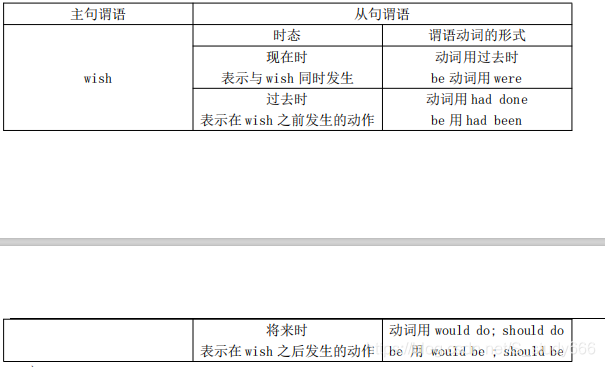
1)I wish I knew the key to the answer.
2)I wish I were ten years younger.
3)I wish that I had gone to the football match last week.
4)I wish that you had been here yesterday.
5)He wishes that we would visit the old school.
7.表示命令或建议动词 suggest, insist, propose, desire, demand, request, order, command 后的宾语从句中应 使用虚拟 should +动词原形; should 不可用 would 来替代; 主句所使用的动词时态不限。
8.suggest 为“建议去做…; 命令…”从句用 should + do 为“ 说明; 暗示”, 从句用过去时或过去完成时。
- The doctor suggested that I should take the medicine three times a day.
- The doctor suggested that my grandmother had caught a bad cold.
9.insist “坚持要去做…,坚持应该去做”,从句用 should + do 为“坚持表明,坚持说/解释”, 从句用过去时或过 去完成时。
10.虚拟语气也用于表语从句和主语从句中,表示间接的命令、要求、请求、建议、决定等,主句的主语通常是 suggestion, proposal, request, order, idea 等。表语从句中的谓语动词是 should +动词原型,should 可以省略。
11.在主语从句中,当从句用来表示惊奇、不相信、惋惜等,从句的谓语动词用需拟语气形式。其谓语动词时 should + 动词原型, 或 should 省略。
三.巩固练习
- If there were no subjunctive mood, English _________ much easier.
A. will be B. would have been C. could have been D. would be - If I _____ you, I’d join the army.
A. am B. was C. were D. would be - If he _______ tomorrow, he would find Mr Wang in the office.
A. comes B. will come C. should come D. come - If it _______ next week , the crops would be saved.
A. rains B. will rains C. would rain D. should rain - If I _______ it, I would do it in a different way.
A. were to do B. do C. had done D. was to do - Supposing the weather ________ bad, where would you go ?
A. is B. will be C. were D. be - If he had worked harder, he _________.
A. would succeed B. had succeeded C. should succeed D. would have succeeded - If he ________, he _________ that food. A. was warned; would not take B. had been warned; would not have taken C. would be warned; had not taken D. would have been warned; had not taken 9. If my lawyer _________ here last Saturday, he _______ me from going.
A. had been; would have prevented
B. had been; would prevent
C. were; would prevent
D. were; would have prevented
10 - If he ______ it, he _______ it.
A. had seen; could have believed
B. saw; couldn’t believe
C. saw; couldn’t have believed
D. has seen; had believed - —Do you think the thief entered through the window?
—No, if he had, I don’t believe, _______ broken the living-room’s window.
A. he would have B. he must have
C. he had D. should he have - —Did you go swimming last Sunday?
—No. We would have gone ______ nicer.
A. if the weather was
B. would the weather have been
C. had the weather been
D. should the weather be - ______ it ______ for your help, I couldn’t have made any progress.
A. Had; not been B. Should; not been C. Did; not been D. Not; been - _______ today, he would get there by Friday.
A. Would have left B. Was he leaving C. Were he to leave D. If he leaves - It is ordered that a new bridge ______ over the wide river.
A. should be built B. would built C. will be built D. built
四.答案
1.D 2.C 3.C 4.D 5.A 6.C 7.D 8.B 9.A 10.A 11.D 12.C 13.A 14.C 15.A
第 5 章 助动词
一.概念:
助动词是帮助主要动词构成各种时态,语态,语气以及否定或疑问结构的动词.助动词分为时态助动词和结构助动词 两种.
二.相关知识点精讲:
- 助动词 be 的用法
1) be +现在分词,构成进行时态。
例如: They are having a meeting. 他们正在开会。
English is becoming more and more important. 英语现在越来越重要。
2) be + 过去分词,构成被动语态。
例如: The window was broken by Tom… 窗户是汤姆打碎的。
English is taught throughout the world. 世界各地都教英语。
3) be + 动词不定式,可表示下列内容:
a. 表示最近、未来的计划或安排。例如: He is to go to New York next week… 他下周要去纽约。 We are to teach the freshmen. 我们要教新生。 说明: 这种用法也可以说成是一种将来时态表达法。
b. 表示命令。例如: You are to explain this. 对此你要做出解释。 He is to come to the office this afternoon. 要他今天下午来办公室。
c. 征求意见。例如: How am I to answer him? 我该怎样答复他? Who is to go there? 谁该去那儿呢? d. 表示相约、商定。例如: We are to meet at the school gate at seven tomorrow morning. 我们明天早晨 7 点在校门口集合。 - 助动词 have 的用法
1)have +过去分词,构成完成时态。
例如: He has left for London. 他已去了伦敦。 By the end of last month, they had finished half of their work. 上月未为止,他们已经完成工作的 一半。
2)have + been +现在分词,构成完成进行时。例如: I have been studying English for ten years. 我一直在学英语,已达十年之久。
3)have +been +过去分词,构成完成式被动语态。例如: English has been taught in China for many years. 中国教英语已经多年。 - 助动词 do 的用法
1)构成一般疑问句。
例如: Do you want to pass the CET? 你想通过大学英语测试吗? Did you study German? 你们学过德语吗?
2)do + not 构成否定句。例如: I do not want to be criticized. 我不想挨批评。 He doesn’t like to study. 他不想学习。 In the past, many students did not know the importance of English. 过去,好多学生不知道英语的重要性。 3) 构成否定祈使句。例如: Don’t go there. 不要去那里。 Don’t be so absent-minded. 不要这么心不在焉。 说明: 构成否定祈使句只用 do,不用 did 和 does。
4)放在动词原形前,加强该动词的语气。例如: Do come to my birthday party. 一定来参加我的生日宴会。 I did go there. 我确实去那儿了。 I do miss you. 我确实想你。
5)用于倒装句。例如: Never did I hear of such a thing. 我从未听说过这样的事情。 Only when we begin our college life do we realize the importance of English. 进了大学以后,我们才 认识到英语的重要性。 说明: 引导此类倒装句的副词有 never, seldom, rarely, little, only, so, well 等。
6)用作代动词。例如: ---- Do you like Beijing? --你喜欢北京吗? ---- Yes, I do. --是的,喜欢。(do 用作代动词,代替 like Beijing.) He knows how to drive a car, doesn’t he? 他知道如何开车,对吧? - 助动词 shall 和 will 的用法 shall 和 will 作为助动词可以与动词原形一起构成一般将来时。
例如: I shall study harder at English. 我将更加努力地学习英语。 He will go to Shanghai. 他要去上海。
说明:在过去的语法中,语法学家说 shall 用于第一人称,will 只用于第二、第三人称。现在,尤其是在口语中,will 常用于第一人称,但 shall 只用于第一人称,如用于第二、第三人称,就失去助动词的意义,已变为情态动词,试比较: He shall come. 他必须来。(shall 有命令的意味。) He will come. 他要来。(will 只与动词原形构成一般将来时。) - 助动词 should, would 的用法
1)should 无词义,只是 shall 的过去形式,与动词原形构成过去将来时,只用于第一人称。例如: I telephoned him yesterday to ask what I should do next week. 我昨天给他打电话,问他我下周干什么。 比较:“What shall I do next week?” I asked. "我下周干什么?"我问道。 可以说,shall 变成间接引语时,变成了 should。
2) would 也无词义,是 will 的过去形式,与动词原形构成过去将来时,用于第二、第三人称。例如: He said he would come. 他说他要来。 比较:“I will go,” he said. 他说:"我要去那儿。"变成间接引语,就成了 He said he would come。原来的 will 变成 would,go 变成了 come.。 - 短语动词 动词加小品构成的起动词作用的短语叫短语动词。例如: Turn off the radio. 把收音机关上。(turn off 是短语动词) 短语动词的构成基本有下列几种:
1)动词+副词,如:black out;
2)动词+介词,如:look into;
3)动词+副词+介词,如:look forward to。构成短语动词的副词和介词都统称为小品词
三.巩固练习
1.If it is fine tomorrow, we ______ a football match.
a. have b. will have c. has d. shall has
2.When he was at school, he ______ early and take a walk before breakfast.
a. will rise b. shall rise b. should rise would rise
3.In the past 30 years China ______ great advances in the socialist revolution and socialist construction.
a. has made b. have made c. had made d. having made
4.I ______ go to bed until I ______ finished my work.
a. don’t/had b. didn’t/have c. didn’t/had d. don’t/have
5.______ you think he ______ back by dinner time?
a. Do/have come b. Did/will have come
c. Does/will come d. Do/will have come
6.He said that he dropped his bag when he ______ for the bus.
a. was runing b. was running
c. were running d. is running
7.No sooner ______ he arrived home than he ______ to start on another journey.
a. has/was asked b. have/were asked
c. had/is asked d. had/was asked
8.“______ you give me a room for the night?” I asked on arriving at the hotel.
a. Should b. Can c. Might d. May
9.There are nine of them, so ______ get into the car at the same time.
a. they may not at all b. all they may not c. they can’t all d. all they can’t
10.“We didn’t see him at the lecture yesterday.” “He ______ it.”
a. mustn’t attend b. cannot have attended
c. would have not attended d. needn’t have attended
11.“You realize that you were driving at 100 mph, don’t you?” “No, officer. I ______. This car can’t do more than 80.”
a. didn’t need to be b. may not have been
c. couldn’t have been d. needn’t have been
12.he was a good runner so he ______ escape from the police.
a. might b. succeeded to c. would d. was able to
13.If they , our plan will fall flat. a. are co-operating b. had not co-operated c. won’t co-operate d. didn’t co-operate
14.I hoped ______ my letter.
a. her to answer b. that she would answer
c. that she answers d. her answering
15.He ______ live in the country than in the city.
a. prefers b. likes to c. had better d. would rather
16. to see a film with us today?
a. Did you like b. Would you like
c. Will you like d. Have you liked
17.I’m sorry, but I had no alternative. I simply ______ what I did.
a. must do b. had to do
c. ought to have done d. have to do
18.“Time is running out,______?”
a. hadn’t we better got start
b. hadn’t we better get start
c.hadn’t we better get started
d. hadn’t we better not started
19.No one ______ that to his face.
a. dares say b. dares saying
c. dare say d. dare to say
20.The students in the classroom ______ not to make so much noise.
a. need b. ought c. must d. dare
21.You ______ last week if you were really serious about your work.
a. ought to come b. ought to be coming
c. ought have come d. ought to have come
22.The elephants ought ______ hours ago by the keepers.
a. to be fed b. to feed
c. to being fed d. to have been fed
23.“I wonder why they’re late.” “They ______ the train.”
a. can have missed b. could miss
c. may have missed d. might miss
24.“Tom graduated from college at a very young age.” “He ______ have been an outstanding student.”
a. must b. could c. should d. might
25.You ______ the examination again since you had already passed it.
a. needn’t have taken b. didn’t need to take
c. needn’t take d. mustn’t take
26.He is really incompetent! The letter ______ yesterday.
a. should be finished typing
b. must be finished typing
c.must have finished typing
d. should have been finished typing
27.The boy told his father that he would rather ______ an astronaut.
a. become b. to become c. becoming d. became
28.When we reached the station, the train had still not arrived; so we _.
a. needed not to hurry
b. needn’t have hurried
c. need not to have hurried
d. didn’t need to hurry
29.Since your roommate is visiting her family this weekend, you like to have dinner with us tonight?
a. will b. won’t c. wouldn’t d. do
30.He was afraid what he had done ______ a disastrous effect on his career.
a. might have b. could be c. have been d. shall be
四.答案
1-10 BDACDBDBCB 11-20 CDCBDBBCCB 21-30 DDCABDABCA
第六章 情态动词
一.概念:
情态动词是表示能力,义务,必须,猜测等说话人的语气或情态的动词.
二.相关知识点精讲:
1.can
1)表能力 can 表能力时意味着凭体力或脑力或技术等可以无甚阻力地去做某事。
I can climb this pole. 我能爬这根杆子。
He is only four , but he can read. 他只有 4 岁,但已认得字了。
Fire can’t destroy gold. 火烧不毁金子。
因为 can 不能和其他助动词连用,所以表示将来式时用 will be able to
You will be able to skate after you have practiced it two or three times. 你练习两三次后就会溜冰了。
2)表可能性 多用于否定与疑问结构中,但也可用在肯定句中。
Can the news be true? 这消息可能是真的吗?
It can’t be true. 它不可能是真的。
What can he possibly mean? 他可能是什么意思?
can 用在肯定句中表示理论上的可能性(一时的可能)。
A horse in the center of London can cost a lot of money.
Attending the ball can be very exciting.
The road can be blocked. 这条路可能会不通的。
may 在肯定句中表示现实的可能性。
The road may be blocked. 这条路可能不通了。
3)表示允许(和 may 意思相近)常见于口语。
Can (May) I come in ? 我能进来吗?
Can I smoke here ? 我可以在这里抽烟吗?
2.could 的用法
1)表过去的可能和许可,(多用于间接引语中)
At that time we thought the story could not be true. 那时我们认为所说的事不可能是真的。
Father said I could swim in the river. 爸爸说我可以在河里游泳。
2)表过去的能力
I could swim when I was only six. 我刚六岁就能游泳。
Could 在肯定句中表示过去的能力时,常表抽象的一般的能力。
He could be very naughty when he was a child. 他小时候会是很顽皮的。
3)表“允许”。可表示委婉客气的提出问题或陈述看法
Could I use your bike? Yes, you can. 他会记得那时吗?
I’m afraid I couldn’t give you an answer today. 恐怕我今天不能回答你。
The teacher said you could go to the store for sweets. 老师说你可以去商店买糖。
3)Could/can+have done 结构表示对过去发生的事情的“怀疑”或“不肯定”。 could 加完成式还用于肯定句时一般 表过去可能完成而却未完成的动作。 Can they have won the basketball match? 他们赢了那场篮球赛吗?
What you referred to just now can have made her very sad. 你刚刚所谈到的可能令他很伤心。
You could have completed the task a little earlier. 你本来能早点完成任务的。(但事实上并没有提前完成任务)
I could have passed my examination easily but I made too many stupid mistakes. 我本可以轻易通过考试,但我犯了太多不该犯的错误。
如表具体做某一件事的能力时,则须用 be able to .
He was able to translate the article without a dictionary. 他可以不用词典翻译那篇文章。
Can 表示一贯的能力 ,be able to 表示客观能力和通过努力可以达到的能力
I can’t swim. But I am sure I will be able to swim through more practicing.
The fire spread through the hotel, but everyone was able to get out When the boat sank he was able to swim to the bank
3.may 的用法
1)表示请求、可以、允许。
You may drive the tractor. 你可以开那台拖拉机。
2)当回答由 may 引起的问题时,否定答语要用 must not,表示“不许可”、“不应该”、“不行”。
May I come in?
Yes, you may.
No,you can’t
No, you may not .
No ,you mustn’t
No ,you’d better not.
3) may /might 推测性用法 可能 He may be right. He may not come today (可能不) He may /might come tomorrow. ,
注意: 1 只用于肯定和否定句中,不用于疑问句中。 2 might 比 may 可能性更小
He might get a job.
He may get a job.
3 may no 可能不 can not 不可能 He may not come He can’t come
3)表建议(可和 as well 连用)
You may(might)as well stay where you are. 你还是原地待着好。
(may as well 有“还是……的好”的含义)
4)表祝愿 May you be happy! might
1)表过去的“可能”和“允许”多用于间接引语。
She said that he might take her dictionary. 她说他可以拿她的词典去用。
除在间接引语中外,might 一般不表示过去的“可能”与“许可”。表过去的“可能”可用 could,表过去的“许可” 可用 were (was) allowed to。
2)表现在的“可能”,其可能性要比 may 小。
Electric irons could be dangerous; they might give you a severe shock. 电熨斗会有危险,它可能电着人。
3)may (might) + have +done 表示对过去发生行为的推测,含有“想必”、“也许是”的意思。
It may have been true. 这事也许是真的。
He might not have settled the question. 他可能尚未解决那个问题。
4.must 的主要用法。
1)表示必须、必要
We must do everything step by step .我们必须按部就班地做一切事情。 Why must you always bother me? 为什么你偏要打扰我呢。
2)must be + 表语的结构,通常表示猜测,含有“一定”之意。(只用在肯定句中)
He must be an honest boy. 他一定是个诚实的男孩。
This must be your room. 这一定是你的房间。
3)must 的否定式有两个:当回答由 must 引起的问题时,否定答复要用 needn’t 或 don’t have to 表示“不必”、“无 须”、“用不着”、“不一定”的意义。
当表示“不应该”、“不许可”、“禁止”时,就用 must not。
Must I go tomorrow?明天我必须去吗?
Yes, please.是的,请吧!
No , you needn’t. 不,你不必去。
4)must +have +过去分词的结构,常用在肯定句中,表示对过去发生行为的推测,含有“一定”、“准是”的意思。否 定和疑问句用 can。
She must have studied English before.她以前一定学过英语。
5.have to 的含义与 must 是很接近的,只是 have to 比较强调客观需要,must 着重说明主观看法。
I must clean the room.(主观想法)
I have to clean the room.(客观需要)
另外,have to 能用于更多时态:
We had to be there at ten .我们得在十点钟到那里。
We will have to reconsider the whole thing. 这一切我们将不得不重新加以考虑。
have to 的否定式:don’t have to do 表示“不必做……”之意。
6.ought to 的用法
Ought to 后接动词原形,表义务,但不及 must 那样具有信心,
如: You don’t look well. You ought to go to see the doctor. 你气色不好,应该去看病。
Ought to 用于否定句,其否定形式可缩略为 oughtn’t ,
如: You oughtn’t to smoke so much. 你不应该抽这么多烟。
也可以用于疑问句,
如: Ought you to smoke so much?你应该抽这样多烟吗?
Ought to 在间接引语中表过去时形式不变,
如: He said you ought to tell the police. 他说你应该去报告警察。
7.shall 的用法
1)用于第一人称征求对方的意见,
如: What shall I wear on the journey? 我路上穿什么好呢?
Shall we dance? 我们跳舞好吗?
2)shall 用于第二、三人称时表允诺,警告,命令,威胁(现已少见),
如: She shall get her share. 她可以得到她的一份。
You shall have it back tomorrow.你明天可以将它拿回。
情态动词 should 一般不应被认为是情态动词 shall 的过去式,主要用法有: 1)用于第一人称疑问句中询问对方的意愿,但语气较委婉温和,如: What should we do now? 我们现在该怎么办?
2)表示应该、必须,常与 must 换用。
例如: We should (must) master a foreign language at least. 我们应当至少掌握一门外语。
3)“should+be+表语”的结构,表示推测或惊奇。
例如: They should be back by now. 他们现在应该回来了吧。
I am sorry that she should be so careless. 我感到遗憾她竟会那样粗心。
4)“should+have+过去分词”的结构,表示过去该做而实际上尚未做的动作或行为;其否定则表示发生了不应该发生 的行为。其同义结构“ought to have +过去分词”,表示过去“早应该”、“本当”之意,语气较强。
例如:
I should have thought of that. 这一点我是应当想到的。(但没想到)
They should not have left so soon.他们不应当走得这么早。(但已走了)
5) 在“It is natural (strange, natural, necessary, surprised, impossible, important ) that……”句型中, 主语从句中的谓语动词要用 should +动词原形”表示“理所当然”、“奇怪”、“必要”、“惊异”等的意思。
在 lest(以 免)、for fear (that) (以防)、in case(以备万一)等之后也要用 should+动词原形;在 advise, sugest, order, demand, request 等的从句中 should+do”
例如: It is necessary that he(should) be sent there at once. 有必要马上派他到那里去。
It is strange that he should say so. 他会说这样的话真是奇怪。
Let us go at once lest we should be late for the train. 我们马上走吧,以免赶不上火车。
8…will 和 would 的用法
1)表示意志,决心或愿望。
例如: Surely we will support all the people in the world in their struggle for peace. 我们一定要支持全世界人民争取和平的斗争。
He would not let me try it . 他不肯让我去试。
2)will 表示经常性、习惯性、倾向性,would 表示过去的习惯行为。
He will sit there hour after hour looking at the traffic go by. 他会经常一连几个小时坐在那儿观看来往的车辆。
He would come to see me when he was in Beijing. 他在北京时,常来看望我。
3)用于第二人称作主语的疑问句中,表示对对方的请求,would 的语气比 will 委碗
Would/will you kindly tell me the way to the station? 请问到火车站怎么走?
4)表可能性
This will be the book you are looking for. 这可能就是你要找的书。
She eould be about 60 when she died. 他死时大概 60 岁。
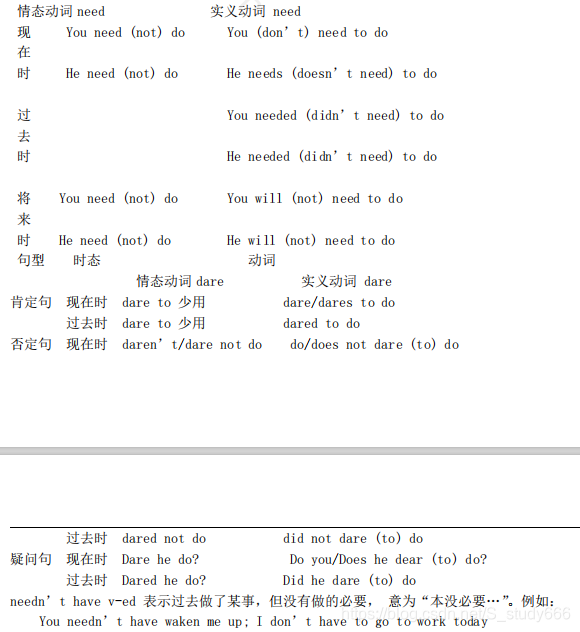
10.表推测的情态动词句子的反意疑问句
He must/may be in the room, isn’t he?
He can’t be in the room, is he?
He must have finished the work, hasn’t he?
He may have done the work last night, didn’t he? :
情态动词+行为动词进行式 情态动词+行为动词进行式(即情态动词+ be + v-ing 形式),表示推测或评论某动作现在是否正在进行。
例如:
1)He must be playing basketball in the room.
2)She may be staying at home.
11.情态动词+行为动词完成进行式 情态动词+行为动词完成进行式(即情态动词+ have been + v-ing 形式),表示推测或评论过去某动作是否正在 进行或一直在进行。
例如:
1)They should have been meeting to discuss the problem.
2)He may / might have been buying stamps in the post office when you saw him.
12.used to +v, be used to +v-ing 和 be used to +v
(1)used to +v 意为“过去常常”,“过去一直”;be used to +v-ing / n(名词)意为“习惯于”;be used to +v 意为“被用来(做某事)”。
(2)used to 只表示过去,而 be used to +v-ing / n 可表示现在、过去或将来。
例如:
1)He used to smoke. Now he doesn’t.
2)He’s quite used to hard work / working hard.
3)The knife is used to cut bread.
13.用作情态动词的其他短语 would rather, would sooner, would (just) as soon, had rather, had better, had sooner, can not but, may (just) as well 等可用作情态动词。
例如:
1)The soldier would sooner die than surrender.
2)The brave soldier would as soon die as yield to such an enemy.
3)I’d rather walk than take a bus.
4)If you don’t like to swim, you may just as well stay at home.
注:这些短语后一般直接跟动词原形.would (had) rather, would (had) sooner, would (just) as soon 后可跟 that 引导的从句,that 常省去,从句要用虚拟语气。对现在和将来的假设用过去时,对过去的假设用过去完成时。
例如:1)I would rather you came on Sunday.
2)I would sooner you hadn’t asked me to speak yesterday.
三. 巩固练习:
- _____ you ready?
(A) Are (B) Have © Will (D) Can - ____ here early?
(A) Will he (B) Was he © Did he be (D) Were he - I ___ happy about the price of eggs.
(A) am’t (B) am not ©do not (D) won’t - Since last year I____ him only once.
(A) have seen (B) have been seeing © see (D) was seeing - Donald ___ sixteen tomorrow.
(A) is being (B) going to be © shall be (D) will be - I ___ the story at all.
(A) don’t like (B) like © am fond of (D) would like - I would rather ___ than play now.
(A) to study (B)am studying © study (D) studied - I’d rather you ___ anything about it for the time being.
(A) do (B) didn’t do © don’t (D) didn’t - The car___much money.
(A) not cost (B) not have cost © isn’t cost (D) didn’t cost - I ___ like to eat fish.
(A) am (B) have © do (D) be - ___ repeat the question?
(A) Shall I (B) Will I ©Would you like that I (D) Do you want that I - My teacher knows more than ___.
A) my uncle knows (B) my uncle does © they know (D)they don’t know - He___to meet us at the station, but didn’t see us.
(A) did go (B) did went © goes (D) had - Not only ____us light.
A) does the sun give (B) the sun gives © gives the sun (D) the sun does give - ____ you tell me what has happened?
(A) May (B) Must © Can (D) Could - Anne___tomorrow.
(A) can sing (B) can to sing © is going sing (D) going to sing - You___hand it in at once, you may hand it in tomorrow.
A) needn’t (B) may not © can’t (D) must not - Tell the boy that he ___ in the river.
A) swims (B) swim © swimming (D) to swim - Joan___play on Saturday.
A) going to (B) can © is going (D) can to - Susan and I can go to the lecture ___.
(A) but neither can Charles (B) and so Charies can © but Charles can’t (D) and Charles also can
四.答案
- (A) 2, (B) 3. (B) 4. (A) 5, (D) 6, (A) 7. © 8. (B) 9. (9) 10, © 11. (A) 12. (B) 13. (A) 14. (A) 15. (D) 16. (A) 17. (A) 18. (B) 19. (B) 20, ©
第七章 动词不定式
一.相关知识点精讲:
- 不定式作补语
1) 有些有动词+宾语+不定式的结构。例如:

例如; Father will not allow us to play on the street. 父亲不让我们在街上玩耍。 The officer ordered his men to fire. 长官命令士兵开火。
注意:有些动词如 make,have,get,want 等可用不定式作做宾补,也可用分词作宾补。
现在分词表达主动,也表达 正在进行,过去分词表达被动。
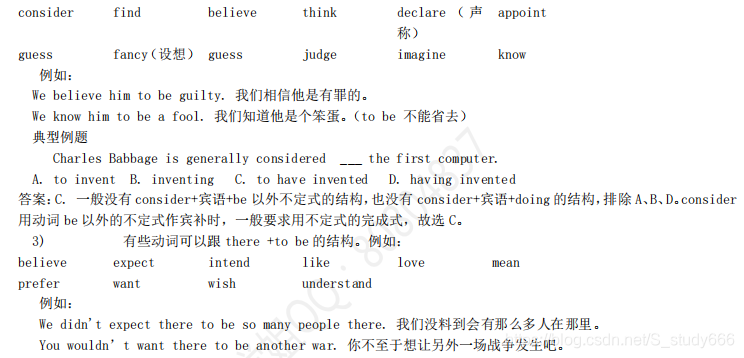
- 有些有动词+宾语+不定式的结构,不定式的动词往往是 be,不定式一般可以省去。例如
- 不定式作主语 不定式作主语,往往用 it 作形式主语,真正的主语不定式放至句子的后面。
例如:It’s so nice to hear your voice. 听到你的声音真高兴。
It’s necessary for you to lock the car when you do not use it. 不用车的时候,锁车是有必要的。
It’s very kind of you to help us. 他帮助我们,他真好。
It seemed selfish of him not to give them anything. 他不给他们任何东西,这显得太自私了。
但是,用不定式作主语的句子中还有一个不定式作表语时,不能用 It is… to…的句型。另外,这样的句子,不能用 动名词作表语。 - It’s for sb.和 It’s of sb. 这样的句子中,由于表语形容词性质的不同,导致了不定式逻辑主语标志用 for 或 of 的区别。
1)for sb. 句型中的形容词一般为表示事物的特征特点,表示客观形式的形容词,如 easy, hard, difficult, interesting, impossible 等:例如: It’s very hard for him to study two languages. 对他来说学两门外语是很难的。
2)of sb句型中的形容词一般为表示性格,品德,心智能力,表示主观感情或态度的形容词,如good, kind, nice, clever, foolish, right。
例如: It’s very nice of you to help me. 你来帮助我,你真是太好了。
用 for 还是用 of 的另一种辨别方法: 用介词 for 或 of 后面的逻辑主语作句子的主语,用介词前边的形容词作表语,造个句子。如果通顺用 of,不通则
用 for。
例如: You are nice. (通顺,所以应用 of)。
He is hard. (非所表达的意思,不通,因此用 for。) - 不定式作表语 不定式可放在 be 动词后面,形成表语。
例如: My work is to clean the room every day. 我的工作是每天清扫房间。
His dream is to be a doctor. 他的梦想是成为一名医生。 - 不定式作定语 不定式做定语通常要放在被修饰的词后,往往表示未发生的动作。
例如: I have a lot of work to do. 我有许多事要做。
There was nothing to bring home that morning. 那天早上(他回家时)两手空空。 - 不定式作状语
1)目的状语 常用结构为 to do ,
only to do(仅仅为了),
in order to do,
so as to do,
so(such)… as to…(如 此…以便…)。
例如: He ran so fast as to catch the first bus. 他飞快地跑以便赶上第一班车。
I come here only to say good-bye to you. 我来仅仅是向你告别。
2)作结果状语,可以表示没有预料到的或事与愿违的结果,不定式要放在句子后面。
I awoke to find my truck gone. 我醒来发现箱子不见了。
He searched the room only to find nothing. 他搜索了房间,没发现什么。
3) 表原因 I’m glad to see you. 见到你很高兴。 She wept to see the sight. 她一看到这情形就哭了。
4)表示理由和条件 He must be a fool to say so. You will do well to speak more carefully. - 用作介词的 to to 可以用作介词,也可用作不定式的标示。下面的 to 都用作介词

- 省去 to 的动词不定式
1) 情态动词 ( 除 ought 外) 后。
2) 使役动词 let, have, make 后,感官动词 see, watch, look at, notice , observe, hear, listen to, smell, feel, find 等后。
注意:被动语态中不能省去 to。
例如: I saw him dance. 我看见他跳舞。
=He was seen to dance.
The boss made them work the whole night. 老板让他们整夜干活。
=They were made to work the whole night.
3) would rather,had better 句型后
4) Why… / why no…句型后
5) help 后可带 to,也可不带 to, help sb (to) do sth:
6) but 和 except 后。but 前是实义动词 do 时,后面出现的不定式不带 to。
比较:He wants to do nothing but go out. 他只想出去玩。
He wants to believe anything but to take the medicine. 除了吃这药,他什么都信。
7) 由 and, or 和 than 连接的两个不定式,第二个 to 可以省去:
8) 通常在 discover, imagine, suppose, think 等词后作宾补时,可以省去 to be。例如: He is supposed (to be) nice. 他应该是个好人。 - 动词不定式的否定式 在不定式标志 to 前加上 not。
- 例如: Tell him not to shut the window。让他别关窗。 She pretended not to see me when I passed by. 我走过的时候,她假装没看见。
- 不定式的特殊句型 too…to…
1)too…to 太…以至于…。
例如: He is too excited to speak. 他太激动了,说不出话来。
---- Can I help you ? 需要我帮忙吗?
---- Well, I’m afraid the box is too heavy for you to carry it, but thank you all the same. 不用了。这箱子太重,恐怕你搬不动。谢谢。
2) 如在 too 前有否定词,则整个句子用否定词表达肯定,too 后那个词表达一种委婉含义,意 为"不太"。
例如: It’s never too late to mend. 改过不嫌晚。(谚语)
3) 当 too 前面有 only, all, but 时,意思是:非常… 等于 very。
例如: I’m only too pleased to be able to help you. 能帮助你我非常高兴。
He was but too eager to get home. 他非常想回家。 - 不定式的特殊句型 so as to
1) 表示目的;它的否定式是 so as not to do。
例如: Tom kept quiet about the accident so as not to lose his job.汤姆对事故保持沉默是为了不丢掉他的工 作。
Go in quietly so as not to wake the baby.轻点进去,别惊醒了婴儿。
2) 表示结果。
例如: Would you be so kind as to tell me the time? 劳驾,现在几点了。 - 不定式的特殊句型 Why not "Why not +动词原形"表达向某人提出建议,翻译为:“为什么不……?” “干吗不……?”。
例如: Why not take a holiday? 干吗不去度假? - 不定式的时态和语态
1) 一般式表示的动词,有时与谓语动词表示的动作同时发生,有时发生在谓语动词的动作之后,
例如 He seems to know this. 他似乎知道这事。
I hope to see you again. = I hope that I’ll see you again. 我希望再见到你。
2) 完成式表示的动作发生在谓语动词表示的动作之前。
例如: I’m sorry to have given you so much trouble. 很抱歉,给你添了那么多的麻烦。
He seems to have caught a cold. 他好像已经得了感冒。
3) 进行式表示动作正在进行,与谓语动词表示的动作同时发生。
例如: He seems to be eating something. 他好像正在吃什么东西。
4) 完成进行式表示动作从过去开始并延续至说话的时候。
例如: She is known to have been working on the problem for many years. 我们知道她研究这问题有好几年了。 - 动名词与不定式
1)动名词与不定式的区别: 动名词表达的是: 状态,性质,心境,抽象,经常性,已发生的 不定式表达的是: 目的,结果,原因,具体,一次性,将发生的
2)有些动词如 continue 接不定式或动名词作宾语,意义基本相同。
3)有些动词如 continue 接不定式或动名词作宾语,意义大相径庭。常见的,下一节有专门讨论
第八章 分词
一.概念:
分词分为现在分词和过去分词两种,是一种非谓语动词形式
二.相关知识点精讲:
1.现在分词的用法:
- 做表语: He was very amusing. That book was rather boring. 很多动词的现在分词都可以作表语: exciting, interesting, encouraging, disappointing, confusing, touching, puzzling.
- 作定语: 上面所出现的现在分词都可以用作定语, 修饰一个名词:
That must have been a terrifying experience.
I found him a charming person.
现在分词短语还可以放在名词的后面修饰名词, 相当于一个定语从句:
There are a few boys swimming in the river.
There is a car waiting outside. - 作状语: 现在分词短语可以表示一个同时发生的次要的或伴随的动作: Following Tom, we started to climb the mountain.
Opening the drawer, he took out a box.
Taking a key out of his pocket, he opened the door.
现在分词短语还可以表示原因, 相当于一个原因状语从句:
Not knowing her address, we couldn’t get in touch with her.
Being unemployed, he hasn’t got much money.
现在分词短语还可以表示时间, 相当于一个时间状语从句:
Hearing the news, they all jumped with joy.
Returning home, he began to do his homework.
Jim hurt his arm while playing tennis.
Be careful when crossing the road.
Having found a hotel, we looked for somewhere to have dinner.
Having finished her work, she went home. - 作宾补: 现在分词在一些动词之后可以做宾语的补语:
例如, see, hear, catch, find, keep , have 等.
I see him passing my house every day.
I caught him stealing things in that shop.
I smelt something burning.
She kept him working all day.
2.过去分词的用法:
- 作表语:
We were so bored that we couldn’t help yawning.
She felt confused, and even frightened.
They were very pleased with the girl.
I’m satisfied with your answer.
He is not interested in research. - 作定语:
She has a pleased look on her face.
The teacher gave us a satisfied smile.
cooked food,a written report,fried eggs ,boiled water ,frozen food ,armed forces ,required courses ,fallen leaves ,finished products ,a forced smile ,the risen sun ,new arrived visitors ,
What’s the language spoken in that country?
They’re problem left over by history.
The play put on by the teachers was a big success.
Is there anybody injured?
Do you know the number of books ordered? - 作状语:
Seen from the hill, the city looks magnificent.
Given good health, I hope to finish the work this year.
They came in, followed by some children.
Depressed, he went to see his elder sister.
When treated with kindness, he was very amiable. - 作宾补: 过去分词也同样可以作宾语的补语, 接在某些动词后面
I will have the clothes washed tomorrow.
When they get back home, they found the room robbed.
三.巩固练习
- __________ with the best students, I still have a long way to go.
A. Having compared B. To compare C. Compared D. Compare - The music of the film _________ by him sounds so ___________ .
A. playing, exciting B. played, excited C. playing, excited D. played, exciting - __________ against the coming hurricane, they dared not leave home. A. Warned B. Having warned C. To warn D. Warn
- In __________ countries, you can’t always make yourself _______ by speaking English.
A. English-speaking, understand B. English-spoken, understand C. English-speaking, understood D. English-speaking, understood - After _____________ the old man, the doctor suggested that he ___________ a bad cold. A. examining, should catch B. examined, had caught C. examining, had caught D. examined, catch
- _____________ , Tom jumped into the river and had a good time in it.
A. Be a good swimmer B. Being a good swimmer C. Having been good swimmer D. To be a good swimmer - ________ how to read the new words, I often look them up in the dictionary.
A. Having not known B. Not to know
C. Don’t know D. Not knowing - As his parent, you shouldn’t have your child ___________ such a book.
A. read B. to read C. reading D. be reading - He returned from abroad ______________ that his mother had been badly ill.
A. heard B. having been heard C. having phoned D. having been phoned
四.答案:
- C 2. D 3. A 4. C 5. C 6. B 7. D 8. C 9. D
第九章 动名词
一. 概念
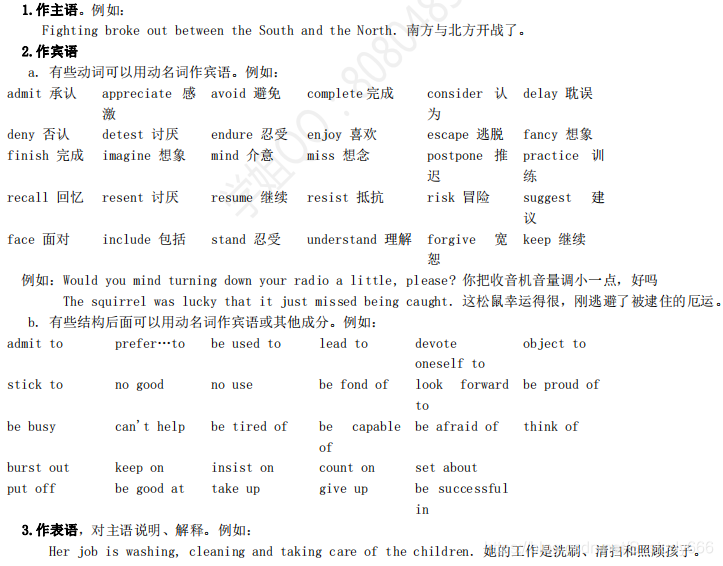
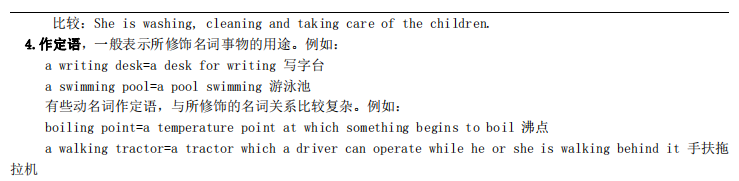
动名词由动词原形+ING 构成,是一种非谓语动词形式
二. 相关知识点精讲:
三.巩固练习
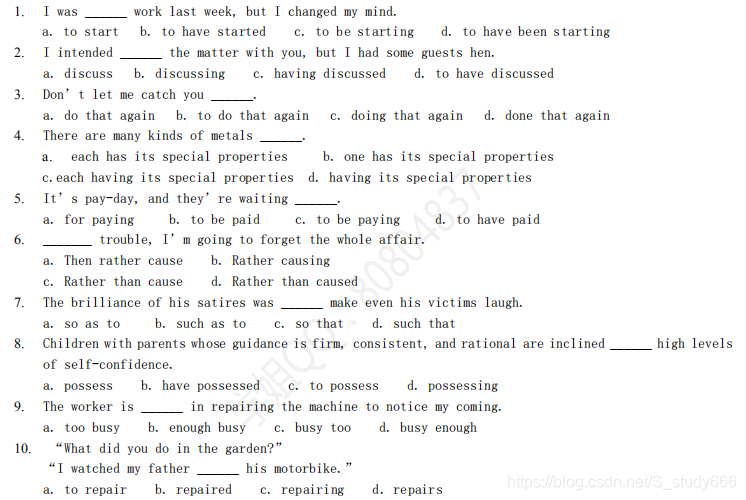
四.答案
BDCCBCBCAC
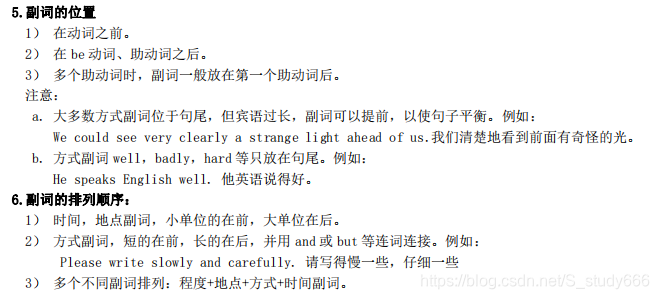
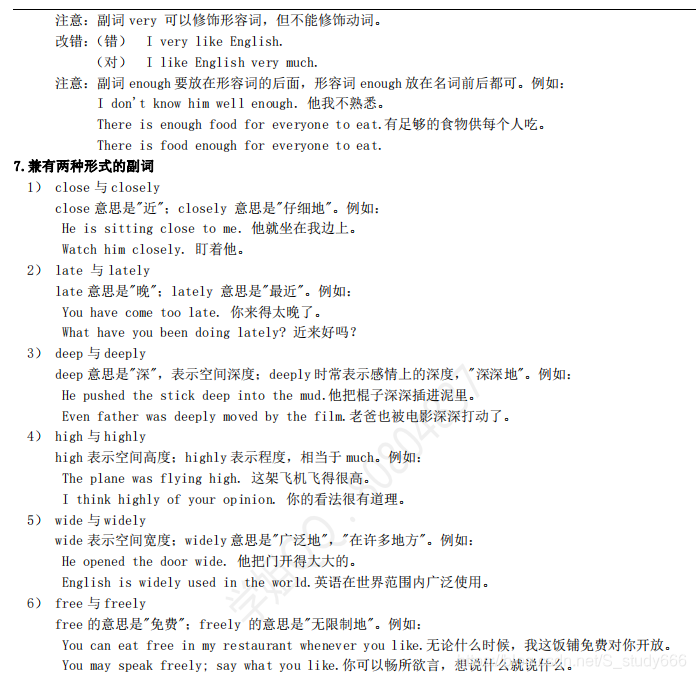
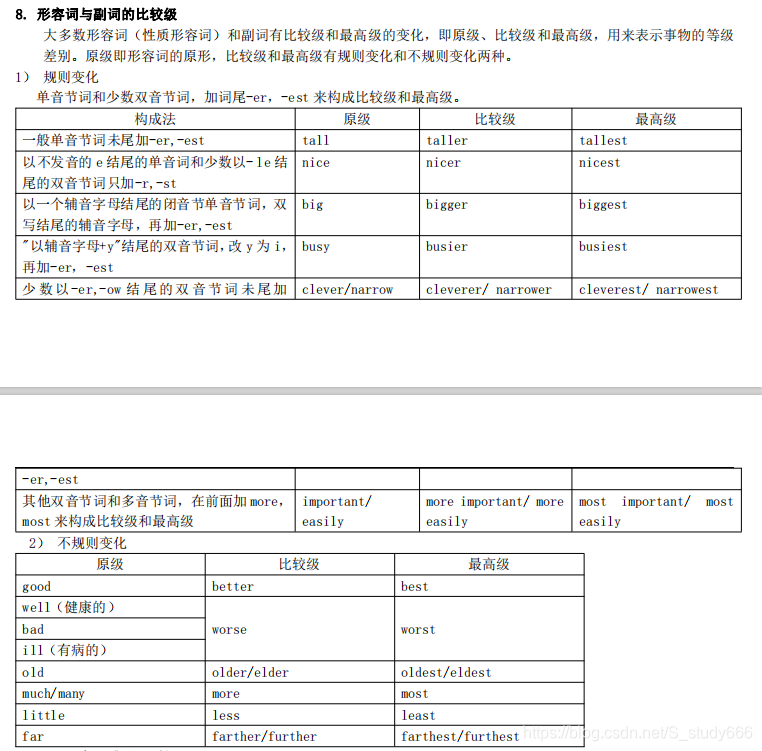
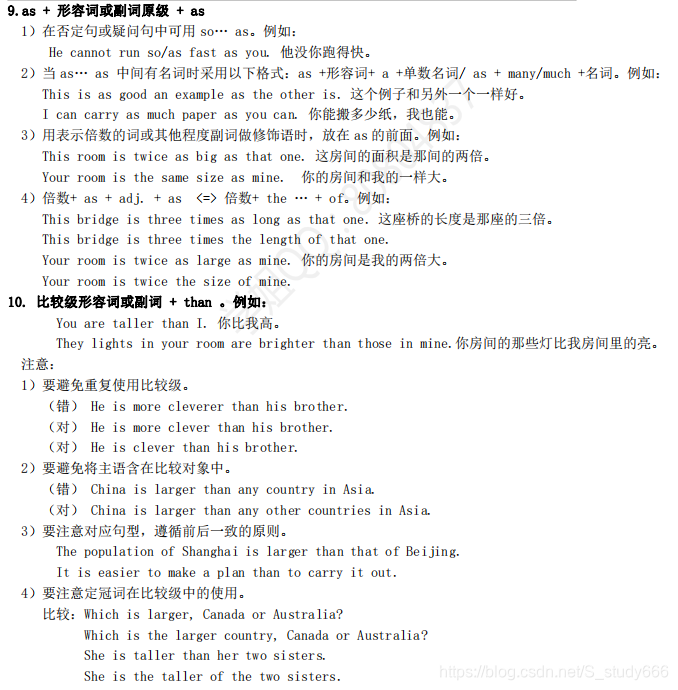
第 10 章 形容词和副词
一. 概念
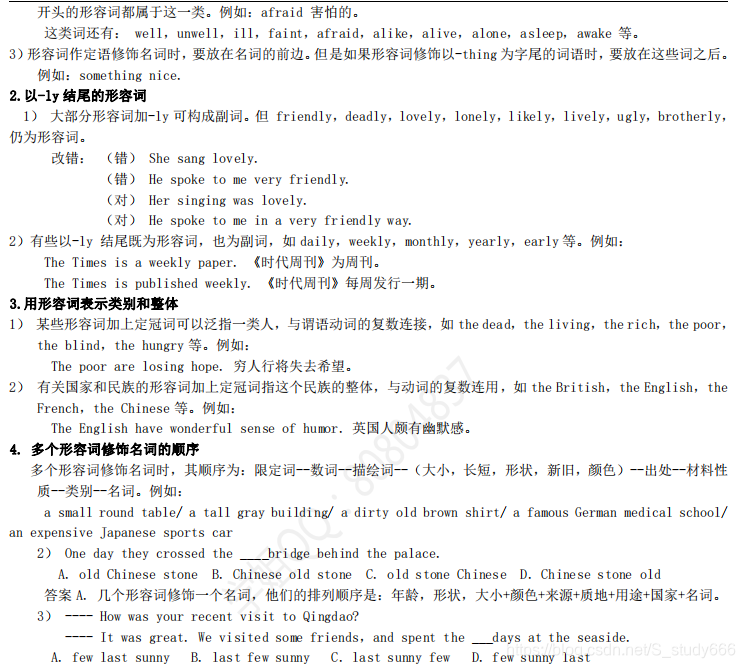
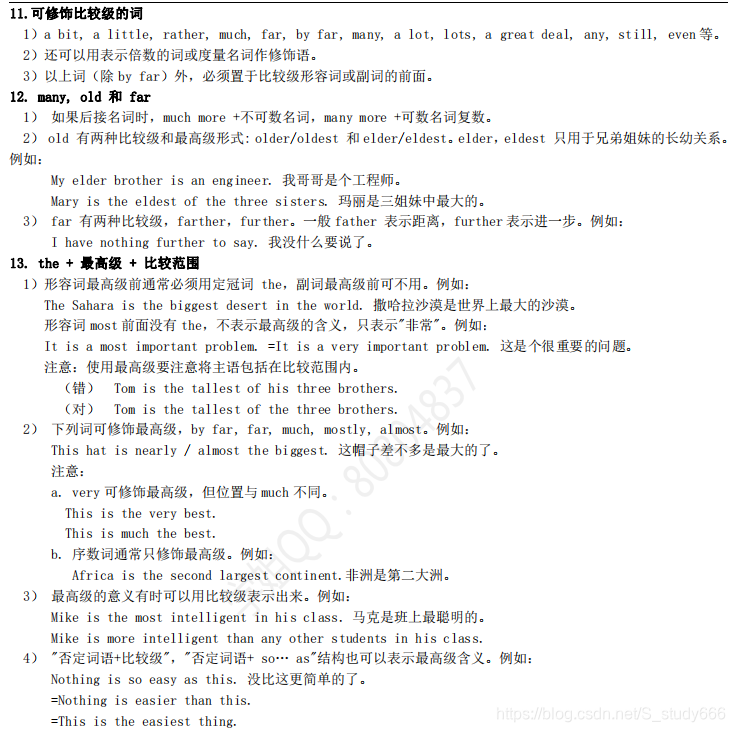
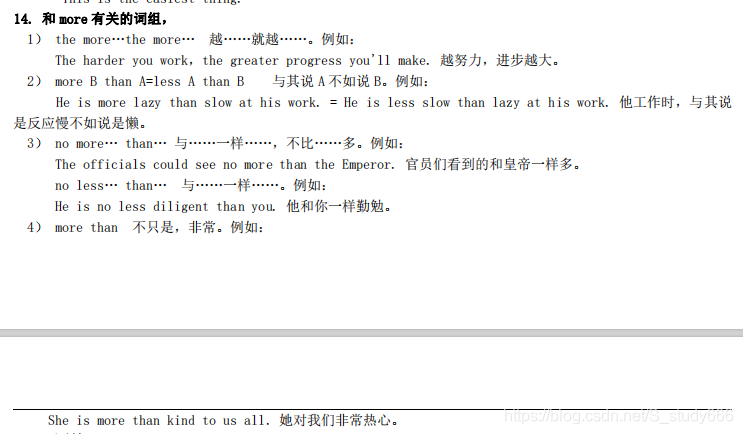
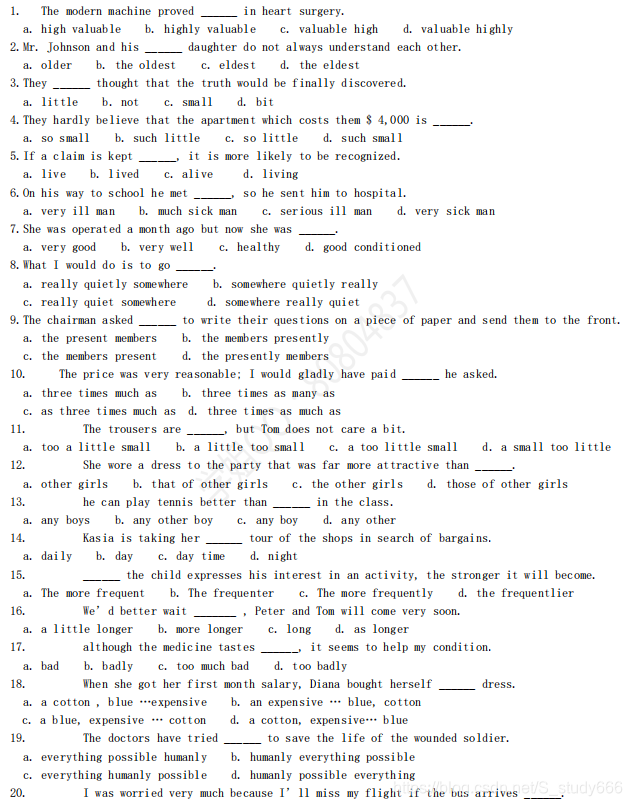
形容词是用来修饰,描述名词或代词的词,主要用作定语,表语和补足语等. 副词是用来修饰动词,形容词,其化副词,介词短语或全句的词.
二.相关知识点精讲

三.巩固练习
四.答案

第 11 章 代词
一.概念:
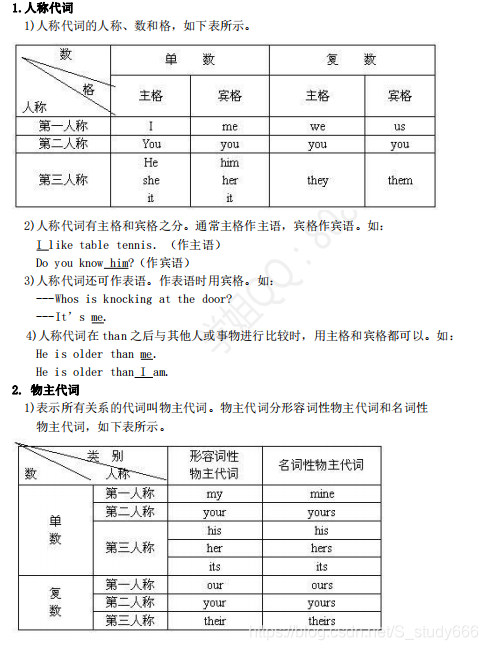
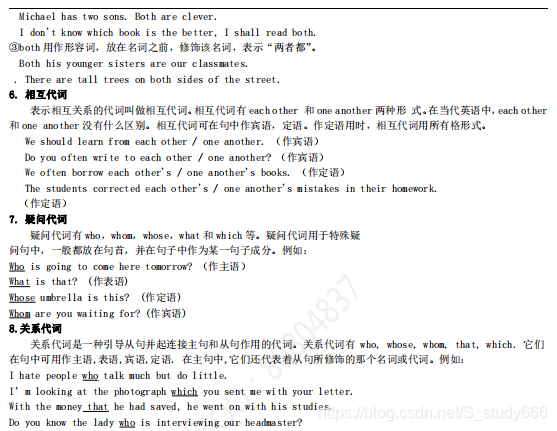
代词是代替名词的词, 按其意义、特征及其在句中的作用分为:人称代词、物主代词、指示代词、反身代词、相互 代词、疑问代词、不定代词和关系代词等。
二.相关知识点精讲
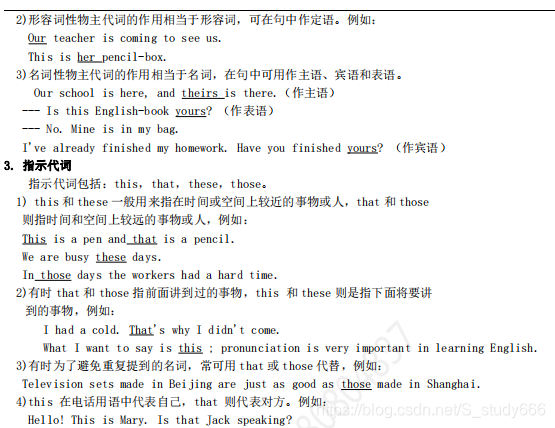
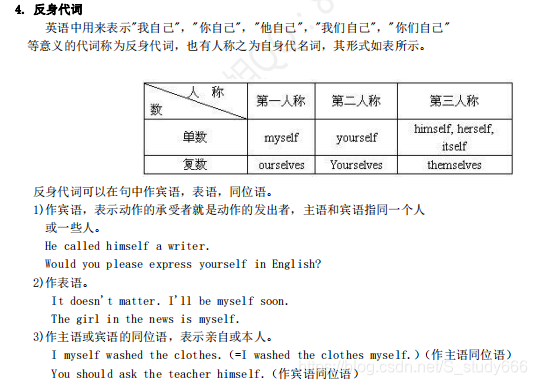

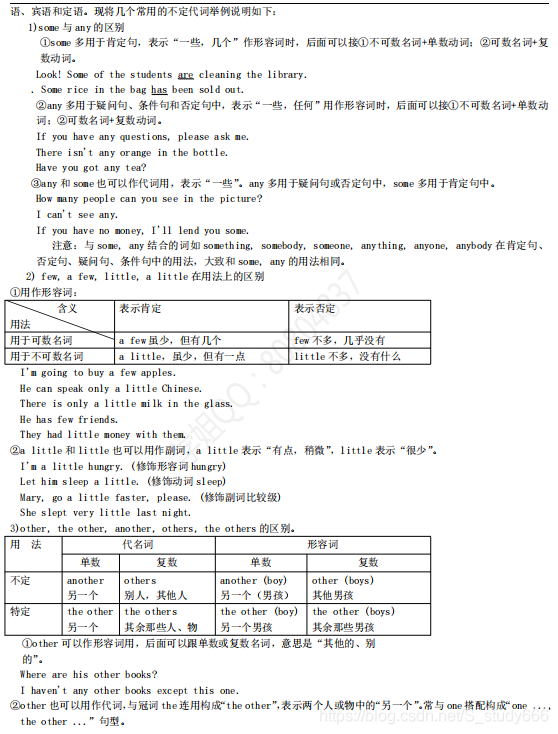
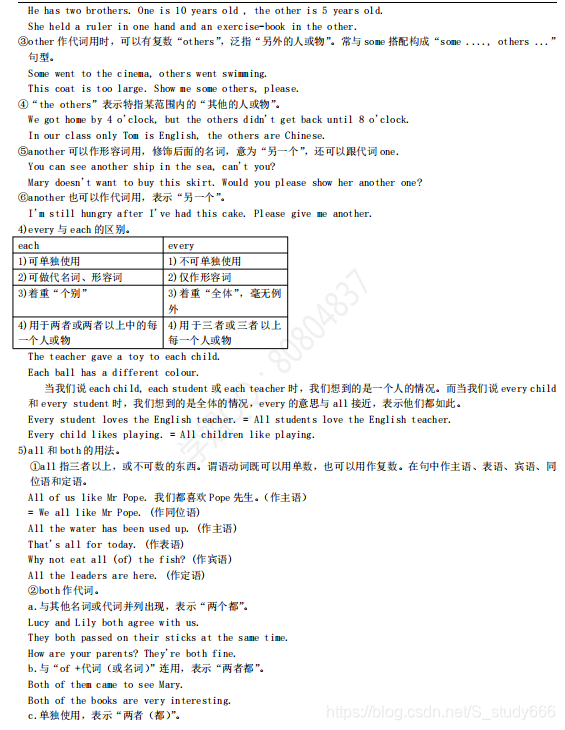
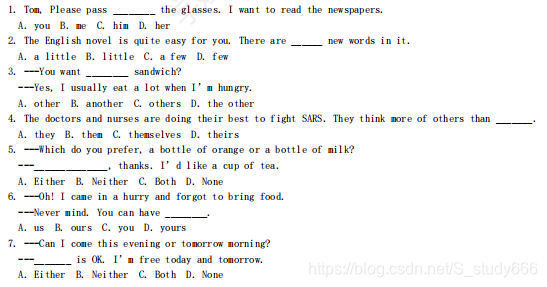
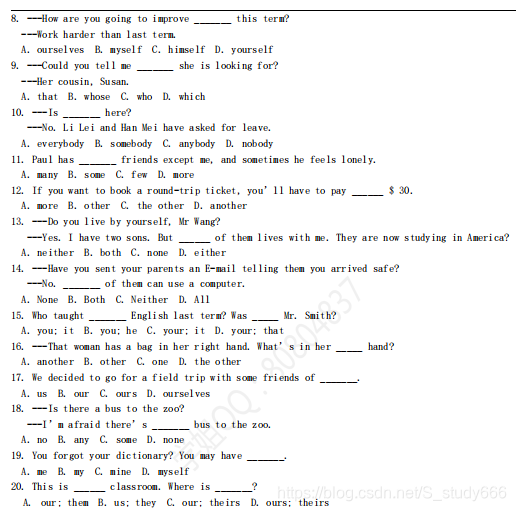
三.巩固练习
四.答案







 扫一扫
扫一扫


 2203
2203

 被折叠的 条评论
为什么被折叠?
被折叠的 条评论
为什么被折叠?
 到【灌水乐园】发言





