


 本文详细介绍了Java实现的四种经典排序算法:快速排序、选择排序、堆排序和归并排序。快速排序平均时间复杂度为O(nlogn),选择排序每次选取最小元素,堆排序利用二叉树特性,归并排序通过分治策略实现。每个排序算法的实现细节、特点和时间复杂度都进行了说明,并附有测试用例和运行截图。
学习来源:日撸 Java 三百行(41-50天,查找与排序))_闵帆的博客-优快云博客
46.快速排序
1.平均时间复杂度为O(nlogn), 但最坏情况还是 O(n^2)
2.Pivot 应该选 (该子序列的) 最后一个元素.
3.递归算法, 每次只能确定 pivot 的位置.
4.判断条件 && (tempLeft < tempRight) 不能少.
5.(data[tempRight].key >= tempPivot) 不能写成 >, 否则出现两个相同 key 时可能出错.
public void quickSortRecursive(int paraStart, int paraEnd) {
		// Nothing to sort.
		if (paraStart >= paraEnd) {
			return;
		} // Of if

		int tempPivot = data[paraEnd].key;
		DataNode tempNodeForSwap;

		int tempLeft = paraStart;
		int tempRight = paraEnd - 1;

		// Find the position for the pivot.
		// At the same time move smaller elements to the left and bigger one to the
		// right.
		while (true) {
			while ((data[tempLeft].key < tempPivot) && (tempLeft < tempRight)) {
				tempLeft++;
			} // Of while

			while ((data[tempRight].key >= tempPivot) && (tempLeft < tempRight)) {
				tempRight--;
			} // Of while

			if (tempLeft < tempRight) {
				// Swap.
				System.out.println("Swapping " + tempLeft + " and " + tempRight);
				tempNodeForSwap = data[tempLeft];
				data[tempLeft] = data[tempRight];
				data[tempRight] = tempNodeForSwap;
			} else {
				break;
			} // Of if
		} // Of while

		// Swap
		if (data[tempLeft].key > tempPivot) {
			tempNodeForSwap = data[paraEnd];
			data[paraEnd] = data[tempLeft];
			data[tempLeft] = tempNodeForSwap;
		} else {
			tempLeft++;
		} // Of if

		System.out.print("From " + paraStart + " to " + paraEnd + ": ");
		System.out.println(this);

		quickSortRecursive(paraStart, tempLeft - 1);
		quickSortRecursive(tempLeft + 1, paraEnd);
	}// Of quickSortRecursive

	/**
	 *********************
	 * Quick sort.
	 *********************
	 */
	public void quickSort() {
		quickSortRecursive(0, length - 1);
	}// Of quickSort

	/**
	 *********************
	 * Test the method.
	 *********************
	 */
	public static void quickSortTest() {
		int[] tempUnsortedKeys = { 1, 3, 12, 10, 5, 7, 9 };
		String[] tempContents = { "if", "then", "else", "switch", "case", "for", "while" };
		DataArray tempDataArray = new DataArray(tempUnsortedKeys, tempContents);

		System.out.println(tempDataArray);

		tempDataArray.quickSort();
		System.out.println("Result\r\n" + tempDataArray);
	}// Of quickSortTest
运行截图:

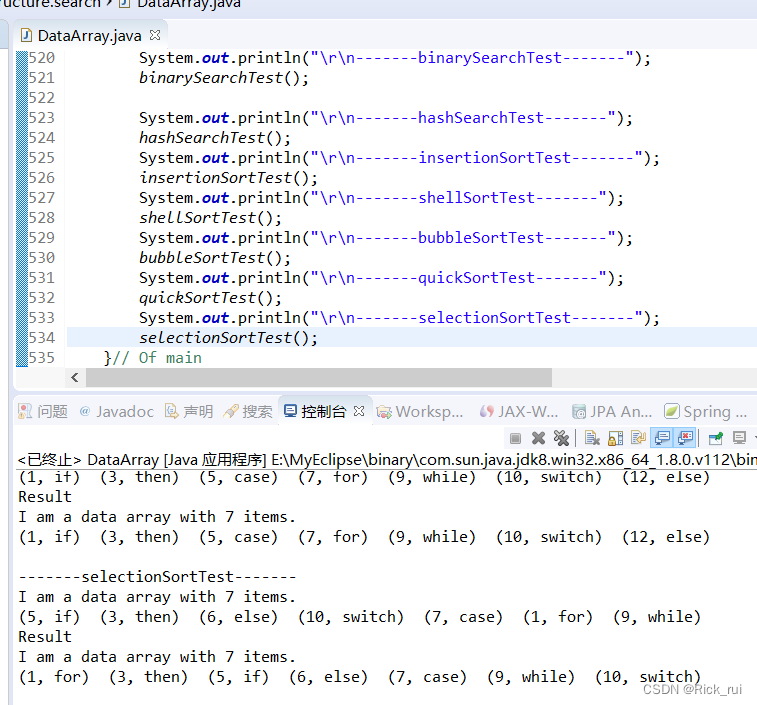
47.选择排序
1.与插入排序不同, 先做最麻烦的, 要进行 n − 1 次比较才能获得最小的数据.
2.数据一旦被选择并确定位置, 就不再改变.
3.做为一种简单算法, 其时间复杂度为 O ( n 2 )
4.只需要两个额外的空间来存放最小数据的引用与下标, 因此空间复杂度为 O(1).
public void selectionSort() {
		DataNode tempNode;
		int tempIndexForSmallest;

		for (int i = 0; i < length - 1; i++) {
			// Initialize.
			tempNode = data[i];
			tempIndexForSmallest = i;
			for (int j = i + 1; j < length; j++) {
				if (data[j].key < tempNode.key) {
					tempNode = data[j];
					tempIndexForSmallest = j;
				} // Of if
			} // Of for j

			// Change the selected one with the current one.
			data[tempIndexForSmallest] = data[i];
			data[i] = tempNode;
		} // Of for i
	}// Of selectionSort

	/**
	 *********************
	 * Test the method.
	 *********************
	 */
	public static void selectionSortTest() {
		int[] tempUnsortedKeys = { 5, 3, 6, 10, 7, 1, 9 };
		String[] tempContents = { "if", "then", "else", "switch", "case", "for", "while" };
		DataArray tempDataArray = new DataArray(tempUnsortedKeys, tempContents);

		System.out.println(tempDataArray);

		tempDataArray.selectionSort();
		System.out.println("Result\r\n" + tempDataArray);
	}// Of selectionSortTest
运行截图:
48. 堆排序
1.堆排序可能是排序算法中最难的. 用到了二叉树.
2.建初始堆比较费劲.
3.调整堆的时间复杂度为O(logn), 所以总体时间复杂度只有 O(nlogn).
4.空间复杂度只有O(1).
public void heapSort() {
		DataNode tempNode;
		// Step 1. Construct the initial heap.
		for (int i = length / 2 - 1; i >= 0; i--) {
			adjustHeap(i, length);
		} // Of for i
		System.out.println("The initial heap: " + this + "\r\n");

		// Step 2. Swap and reconstruct.
		for (int i = length - 1; i > 0; i--) {
			tempNode = data[0];
			data[0] = data[i];
			data[i] = tempNode;

			adjustHeap(0, i);
			System.out.println("Round " + (length - i) + ": " + this);
		} // Of for i
	}// Of heapSort

	/**
	 *********************
	 * Adjust the heap.
	 *
	 * @param paraStart  The start of the index.
	 * @param paraLength The length of the adjusted sequence.
	 *********************
	 */
	public void adjustHeap(int paraStart, int paraLength) {
		DataNode tempNode = data[paraStart];
		int tempParent = paraStart;
		int tempKey = data[paraStart].key;

		for (int tempChild = paraStart * 2 + 1; tempChild < paraLength; tempChild = tempChild * 2 + 1) {
			// The right child is bigger.
			if (tempChild + 1 < paraLength) {
				if (data[tempChild].key < data[tempChild + 1].key) {
					tempChild++;
				} // Of if
			} // Of if

			System.out.println("The parent position is " + tempParent + " and the child is " + tempChild);
			if (tempKey < data[tempChild].key) {
				// The child is bigger.
				data[tempParent] = data[tempChild];
				System.out.println("Move " + data[tempChild].key + " to position " + tempParent);
				tempParent = tempChild;
			} else {
				break;
			} // Of if
		} // Of for tempChild

		data[tempParent] = tempNode;

		System.out.println("Adjust " + paraStart + " to " + paraLength + ": " + this);
	}// Of adjustHeap

	/**
	 *********************
	 * Test the method.
	 *********************
	 */
	public static void heapSortTest() {
		int[] tempUnsortedKeys = { 5, 3, 6, 10, 7, 1, 9 };
		String[] tempContents = { "if", "then", "else", "switch", "case", "for", "while" };
		DataArray tempDataArray = new DataArray(tempUnsortedKeys, tempContents);

		System.out.println(tempDataArray);

		tempDataArray.heapSort();
		System.out.println("Result\r\n" + tempDataArray);
	}// Of heapSortTest
运行截图: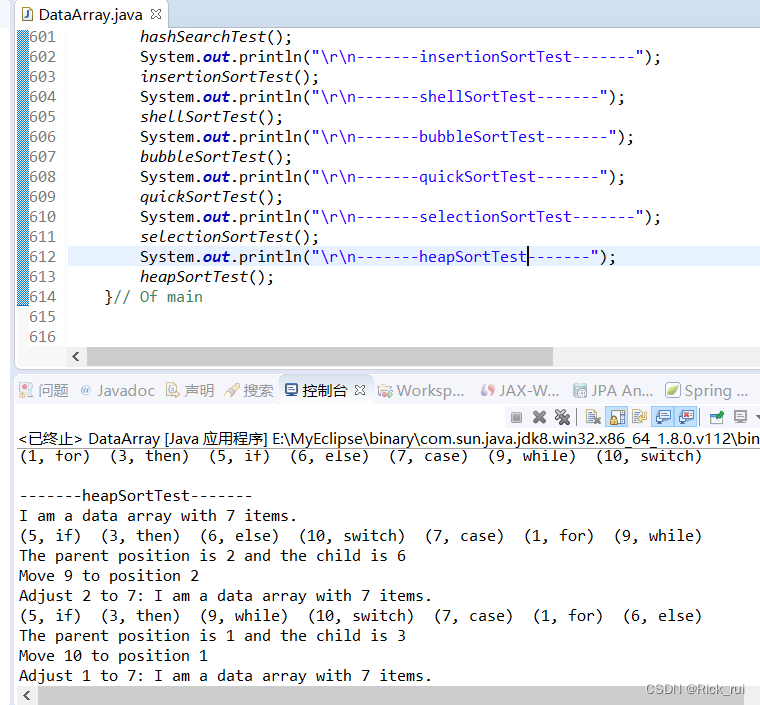
49.归并排序
1.nlogn 轮, 每轮O(n) 次拷贝. 因此时间复杂度O(nlogn).
2.空间复杂度为 O(n). 只需要一行辅助空间.
3.全都是在拷贝引用, 而不是数据本身. 这是 Java 的特性.
4.里面的两重循环总共只有O(n). 这里是分成了若干个小组.
5.归并两个有序小组的时候, 用了三个并列的循环.
6.涉及分组后尾巴的各种情况, 所以需要相应的 if 语句.
public void mergeSort() {
		// Step 1. Allocate space.

		int tempRow; // The current row
		int tempGroups; // Number of groups
		int tempActualRow; // Only 0 or 1
		int tempNextRow = 0;
		int tempGroupNumber;
		int tempFirstStart, tempSecondStart, tempSecondEnd;
		int tempFirstIndex, tempSecondIndex;
		int tempNumCopied;
		for (int i = 0; i < length; i++) {
			System.out.print(data[i]);
		} // Of for i
		System.out.println();

		DataNode[][] tempMatrix = new DataNode[2][length];

		// Step 2. Copy data.
		for (int i = 0; i < length; i++) {
			tempMatrix[0][i] = data[i];
		} // Of for i

		// Step 3. Merge. log n rounds
		tempRow = -1;
		for (int tempSize = 1; tempSize <= length; tempSize *= 2) {
			// Reuse the space of the two rows.
			tempRow++;
			System.out.println("Current row = " + tempRow);
			tempActualRow = tempRow % 2;
			tempNextRow = (tempRow + 1) % 2;

			tempGroups = length / (tempSize * 2);
			if (length % (tempSize * 2) != 0) {
				tempGroups++;
			} // Of if
			System.out.println("tempSize = " + tempSize + ", numGroups = " + tempGroups);

			for (tempGroupNumber = 0; tempGroupNumber < tempGroups; tempGroupNumber++) {
				tempFirstStart = tempGroupNumber * tempSize * 2;
				tempSecondStart = tempGroupNumber * tempSize * 2 + tempSize;
				if (tempSecondStart > length - 1) {
					// Copy the first part.
					for (int i = tempFirstStart; i < length; i++) {
						tempMatrix[tempNextRow][i] = tempMatrix[tempActualRow][i];
					} // Of for i
					continue;
				} // Of if
				tempSecondEnd = tempGroupNumber * tempSize * 2 + tempSize * 2 - 1;
				if (tempSecondEnd > length - 1) {
					tempSecondEnd = length - 1;
				} // Of if

				System.out
						.println("Trying to merge [" + tempFirstStart + ", " + (tempSecondStart - 1)
								+ "] with [" + tempSecondStart + ", " + tempSecondEnd + "]");

				tempFirstIndex = tempFirstStart;
				tempSecondIndex = tempSecondStart;
				tempNumCopied = 0;
				while ((tempFirstIndex <= tempSecondStart - 1)
						&& (tempSecondIndex <= tempSecondEnd)) {
					if (tempMatrix[tempActualRow][tempFirstIndex].key <= tempMatrix[tempActualRow][tempSecondIndex].key) {

						tempMatrix[tempNextRow][tempFirstStart
								+ tempNumCopied] = tempMatrix[tempActualRow][tempFirstIndex];
						tempFirstIndex++;
						System.out.println("copying " + tempMatrix[tempActualRow][tempFirstIndex]);
					} else {
						tempMatrix[tempNextRow][tempFirstStart
								+ tempNumCopied] = tempMatrix[tempActualRow][tempSecondIndex];
						System.out.println("copying " + tempMatrix[tempActualRow][tempSecondIndex]);
						tempSecondIndex++;
					} // Of if
					tempNumCopied++;
				} // Of while

				while (tempFirstIndex <= tempSecondStart - 1) {
					tempMatrix[tempNextRow][tempFirstStart
							+ tempNumCopied] = tempMatrix[tempActualRow][tempFirstIndex];
					tempFirstIndex++;
					tempNumCopied++;
				} // Of while

				while (tempSecondIndex <= tempSecondEnd) {
					tempMatrix[tempNextRow][tempFirstStart
							+ tempNumCopied] = tempMatrix[tempActualRow][tempSecondIndex];
					tempSecondIndex++;
					tempNumCopied++;
				} // Of while
			} // Of for groupNumber

			System.out.println("Round " + tempRow);
			for (int i = 0; i < length; i++) {
				System.out.print(tempMatrix[tempNextRow][i] + " ");
			} // Of for j
			System.out.println();
		} // Of for tempStepSize

		data = tempMatrix[tempNextRow];
	}// Of mergeSort

	/**
	 *********************
	 * Test the method.
	 *********************
	 */
	public static void mergeSortTest() {
		int[] tempUnsortedKeys = { 5, 3, 6, 10, 7, 1, 9 };
		String[] tempContents = { "if", "then", "else", "switch", "case", "for", "while" };
		DataArray tempDataArray = new DataArray(tempUnsortedKeys, tempContents);

		System.out.println(tempDataArray);

		tempDataArray.mergeSort();
		System.out.println(tempDataArray);
	}// Of mergeSortTest
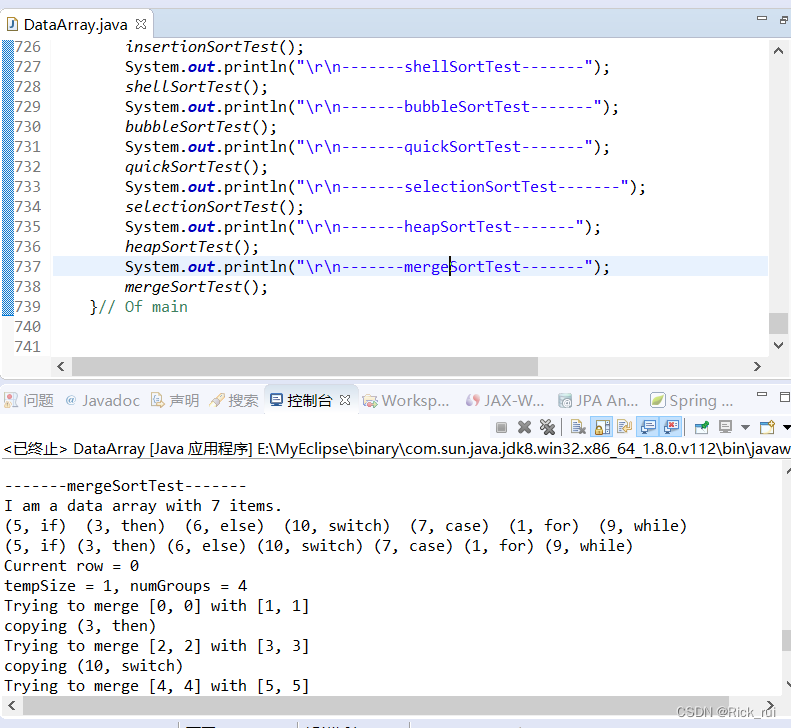
运行截图:





 扫一扫
扫一扫


 8万+
8万+

 被折叠的 条评论
为什么被折叠?
被折叠的 条评论
为什么被折叠?
 到【灌水乐园】发言





