


Why the principles of DevOps are being reimagined for a world of autonomous agents, and how we’re building the platform to power it.

The AgenticOps Lifecycle: A continuous, data-driven flywheel for AI application development.
The AI world is experiencing a Cambrian explosion. New models from giants and open-source communities alike are released almost weekly, each more capable than the last. For enterprises, this is both a massive opportunity and a source of immense chaos. The initial excitement of plugging into an API has given way to a stark reality: building, deploying, and maintaining robust, enterprise-grade AI applications is incredibly difficult.
At OpenCSG, we talk to leaders across dozens of industries, and we consistently see three critical pain points derailing their AI ambitions:
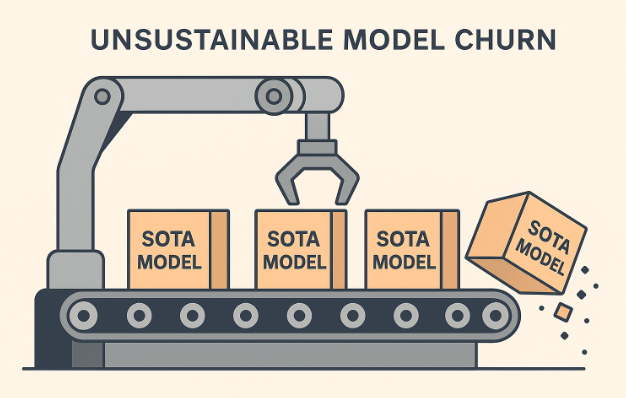
- Unsustainable Model Churn: State-of-the-art (SOTA) models like DeepSeek, Llama, and Qwen are iterating at a blistering pace. An application built on today’s best model is outdated in three months. How can an enterprise build a strategy on such shifting sands?
- Ineffective Data Value-Capture: AI applications generate a treasure trove of valuable data — user interactions, successful outputs, failed attempts. Yet, most companies lack the pipeline to systematically collect, clean, and use this data to improve their own systems. The value evaporates.
- Weak Application & Agent Updates: As models evolve and data accumulates, updating the AI application or agent becomes a complex, high-risk procedure. The feedback loop between production use and development is broken, leading to stagnant, underperforming AI.
These challenges signal that the current approach, often a simple extension of MLOps, is insufficient. A new, more holistic methodology is required. We call it AgenticOps.
History is Replaying Itself: From Code to Models to Agents
To understand AgenticOps, it helps to look at the evolution of software development infrastructure.
- GitHub (2008): Revolutionized development by creating a central hub for code versioning and collaboration. It was about managing the core asset: code.
- GitLab (2011): Rose to prominence by packaging the entire development-to-deployment lifecycle into a single platform. It introduced an integrated approach to DevOps.
- Hugging Face (2016): Became the “GitHub for AI” by creating a central hub for the new core asset: models and datasets.
Each platform emerged to manage a new layer of abstraction and complexity. Today, the new layer of abstraction is the AI Agent — an autonomous system that uses models, tools, and data to accomplish complex tasks. Managing the lifecycle of these agents requires a new paradigm, one that integrates the principles of DevOps with the unique needs of AI. This is the space where OpenCSG operates.
What is AgenticOps?
AgenticOps is a systematic, end-to-end methodology for building, deploying, operating, and continuously improving AI agents and their underlying applications.
Zoom image will be displayed
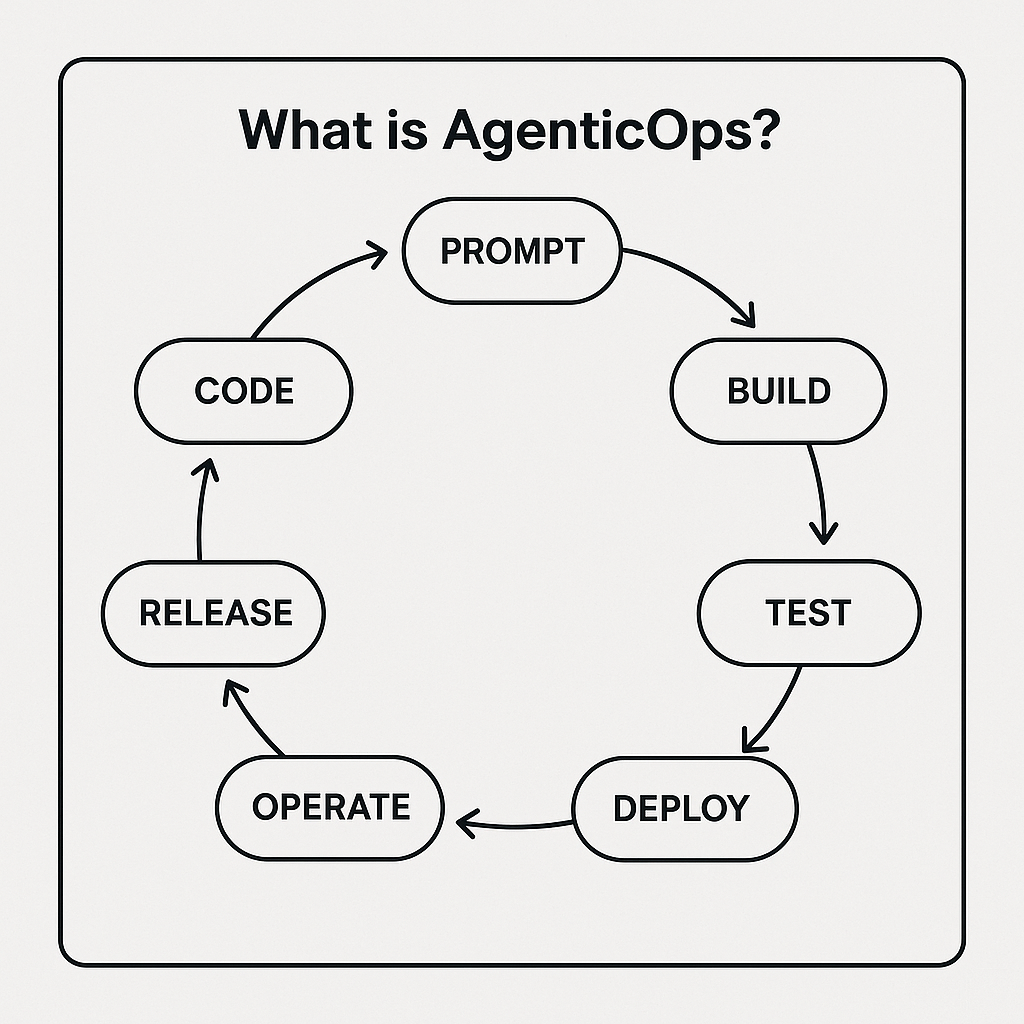
It’s not just about managing models; it’s about managing the entire intelligent system in a continuous, data-driven loop. This lifecycle consists of eight interconnected stages:
- PROMPT: Defining the goal in the IDE, from a simple user request to a complex business objective.
- CODE: Using AI-powered tools (like coding agents) to generate, review, and test the application’s source code.
- BUILD: Assembling the code, models, and tools into a deployable AI application or Agent.
- TEST: Running automated tests to validate the Agent’s functionality, logic, and safety.
- RELEASE: Publishing the finalized Agent as a stable, versioned artifact.
- DEPLOY: Pushing the Agent into a production environment.
- OPERATE: The Agent runs, interacts with users, and performs tasks, while the system meticulously logs all interactions and outcomes.
- RETRAIN: Using the data collected during operation to fine-tune existing models or train new, specialized ones, creating a powerful feedback loop that improves the entire system.
Core Principles of AgenticOps
- System-First Thinking: Focus on the entire intelligent system, not just the individual model.
- Data as a Compounding Asset: Treat operational data as the most valuable resource for creating a competitive advantage. The mantra is: “Models change daily, but data is the constant that compounds.”
- Automation at Every Step: Leverage AI to automate tasks across the lifecycle, from coding and testing to monitoring and retraining.
- Human-in-the-Loop Governance: While agents operate autonomously, humans provide strategic oversight, set goals, review performance, and manage exceptions, ensuring alignment with business objectives.
The most critical part of this cycle is the bridge from OPERATE back to PROMPT and CODE via RETRAIN. This is where the compounding value lies. It’s the embodiment of our core belief: “Models change daily, but data is the constant that compounds.”
Why is AgenticOps Necessary?
Traditional MLOps focuses on the pipeline for training, validating, and deploying machine learning models as artifacts. However, in the new paradigm, models are not the final product; they are components within a larger, more dynamic system — the AI Agent. This shift introduces new complexities that MLOps alone cannot address:
- System-Level Complexity: An Agent is more than a model. It includes prompts, tools, external data sources, business logic, and memory. Managing this interconnected system requires a broader perspective.
- Continuous Data Feedback: The most valuable asset an AI application generates is interaction data. AgenticOps provides the framework to capture this data and use it to systematically improve the system, creating a powerful data flywheel.
- Dynamic Adaptation: The AI landscape is in constant flux. AgenticOps allows organizations to build resilient systems that can adapt to new models, new tools, and new user requirements without complete overhauls.
The OpenCSG Platform: Bringing AgenticOps to Life
To turn this methodology into reality, we’ve built a comprehensive, integrated platform. Our vision is to create a “Hybrid Huggingface+” — an ecosystem that is open-source, supports on-premise deployment, and is natively designed for the Agentic era.
Our product suite is built on two pillars that directly map to the AgenticOps lifecycle:
1. CSGHub: The “Ops” Foundatio
CSGHub is our open-source, enterprise-grade asset management platform. Think of it as a private, self-hosted Hugging Face designed for serious enterprise use. It forms the Ops layer of AgenticOps (Deploy, Operate, Retrain).
- Unified Asset Management: It provides a single source of truth for all your AI assets: models, datasets, code, and prompts.
- Complete Lifecycle Control: It manages versioning, access control, and compliance, giving enterprises the governance they need.
- DataFlow Engine: It includes powerful tools to process, clean, and label the data flowing back from production, preparing it for the Retrain stage.
- On-Premise & Hybrid: Unlike SaaS-only platforms, CSGHub can be deployed anywhere — in a private data center, a public cloud, or a hybrid environment — ensuring data security and sovereignty.
2. StarShip: The “Agentic” Super-Factory
StarShip is our intelligent platform for building and orchestrating Agents. It provides the tools for the Agentic part of the lifecycle (Prompt, Code, Build, Test).
- CodeSouler & CodeReview: An IDE plugin and LLM-driven review assistant that accelerates development, improves code quality, and automates testing.
- Agent Builder & Orchestration: A low-code environment for building sophisticated agents, chaining models, and integrating tools.
- Multi-Agent Systems: StarShip is designed to build and manage complex systems where multiple specialized agents collaborate to achieve a goal.
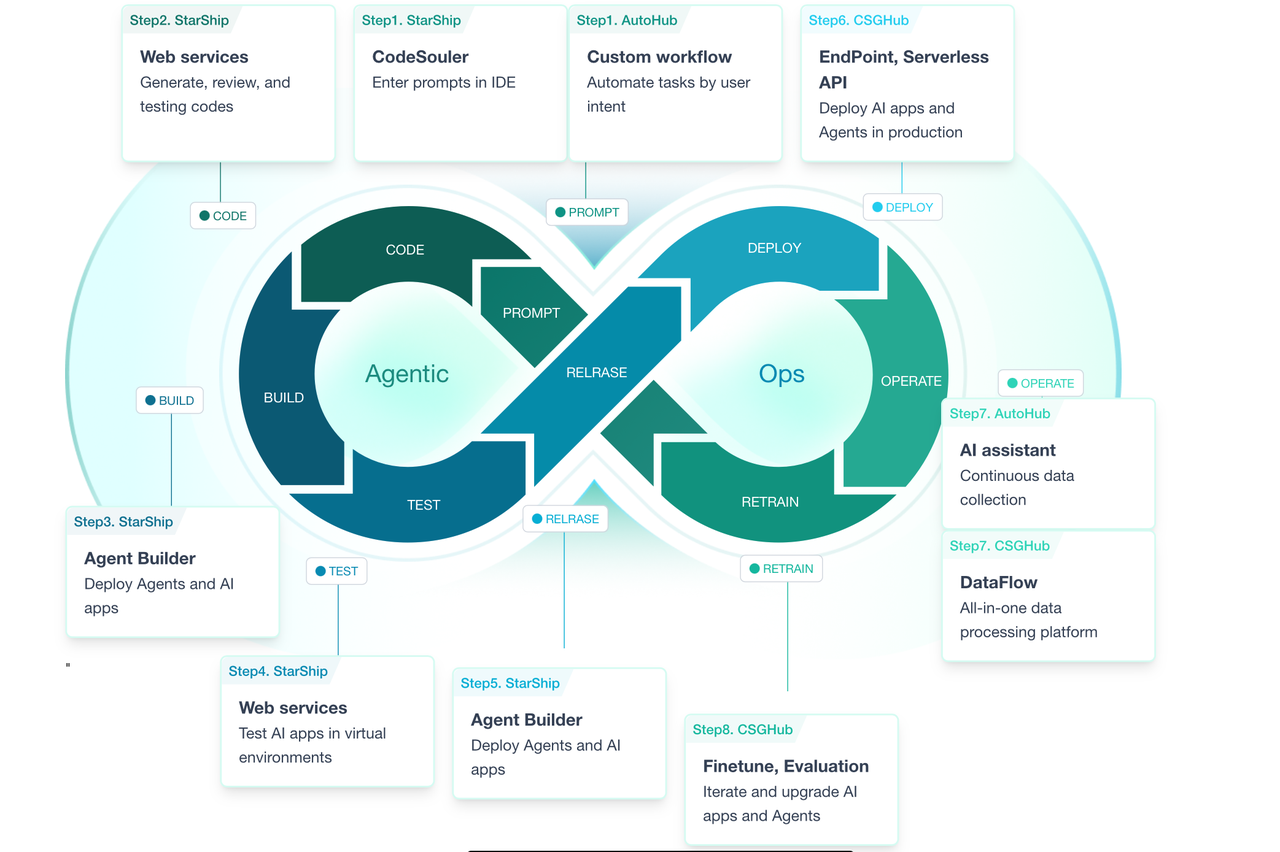
The OpenCSG architecture, integrating the StarShip AI Application layer with the CSGHub Model Platform.
AgenticOps Demo — Step-by-Step Flow
1.PROMPT (Goal Definition)
- Use natural language in the StarShip IDE to specify business objectives, compliance constraints, and requirements.
- Automatically compile them into an executable task graph/plan.
2.CODE (Intelligent Generation & Review)
- CodeSouler generates/completes code and auto-produces unit tests.
- CodeReview performs line-level inspections; engineers only resolve a small number of flagged segments.
3.BUILD (Application/Agent Assembly)
- Package code, models, and toolchains into a deployable agent.
- Produce a versioned, traceable artifact.
4.TEST (Automated & Adversarial Testing)
- Cover functional regression, security policies, prompt-injection resistance, and task success rates.
- Pipelines are automatically blocked if thresholds are not met.
5.RELEASE (Versioned Publication)
- Publish validated agents as stable, auditable versions.
6.DEPLOY (Production Deployment)
- One-click deployment to private or hybrid enterprise clusters.
7.OPERATE (In-Production Execution & Full Telemetry)
- Agents handle real tickets/logs in production.
- Log model routing, reasoning traces, tool calls, and user feedback in detail.
8.RETRAIN (Data Flyback & Fine-Tuning)
- CSGHub DataFlow cleans, deduplicates, clusters, and semi-automatically labels production data to form high-quality datasets.
- Perform few-shot fine-tuning on task-specific sub-models/retrievers and feed them back.
9.Flywheel Restart & KPI Dashboarding
- New models/strategies re-enter PROMPT → CODE, continuously iterating.
- Dashboards continuously track R&D productivity, one-shot usability, task success rate, and mean handling latency, quantifying each iteration’s gains.
Proof in Practice: From Theory to Impact
This is more than just a vision. Our AgenticOps platform is delivering measurable results for enterprises today.
- World-Class Performance: The OpenCSG StarShip CodeGen Agent recently achieved 2nd place globally in the SWE-bench Lite evaluation, a prestigious benchmark from Princeton University for large model software engineering capabilities. It is the highest-ranking (SOTA) non-GPT-4o based model, validating our core technical strength.
- Real-World Efficiency Gains: In a month-long POC with a major financial software company, implementing StarShip resulted in a nearly 40% increase in R&D efficiency, with AI-generated code achieving over 88% direct usability.
- Trusted by Industry Leaders: We are proud to partner with organizations at every scale, from the Ministry of Industry and Information Technology (MIIT) and China Unicom to innovative chip companies and commercial banks. They are using CSGHub and StarShip to build their own private AI ecosystems, securely and at scale.
The era of ad-hoc AI development is ending. To truly harness the power of large models, enterprises need a factory, not just a toolbox. They need a systematic, repeatable, and scalable operating system for intelligence.
AgenticOps is that system. And at OpenCSG, we are building the open, hybrid, and enterprise-ready platform to power it, fulfilling our mission to empower everyone with large models.
To learn more, explore our projects on GitHub or visit our website at https://opencsg.com.






 扫一扫
扫一扫


 911
911

 被折叠的 条评论
为什么被折叠?
被折叠的 条评论
为什么被折叠?
 到【灌水乐园】发言





