


 本文提出了一种联合优化框架,利用电池储能系统同时进行峰值削平和频率调节,考虑了电池退化、操作约束和客户负载不确定性。实证数据显示,用户电费可减少高达15%,并且联合优化的节省通常大于单独应用电池的总节省。研究还提出了一种简单的实时算法,实现了超线性收益。相比于仅用于单一服务的电池储能系统,该研究表明,电池在提供多种服务时能实现更大的经济效益。
✅作者简介:热爱科研的Matlab仿真开发者,修心和技术同步精进,matlab项目合作可私信。
🍎个人主页:Matlab科研工作室
🍊个人信条:格物致知。
⛄ 内容介绍
We consider using a battery storage system simultaneously for peak shaving and frequency regulation through a joint optimization framework which captures battery degradation, operational constraints and uncertainties in customer load and regulation signals. Under this framework, using real data we show the electricity bill of users can be reduced by up to 15%. Furthermore, we demonstrate that the saving from joint optimization is often larger than the sum of the optimal savings when the battery is used for the two individual applications. A simple threshold real-time algorithm is proposed and achieves this super-linear gain. Compared to prior works that focused on using battery storage systems for single applications, our results suggest that batteries can achieve much larger economic benefits than previously thought if they jointly provide multiple services.
⛄ 部分代码
function [total, elec, peak, bat, reg, regc, regp] = ...
    ps_only(fig_flag, lambda, battery, T, ts, tt, s)

cvx_begin quiet
    variables b(T,1);
    minimize (lambda.elec*ones(1,T)*(s-b)*ts + ...
        lambda.peak*max(s-b) + lambda.battery*norm(b,1)*ts);
    subject to
    ones(1,T)*b == 0;
    b >= -battery.power;
    b <= battery.power;
    tril(ones(T))*b*ts <= ones(T,1)*...
        (battery.socini-battery.socmin)*battery.energy;
    tril(ones(T))*b*ts >= ones(T,1)*...
        (battery.socini-battery.socmax)*battery.energy;
cvx_end

% Bill
total = lambda.elec*ones(1,T)*(s-b)*ts + lambda.peak*max(s-b)...
    + lambda.battery*norm(b,1)*ts;
elec = lambda.elec*ones(1,T)*(s-b)*ts;
peak = lambda.peak*max(s-b);
bat = lambda.battery*norm(b,1)*ts;
reg = 0;
regc = 0;
regp = 0;

if fig_flag == 1
    % SoC
    SoC_3 = zeros(T,1);
    SoC_3(1) = battery.socini;
    for i = 2:T
        SoC_3(i) = (battery.socini*battery.energy-sum(b(1:i-1))*ts)/battery.energy;
    end

    % figure
    figure;
    subplot(2,1,1)
    hold all;
    plot(tt,s,'-.b','LineWidth',2);
    plot(tt,s-b,'--g','LineWidth',2);
    hold off;
    xlabel('time[s]');
    ylabel('power[MW]');
    grid on
    legend('grid consumption','after shaving');
    title(sprintf('Peak shaving only, shaved peak: %.2f', max(s)-max(s-b)));

    subplot(2,1,2)
    plot(tt,SoC_3,'b');
    xlabel('time[s]');
    ylabel('SoC[%]');
    grid on
    title('Battery only for peak shaving: SoC curve');
end
end
⛄ 运行结果
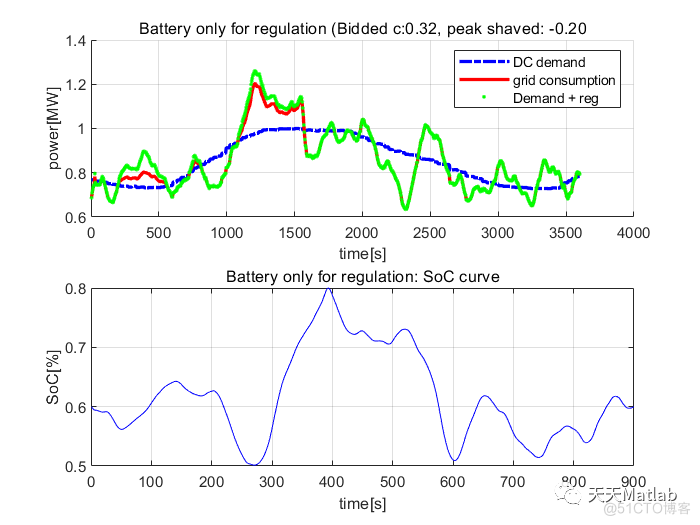
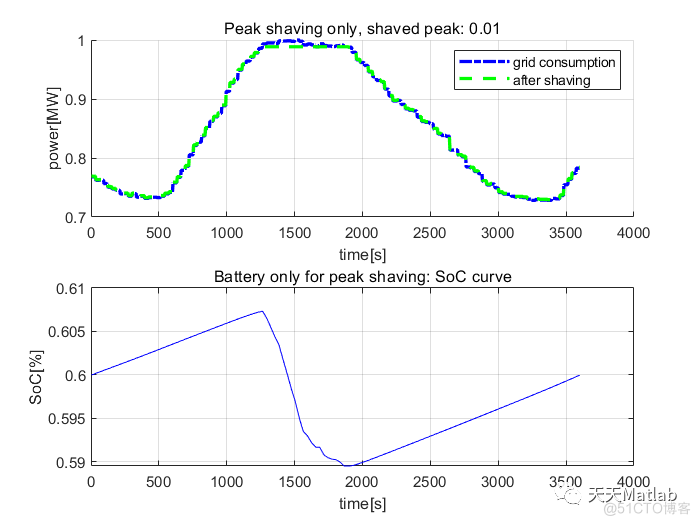
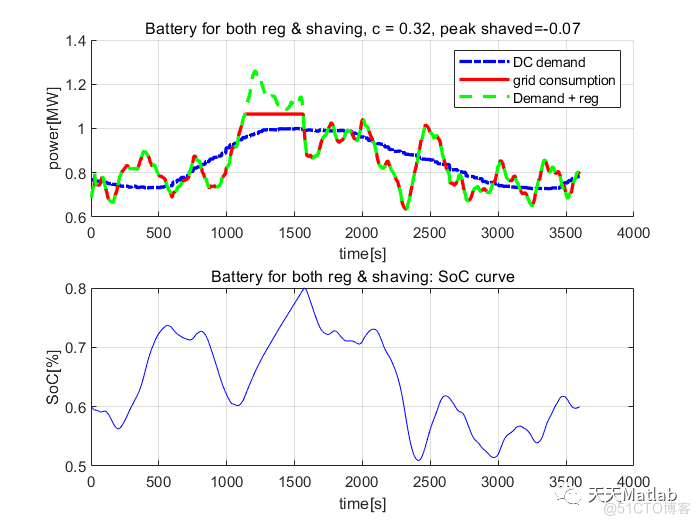
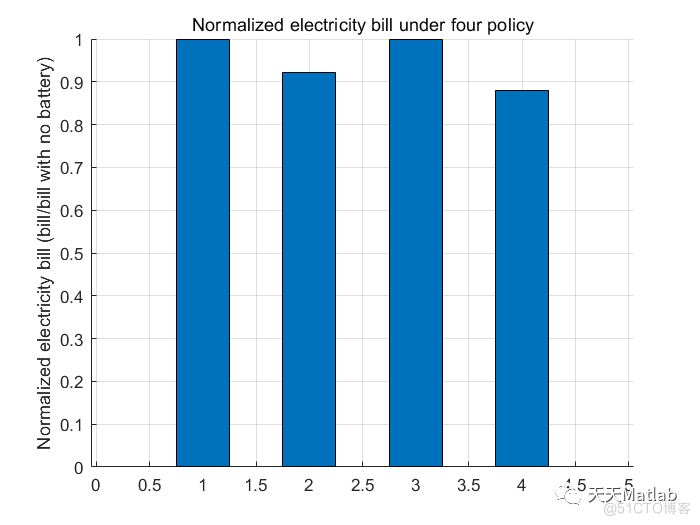
⛄ 参考文献
[1] Shi Y , Xu B , Wang D ,et al.Using Battery Storage for Peak Shaving and Frequency Regulation: Joint Optimization for Superlinear Gains[J].IEEE Transactions on Power Systems, 2017:1-1.DOI:10.1109/TPWRS.2017.2749512.





 扫一扫
扫一扫


 247
247

 被折叠的 条评论
为什么被折叠?
被折叠的 条评论
为什么被折叠?
 到【灌水乐园】发言





